
The Devil is in the Data

Accurate Data is Key to Increasing Sales Performance Metrics

Did you know that poor quality data is costing your sales team at least 30 percent of revenues?

Allow me to illustrate. My inside sales manager once showed me a former Tyson Group employee’s LinkedIn profile, in which he claimed he won Rookie of the Year at my company. Trouble is, we don’t have a Rookie of the Year award. I sent him a note apologizing for missing the ceremony with a P.S. explaining that he might want to represent himself accurately.

I don’t tell these stories to embarrass anyone, just to illustrate that there’s plenty of bad data out there, even on LinkedIn. Inaccuracies, including the faulty information salespeople glean when they rely on the same online sources, ramp up the pressure on salespeople. That means a salesperson has to be asking the right questions at the right time in a live conversation or through research. Salespeople must take time throughout the sales process to take the temperature of prospects.

We surveyed salespeople in sixty-seven training engage­ments between 2017 to 2018 and found that 40 percent of sales teams feel they do not have the right information before making a sales call. Clean, accurate data makes all the difference for high performing sales teams seeking to streamline and clarify the front end of the sales cycle. Our studies show that sales reps are spending at least 32 percent of their time searching for missing data, then manually entering it into their CRM. Quality data is all about working smarter, preserving your resources, and accelerating your team’s sales cycle.

The Devil may be in the details, but it’s in the data, too.

For additional ideas on powering the sales process and building a high performance sales team, get your copy of Selling is an Away Game, available online at Amazon.

Cop an Attitude

How Grit and Determination Underpin Sales Effectiveness

There’s an exercise I like to do with management teams and salespeople in which they list attributes that would make their replacements successful. “If you had to hire somebody for your job and would get a bonus of 20 percent of your salary, what are things you would hire on?” I ask. They make a list of twenty or thirty things. But it comes down to three broad categories. At least 60 percent of success is based on attitude—things like grit, endurance, and perseverance. Another 20 to 30 percent revolves around skills like goal-setting and communication. The rest comes down to knowledge of basic theories and education.

In case you haven’t noticed, sales ain’t easy. It’s hard. Especially in today’s ever-shifting landscape. To be successful at it, sales leaders need to understand how attitude drives success in their teams, and how difficult it is to develop the right attitude in your sales talent. Sales leaders also need to appreciate the difficult market envi­ronment salespeople face today—regardless of attitude—so they can see for themselves how important it is to have a predictable, proven sales process.

You can coach all day long for skills, and you can always pick up knowledge. But attitude and grit are something salespeople have to pull from down inside themselves.

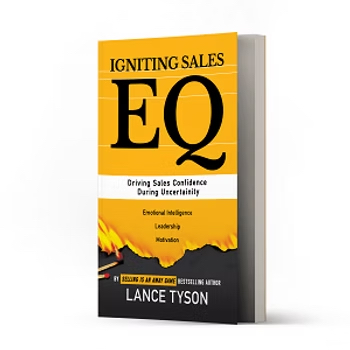
For additional ideas on helping your sales team discover their true grit, get your copy of Igniting Sales EQ, available online at Amazon.

Fake it Until You Feel it

Adopt and Express Humility to Increase Sales Effectiveness

Are you the kind of sales leader who often thinks: “I’m constantly dealing with idiots”? I get it, sometimes it can feel like you’re working on an island managed by six-year-olds. With that perspective, however, it’s likely that not only prospects, but your sales team, will view your self-assured behaviors as arrogant, forceful, and incapable of admitting mistakes. Climbing the organizational ladder requires an extraordinary degree of self-belief, which up to a certain point is seen as inspirational. Yet the most-effective leaders are the ones who don’t seem to believe their own hype. Instead, they come across as humble.

Striking a healthy balance between assertiveness and modesty, demonstrating receptiveness to feedback, and the ability to admit one’s mistakes, is one of the most difficult tasks to master. When things go wrong, sales talent seeks confident leadership. But they also hope to be supported and taught with humility as they work to improve the situation. To ignite this component of EQ, it is sometimes necessary to fake confidence. And even more importantly, it’s necessary to fake humility.

We live in a world that rewards people for hiding their insecurities. But the truth is that it is much more important to hide one’s arrogance. So if you want to make an impact on your sales performance metrics, learn to swallow your pride, pick and choose your battles, and look for opportunities to recognize others even if you feel you are right and they are wrong. Why? Because fake humility in sales is better than no humility at all. And like anything else, if you practice it enough, eventually you’ll get the feel for it.

For additional ideas on using Sales EQ to build a high performance sales team, get your copy of Igniting Sales EQ, available online at Amazon.

No Crying Allowed: Only Results Matter

A Shift in Attitude and Behaviors is Key to Building a High-Performing Sales Team

Does someone on your sales team wear their heart in their sleeve? While a certain level of openness, transparency, and vulnerability can be a good thing and are all signs of a high sales EQ, too much unfiltered expression can work against you. Passion and intense enthusiasm can easily cross the line to become moodiness and outright excitability when the pressure’s on. Nobody likes a crybaby. And in the business world, those who become particularly disappointed or discouraged when unanticipated issues arise are viewed as undeserving of a seat at the grown-ups’ table.

If you’re a sales manager and have any team members who suffer from too much emotional transparency, encourage them to reflect on which situations tend to trigger feelings of anger or frustration. Have them monitor their tendency to overreact in the face of setbacks. For example, if they wake up to a bunch of annoying emails, tell them to avoid responding immediately. Wait until they have had some time to calm down. Likewise, if someone makes an irritating comment during a team meeting, encourage them to control their reaction and keep calm.

While they can’t exactly go from being Woody Allen to the Dalai Lama overnight, they can be coached to avoid stressful situations and inhibit their volatile reactions by being aware of their triggers. And to increase sales performance in your team overall, start working on tactics that help them become aware of their emotions in real time, not only in terms of how they experience them, but more importantly, in terms of how they are being experienced by others.

For additional ideas on using Sales EQ to build a high performance sales team, get your copy of Igniting Sales EQ, available online at Amazon.

Put Yourself in the Buyer’s Sneakers

Leverage Empathy to Build a Strong Sales Team

Think about the steps you take when you buy a pair of sneakers. Something in your world gets your attention and you come to the conclusion: I need a new pair of sneakers. In that process, you remove doubt because you’re actively looking. Then you start to consider your options, lay them out and say, “Jeez, do I really need these? What pair do I want?” Ultimately, you buy a pair. That’s a simple buying process.

With most sales—especially B2B sales—it’s more complex, but the gist is the same: selling is just the buying process, inverted. Sales effectiveness stems from reverse-engineering the buying process to make a sale. But to do that, successful sales talent know they need to exercise empathy. They are able to leverage their EQ by putting themselves in the buyer’s sneakers.

The ability to recognize how others feel is important to success in your life and career. The more skillful you are at discerning the feelings behind others’ signals, the better you can control the signals you send them. An empathetic person excels at:

  1. Service Orientation — anticipating, recognizing, and meeting clients’ needs
  2. Leveraging Diversity — cultivating opportunities through diverse people
  3. Understanding Others — discerning the feelings behind the needs and wants of others

Selling is not the kind of situation you will solve with the force of your personality, no matter how charismatic a salesperson you are. You need to pull the skill of empathy from the sales playbook to get in alignment with what’s in the buyer’s mind, and that requires igniting your EQ.

Sales Isn’t Always About You—It’s About Them

Taking an Other-Centric Approach to Increase Sales Performance Metrics

Have you ever wondered why people sometimes form inaccurate impressions about you? Do they rush to judge you too quickly? This limited view we have of ourselves, and of others judging us only on what they see of us is called the Iceberg Effect. It’s based on our perception of who we are (identity), and of how others see us (reputation).

For most people, there is a disparity between identity and reputation that can cause them to ignore feedback and derail their efforts. Real self-awareness is about achieving a realistic view of one’s strengths and weaknesses, and of how those strengths and weaknesses compare to others’. For instance, most people rate their own EQ highly, yet only a minority of those individuals will be rated as emotionally intelligent by others.

Turning self-deception into self-awareness will not happen without accurate feedback, the kind that comes from data-based assessments such as valid personality tests or 360-degree feedback surveys. Such tools are fundamental to help us uncover EQ-related blind spots, mostly because other people are generally too polite to give us constructive feedback.

One of the best things sales managers can do when building a strong sales team is to keep self-deception in check by fostering an other-focused atmosphere. Developing an other-centric approach starts with a basic appreciation and acknowledgement of team members’ individual strengths, weaknesses, and beliefs. Brief but frequent discussions with team members will lead to a more thorough understanding of how to motivate and influence others. Such conversations might be difficult at first, but over time should inspire ways to create opportunities for collaboration, teamwork, and external networking.

The bottom line is: igniting your sales EQ means it’s all about them, not you!

Self-Regulate to Sell

High performing sales teams exhibit behavioral activity that matches those that they are dealing with, people who go out of their way to make that personal connection. That’s means having a high EQ.

But EQ isn’t just one dimension, one aspect of your personality. It’s so much more than being nice, opening the door for others, letting your colleagues hit the buffet line first, making someone laugh until they shoot wine out of their nose, or refusing to take the last grape tomato from the salad bar.

In fact, EQ is siloed into a handful of distinct categories. Here are details on one of the most important:

Self-Regulation

You often have little control over when you experience emotions. You can, however, have some say in how long an emotion will last by using a number of techniques to alleviate negative emotions such as anger, anxiety, or depression. A few of these techniques include recasting a situation in more positive light, taking a long walk, and meditation or prayer. Self-regulation involves:

  1. Self-control—managing disruptive impulses
  2. Trustworthiness—maintaining standards of honesty and integrity
  3. Conscientiousness—taking responsibility for your own performance
  4. Adaptability—handling change with flexibility
  5. Innovation—being open to new ideas

Raising EQ to be able to compete and close deals in a complex world is an effort sales talent has to make. The sales profession is so difficult. You get your ass kicked on a day-to-day basis. People say no to you nine times out of ten. People lie to you and act like your friend, then dodge your calls. At the end of the day, you’re going to get your ass kicked. And if you don’t increase sale effectiveness by igniting the power of EQ, then that will kick your ass, too.

Red-Ocean Mindset

Revising the Sales Playbook to Ignite Sales EQ

There was a book a few years ago called Blue Ocean Strategy. The concept was that a blue ocean means that the water is deep, has a lot of fish, and has fewer people fishing. Thanks to COVID-19, however, businesses are suddenly finding themselves in a red ocean; shallow water, fewer fish, more competitive fishing, bloody with competition.

This pandemic is a 360-degree issue. It’s not like a hurricane that just hit New Orleans. COVID has happened everywhere. It’s affected everybody. And it’s disrupted the very basic levels of Maslow’s hierarchy of needs.

So, the landscape has changed. From a sales perspective, this means competition. The pressure is going to be on sales team management to select the right sales talent and to revise the sales playbook. And that sales playbook is going to require igniting the talent’s sales EQ to create a high-performing sales team. Sales leaders and their teams are going to need to learn how to think on the fly, to improvise, to get creative.

Have you ever wondered how a SEAL team, who strictly operates in times of uncertainty, can have an 80 percent success rate? They have an extremely high EQ. Most SEALs teams prepare for seven to eight scenarios prior to a mission, though less than 30 percent of the time do any of those scenarios they prepared for actually happen. Their success is based on great decision-making in the moment and having a red-ocean mindset at all times.

For sales leaders to succeed in today’s marketplace, they need to train their sales talent to think like SEALs and ignite their sales EQ!

For additional ideas on using Sales EQ to build a high performance sales team, get your copy of Igniting Sales EQ, available online at Amazon.

Don’t Be a Battleship

In the early 2000s in the Atlantic, there was a tense showdown between Spain and the US Navy. Essentially, there’s an emergency frequency that maritime uses, and a message went out at night from a what the crew thought was a small Spanish boat to the USS Lincoln, the second largest battleship in the Navy.

The Spaniard said, “We need you to adjust your course by 15 degrees North. You’re headed right for us.” Do you think the United States Navy was going to bow down to a foreign ship? Hell no. The US responded: “No, we need you to immediately move 15 degrees South.” The Spaniard got back on and said, “Look, that is not possible or convenient. We need you to adjust.” The American’s response was: “We actually demand that you change your course.” Spain responded with: “Sorry, we can’t, it’s not convenient.”

This exchange went back and forth for a while, until finally the US captain picked up the radio and said, “Look, I’m the captain of the USS Lincoln. We’re the second largest battleship in the US Navy. We need you to adjust your course very quickly.” Again, Spain responded “That’s not going to happen.” The US Navy replied: “We are accompanied by two battleships, six destroyers, five cruisers, and multiple support craft. We demand that you change your position 15 degrees South.” Moments later, the Spaniard responded: “There’s two of us—we’re accompanied by a dog, some provisions, and a Canary that’s asleep. We highly suggest you change your course because we’re actually on dry land. We’re a lighthouse, not a ship. And you’re not far out.”

The US response? “Okay.”

How EQ Helps You Navigate This New Business Reality

What this story demonstrates at the end of the day is that bullying, intimidation, shaming, guilting—low EQ tactics—doesn’t work anymore. What worked then won’t work now. Power lies in the ability to connect emotionally.

With everything that’s happening in the world, the uncertainty in business, the uncertainty in sales, the social climate, the wokeness, using EQ to sell is more relevant than ever. The landscape of everything has changed, not just with sales. We need to have more empathy as human beings. We NEED to change our mindset and ignite our EQ.

I get it, there’s a ton of misinformation and uncertainty out there. Do we go or do we wait and see? Do we actually have the right people on the team? Can we sell our way through this? We’re training, but training for what? And as many times as I hear people ask, “What’s the new normal?” my response is: “There is no new normal. There’s a new business reality.”

In some cases, opportunities are going to be scarce. There are industries that are going to be hunting in winter for a long time. On the flip side, there are also going to be new opportunities. There are going to be new products, new services to offer. This uncertainty is going to require us to sell more creatively.

And when you’re being creative, you’re going to think like a buyer, not a battleship.

I’ll Take EQ Over IQ Any Day

Have you ever thought about the potential of a $5 bar of iron? If you’ve never seen one, there’s not much to it. Just a simple rectangle, like a bar of gold bullion, though a heck of a lot less expensive. But just because it’s a $5 bar of iron doesn’t mean it has to stay that way. There are actually lots of things you can do to increase its value.

If you take that $5 bar of iron and melt it down and turn it into horseshoes, you could more than double its value to $12. Not bad. And if you take that $5 bar of iron and turn it into sewing needles, you increase the value to nearly $3500. Pretty good for a $5 bar of iron, right? But get this: if you take that same bar of iron and turn it into watch springs for the finest Swiss watches, you increase its value to $300,000!

If you’re in the sales game during these times of economic uncertainty, you have your work cut out for you. But the good news is you have a bar of iron ready to be shaped. No, I’m not talking about your product or service. Even in a recession, individuals and businesses still have problems that need solutions. And as long as you have a product or service that’s efficient and effective, it has the potential to sell.

The bar of iron I’m talking about is your sales team.

The Impact of EQ on Your Sales Team

To unlock that potential, you need to understand that there are a whole lot of new variables with selling in today’s world. Something called COVID-19 changed the rules of the game—maybe not permanently—but for the next decade or so at least. Virtual conferences, limited-capacity sporting events and entertainment venues, online retail, virtual education, video training; new models for our new world are emerging every day. But the bedrock of sales is what it always has been: having a high emotional intelligence, colloquially known as emotional quotient or EQ.

EQ, the psychological equivalent of IQ, is “the capacity for recognizing our own feelings and those of others, for motivating ourselves, and for managing emotions well in ourselves and in our relationships.” EQ is an absolute requirement for effective and sustainable relationships, and should not be regarded as a “soft” skill in business, but as a critical one.

When you think about it, buyers actually might have a lot more information than you, or a different version of information. So, you’ve got to somehow get into their head and enable them to share, so you can help them ultimately weigh out whether the decision’s right or not.

In times of economic uncertainty and our post-COVID-19 world, igniting the EQ factor in your sales team is more important than ever.

Having a high IQ might get you on Jeopardy!, but when it comes to selling, it’s just not enough. EQ also matters. In fact, psychologists generally agree that among the ingredients for success in sales, IQ counts for only 10 percent; the rest depends on EQ!<1>

<1> Michael D. Akers and Grover L. Porter, “Your EQ Skills: Got What It Takes?”, Journal of Accountancy. March 2003