Building Sales Team Values with Chad Estis

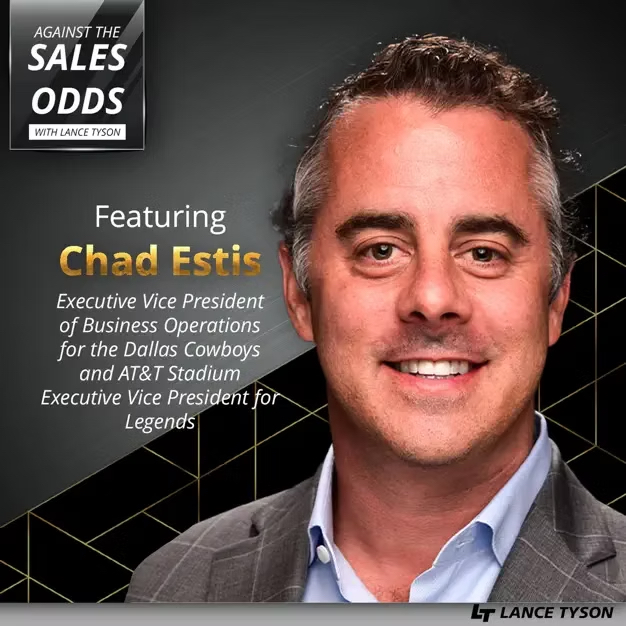
Success in sales is gained not just by yourself and the position you have achieved. More importantly, it is impacted by how you influence the people around you, which calls for the right sales team values. Join us as Lance Tyson goes one-on-one with, Executive VP of Business Operations with the Dallas Cowboys and Legends Global Sales. They discuss several topics ranging from how selfishness could destroy any dream team, the importance of career development, and how selling would look in the future. This is a fast-paced 30-minutes episode you do not want to miss.

Listen to the podcast here.

Against the Sales Odds Interviews Chad Estis on Building Sales Team Values

I’m here having a riff session with an old friend of mine and business partner, Chad Estis, with the. He is gracious enough to spend a little time with me. What we are doing in this show is talking to sales leaders about their approach and their outlook on things in this day and age. Chad is going to talk. I’m going to ask him a lot of questions. He has one of the best stories I know. Not only is he somebody I do business with, but I also consider him a coach. Welcome, Chad.

Thanks, Lance. I’m looking forward to spending some time with you in a new format. Let’s jump in.

For people that don’t know you who might be outside of pro sports or maybe some people don’t know your story, give us a few minutes on your rise coming through sales and to what you’re doing now.

The quick story is I was upwards to my junior year of college. I had no idea what I wanted to do post-college career-wise. I had always loved and played sports. I was fortunate and lucky enough to be at Ohio University and got exposed to the fact that they have a Master’s in Sports Administration, which I didn’t know what that was and what that meant. As soon as I gathered a little more info about that and realized, “There’s a whole business career in sports that I was unaware of at that time,” then I got pretty focused on trying to get into that program. That’s how it started for me.

One of the first things they told me was, “If you want to get into the program, go get an internship that’s going to have to put on your resume.” I was able to use a family relationship to get an internship at the Cleveland Cavaliers. That was my first exposure to the inside of a business of sports. I did that for the summer. I liked it and got a chance to ask a lot of people in the organization what they did and how they did it. I watched, learned and that set me off.

People told me to go into sales. That wasn’t something I probably would have come up with on my own. I didn’t consider myself a salesperson. They said, “That’s how you should start.” My first job was an entry-level sales job at the Cleveland Cavaliers. I got committed to it, worked pretty hard at it and made some different moves. I went up to the Detroit Pistons and worked there.

I got an opportunity to get into sales leadership and then went down to the Tampa Bay Lightning and back to the Cavs. I had a long stint where you and I met. I worked there for eight years. It has been many years now that the Cowboys opportunity came up. Legends became a part of my responsibility as well. That’s a bit of the quick career history.

Between you and I, you use some real specific language. What did you suck at in your first sales job?

Honestly, I remember it well and it’s an easy question for me to answer. This was pre-computer and the internet. This was in the mid-’90s and I was at the Cavs and in one day, they set you up. They had me sit next to another rep and listen. They handed me a computer printout stack that if you’re bored, you could peel the sides off. I had a ruler, highlighter, phone and script. The expectation was around 100 calls a day. I was extremely uncomfortable. I lacked confidence. I didn’t feel like I was good at it. I wasn’t having much success. I didn’t like it. There was nothing about it to report to you that was positive on the early sides of that.

How many times were you ready to quit in the first couple of months?

The problem with the quitting idea was that it was difficult for that to enter into the mind because I invested a lot to get there. I had done an internship and then I had a Master’s Degree. I had told everybody in my circle I was going to work in sports. You create that own pressure. What are you going to do? In two months, “I didn’t like it and I quit.” That wasn’t part of my DNA.

You had enough out there. It’s like how we always talk, “Are you the chicken or the piggy?” The piggy commits his life for the breakfast. The chicken just contributes to you.

Sales Team Values: If you could spend a little time learning how to sell early in your career no matter what you end up doing, that is a great skill set.

It would have been a bad look for me to walk away from that. I would have been letting some people down. I had that good pressure on me in a good way to stick with it. My parents doubted me at that time. Unfortunately, I had to move back into my house. I was making $16,000 a year with no benefits. That put me right back into the home in Aurora. None of it was good. Personally and professionally, it wasn’t good. You go from college back into your twin bed in the house. All of it was rough.

I’m always telling salespeople all the time, “If you look at the trajectories of very successful people, most either come out of high finance or they could bring something to the table like a sale.” You worked your way up. With that said, what were you good at? The second question is, what was difficult about managing you when you were in sales?

“Sales is a great teacher of life. It’s got a little bit of everything.”

At the earliest stages, I was good at nothing. I’m being honest with you about that. What I became decent at was my work ethic. When I had no skill, the one thing I knew I could do was work. Honestly, that was a page out of my athletic book. I worked hard to be a college basketball player and had some success and I thought, “I know I can do that.” I was like, “I’ll outwork everybody.” I was a grinder.

You know a little bit of this story. My brother was two years ahead of me out of school. He was in a sales role and he said, “You need to start self-educating and reading these books. There’s a material out there that you can teach yourself how to sell to be a good salesperson.” I started to do that. Self-education became something that I valued greatly back then.

The first time I started reading about what you teach, the skill of selling, it became a different mindset. I started worrying a little less about what people were saying on the other end of the phone. My anxiety dropped, my feelings of failure. If I wasn’t making sales lessons, I started to treat it as more of a game. Some of that stuff mentally and emotionally was helpful to me.

Sales Team Values: Even when you’re just trying to convince your boss about something, what you are doing is also a form of selling to some degree.

To your second question about what was I like to manage, I was hard on myself. The failure element of sales in that environment was hard for me. I was probably to my manager more of like, “Why can’t I be better?” I was frustrated and I probably projected that. I would assume my manager also saw me as a hard worker on the positive side. I was pretty much willing to do whatever anybody asked me to do. I volunteered for the extra stuff. I was trying to make an impression in a variety of different ways.

I’m sure my manager would have liked me to produce more, quite simply. I had two managers at that time. I had good relationships with both and carried those for a long time. I look at that stage of my life and view it as I get through it. It was more of how I felt. It’s probably part of why I have made a commitment to try and help people when they are in that stage of life because it was the stage that was rather difficult for me.

It doesn’t sound like you were the top guy. It sounded like you worked hard. You probably had glimpses of genius. I never heard you say once like, “I was the number 1 or number 2 guy.” You probably made your way up and down the list a little bit, correct?

It’s interesting you bring up the list because the list was up on the board. I was a high middle of the packer. I couldn’t find my way to 1, 2 or 3. It’s probably hanging in around 4 or 5. It’s like, “Just good enough.” Back then, there was an expectation of top of the board for sure. With those early learnings, I logged a lot of that stuff in the memory bank because when I got into leadership and particularly as I evolved more and when I got to the Cowboys, we hired 36 salespeople. We had a top ten and we celebrated it, but there was no shame in being 25th. The difference between the 25th and 8th could be a day or two in the office of picking up the phone.

I tried to get away from the emphasis of top of the board. I found myself promoting a fair amount of people with years in a leadership position that wasn’t necessarily top of the board but displayed the skills and qualities of good teamwork and leadership. It’s not about being number one. I have seen some people being number one that quite honestly, at some point, didn’t even belong to be in the office because of the way they acted and handled themselves. Being top of the board was overly emphasized to me to the point of discomfort. I tried to make a note that’s not how I was going to operate when I had a chance to run it.

“Success means too many things to too many different people. Only you can define your own success.”

Let’s flip this over then. As you started to move your way through your career, you started getting some more sales leadership. How did sales prepare you to be a sales leader? What did it not do to prepare you to be a leader?

My belief now and I have been selling my whole career. Sales is a great teacher of life. It’s got a little bit of everything. One thing is at the very heart of it, if you can develop the skill of selling, there’s a place for you in the world. It’s a little bit of that security and comfort that no matter what happens and thinking of it in this weird time, you can think about that a little bit. I feel like if my career didn’t work out how I had hoped or expected, I’d be able to sell something somewhere to somebody. It’s a baseline that gave me a little comfort.

Sales Team Values: Your days, success, and income are defined by your own actions to a large degree. But at the same time, you need people who are good teammates.

It’s got so much too. It’s got the ups and downs. It’s got the thrill of victory and defeat. You need to do your best when you’re working around a team and you’re collaborating on selling. It’s got strategy and relationships. It’s fun. I would almost say to anybody if you early in your career could spend a little time learning how to sell on selling. No matter what you end up doing, it’s a great skillset.

How did selling prepare you for leadership? What I heard you say was like, “No matter what I’ve done, I still had to sell.”

It prepares you for life to a degree. Even when you’re not directly selling, you’re trying to convince your boss around an idea or you’re trying to convince them that someone should get promoted. When are you not selling to some degree, is the way I look at it.

If you have never met Chad, if you do any looking him up and looking at the number of people, I always gauge somebody with how many careers they have started and Chad has promoted so many careers. You’re always known, especially in sports and entertainment, for building some of the best sales cultures you could ever find and the loyalty that creates.

I’m going to ask this question this way. When you look at a sales team, sometimes it’s hard to define the words to determine your value system. What is it about a salesperson’s behavior that grinds you? An observation is something you have to keep reminding somebody of or you observed the behavior and it pisses you off. What is that one thing? A lot of times, that is where your value system starts. It’s something that bothers you with their behavior.

It’s selfishness.

Define it.

The interesting thing is you do need to be a little bit selfish to be a good salesperson. When you’re solely selling every day, you’re working on behalf of yourself. Your day and often your success and income are defined by your own actions to a large degree. At the same time, to have the right culture of an office, you need people that are good teammates.

What I want is that aggressive, hard-charging sales rep that wants to be the leader on the board but, at the same time, would stop and make a sale for the person next to him when they receive no credit and not worry if anybody knows about it because they want to help their teammate. It’s someone who is willing to celebrate the success of those around them even if they are in a slump.

It’s someone who, when you rally around in the morning getting ready for the day and you have someone to share a sales success story, has good body language because they are generally happy for that person even though you’re not talking about them. That gets displayed every day in a whole lot of ways. It’s someone who is generally positive even when things aren’t all going their way or things aren’t in the office maybe all the time the way they want them. They are not the first person to gather, three people to go to lunch and have a session.

Success will come to you if you just put your head down at all costs. You will get there eventually.

I have seen it manifest in a whole lot of ways. That to me, probably more and more as I go. A good salesperson that’s overly selfish has no place with me. I’ve addressed that with people over the years in a whole variety of different ways and seen different versions of it. A lot of salespeople want to become the next leader. It’s not everybody but a lot of them do. That’s a quick way in my eyes to take yourself out of the running for that.

Don’t Fire Them, Fire Them Up: Motivate Yourself and Your Team

With your definition of selfishness and I definitely concur, it probably takes a lot of communication to your teams of how you define that because there are a lot of angles there where you throw at that. You said like, “You display this. You’re doing this. You’re not doing this.” It sounds like you need to be in tune with your people to say, “This is my expectation.” Talk to me about what your sales leadership style is now. You and I have talked a lot over the years about this and how your leadership style has evolved. In the beginning, it was this. Where is it now?

The way to talk to the team about not being selfish is to do it in the positive form, which is how to be a great teammate. If you’re a great teammate, then you’re not going to display selfish characteristics. I don’t talk about, “Don’t be selfish.” It’s more about, “Let’s talk about what our office would look like if everybody is being a great teammate.” We do talk about that.

As far as my style and evolution over time, it’s constantly evolving. Some of it is with the times. There are times where I have been more old school. Things shift in the world and you have to adapt to that. There were some core principles of what I would like an office to look like from a cultural standpoint. It all starts with career development. That’s the first thing I think about. That’s the first thing we talk to people about when we interview them.

We try and interview people and find people that are interested in that. We like a career to be a motivation, particularly for young salespeople. If they are interested in career advancement and we are interested in creating an environment that helps them evolve in that way, then you have what I call an unwritten agreement right out of the gate. We are here to help you evolve your career. For that, we are going to ask you to do things a certain way and lay out the expectations.

I have found if they generally believe you are there to help them, you laid out the expectations and have hired a good career-driven person, you have got a nice little arrangement there that doesn’t need to be cleaned up that often. You can put them around other people that are living the same thing. What stands out like a sore thumb is the selfish prick that no one wants in the office anyways. It’s not that hard. Being committed to developing people’s careers doesn’t exist everywhere. That exists at Dallas Cowboys and within Legends. That’s a core philosophy and principle that we go by.

That creates that loyalty factor and those roots that you need. I don’t even know what to say to people about this time. If you’re reading this years from now, we are in the middle of COVID-19. We have been all bottled up in our houses. I’m in my office at my home and so is Chad. We have not left our houses in 45 days.

As you’re looking to the future of selling, I’m not asking you to have some positive like, “Everything is going to be okay.” I’m thinking back to your career. When you were in the NBA, you lasted through that first lockout that year. You had to come out of that. It was at the end of the ’90s. It will live through that a little bit with 9/11 and then the other stuff. What is your forecast not just in sports but selling in general? How do you think it’s going to change? What do you think it’s going to look like moving forward, if at all?

To your point, whatever how many days we are into this odd experience, I wouldn’t want to predict what may or may not happen with this. You and I talked a bit at the beginning. You think there are going to be some changes. The fact that we are doing this, you could have said, “There would have been value to this months ago potentially, but we weren’t thinking about doing it. Why not?”

I did a Zoom with my family, with my brothers in Minneapolis and my mom and sister in Cleveland in different towns. We had a blast and we drank some wine. We ended up spending two hours doing this and you say, “Why haven’t we ever done that before? We all lived in different places at that time.” Things will be different. There will be a change. To me, the world will always have a place for selling technology and the use of it like this.

Certainly, I’ve spent a lot of time back in the day driving all over Detroit, Tampa and Cleveland to do face-to-face meetings. I sit here and I’m looking at you and thinking, “We could probably get a lot done going through some information about a premium seat doing it this way.” There might be some more of this in the future. It doesn’t mean that skillset would be any less and if not, maybe it even needs to be enhanced more.

You know me pretty well. Through this, I have had my moments and this has been a bit scary. A significant change happened quickly, a lot of business issues to deal with and a lot of concerns over people’s health. At the same time, I remain optimistic. Humans figure stuff out that there are great scientists and people that are going to figure this out. It’s not without casualty. We’ll come out of this and find over time a world in a better place.

I know personally, I’m thinking of, “What are the things that I want to do more of and less of when this is over?” There are some things about this that have been good for me. There are certainly some things that I miss and want to get back to. I’ll go about some things a bit differently as well. There will be a place for good selling. I have no doubt about that. That means there’s a place for me and you in the world. That’s all that means.

We are going to bring this down for landing with three more rapid fires. You got an eight-year-old niece and nephew and they say, “Uncle Chad, how do you define success to an eight-year-old?”

It’s hard to ask an eight-year-old how they would define success, but that’s where my mind goes first. Success is only defined by the individual. I couldn’t define anybody else’s success because success means too many things to too many different people. I start thinking about things like financial, lifestyle, role, responsibility and how you want to go about your day. I used to think success was defined by the title, role and responsibility. You obtain some driven career that you would put your head down and at all costs, you’re going to get there.

My perspective is completely different. I think to each his own on that question. When someone tells me they are driven and they want to be the president of a team, there was a conversation we had about that. If someone says, “No, I want to be a senior account executive because I like what that provides me for this and this,” I totally appreciate and respect that. It’s defined by how the individual defines it.

When you were selling yourself, pick your sales song. What is the song you play? Mine is Onyx’ Slam.

It’s Welcome To The Jungle. The only reason I picked that is because my high school basketball team used to warm up to that and I would get super fired up.

What book do you gift most? If you had to give somebody a book, what are you giving them? It tells us a lot about how your thinking is. You have gifted me a few.

The most impactful book on my career and life, which I read when I was in my twenties, there’s a book called Don’t Fire Them, Fire Them Up by Frank Pacetta. It’s an old book now. There are incredible lessons in that. That started to shape for the first time. If someone said to me, “What do you want to be as a manager or leader?” Prereading Don’t Fire Them, Fire Them Up, I would have said I have no idea and that gave me a lot of ideas. I’m super appreciative of the fact that it was an early book I read.

Chad, I appreciate your time. You’re the man. We are going to get this out to everybody. Thanks for being a great guest.

Thanks, Lance. I enjoyed it. Take care.

Important Links:

Dallas Cowboys Legends Don’t Fire Them, Fire Them Up

What is the Best Time for Handling Sales Objections?

I remember attending a sales call with one of my salespeople back when we were expanding our performance sales training organization. He had landed an opportunity for a sizable, in-house training deal and he knew he was going to get some resistance with a deal of this magnitude. He wanted me to join him and give him some coaching on handling sales objections during a presentation.

After we arrived and made our introductions, we settled in to review the proposal. During this time, I quickly took stock of the room. Then I  prefaced the meeting with this comment:

“What we ask people to do is not cheap, and it is not convenient. We’re asking them to take time out of their lives at great expense to themselves and to the company. But participants have told us the results they see on the other side of this process alters their careers immeasurably. And the owners of these companies have told us that the initial investment was small in comparison to the increased revenue.”

After the meeting, my sales rep pulled me aside and asked me about my opening statement. “Why did you start off by drawing their attention to a reason not to do business with us?”

I said. “We get those kinds of sales objections all the time. For what we’re offering, our prospects have always claimed that it’s inconvenient and that it’s too expensive. We know new prospects will probably have these same concerns. So, we deal with them at the start of the sales process to get them out of the way. That way, they can’t hit us with these objections later in the sales process.”

Did it work? I’ll tell you in a moment. But first, let’s talk about the best times for handling sales objections.

Identifying Objections in the Sales Process

Salespeople are constantly handling sales objections. It’s part of the job. As stated before, if a prospect is voicing a real sales objection, they are seriously interested in your offer. We already reviewed how to get the prospect to clarify and define the sales objection. So what you should be dealing with is a real objection and not a stall. Remember, you don’t want to waste your time, or theirs, solving something that’s trivial.

Give your sales team an unfair advantage. Download the free manual, Seven Steps to Resolving Objections here.

But let’s say you’re deep into the sales process and your prospect is interested in your offering but there’s some hesitation.  In addition, you’ve used the seven-step process to determine that this is a real concern for them.

Now you’re probably wondering when’s the best time for handling sales objections.

The Best Times for Addressing Objections

In general, there are four points in time where we can address our prospects’ objections:

1. Handling Sales Objections Before the Prospect Brings Them Up.

If you repeatedly encounter the same objection, then there’s a universal concern that you need to address.  Deal with it early in the sales process.  If your past clients have voiced concerns over an aspect about your offering, it’s probably on the mind of your current prospects as well.  Address it before they have a chance to bring it up and show them that you’ve done your homework.

2. Handling Sales Objections When the Prospect Brings Them Up.

If your prospect raises a relevant concern in the middle of your presentation or during an exploratory discussion, then this is something on their mind right now. More than likely, it relates directly to a specific application they have in mind. You’ll have to make a snap dissection on whether it’s something that needs addressing immediately or if it can be put off to a later point in time. Of course, before you address it, be sure that it’s a real concern.  Go through the 7-step process for identifying the true objection before you spend your time and energy addressing it.

3. Handling Sales Objections After the Prospect Brings Them Up.

If your prospect raises an objection and you know that you will address this challenge later in your presentation, there is nothing wrong with telling your prospect to hold their thoughts and you will address the challenge shortly.  Sometimes, waiting for the big picture will resolve that and other objections they may have.

4. Ignore the Sales Objection Entirely.

There are some objections that make no sense to address and they serve only as distractions.  Members of the buying team who aren’t stakeholders typically voice these to stay relevant.  If you’re looking to save time and address the right concerns, avoid these objections completely.  For objections that are technical in nature and don’t add value to the sales process, let your sales engineer address it offline. Or, if it’s only you delivering your proposal presentation, take the concern offline and send a request to your technical person to address it after your presentation is over.  For these types of concerns, how you handle the person will be more of a deciding factor than how you handle the objection.

Curious? Want to know more? Then be sure to download your copy of our manual on resolving objections.

P. S. In case you were wondering, my sales rep did close the deal and we got the business!

6 Types of Common Sales Objections You Need to Know

In a previous post, we outlined a process for resolving sales objections. It’s a way of adding some stability, scalability, and repeatability to the sales process. In other words, all members of your sales team, from the freshman sales rep to the seasoned saleswoman, now have a way of producing repeatable results when resolving common sales objections.

What’s missing here is the sales rep’s ability to run that process and determine what kind of sales objection they are facing. Now I’m sure every salesperson can determine the kind of objection they are facing based on the content of the objection. For example, if the objection deals with the product, service, the relationship, or the reputation of the sales rep.

See Common Sales Objections From the Prospect’s Perspective

But let’s step back and see the situation from the customer or prospect’s position. Are they bringing up the objection because they have a real problem to resolve, or are they trying to get rid of the sales rep? Are they bringing up issues because they are misinformed? Or do they have an underlying bias for a competing product?

Using the process outlined in the previous post, your sales reps will have an opportunity to determine the type of common sales objections they are facing allowing them to respond accordingly.

Give your sales team an unfair advantage. Download the free manual, Seven Steps to Resolving Objections here.

Throughout my career in sales, I have heard many sales objections. And in my time as a sales trainer and in training trainers, I understand the need for salespeople to simplify and streamline the process as much as possible. Fortunately, I’ve come to notice that sales objections, from the customer’s perspective, fall into 6 categories. The are:

  1. Genuine
  2. Stalls and Put-Offs
  3. Misconceptions
  4. Biases, Prejudices, and Skepticism
  5. Unsolvable
  6. Trivial

So your salespeople don’t need to remember the big book of 100 common sales objections. They only need to isolate and address the 6 types detailed below.

6 Types of  Common Sales Objections

1. Genuine Sales Objections

The first type of common sales objection is the genuine one. A real sales objection is a legitimate concern that your prospect has and you need to address the problem before you can move the sales process forward. This can be anything from “Your service costs $500K and we only have $400K allocated in our budget” to “Your system requires a raised floor that supports 500 pounds per square foot and ours isn’t rated that high”.  A genuine objection indicates interest in your product and is your opportunity to shine.  Solve the problem and you will close the business.

2. Stalls and Put-Offs

A prospect or client will use this type of sales objection if they feel events are moving too fast for them and they need to use a delaying tactic. They need to slow down and get control of the sales process. Prospects who don’t have the authority to buy and are looking for a way to save face will also use this kind of objection and stall for time while they run the options by their management. Lastly, if you’re facing put-offs early in the sales process, your prospect considers you an annoyance and they don’t want to talk. Any way you look at it, they’re purposely stretching out the process to run down the clock.

3. Misconceptions

With this type of objection, your prospect is hesitant to move forward because of something they heard or saw. This type of objection has more emotion in it than fact.  It can be the result of your competition running a campaign of fear, uncertainty, and doubt (FUD) against your product or company. Or it can be something as honest as the prospect having outdated information. In these instances, your client or prospect is going to need educating. Use the process to get them to define, defend, and explain their objection and then correct the misinformation.

4. Biases, Prejudices, and Skepticism

In this sales objection, your prospect doesn’t think you or your solution will solve their problem. This means you missed something during your investigative analysis and their trust is with someone or something else. Go back and ask more questions to adequately diagnose the challenges they are facing. In doing so, you’ll improve your integrity and trust.

5. Unsolvable

With these kinds of sales objections, you’re facing challenges you can’t resolve within a reasonable time and you have no control. For example, let’s say you’re meeting with a client to sell them capital equipment, like a sizable phone system. They say, “Wow, this thing looks good. Unfortunately, we bought a similar system from Acme Communications about 2 months ago and we use a 3-year depreciation model”. Under these conditions, your prospect won’t be in the market for your kind of system for at least 2 years. Perform your discovery and identify these types of situations at the beginning of your sales cycle. You’ll save yourself time by not investing your resources and energy into designing solutions they can’t use.

6. Trivial

These sales objections don’t move the sale forward, but they will eat up a lot of your time. You’ll typically find these types of objections when performing your sales presentation to a group of stakeholders. In fact, if your offer involves a lengthy sales cycle and requires input from several stakeholders, you will encounter these. Trivial objections have no bearing on the business reasons for moving the sale forward. But they do make some of the lower level stakeholders feel like they are a part of the process. Don’t get caught up in resolving objections that add no value to your business case. With a little tact and diplomacy, you can gracefully bypass these objections. Simply state, “You raise a valid point and we’ll cover that in a moment”.  Then you let the politics of the group determine just how relevant the objection really is.

In your next sales call postmortem meeting, ask your team how many sales objections they received and how they would classify them.  In time, they will get better at identifying which objections they need to address immediately, which ones they can put off, and which ones they can completely ignore.

And streamlining your process like that should improve your sales KPIs considerably!

Good Selling!

5 Steps to Buying Sales Training

Around 18 months ago, we published an article on how to purchase sales training. There, we described the three factors you should take into consideration when buying sales training: content, process, and methodology. I began thinking about all this in early 2000 when I met a sharp HR executive who reminded me she bought millions in training each year — and promptly told me how to sell it.

Over the last year and a half, we’ve had good response to this article, so I wanted to update it a little bit. We’ll start in the same place we started the last version: content.

How To Buy Sales Training: The Role And Value Of Content

When it comes to the intersection of sales training and content, you’ve usually got two big buckets of companies; they reside on opposite ends of the spectrum.

In one case, you’ve got training companies that basically act as a big content house. They specialize in the latest trends and thought leadership around sales execution, and they expect you to implement.

The other case is someone with a PowerPoint full of opinions and broad generalizations about sales. Sure, they may have some experience in sales management. But if there is no formal training, organizational development, or understanding of adult learning and behavioral change, then you aren’t going to see the result you are paying for.

There are shops that fall between these two extremes, but these two are most of what you’ll encounter in the market.

In any business, the bedrock of a good strategy lies in asking strong, intelligent questions. If you encounter either of these buckets when buying sales training, start with questions focused on the following areas:

  • Customization. Is the content customized to your sales team’s needs and learning styles? Or is it a one-size-fits-all deal?
  • Design. Is the content put together by someone with an instructional design background?
  • Tested. Is the content tested prior to being used on your team? Or are your people guinea pigs?
  • Accessories. Are there learning aids and manuals to accompany the training?

This is how you approach the content phase of buying sales training. It’s a “trust but verify” tactic.

The Process Side Of Buying Sales Training

There are two main decision points around process when evaluating different training options.

The first is a simple, yet profound question: is this training company trying to teach you how they sell, or how to sell? Sounds the same, but it’s not. Their approach might not work for your team. But teaching a team how to sell — well, that works for all teams.

Are they molding training to your team, or your team to their training? There is an important difference.

Second, you need to know the difference between whether the person you are bringing in is going to educate your team (teach something new), or whether you’re bringing in someone to train your team (enhance and take action). These two processes are vastly different and knowing this is crucial to your team.

Education is something different. Training is doing something different.

What questions can you ask to evaluate process better?

  • How many steps is their sales process?
  • How many steps to the actual close?
  • Is there a separate process for negotiations or presenting?
  • Can your trainer and the process withstand other industries and unique situations — or is it the same every time?

Now we have a roadmap on how to think about content and process. Let’s knock out methodology and iron out the last wrinkle.

Evaluating Methodology When You Buy Sales Training

The methodology is how the trainer is going to deliver the content to the participants. A good trainer should create a positive change (the buzzword is “delta”) in your team that ultimately leads to better results. There are two tiers to this: delivery and assessment.

There are more than 15 ways to change behavior. What will they use?

In terms of delivery, you need to understand the basics. For example: how will the trainer deliver the content? Will they be educating your team, or actually trying to create some change and drive results for your team?

This all needs to begin from a place of assessment or profiles. How can a sales trainer come in and solve the challenges of your team if they don’t know where to start? That’s why you need to assess any team you train.So when you evaluate trainers, ask them this question upfront. How are you going to assess my team? If they say “We come in and work with them,” get off the phone. That probably means their approach is cookie-cutter.

Once you have an answer on assessment, you need to know more about customization. You’re about to buy a sales training, right? So you have some idea (or a very good idea) of how this trainer will assess your team. Now you need to know: once the assessment is done, how are you going to customize the content to my team’s challenges? Are learning styles being taken into account?

The New Bucket: Adaptability

Ask yourself this. Why are some trainers on the scene for maybe 1-2 years and work with sales teams once or twice and that’s it? And then, why are there some trainers who work with a given company for 15+ years?

The answer is adaptability. Good sales training companies can adapt. They know the team (their client) has grown and regressed since the last training in different ways. They assess, they customize, they have a process that tailors content, and they deliver a new training to meet the sales reps where they’re at now. The best sales training companies constantly adapt and meet clients in the present; the worst sales trainers are one-stop shops with cookie-cutter solutions. The latter type usually flames out.

When evaluating a sales training option, how do you distinguish between the two types of trainers? Consider these questions:

  • Do they offer other training curriculum or modules?
  • Are there programs like negotiations and presentations outside of the standard sales training?
  • Do they offer train the trainer or coaching modules?
  • Do they have sales management programs?
  • Usually the trainers who offer more, or are willing to change/shift with what you tell them, are going to be the adaptable ones.

When You’re Buying Sales Training, Consider How You Got Sold

This is a little bit meta, but it’s important to consider: how did this company sell you on being a client? The process they worked with you often says a lot about how they will train your team. For example:

  • How did they resolve objections?
  • Sales guys that can’t resolve objections usually can’t train others very well either.
  • Are they the cheapest option?
  • (Ask yourself: do you really want your team in the hands of the cheapest option on the market?
  • Do they offer big ‘price cuts’ or ‘buy now : $199 a session’-type discounts?
  • Simply put, guys who do this are usually chasing leads and not really interested in the outcome after they work with your team.)
  • Did they educate you in the sales process or are they pushing a product?
  • In a way, we all push product, but you can push with value or you can just push. The former is who you want for sales training.
  • How did they present their information?
  • Context? Transparency? Or buzzwords and BS?
  • How did they communicated with you?

This is crucial because it speaks to both levels of adaptability — they meet you where you’re at — and levels of respect, and both of those show up in the training process as well).

Essentially, are they selling in a way that you want your salespeople to sell?

So What’s The Bottom Line On Buying Sales Training?

The four buckets above — content, process, methodology, and adaptability — are the major buckets you need use when evaluating vendors. Hopefully these guiding questions are helpful for you. Definitely feel free to reach out if you’re wondering how best to evaluate some of the market options.

I will reiterate, absolutely do not make your selection based on price in this space. Even if it’s low cost, bad sales training is always a waste of money. Maybe your boss gave you a target or a range to spend on sales training, and that’s understandable. You need to stay within reason there. But competing on price works in some industries, although usually not with person-to-person tactics and strategy sessions like a sales training. There, you need the best, and the best usually costs a little bit more.

Buying sales training and empowering your team is a big decision. But if you think through the steps above, you will find the right option for you, your team, and your organization.

How to Resolve Sales Objections Quickly and Easily

In one of our sales training sessions, a participant asked me for ideas on how to avoid some of the objections she was getting from her prospects. Now, in these situations, my experience is if one person asks a question, then there are at least 5 other people with the same question simmering just below the surface.  And for a hot topic like this, the majority of salespeople want some way to resolve their prospects’ sales objections that not only makes them look good and helps them get to close deals faster.

Before we jump into how to resolve sales objections,  realize that the majority of salespeople actively avoid encountering objections, as if an objection was the equivalent to saying “your product or service isn’t good enough” or “you did something wrong in the sales process.”

What your salespeople must first realize is that sales objections are a natural part of the sales negotiation process. Real sales objections, ironically, signify a prospect’s interest in your offer. They are not something that must be overcome. They are problems that must be resolved. Once your salespeople realize this fact, they put themselves in a better position to address their customer’s concerns.

So, the first task for your salespeople is to determine if the objection is really a sales objection and not merely a tactic to push them  out the door.  To do this, your people must ask their prospect if their concern is legitimate, but they have to do it in a way that doesn’t put the prospect or customer on the defensive.

Enhance your salespeople’s effectiveness with the full process. Download the guide, Seven Steps to Resolving Sales Objections here.

Keep this in mind as we briefly review the step by step process to resolve sales objections

Process to Resolve Sales Objections

  1. Bridge their statement and acknowledge their concerns. This gives you rapport with the prospect instead of preparing your relationship for a confrontation.
  2. Ask a question for clarification. You never know what a prospect means when they voice an objection. Instead of guessing or assuming you know what they’re talking about, ask them to define, defend, and explain their concern..
  3. Verify that this is their primary concern. Give them the option to identify other areas that may be troubling them. An easy way to do this is by asking, “In addition to this, is there anything else?”
  4. Test their state with a trial close. If they are truly interested in your offer and this is a legitimate concern, they’ll respond in the positive. However, if this is a smoke screen or a quick response to get rid of you, they’ll respond in the negative.
  5. For those that hesitate or respond in the negative, ask them what else is holding them back. Simply state the obvious and inquire: “Bob, there appears to be something else holding you back. Do you mind if I ask what that is?”
  6. When they tell you what else is bothering them about your offering, contrast their two concerns and ask the prospect which one is more important.
  7. Lastly, use questions to perform a trial close and determine if resolving the new condition allows the sale to move forward.

Supplement the Process of Resolving Sales Objections With These Ideas

Here are some supplemental tips for your salespeople when they’re resolving sales objections:

  1. Avoid being confrontational or argumentative. As the salesperson, you are there to negotiate. Find points of agreement.
  2. Don’t tell your prospect that they are wrong. Telling your prospect or customer that they are wrong sets the stage for a confrontation. Instead, acknowledge where they are mentally and lead them to where you want them to go. Everyone is entitled to their opinion. You don’t want to take those opinions away. However, you do want to offer them alternatives and let them choose the better option..
  3. Your presentation matters. If all you had to do was present facts, you could give your prospect the user manual or the brochure.  The facts you use to counter an objection need the appropriate presentation suited for the audience.  Deliver your evidence using an appropriate amount of dramatic flair to make your point.  Anytime you can use your presentation skills to make unfamiliar concepts easily understood, do it and you’ll effectively deal with most of the objections you’ll encounter.

Remember, when you encounter a real sales objection, it’s an indication that your prospect or client is genuinely interested in your proposed solution. Take some time to investigate the objection and use the opportunity to move the sales forward.

Good Selling!

Tyson Group Wins Stevie® Award for Sales Consulting Firm of the Year

With a nation struggling to go back to “business as usual” in a no-contact era, sales efficiency has never been more critical.

Press Release: Tyson Group

DUBLIN, Ohio, February 10, 2021  – Tyson Group competed against some of the industry’s best sales consulting firms to win this year’s Stevie Award. Winning the Silver Award for Sales Consulting Practice of the Year proves that Tyson Group’s business acumen and tactical solutions prepare sales teams to handle unpredictable situations with confidence.

The Stevie Awards for Sales & Customer Service are the world’s top honors for customer service, business development, and sales professionals. More than 2,300 nominations from organizations of all sizes and in virtually every industry, in 51 nations, were considered in this year’s competition. Winners were determined by the average scores of more than 160 professionals worldwide on nine specialized judging committees.

“Great Entry,” said one of the judges. “It demonstrates the achievements of the organization with respect to the current COVID-19 pandemic. The entry reflects the dedicated team working towards the goal. And the evidence shows a team dedicated to excellence. The planning roadmap, the execution, and the way the organization has communicated its achievements are commendable.”

Tyson Group offers expert sales consulting and training tailored to companies’ individual needs, cultivating talent that yields measurable results. They have consulted and provided negotiation strategies for multi-billion dollar deals for the nation’s most prominent sports stadiums, developed elite sales teams, and advised on the installation of sales methodology for countless organizations.

Their expertise in recruiting, training, and coaching helps the right talent drive organizations to the next level. They have proven experience creating, establishing, and implementing organizational changes and new processes that help sales teams meet and exceed goals in all industries.

Tyson Group is available for commentary.

sian.valentine@tysongroup.com

Sales Presentation Tip – Rehearse The Opening And Close

Prepare And Rehearse Your Opening And Close.

Yes, we’ve said preparation and rehearsal are necessary in your sales presentation. But you want to pay particular attention to your opening and your close.

Two Essential Principles of Learning

In his book, “Use Both Sides of Your Brain”, memory expert Tony Buzan highlighted two principles at work during any training activity. The first was the principle of primacy. With this principle, if someone was learning new material, they’d have better retention and recall of the information at the beginning of the training session. So, if you wanted to remember a list of items, you’d find it easier to remember the initial items.

The other was the principle of recency. According to Buzan, if someone was learning new material, they’d have good retention and recall of information near the end of the training session. So, again, if you wanted to remember a list of items, you’d find it easier to remember the last items.

Using these two principles, we see that we’d have an easier time recalling and retaining more information if we segmented our training opportunity into several,10-minute sessions. This would give us multiple opportunities for the primacy and recency effects to take effect.

Conversely, using one long, training session would give us only one opportunity to leverage the primacy effect and one for the recency effect.

Transferring These Learning Principles to Your Sales Presentation

These principles also work when delivering presentations. Applying the above principles to your audience, they would have a tendency to retain and recall your presentation opening and your close. Everything else falls aside unless you take steps to help them remember particular points within your presentation. We’ll outline those in a later post.

But lets stick with the opening and the close for now.

Like in sales, your opening is the most important part. The opening grabs your audience’s attention and keeps them engaged. And just like the sales call, if you can’t get their attention, then the rest of your presentation is irrelevant. You’ve lost your audience before you’ve even started.

For opening your presentation, take a hint from your sales call. Pay your audience a compliment to get them in the same frame of mind. Or you can begin by posing a rhetorical question to focus their attention. Or you can use a relevant personal anecdote to capture your audience’s imagination. We’ll touch on the various methods to open your presentation in a future post.

Closing Your Sales Presentation

The second most important part of your presentation is the close, or your call to action. This is where you tell your audience the action you want them to take. Again, as in your sales call, make your case and provide a clear call-to-action after delivering your presentation. If you don’t, your audience will leave your meeting feeling like there is unfinished business.

So remember, practice your opening until you know you can get your audience’s attention smoothly and easily. Rehearse your close until you can leave your audience with a definite and clear call-to-action. Focus on these two points in your sales presentation, and you’ll close more deals.

You’ll find other ideas for creating your sales presentation in our playbook, Persuasive Sales Presentations. You can download your copy of the manual here.

Training Industry Recognizes Tyson Group for Its Unique Training Style

There’s no doubt that we’re in the middle of some tough times – a raging pandemic, a downturned economy, rising unemployment…  Yes, we can all agree that times aren’t the best right now.

But speaking as someone who has served as a salesperson, sales coach, sales manager, and CEO, I can say that we’ve faced tough times before. And to get through the dark times, we do two things. First, we focus on what we can control and change it for the better. And second, we highlight our accomplishments to carry us to better times.  As I’ve coached my team through the years, acknowledge the situation. But work to change what’s in your control and celebrate your victories when they happen.

Recently, Training Industry announced its 2020 Top Sales Training Companies List and they included Tyson Group in their Watch List.

Now, Training Industry has some rigorous criteria they used in selecting the companies for these lists:

  1. Thought leadership and influence on the sales training sector
  2. Breadth and quality of sales training topics and competencies
  3. Company size and growth potential
  4. Industry recognition and innovation
  5. Strength of clients and geographic reach

But what I find interesting about the Watch List is how Danielle Draewell, a market research analyst at Training Industry, Inc., described it: “The companies selected for the 2020 Sales Training Companies Watch List bring unique and specialized strengths to the sales training industry. These organizations create exclusive learning experiences and sustainment practices that keep the learner involved and connected in the industry.”  Read the full press release here.

Building a Larger Sales Community

Such milestones aren’t the result of any single individual. They are the fruits of the entire team’s collected efforts.  And the entire team deserves recognition. To be included on Training Industry’s list of influential players is an affirmation that the entire team is making an impact on the sales community.

We’ve always sought to capitalize on the skills, creativity, and energy of our team members to create a unique learning experience for our clients. Be it training, coaching sessions, or consulting on our assessments, each one of our clients are unique with unique circumstances. As such, we need to take a tailored approach to best serve each one.

But we also seek to provide our entire community of sales professionals with rich and unique learning experiences.  To that end, we recently launched Against the Sales Odds, a series of interviews with sales leaders. In this series, we have tapped some of the biggest names in the industry and given them a platform where they can share knowledge, wisdom, and advice with the sales community at large. It’s one of the ways the Tyson Group team is changing what’s in our control to improve the current situation.

You can Listen to the interview series, Against the Sales Odds, here.

As I said at the top of this post, to get through the tough times, including the one we are currently in, change what’s in your control and celebrate your victories when they happen.

Good Selling!

Sales Leadership During Times of Uncertainty

In the original version of the Magnificent Seven, Yul Brenner and Steve McQeen spend the opening scenes recruiting men to, “shoo some flies away from a little village.” In one scene, they come across Robert Vaughn who is on the run and now looking for work. When Vaughn agrees to join the team, Brenner holds up seven fingers indicating that they now have seven men on the team. McQueen, however, waves his hand as if to say, “hold on.” He has reservations about Vaughn. That’s when Brenner says, “No. No. He’s a good gun. And where we’re going is no church social.”

Our current business environment is also no church social. As sales leaders, we’ve seen some tumultuous times, such as 9/11, the Great Recession of 2008, and now the COVID-19 crisis. Let me ask you, do you have the right people in the right roles to address these challenging times?  Do you have a way to identify and recruit those “good guns” on your team to pull your group through the rough patches?

In this time of business uncertainty, your system for hiring, assembling, and developing your sales team should include the six strategies outlined below.

Register for the webinar, Sales Leadership During Times of Uncertainty here.

Factors That Predict Success

To ensure you have the right team in place, you’re going to have to look at some of the identifying factors that can statistically predict sales success. The new business reality is you aren’t going to have all the available resources to get the job done. Many of your resources might be trimmed down. Some of those resources may not even be available. So, like Billy Beane in Moneyball, if we are going into a championship match, you need a way to know your people are bringing the right skills and capabilities to the game for each role.

The Sales Team’s Capacity

We’ve talked about the shifting business landscape in the past. Sales leadership needs to gain a viewpoint of the capacity of salespeople in relation to what the business landscape now calls for. Many sales leaders know the attitude of their people. They like the people they hired. But their knowledge of their people’s capacity becomes spotty when it comes to what their people can really do. You need ways to understand how our people can perform under not-so-ideal conditions.

Select, Develop, and Retain Sales Talent

As a sales leader dealing with this business uncertainty and the demands from your organization, you’ll need to retain and develop your sales talent. You need to know where their strengths are and coach them through their opportunities for improvement. You’ll also need to address your overall training strategy for your people. I’ve seen many sales leaders simply pump content on their team thinking that exposure will result in a behavioral change. Instead, sales leadership needs to involve providing the right content to address the situation at hand.

The Right People Attached to the Right Job

You’ll also need systems for putting the right people in the right jobs. We covered this topic in a previous post on motivation. It goes back to a principle covered by Jim Collins in his book, Good to Great. You must get the right people on the bus, the wrong people off the bus, and the right people in the right seats. And when dealing with business uncertainty, you need a system for accurately determining the right people for your organization and getting them into the right roles. Otherwise you’ll have an unmotivated and underperforming work team.

Future Facing

As stated before, business environments change. Sometimes the change is a fast hit and the business environment returns slowly. Other times, the change can be permanent. You and your team need to be flexible, innovative and nimble enough to address these events. So, your talent system needs to include ways to identify and develop your sales talent to accommodate future needs as well as a progression path for the people on your sales team.

Alignment of Strategies

Lastly, sales leadership needs to consider the whole system. Your sales team, your sales goals, and your go-to-market strategy all must play together. So, you need to take measures to align your strategy for onboarding and developing your sales talent with your goals and your marketing strategy.

In reviewing these strategies, there are a few key questions you must ask yourself when considering your talent strategy. First, do you have the right sales structure and the roles to execute the strategy you need to move forward? For example, in the businesses we deal with, most of our clients deal with what I call the disease of uniqueness. They have unique circumstances in the marketplace, unique demands of their customers, which means they will need to apply certain strategies when moving forward.

Secondly, what’s going to predict success in each of your sales roles? Do you know what those factors are and how to identify them? Or are you hiring someone just on raw attitude as mentioned above?

Lastly, do you have the right people in the right roles?

Detailed Review of These Sales Leadership Strategies

Our next webinar will cover these topics in more depth, look at answering these questions, and address ways to align your sales talent with your overall sales strategy. The webinar will help you:

  1. Recognize the 6 strategies listed above to find and retain the right sales talent
  2. Answer those 3 important questions to define your sales talent strategy
  3. Analyze your product life cycle
  4. Align your sales approach with what your market buys
  5. Determine if your sales roles align with your sales approach

In these critical times, you’re going to need the most versatile sales force you can assemble because we all are going to be running a little leaner and meaner.

You can access the webinar on demand here.

How to Drive Sales in the Face of Business Uncertainty

One of the things that I talk to sales leaders about is the difference between a thermometer and a thermostat. A thermostat can set the temperature and manipulate the climate to get to the desired temperature. A thermometer can only take the temperature. With the business uncertainty in today’s climate, we can only take the temperature and react minute-by-minute to this uncertainty.

Over the past week I have personally interviewed 18 different C-Suite sales executives about taking the temperature of their business and how they’re leading, coaching, and managing their salespeople with the business uncertainty of today’s sales environment.

Here are a few things that became obvious:

  1. Extraordinary circumstances (in this case, the COVID pandemic) can alter the business climate, and in this case, it’s going to create a very different world moving forward.
  2. Messaging in the moment was absolutely critical to your  their clients and prospects and even more now. These sales leaders are micro-coaching on messaging.
  3. Salespeople can’t be tone deaf to the prevailing circumstances. They must display tactical empathy. That’s key.  Depending on their role, each conversation may be different.
  4. With many of their salespeople working remotely, sales leaders are spending an inordinate amount of time with prep, training, and coaching, and addressing how their salespeople will move forward within the current business uncertainty.
  5. Key performance indicators are being adjusted, as are goals. This obviously affects performance and expectations.

A recent study by the Sales Management Association stated that 43% of firms improved sales organization effectiveness over the prior 12 months, and fewer than one in five (18%) consider their salesperson training and development efforts effective. With today’s business uncertainty, it feels like the climate is changing by the minute.

Over the past year, Tyson Group has assessed, trained, and profiled over 2,500 salespeople in various industries from technology to sports and entertainment. That data has given us the ability to identify a number of factors that define success. That information, coupled with the content from my best-selling book, Selling Is An Away Game, gives a unique approach to assist sales leaders when looking to improve the overall skills, tactics, and strategies of their sales teams.

After connecting with our clients and receiving multiple requests, I determined that I want to address the issues being faced in this current climate, where salespeople are not only working in new, remote environments, but facing an unprecedented sales climate.  I’ve pulled together our resources for a webinar to address these challenges and trends.

View the video, How to Drive Sales in the Face of Business Uncertainty here.

In this webinar, together we will:

  1. Identify 9 key skills that your salespeople will need moving forward through extraordinary business climates like the COVID pandemic we are currently facing. These range from how you prospect, how you facilitate, how to emotionally deal with objections, and to how to negotiate.
  2. Address what it really means to “sharpen the ax” and develop the right learning, training, and coaching plan for your salespeople in the moment.  And how to execute.
  3. Integrate the 3 key concepts to achieve maximum skill development, from different sales methodologies to the right content.
  4. Introduce the 4-step behavioral change model.
  5. Present the 4 key ingredients to communicate effectively with your team.

Please join us. You can view the on-demand webinar here