Tyson Group Brings Talent & Performance Strategies to ALSD

Two Major Players in the Sports Industry Team Up: Tyson Group Brings Talent Assessment and Team Performance Strategies to The Association of Luxury Suite Directors

DUBLIN, Ohio, October 25, 2022 – Tyson Group, the award-winning sales consulting, coaching, and training firm that serves some of the biggest names inside and outside of sports and entertainment announces an exciting new partnership with The Association of Luxury Suite Directors (ALSD)—the sports and entertainment industry’s community leader in premium seating, venue design, build, and technology.

“We’re seeing our clients contending with three major issues: a changing sales landscape, more pressure on sales leaders, and shifting selling profiles,” says Lance Tyson, President and CEO of Tyson Group. “We’ve helped countless organizations within the sports and entertainments space increase sales productivity, reduce sales cycle time, and gain higher close rates. We couldn’t be happier for this partnership with ALSD, a world-class organization. We understand their marketplace and we know their clients’ needs.”

This is another big step in ALSD’s evolution as the company looks to expand internationally, coming off the heels of their 4th annual conference in London.

“We’ve been excited about this partnership for months, because it’s exactly what we wanted to add to ALSD,” says Jeff Morander, the newly appointed CEO of ALSD. “I’ve had countless people tell me their biggest pain point is staffing and recruiting. And that’s where Tyson Group comes in.”

A key component of the partnership provided by Tyson Group is Sales Leadership Training, beginning with a leadership track during ASLD conferences that builds throughout the event, featuring topics such as Hiring and Selection and Agile Negotiations. Tyson Group is also giving ALSD participants exclusive access to Tyson Group’s talent assessments, based on changes to KPIs as they relate to the market. These assessments evaluate up to 140 core sales competencies necessary for a truly high-performance sales team. Leaders are then coached by Tyson Group how to utilize team and individual assessment results to improve team performance.

“This assessment tool is going to be an eye opener for a lot of teams and venues,” says Morander. “We knew that a key component to the new growth strategy of the ALSD brand was to bring in the best of the best in sales solutions. Without question that company is Tyson Group.”

About Tyson Group

Tyson Group offers expert sales consulting and training tailored to companies’ individual needs, cultivating talent that yields measurable results. They have consulted on multi-billion-dollar negotiations for the nation’s most prominent sports stadiums, developed elite sales teams, and advised on the installation of sales methodology for countless organizations.

Tyson Group is frequently sought out for its expertise in selecting, onboarding, training, and coaching the right talent to drive organizations to the next level. They have proven experience creating, establishing, and implementing organizational changes and new processes that help sales teams meet and exceed goals in a vast array of industries.

For more information, visit: tysongroup.com

About Association of Luxury Suite Directors (ALSD)

ALSD was established in 1990 to provide a single platform for its member teams and venues with accurate and timely information from across all layers of the premium seat industry in stadiums and arenas throughout North America with a growing global reach. With its integrated marketing and advertising programs, the ALSD is also positioned to link buyers and sellers, including vendors, suppliers, and food and beverage concessionaires for the venue marketplace. In 2013, the ALSD rolled out the Design & Build Forum, on the heels of a key period for new venues and major renovations. For more information, visit www.alsd.com.

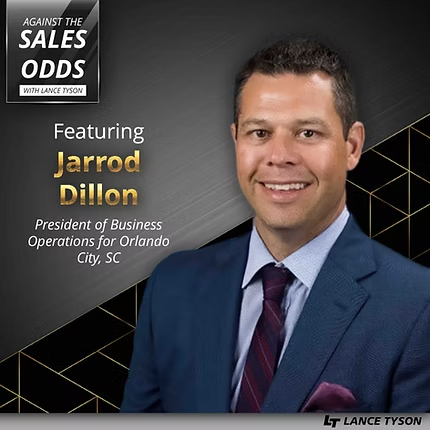
Sales Success, Mentorship, And Achieving Goals With Jarrod Dillon

Are you looking to start a career or build a business? Tune in to this episode for some success secrets! Jarrod Dillon, the President of Business Operations for the Orlando City Soccer Club, is on the set. He and Lance Tyson touch on several essential processes for sales success, the importance of mentorship, and some important advice for young people just entering the workforce. This episode has something for people at all stages in their careers. Listen to Jarrod talk about his wins and be inspired to experience yours, too.

Listen to the podcast here:

Against the Sales Odds and Jarrod Dillon Drill Down into the Elements of Sales Success

I’m excited to have a close friend I have known for years in the industry, Jarrod Dillon, who’s the Chief Marketing and Revenue Officer for Vinik Sports Group in the Tampa Bay Lightning. Welcome, Jarrod.

How are you doing?

I’m doing good. Here we are, quarantined. Jared’s in his house down in Tampa, and I’m up in Columbus, Ohio. For people who don’t know you, could you introduce yourself?

First of all, you look too good to be quarantined. You are freshly groomed and very chipper, so I’m proud of you for keeping your spirits up. That’s the number one takeaway for me through all this time. It’s a positive attitude.

Hands washed, heads up, right?

That’s right. I’m the Chief Marketing and Revenue Officer for Vinik Sports Group. Vinik Sports Group is the parent company for the NHL’s Tampa Bay Lightning. We also manage and do everything related to Amalie Arena in Tampa with all the concerts and shows there. We have a strategic partnership with the University of South Florida. We represent the Bulls and their athletics department for multimedia rights, partnership sales, and activation. We also manage the building there on campus, the basketball arena, the Yuengling Center.

We also have a digital network, The Identity Tampa Bay, which focuses on lifestyle and all the great things going on in the Greater Tampa Bay area with a network of 50 plus influencers. We get to put the content, distribute the content, and sell against the content. Those are our major properties that roll into Vinik Sports Group.

That is a ton of responsibility. One of the things people might not know about you is you were a Division 1 athlete. I was telling my sons when I was talking about this interview, and they go, “Really?” They started to look you up. You probably got to a point you played football D-1. Tell everybody where you played.

I represented right here from my University of Oregon Ducks. It has one of the best sports marketing programs in the country, the Warsaw Sports Program. I had an opportunity. A lot of what I’ve learned from a leadership standpoint came from being an athlete and as a young person in high school and through college. I learned a lot. I was a recruited walk-on, so I was not a scholarship athlete. The odds were very much stacked against me.

I did not end up playing a ton, but was on the team and got some mop-up duty here and there over the course of the four years I was there, but more importantly, I had an incredible life experience playing athletics at that level or that level of competition with and against many names people out there would know that are in the NFL or were. I go back to the leadership that I learned from a lot of my coaches that I emulated over the years that I’ve taken into helping me become the leader I am now.

Let’s reverse that. You get out of school, and you break into sports, so you’re not playing anymore. What was your first sales job?

To get good at sales and service, you have to be constantly learning from every call when you get off.

My first sales job was not in sports. While I was going to school at the University of Oregon, through one of my teammates, I was fortunate to meet a couple of senior advisors at Merrill Lynch. I was paid part-time quasi internship for 2 or 3 years. While I was playing football and going to school full-time, I was also working for them.

My job was to bang phones all day and call folks around the Greater Eugene-Springfield, Oregon area and get them to take meetings or to come to the Eugene Country Club and have a luncheon with our senior advisors all around the topics of investing in the new millennium. That dates me a little bit. I graduated from Oregon around 2000, so this was probably 1998 to 2000, in that range. I consider that my first sales job.

We weren’t selling stocks and bonds over the phone, but my job was to sell these people on why they should come and listen to these senior advisors that I worked for. As I learned on one of my very first calls, my pitch was about, “Come and have this free lunch at the Eugene Country Club. There are three different entrees you can choose from. Come and listen for 45 minutes.”

There was one astute gentleman that I was cold calling, and he told me, “There’s no such thing as a free lunch in life. What are you selling me?” I had to change my pitch and approach. I didn’t have a lot of formal training those days. I would come into the office and sit in a boardroom with myself and a phone book and a phone, but that’s where I cut my teeth, at least, because of the sales and talking to people on the phone.

How long did you do that?

It was roughly a couple of years.

I had no clue. Selling time is the hardest thing to sell in all sales. If you can’t sell time and awareness, you are not going to sell a damn thing. From there, go to your next sales job, and then I’m going to double ask this question, how were you as a salesperson? I was talking to Chad. I said, “Where were you on the board?” He goes, “I was a strong 5, 6, or 7.”

Chad was probably out of 100. He’s a top 5%, so give him credit where credit’s due. My path was very different. Shortly thereafter, after that job and going to the University of Oregon, I shifted my focus on wanting to work in the sports business. I knew I wanted to work in a front office for a team ideally, but I didn’t know exactly what that meant. I didn’t have a lot of mentors at the time that worked in the industry, so it was very much calling people out of the blue, getting informational interviews, sitting with my professors or athletic directors, or whoever that may be at the University of Oregon to help get some guidance.

I was very blessed and fortunate that a connection to the University of Oregon put me in touch with and I was able to speak to somebody at a little Minor League Baseball team back in Sonoma County right outside of Santa Rosa, California, which is about an hour North of San Francisco where I grew up. They had an independent Minor League Baseball team. Independent means there was no parent affiliation with a Major League team, so they didn’t have the players and payroll being provided. It was a mom-and-pop shop.

When I joined them, I was the 4th or 5th full-time employee, but I had an opportunity because of the experience I had established through Merrill Lynch of being able to understand sales and to be able to get on a phone and talk to people. I figured that I could translate that to selling sports. I was fortunate to take an entry-level ticket sales job in Minor League Baseball. I went into selling tickets for that club, the Sonoma County Crushers.

I did not know that. How long was that, and what kind of salesperson were you?

The things I’ve been able to do well in my career are network and get to meet people and establish some rapport. Over time, that becomes trust and friendship. I was reaching out to every professional team and every collegiate property in the San Francisco Bay Area at the time that I took this job. I was establishing relationships. Even though they didn’t have something available, I was meeting with people and having one-to-one relationships. My football coach, Mike Bellotti, at the University of Oregon put in a call to one of my earliest mentors in the business, Tom McDonald, who was a Senior Executive at the San Francisco Giants at the time.

I started a relationship getting to know some of the folks at the San Francisco Giants and the same thing at a couple of the other teams in there. Through that first year of working in Minor League Baseball, I was working full-time. I decided to pursue my MBA at night at Sonoma State University. I was going to graduate school at night, working full-time during the day, and then any opportunity that I had to volunteer on events in the San Francisco Bay Area or go meet people one-on-one, I would do that.

Sales Success: At some point, you have to be comfortable in your own skin and be okay with the objections, which is a big part of the fear in doing a sales job.

I was working from anything from San Jose State Projects with hosting the NCAA men’s basketball tournament in Santa Clara to the San Francisco Giants hosting the East-West Shrine football game at the time. That gave me an opportunity to come in and do some volunteer work from a PR perspective. I had no PR experience or desire, but it gave me a foot in the door to start meeting people.

At that point, you’re like, “I want to break into this. I’m going to network myself. I’m going to do whatever needs to be done. I’m going to take as much property as I can get here.” I love it.

At the same time, I had real-life training every single day when I started at the Sonoma County Crushers. You talked about being intense. I know a lot of folks that are reading this probably started in inside sales or what that is being in that room with 10 or 20 people making sales calls. I was in this little trailer with four other employees. There were only four of us running the place year-round and our desks were probably three feet away from me. We were not social distancing. We had no computer systems or CRM. We still had hard stock tickets in the ticket office. We didn’t have Ticketmaster or anything like that.

My crash course had two other gentlemen that had been doing sales for them sitting two feet apart from me and listening to me making cold calls out of the phonebook every day, day in and day out. I’m leaning over to my buddy, Chris or Kevin, and saying, “Who should we call today? Let’s call banks. You start at A and I’ll start at Z, then we’ll meet in the middle.” That’s how we cut our teeth, and we would learn by a lot of conversation.

If you just rely on the phones, you’re going to close less than 1% of those calls versus meeting people face to face and building relationships.

When I look back now, and I think of what I’ve developed without even understanding was the essence of sales. To get good at sales and service, you have to be constantly learning from every call when you get off. I don’t care if it’s 10 seconds or 10 minutes, take time to evaluate how that call went, what went well, maybe what you would have done differently, or how you could have handled the question a little differently, and having a coach. Those coaches were my coworkers, those two gentlemen that were sitting next to me. I talked through some of the things or some of the objections with them, and that led to us roleplaying. By the end of the first week, I was comfortable in my own skin, and I was okay with the objection, which is a big part of the fear in this job.

No doubt, in any sales job. I’ve heard a couple of themes you’re saying consistently. I interviewed John Clark at the Red Sox in Fenway. He said, “I started in Minor League Baseball also. I had to learn everything,” and he was there for almost eleven years. It sounds like you had to wear a lot of hats, which is good. I first met you when you were at the Padres. I’m going to flip over on sponsorship because there was an opportunity there. It doesn’t look like even in your career, you wanted to learn more, and then you look at your trajectory now to Vinik Sports. That’s important. Talk about how that’s translated into your sales leadership.

Two things I’m fortunate for are I’ve been able to work for good people and have some great mentors. I’ve also been fortunate to develop for whatever reason, partially through a lot of practice but also through mentors, is identifying talented people and therefore, hiring good people. You get this top-down approach. You’ve protected both ways when you’re working for and with great people, and you’re hiring great people. You could be quite frankly pretty average, but if you work hard and put it in every day, those two areas that are both pressing down and pressing up are going to help you. That started pretty early for me when I joined the San Francisco Giants.

I did one year with that little Minor League Baseball team. Through those relationships and those networks that I talked about establishing over the course of the year, I was hired to come onto the Giants ticket sales team. I was selling season tickets, groups tickets, suite rentals. I worked with an amazing group of people there that I’m still in touch with to this day. My first real mentor, Rob Sullivan, who’s the Head of Premium Inn Suites for Madison Square Garden now, was my first boss there at the Giants. He assembled an incredible sales staff with a lot of people that were still working in the industry in high-level positions.

We had a great time. We had fun and learned a lot together. You asked a question earlier about how you are as a salesperson. It would be safe to say that I was a high achiever, but that didn’t necessarily always mean I was number 1 or 2. I was pretty consistent about being in that top third, but where I carved out a niche for myself at the Giants along with maybe 1 or 2 other colleagues was new business, and that was reaching out and starting new relationships and cold calling companies.

Sales Success: You are protected both ways when you’re working for and with great people. You could be average, but if you work hard and put it in every day, those two areas that are both pressing down and pressing up will help you.

It wasn’t easy sitting there in your cubicle making 70 or 80 cold calls a day to companies, but it’s also where I learned the power of face-to-face and getting in person with people. Without any analytic strategy help at the time, I quickly learned on my own that if I just rely on the phones, this isn’t fun. You’re going to close less than 1% of those calls.

I also felt like it was void of human connection because it’s just a voice, but when I can get someone face-to-face and I can meet them, and their husband, their wife, their kids, or their business partner and I could get them out at the time was AT&T Park, now Oracle Park, with me and walk around the ballpark and sit and talk about life and how are they going to use these tickets and how can we help them use them for business or creating memories for their family, do some basic comparing and contrasting sales type of tactics while you’re sitting in seats, and most importantly, building a relationship.

I learned pretty quickly that I could get close to half of these people committing and saying yes on the spot. I pretty quickly changed my mindset early on with the coaching of Rob Sullivan and others to getting face-to-face with people. I learned I was better at that. I can speak well in front of a group, connect with people, I could laugh. I could usually figure out a way with whomever the person was with whatever walk of life or whatever business to connect with them somehow some way through some type of commonality. That started jumping off what has become the core of my sales philosophies and what you and I started working on in San Diego.

There are a couple of questions that are loaded up because there’s a sales philosophy question that I’m going to ask about what you see moving forward because the face-to-face is so important, or even how you and I are engaging now is better than a phone call. I’m going to go back to one thing you said. You start to focus on talent, and it sounds like you remember everybody you worked with, so you have this lineage or this connection of network of people. They’ve helped you, so you’ve helped other people.

I always say to you that you reload the gun because I look at some of the people that have worked for you that have moved on as leaders in other organizations, and that is a mark of a true leader. Some people could say, “You’d lost a lot of talent,” but I always knew and looked at it as I’m developing leaders. You have a guy up with legends, you have a guy over at the Florida Panthers, and then you reload the gun and develop more talent. Talk about that philosophy. That’s not a hiring thing. That’s a cultural thing.

That’s probably the thing I’m most proud of in my career so far and probably always will be. I grew up watching football quite a bit with the San Francisco 49ers, and you always hear about the great coaches like Bill Walsh and the coaching tree, like Bill Belichick or whoever it is. The great coaching trees that they’ve established. I always took that as a challenge to help develop and grow great leaders in our industry because when I’m an old retired guy, I want to be able to look back and say, “Look at all these men and women that we’ve developed as leaders throughout our industry.” I take a lot of personal pride in that.

When I first became an “executive” and joined the San Diego Padres, Tom Garfinkel, who’s the CEO of the Miami Dolphins now, hired me. He took a chance or a huge risk. He had multiple people with the vice president or higher experience that wanted that job, and he gave me, someone that was a director at the time, no vice president experience and executive experience, the opportunity to commit. That was in Tom’s DNA. He had done the same thing with another mentor of mine, Brent Stehlik. He had done the same thing in Arizona, working with Brent.

“When working on a project, make it the best you can make it and see it through. Don’t stop short or put it away. Finish it and take pride in that.”I’ve been able to learn from great mentors like Tom and Brent on taking a chance on people and helping them grow, and investing that. If we are growing leaders in our industry, we shouldn’t expect nor even necessarily want to keep every one of them. We’re probably selfish and want to have great talent around us, but at the end of the day, if we’re growing people and they can see, “If I joined these men and women, I’m going to have an opportunity to grow,” and that maybe I’m going to grow and stay there or maybe I’m going to grow and move on, but if I truly work for great people that are going to invest in me and develop me and then have my back and help me to accomplish those goals, our company’s going to succeed because of that.

I preach it to my guys and gals all the time that I work with. I’m like, “Any one of us is replaceable at any moment. I’m fortunate to be in the seat that I am in now, but I’m not naive to know that there aren’t other people out there that can do that job. I need to develop all the leaders I can now so that when we leave this place, whenever that may be, it’s in a better situation than we found it,” and I look at people the same way.

I love that coaching tree because I read that Bill Walsh book, and he talks about that and what came out of that philosophy from the 49ers. I even missed a guy, Ryan Bringger, who worked for you, is now up at the National’s doing a great job there. That’s a 5 or 6-year period that you had a generation of leaders that you’ve developed and moved on, and you brought up another. I liked what you said. You’re keeping that in front of them, and you’re not going to stop them from growing themselves. That’s cool. It sounds like that’s what was done with you.

After the Giants, I went to the Oakland Raiders for about three and a half years, then San Diego Padres for about six years.

Go back to the Raiders because it’s one of those storied franchises. You hear so many things about Al Davis, positive and negative, and I’ve always dug into the positive things. There’s loyalty there to Mr. Davis where you got the persona of who he was as an owner, but there’s a whole other misinterpretation for the people that work there. Talk about that from the leadership standpoint.

It was a great experience. I wish I had more time to get to know him personally. Our business ops and our football ops were pretty separate, but even at his age and health at the time, he was the first one in the building and the last one to leave. It was amazing. Drawing back on my experience with the Raiders, that’s where I first started to have the opportunity to hire people. That magnified itself over going to the San Diego Padres and running ticketing and, eventually, partnerships there for 6 years and now, 5 years here in Tampa. That’s a long time that I’ve been able to hire people.

At last count, it’s double digits now of people that I hired and worked with that are now vice president or above in our industry. They’re doing amazing work. These are men and women all over the industry. I go back to that point of whether I was talking to Tom Garfinkel, Rob Sullivan, or Brent Stehlik, I passed on opportunities and stayed at jobs longer because I knew I was working for great people who were investing in me, that cared about me, and that was going to help get me ready for that next step. I wasn’t in a rush to go chase a title or a job. I’ve seen that with some of the folks I’ve worked with.

There are certain people that I work with now that we’ve been able to promote to vice president over the last few years that had opportunities to do that before, but they chose to stay with us. It’s hard. It’s easy to say, but it’s hard to do. What are you tangibly doing to show that you’re investing in your people and helping them grow and be ready for that? You can say it, and that might get their attention for 6 or 8 months, but if you’re not sitting down and putting a plan there together and holding each other accountable, at some point, it’s going to be in one ear and out the other. You have to make a concerted effort to do it.

You pull back the current a little bit as their cultural execution, and that culture is defined by the leader. It takes on a persona. I know you as a very high-value person because you have a lot of loyalty. You have a lot of salespeople in Tampa Bay. The Lightning’s fortunate to have some winning ways, but you’ve added so many different things to Amalie and the college stuff, so there are a lot more things for folks to sell.

Values start when you notice something that frustrates you. When you’re looking at a sales team or people underneath you, what’s the one thing that frustrates the hell out of you that you hear about a salesperson and you’re like, “Are you freaking serious?” What’s that 1 or 2 things that pisses you off when you hear it?

My biggest pet peeve would be a lack of follow-up. All of us in sales at some point our career are working through a pipeline. We have prospects that are warmer, cold, or wherever they may be in that pipeline phase. If someone’s trying to sell me something, the biggest thing I want to protect is my time. I’m always very curious to see how people follow up.

What’s the frequency? What’s the tone? Are you just emailing me out of the blue, or are you coming with something relevant to talk about that gets my attention or that’s worthy of us spending some time together? In that case, make it about me or make it about your prospect and not about you, the salesperson.

Focus on the individual is what you’re saying.

There’s always a conversation I love to have with the salespeople, and that is to understand what is your mindset through that managing your pipeline and prospects? How are you following up? What does that look like? When you are getting the meeting or trying to get their time, how are you making that relevant for them? Even if they come away with nothing in terms of your business, how are they coming away with something that was worth the time that they spent with you?

It can’t be selfish and about me. It can’t be like, “I need to sell this season ticket plan or this suite. I need to hit this goal.” It needs to be about, “What’s in it for the prospect? Why is it worth their time?” Even if you walk away and it’s not something you do, how did I enrich your professional life somehow with something meaningful during that time that I spent with you?

One of the things I do know about you, especially when you went into Tampa, every leader that has ever worked for you misreads your attention to detail until you start asking them questions, which I love about you. I’ve seen it three times at this point because I remember when you came into Tampa. That, to me, goes back to your values. That attention to detail for you is so important. The follow-up, the specificity, I love that.

I’m going to switch off of that and come off that because I have been fortunate enough to meet your family. I’ve watched you with your kids and how you talk to your kids. You talk in their terms and not in your terms. It was phenomenal when I came over and had dinner there. I expect it to happen when we finally get back together. I love spending time with your family. If your kids came up to you and said, “How would you define success?” What would you tell them on their terms?

I’ll tell you exactly what we talked about. This is a topic around our house, as many of our audience, too. My wife, Monica, and I have three girls. It’s amazing. For me, it was the scariest and hardest thing I’ve ever done in life. Now, it’s also the most fulfilling by far. It’s my number one job. What we talk about is taking a lot of pride in what you do and seeing things through.

If you’re working on a project, you want to make it the best project it can be. I don’t care if you’re drawing little stick figures running around. Make it the best that you can make it and see it through. Don’t stop short or put it away short. Finish it and take pride in that. What we try to do as a family is we try to celebrate that and talk about that.

Every night at dinner, we’ll talk about our wins and challenges for the day. It sounds hokey, but we go around the table, and I make the kids talk about, “What was the best thing that happened to you today and why? What was your biggest challenge? How did you handle it?” Part of it is just talking through these things. How does that relate to success? To me, being able to talk about your wins and what you learned from them, and being able to talk through your challenges, whether they went your way or not, what did you learn from them? How will you handle that situation next time or differently that leads to your success?

The second thing we talk about is doing things that you’re passionate about. If you’re going to take pride in it, it helps if you’re passionate and you care about it. This is something I tell a lot of people. I’ve committed to myself from day one because I’ve had such great mentors and people that would give me their time in this industry over the years, especially when I was young and starting out, that I would take a call and set up a call with a student or with a young person in the industry anytime. I’ll figure out the time if they reach out to me.

One of the things I always was talking about with young folks coming in from school and they say they say, “How do you break into sports?” One thing I always stress them is, “I don’t believe in just taking a job to take a job.” If you want to work in ticketing and that’s what you want to do, don’t necessarily take a job in marketing or PR because you think you’re going to be able to slide over and get your foot in the door. If that’s what you want to do, go learn that craft. Go learn sales from a different industry and get good at it, because that skillset is going to be more transferrable for you to work for us in sales one day than if you’ve been doing a completely different skillset in a different job for several years.

We see that a lot. I learned that very early on in my career. I had an opportunity to work for the San Francisco Giants, my hometown team. I was going to be doing a job that had nothing to do with sales that I wanted to do. It was not interacting with people. It was completely behind the scenes. My other opportunity was to go to that Minor League Baseball team, which no one knew about. They drew about 2,500 people per game, but I was going to be doing sales and marketing, which is what I knew I wanted to do.

I had great advice at the time to, “Go do that. A year from now, you will be that much more marketable to do what you want to do with us than you will taking a suite attendant, food and beverage type of job.” There’s nothing wrong with that. It’s just not what I wanted to do. I relate that back to my kids with success. Take pride in what you want to do and be passionate about it and you’re going to be that much better at whatever that is that you’re doing.

It’s like you said with your salespeople. Follow through, bring it across the line, and do something that you’re passionate about. Here’s the speed round. Are you ready?

All right.

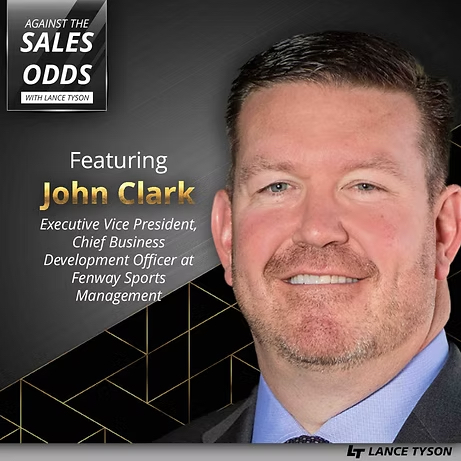
Why All Client Relationships Are Built On Trust With John Clark

In sales, trust is and always will be the name of the game. When you make deals, there has to be a certain level of trust there. You can’t build relationships without trust. Join your host, Lance Tyson, as he sits down with John Clark, the Executive Vice President & Chief Business Development Officer of Fenway Sports Management. John reviews the universal values encompassed in all sales, the importance of trust, and necessary traits of success that will help sales reps in any industry. Give this episode a listen. There are true sales gems enclosed.

Listen to the episode here.

Against the Sales Odds and John Clark Reveal the Importance of Trust in all Client Relationships

I have a good friend of mine, John Clark. I call him Clarkie during the interview because that’s what I call him. He is the Executive Vice President and Chief Business Development Officer for Fenway Sports Management. John, when you introduce yourself, explain to everybody what properties are under Fenway Sports Management. They would like to know about it.

Fenway Sports Management is an agency 100% owned under the Fenway Sports Group umbrella, which originally purchased the Boston Red Sox, Fenway Park and 80% of NESN back in 2000. Over the years have acquired a Liverpool Football Club in the EPL, 50% of Roush Fenway Racing and Minor League Baseball clubs.

Our job is to sit in the middle of all the things that John Henry, Tom Werner and Mike Gordon have invested in over the years and find ways to drive revenue. We’ve been fortunate over the years to build out a couple of other lines of business. Primarily, we’ve been sponsorship-focused but we’ve got a consulting business that we’re on the growth move with. We’ve got an experiences and events business that we’ve been working to grow as well, announcing a college football bowl game, hopefully, at the end of 2021 at Fenway Park.

It’s an interesting line of business to be in. We’ve run something, the Red Bull Crashed Ice at Fenway Park in 2020. We did several different college football games over the years. We’re tasked with trying to fill Fenway when it’s not a baseball game or concert. One of the biggest ones was we did the big air competition. We built a 140-foot ramp in Fenway Park, had skiers and snowboarders, Olympic-style skiing and snowboarding. That was an incredible event.

When was that?

That was years ago. We’re fortunate to be the entrepreneurial arm with the Fenway Sports Group. They push us out there and we’re able to go look at other things. It gives you a lot of different challenges and fun.

You’re all over the place. My sons always get excited when you as do Frozen Fenway with the hubs, teams and stuff like that.

The Inaugural Winter Classic was at Fenway. That’s years ago that that was out there. That did inspire us once we had winter classic. We own a rink. We try to keep it every other year where we put a sheet of ice down. We’re fortunate where we are in Boston. We have some of the best colleges in the country. We’ll do Frozen Fenway and it’s always a big hit.

I’ve been doing a lot of these with my other guests. My premise is if you’re in sales leadership, you probably were in sales. When you move up in an organization, it’s either through high finance or you bring meat to the table at some level. Tell everybody your journey. What was that first sales job?

I sold my lawn mowing services in the neighborhood. I was asking the neighbors for some pity on me. The first time I’ve ever heard the term upsell was when I was working in Burger King in high school. When supersize or value meals came in, every time we got an incentive. It was another $0.50 an hour or whatever it was if we upsold someone to a supersize. Career-wise, I started in Minor League Baseball. I started as an operation guy in Kinston at the time and the same way club for the Cleveland Indians. I defaulted into selling because it was close to where I went to school, East Carolina University.

A lot of friends liked to come down and we had Thirsty Thursdays. I get them a quarter off their tickets. They enjoyed it because they’d see me running around lugging kegs, back and forth in the stadium. I sold a decent number of tickets and did do a couple of program ads. In my mind, I wasn’t selling. I thought there was some value to what I was delivering. At the end of the year, I got a commission check after getting paid nothing for the year. It piqued my interest that the selling thing isn’t bad.”

Was that right after college?

If you bring your family out to a ballgame and only two of you don’t like baseball, it will still be a good family investment.

That was my junior year of college and in my senior year, I went back. I worked with Johnson or any operation down there. He’s still a good friend. Dave Eccles was my direct boss. He runs the Charleston RiverDogs in South Carolina. I was an operations guy. I painted and stow the floor bleachers. I painted rows of seats. I lugged kegs around but then somewhere in there, there was some element of selling that I didn’t even realize. My first full-time job after that was Norwich, Connecticut and I was selling group tickets.

What team was that in Norwich?

It was the Double-A club for the Yankees. I walked into a stack of papers because we didn’t have CRM databases at the time. I was told to call a lot of people and sell in groups. That was the first tangible sales gig. I was there for three years.

Your next move was where?

Another gentleman and I built a ballpark in Lakewood, New Jersey, the Single-A club for the Phillies. I was there for six. At that time, I was the assistant GM in the title, which I was the Head of Operations and Sales. It was clear that doing both of those is challenging. A lot of people still do it in Minor League Baseball. I spent eleven years in Minor League Baseball. I have a ton of respect for anyone that has and still stayed close with a lot of people that I worked with.

Some real talented people frankly worked an incredible amount as they go through it. Those are lessons that I learned everything from the operational side through the sales side. It’s funny. I didn’t come out like, “I’m going to be a salesperson.” I always thought that I would have been selling used cars or insurance stuff.

I do believe that if you bring your family of 4 out to a ballgame in a night and 2 of you don’t like baseball, it’ll still be a good family and investment. I didn’t have a problem saying, “Bring your Cub Scout Pack out. Bring your church out.” The competitive side would get into me and I’d be like, “They did 50 last year. You should do 75 because you had a great time.” That’s when it started. That was the time in Norwich when I was selling group tickets.

I didn’t know that you spent much time in minor league sports. Kerry Bubolz who’s the President of the Vegas Golden Knights and Formerly President of the Cavs always told me that what prepared him a lot for management was the number of jobs he had. If you’re reading and you’re not sports or in entertainment, in a minor league team, you wear a lot of hats. You could be pouring beers one night, cleaning off the field the other night, selling tickets and managing something. Part-time people are all over the place.

Building Trust: When you’re in a sales call, stay in the moment. Make that person on the other end of the phone feel like they’re the only person that matters.

Management leadership was dated back to Kinston, North Carolina. I was 19 or 20. I was an intern. One of my jobs was to manage the main concession stand, which sounds as glamorous as it was. In that concession stand, I would have the teenage kid who was made to get a job and I’d have an adult sometimes retiree having fun or needing the job. I had to figure out how to get both of them to care equally, as odd as it sounds, to make sure that the hotdog going out the window tasted good and warm.

I had realized very quickly, incentivizing, you couldn’t throw money around. You made an hourly wage. The main thing that I still live is I had to prove to them, I’d be willing to do what I was asked to do. That’s fundamental for me as I go through things. I would never have called them strategies or tactics back then but I was realizing early on that exposure helped. In Minor League Baseball and minor league in general, you do get a lot of responsibility that you’re probably not ready for and get thrown into it. It helped me tremendously. Those eleven years were huge for me and my career.

You made that leap from a minor league team to a bigger brand. What was that jump?

It was a very pivotal moment. I have a good friend of mine and someone you know, Tom Glick, who’s the President of the Carolina Panthers. He and I met in ’96 or ’97 at a marketing conference and stayed in touch. He was the guru in Minor League Baseball. He’s running the Lansing Lugnuts. He had come up with all the neat promotions. He was well-polished. Fortunately, for me, he gave me time every time I asked for it. He took a job with the NBA, a TMBO under Scott O’Neil. I didn’t know what TMBO was or anything. He was at the Winter Meetings back in 2005.

I thought he was hanging out with old buddies of Minor League Baseball. He was recruiting people. He and I had a conversation. He said, “What are your goals?” My goal at the time that I stated was, “I want to run a Minor League Baseball Team. I’m going to be the GM,” which was the title. He said, “Have you ever thought of anything more than that?” I said, “The Phillies own half of the BlueClaws. I’ve been sitting in more of the Phillies meetings. I’ve been curious about the business of Major League Baseball.

I’m a baseball fan. It wasn’t just I want to work for a big-league club. I was curious about the business side. He said, “I can share some insight on you. Let me tell you about what I do. Before you go, chase that dream job. Let me open your eyes to a couple of things.” Within two weeks, he had me on a plane to Detroit for the Pistons and Houston with the Rockets. I can only imagine what I was like in these interviews with all of that leadership management that you pride yourself on. You build a team. You’re managing 50 people and a minor league stadium. We need you to sell sponsorship deals.

To me, a lot of what I love is when I get the team in the right direction and we all succeed. That was, “No, I need you to go do deals.” Rightly or wrongly, I still respect the statement that you still have to “do the big lead deals.” That’s what I still say to people in Minor League Baseball. By the way, it was a hell of a lot harder to sell some of the minor league deals that I ever did than it has been for some of the bigger deals that I’ve been a part of.

In sales, when you can sense that someone’s having a bad day, don’t dive in. Read the situation.

Sometimes smaller businesses are way more conservative in spending and not budgets for these bigger deals.

They don’t have people that focus on the value of a sports marketing opportunity. Those working on web design and social media presence are not thinking about a minor league team. That conversation is probably about a month and a half stint that I went and did that. I leaped but had never been to Houston before. I became the Director of Corporate Development, one of five new sales hires down there. After they had some transition, Tad Brown became the President.

Of what team in Houston?

The Rockets, the NBA team. I spent two years there and then had the opportunity to go to Miami with the Dolphins and be a Vice President to help run that organization. It was right in the Steven Ross acquisition time and Wayne Huizenga. There was another leadership change. It was poised to stay there. When Scott O’Neil, who I’d met through the NBA got to MSG, I was fortunate to be one of those folks. There are probably ten to a dozen of us that went in the MSG.

If you’re not in the industry, Scott Neil is the CEO of Harris Blitzer, Philadelphia 76ers and so does the New Jersey Devils. It’s a very big sports entertainment property.

Scott had left the NBA to be the President of Madison Square Garden Sports.

That happened to be right in the middle of the whole financial meltdown.

It was tough but we like this weather through it. I was fortunate to work there for four years. A couple of those, he was there then he had moved on. Sam Kennedy is our President of the Boston Red Sox and at the time Fenway Sports Management. We have known each other for years through the industry. The great thing about sports is it’s a very small network.

Most people who think about big brands don’t realize that the entities themselves are run like midsized businesses because the brand and athletes are big. The organizations are anywhere from 2 to 300 people. They’re not huge companies.

It’s years that we moved up here to Boston and I’ve been with Fenway Sports Management.

Let’s hit reverse on one thing. As a salesperson, John Clark, what were you like? Any competitive situation? Where were you on the board? Were you the number one guy or in the middle?

I feel lucky to have risen the way I spent through Minor League Baseball because I see and talk regularly with our sales academy with David Baggs who runs it. Some folks over at MSG and Adam Campbell are fantastic to run their groups. I walked into their rooms and they’d say, “Will you come to talk to them?” I walk in and I see 20 and 30 people. I’m like, “I’m glad I didn’t start that way.”

I started where there were four people selling group tickets. Three of them had been there in Norwich since they started. The Norwich was three years old when I got there. My boss, the GM had gotten there. Brian Mahoney, who works with the Phillies, was a great friend too. He said, “Call people and you’re going to have success.” Thankfully, that’s all I could probably handle. Much like an athlete, I was good at the fundamentals. I was tenacious in my outreach. I like to think that I was respectful in my relentlessness. I spent time thinking about who I was calling and what I was calling about.

The thing I always said to myself was, “Stay in the moment.” That means two things, “Make that person on the other end of the phone feel like they’re the only person that matters.” More importantly, one of the key indicators for me with salespeople or myself and otherwise is they don’t know if I got off the phone and made the biggest deal of my life or if I got off the phone and got crushed.

Building Trust: Even if you’re speaking with someone who isn’t a client, still build a relationship. All your relationships should be based on trust.

It’s something that’s going on personally. They don’t care because it’s all about them. That’s why I love your ‘Selling Is an Away Game.’ It’s true on many things. You wrote it differently but it’s about them, whatever their situation is, which is why you’ve got to be able to read them. If you get on the phone, you know someone’s having a bad day and sense that it’s not the day to dive in then don’t dive it. I learned that. I was good at fundamentals. I was by no means the best presenter. All due respect to East Carolina where I went, I certainly wasn’t the stats genius that’s for sure. Coming out of it. They’ve been nice enough to let me come back a couple of times. That’s been nice.

This is something that always impressed me about Clarkie. He’s the graduation or commencement speaker they’ve asked.

I did the fall. It’s been a couple of years ago. It was neat. The interaction with the students and parents was an achievement. I was good at fundamentals but frankly, I worked my ass off. I would bury myself in it and will myself in some cases to get where I needed to go.

“Trust is the most important value internally and externally.”

You got to think about what John’s been talking about, especially in the world he lives in. If you’re in sports or not in sports, you’re talking a lot of big deals that are multifaceted where you can be talking naming rights or something, complicated media deals with agencies, other people involved, other buyers across the seas. Take these fundamentals in what you learned in being salespeople. What do you try to instill in your salespeople?

A couple of the traits I had and looked for. Curiosity is one of them. I was a PR major and a business minor. Frankly, that is when I wasn’t working too hard. I was too lazy to go be a business major. My curiosity about business and how businesses operate is what I love about my job. Getting to meet all these companies and understanding how and why they operate. That curiosity will help you craft what you possibly could do with them because you’re trying to understand what those goals and initiatives are. That curiosity is something that has always been there with me. That’s something.

That shows you’re interested in other people too. People buy from people they like. That’s a natural fit there.

Everyone’s story is unique that I enjoy learning that. Also, the more about their story, the more you’ll understand as you go through the possibility of working together, whether that’s negotiation, style or how they operate. That resiliency we talked about keeps bouncing back. Have a closer mentality. Have a poker face where they don’t know if it’s good, bad or indifferent. Also, diligence. Along with that curiosity, asking the right questions and then most importantly, listening for those answers.

I was very diligent. I still am a notetaker. I write it down. If I don’t write it down, it typically doesn’t stick, even then it’s still a little bit debatable. Even in these times, if I fire up the laptop at a meeting, I must say, “I am writing down the notes that you’re giving me. I am not emailing somebody.” The best compliment any salesperson for me can get is, “You heard exactly what I said when you came back with this information.” It still might lead to no deal. Ninety-five of these conversations are going to end up nowhere.

It’s the biggest compliment you can get. If a buyer says to you whether you sell them or not, “You listened to me,” that’s all the credibility you need especially in very complex sales.

That’s where diligence and resiliency come in. Any deal can take a lot of time. Some of them will take 12, 14, 16 months. That takes a commitment that you’ve got. Several people started in sponsorship. I wouldn’t have been able to start in sponsorship because the carrot wasn’t close enough. Tickets, especially Minor League Baseball, “Can I get a credit card?” I do then it’s close. That’s rewarding. That got me through the hundreds of calls where nobody answered, called me an idiot for calling them at dinner time, whatever they did or didn’t do. I needed that reward to keep me going.

That’s one of the things we’re fortunate with our team here. We have such a wide swath of properties that we work with that you can have some smaller, shorter bursts that we can do whether it’s a spring training deal down at Blue Park or worked with the PGA tour and the Northern Trust, which is a golf outing here in Boston, hopefully in August 2021, where you can buy a hospitality option for not an incredible amount of money. It allows us as our team to have some younger, newer salespeople to be involved. At the same time, we’re trying to sell the sleeve of the Liverpool kit.

Developments for many sales leaderships point is important. You said, “I’m good at fundamentals. I want to be in the moment with people.” You’re like a yoga instructor. Be in the moment and meditate. It’s like I listened to that Calm app where Tamara Levitt is always like, “Be in the moment. Pay attention to your breathing.” We need to be with people, whether we’re coaching or selling to them. If you had to pick 1 or 2 values that you instill in your team, give me the cliche. What do you say?

Trust is the first one, internally and externally. This is why I go back to Minor League Baseball. I don’t like ranking the teams I’ve worked with but some of the best I’ve worked with were in Minor League Baseball. With smaller organizations, it’s so easier to get 40 people on the same page than 400, 500 when you get to bigger companies but if one person fell in that 40, the whole place fell. That’s brutal as we fell doing the tarp. The tarp didn’t get on the field and the game didn’t get played. Two merchandise got delivered, we’ve all got to go do it.

That trust internally, I’ve always tried to instill that in the sales teams. I’ve wanted it when I’m on the sales team. I hope as a leader, I preach and live that. That trust goes external. When you do this well, you’re building that trust with your external initially prospect then a client. Even if you’re not a client, you build a relationship and that’s all based on trust.

The bottom line is a lot of people are in a relationship but an outcome is based on how much rapport, credibility and standing because they’re all things you do. You’ve got to establish trust but that comes in how you present and communicate like it’s a brand-new world like when you look at your team. We’re right in the middle of COVID-19. Every day, you watch the news and order your masks. Nobody knows what’s going on. What do you think selling is going to look like?

Building Trust: Everyone gets caught up on their own BS. Your goal should be to be as direct, honest, and transparent with the team as you possibly can be.

When this all went down, John was one of the first execs I talked to. I said, “What do you think?” The first time you hop in a plane or go down across town and meet with somebody, it’s going to mean something. What’s selling in your opinion? You’re looking around the corner. You’re selling the big brand and multi-culturally over in England, Europe and the States. What does this look like moving forward?

That was my initial statement back in the beginning and I’ll stick by that because in person, without a doubt, will always win the day. However, in a certain situation, especially here in Boston, we’re in the surge. I said this on a call with our leadership team saying, “We might get more credibility if we say we’re not going to come to see you.” The face-to-face will always be there. The good news is we’ve been working with you and your team on these types of presentations for years. It’s getting more comfortable. I shared with you a call we had and while face-to-face, I’m a hugger and all that stuff still, that part of the right time will be king to everything. That’s how you’ll know.

The reality of it is I’m getting to know more about people’s families that I don’t know. I have kids running around here all the time. Initially, the first two weeks, I was like, “Timeout. Clear the screen. Turn it off.” We were on a call with a woman that put a necklace on her six-year-old because she wanted a necklace on. She asked one of the smarter questions of the meeting during that time. That might be the difference between women and men. They can handle that. It’s like, “I got to shut it down.”

You will see a lot of progression of deals like this in a place that we’ve not seen before. We closed a deal virtually over the phone. I still think about these bigger broader things that we know are going to take a lot of time. Back to trust. You’re building that trust. When there are bigger deals, there needs to be more trust.

You’ve done a nice job of integrating your sales philosophy and what you’ve installed on people. If you had a label on your sales leadership and sales management style talking about trust and communication, what is it in a nutshell? At the same time, what frustrates you that have to coach salespeople on? What is your leadership style? Your value systems dictate things you observed that frustrated or rub you. Double answer those questions.

My goal is to be as direct and honest with the team as I possibly can be. That’s on all fronts.

Would you say transparency is the word?

Absolutely. What frustrates me is when I feel that that’s not coming back my way. I believe all of our teams have high integrity but we all get caught up in our BS. We all will say, “I heard this,” but when I get involved it’s, “Did you hear that?” You do this with our team so well. It’s diving in and getting past. Don’t just hear what you want to hear. Go to that next level of depth. That’s going back to if you build the right level of trust with a prospect, you can get the real answer. I rarely say, “Let me get on the phone with you.” If I’m doing my job, they’re asking me to get on a phone with them.

Bigger deals equal bigger trust.

They’re saying, “Can you dive in?” Even better, strategically, it’s the right time to bring you in. We’ve got levels and layers of salespeople. I want that working up and down that chain. I’ll get on a call with anybody on the team as well as our VPs and RSVPs but I want it to be never a forced thing. The one thing that frustrates me is when I hear them tell me something that they wanted to hear. When we talk about filling the funnel, they’re telling me all that because they don’t have anything for the next conversation with me. They’re holding out hope that this is the thing that’s going to work.

I never realized this about you. It doesn’t sound like you play much of a political game with your people. If they’re holding back, playing political or not being able to manage up to you, that’s frustrating. I would concur 100%. I can’t stand the rumor mill. I’d rather tell you what’s going on. Let’s deal with it. We went through a tough time as we went into this. It lay a few people off and it sucks. It’s horrible. I had to choose between ship and crew. It’s a horrible situation but I was transparent with my team about what I was going to do with them. We’re a lean organization. They didn’t want to hear it. That was tough transparency but I got more comments about, “I appreciate that.” If it doesn’t reciprocate, it’s very frustrating. It’s very much your style.

Especially in these times, most of us in sales have a certain personality about it. We want certainty. The crazy part about that in sales is there’s much uncertainty. I started in operations. I love the process. For me, it’s two things, people and process. In the process, you put people in it then it gets all screwed up. We get the sales process in and the people part when we’re going to externally, that throws all the uncertainty.

If you’re in sales, you’ll love it. That’s what feeds you and what you were chasing. You’re trying to control some of that. In these times, unfortunately, there’s no certainty for any of us in much broader speaking than what we’re talking about. All I’ve said to the team that I deal with is, “Whenever I can give you any certainty I want to but know there’s a lot of uncertainty around all of us and that includes ownership.”

You’re going to be certain about the uncertainty. I’ve had to get on more executives that are trying to paint this picture of everything’s going to be fine and great. I was like, “You lying to people. You got to tell them it’s going to be different because it is going to be different. There are so many unknowns but to say this is going to go back to what it was, it’s not. There’s going to be a new nature of things. Anytime we’d gone through a transition. You better off tell them you can’t predict it.”

That’s the best way. With tough, it builds trust. When we’re talking to clients that we have and they’re like, “What are we doing about the baseball season?” We don’t know is the answer. While it’s not what you want to hear, we don’t know and we’re working through it. Hang in there with us. Troup Parkinson who runs sponsored for the Red Sox has been there for years as stronger and deeper relationships with clients than I’ve ever seen. I’ve been sadly on these calls with him and the client. The reaction from them is, “Troup, we trust you. We got it. We’ll talk next week.”

Speed round. Think of your sons. You’re sitting on the edge of the dock at one on one side of you, one on the other. They go, “Dad, what’s success mean?” What do you say?

It all starts with your attitude. The same we have in our house is attitude is everything. To get the outcome of success, your attitude has to be right. The simplest way is, “If the two of you have a discussion or disagreement and walk away happy, that’s a success.” It’s like with their classmates. If you want to play this and do that, if you both can come to an agreement that you’re both happy, that’s a success. When you boil it up to us and we can get a deal together, great. If we walk away, don’t have a deal but we respect, trust each other and learned, that a success.

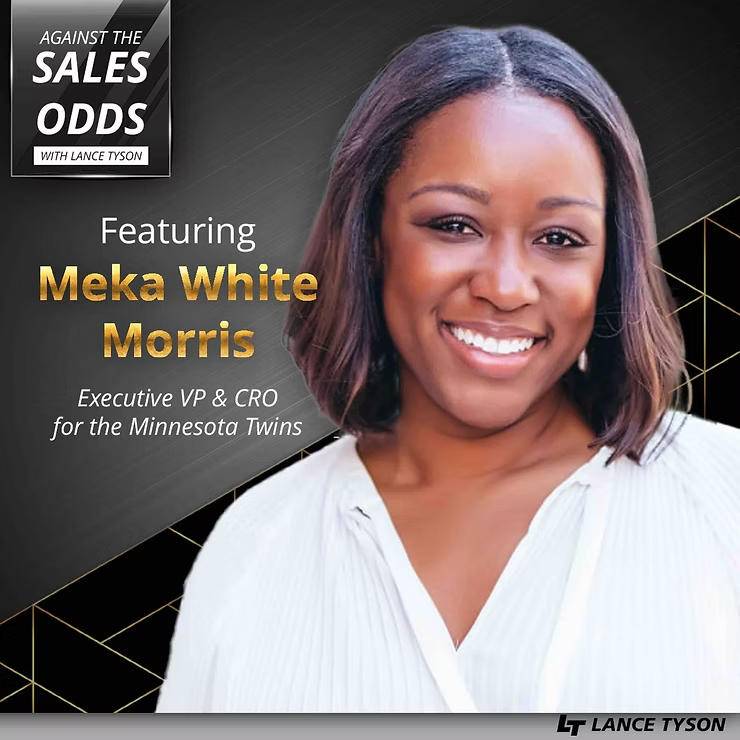
Breaking the Glass Ceiling in Sports with Meka White Morris

When you’re a woman in sports, there’s a proverbial ceiling that no one tells you about. But today’s guest broke through the barriers to become an executive in the field. Meka White Morris is currently the Executive VP and Chief Revenue Officer at the Minnesota Twins. She sat down with Lance Tyson to share how she built her career by not accepting a ‘No’ until it was from someone who could say ‘Yes’. Tune in as she gives valuable real-world advice as a woman executive in sports.

Listen to the podcast here: Link to Podcast

Against the Sales Odds and Meka White Morris Reviews What it Takes as a Woman Executive to Break the Glass Ceiling

I have a dear friend. Somebody I’ve known for a very long time, Meka White Morris. We have worked together at several spots from the Cleveland Cavaliers, at Legends. Meka, why don’t you introduce yourself?

Everybody, excited to be here. Meka White, which is what most of you know me as. I got married and added a Morris on the back end. I’m pumped. I’ve done a lot in sports outside of sports and am certainly excited to share my perspective and everything that I’ve done and all the things that I’ve seen. Lance is a good friend and has been for a long time, so I’m eager to be here.

I botched up. I’m still telling everybody I’m learning this whole interview thing. Tell everybody who you’re with. You’re the chief revenue officer.

I’m the Chief Revenue Officer of Tappit. Tappit is a cashless contactless payment solution. A company that started it in the UK, any RFID and touchless payment services in the festival business and has made a massive splash in the US. Not only because I think contactless and mobile pay wallets are a thing of the future but in the breath of COVID and everything going on, people wanting to use their phones to do everything is becoming at the forefront of how we’re all going to be doing life. Not only now but certainly for the future.

I want everybody to understand this. I think you have one of the most interesting journeys because I remember when you first started in sales and I go, “She loves to debate.” That’s the first thing I remembered about you. I’d be in a room and you would debate me and go, “I don’t know if this is right or not but I don’t think the sounds good.” You had to debate it through to problem-solving. A lot of times, you were right, which I loved about you. Tell everybody about your journey because I think your journey is fantastic.

I grew up in a sports family. Sports have been in my blood. I played sports growing up, went to college on a track and field scholarship to the University of Kansas. A proud J-Hawk, for anybody who cares to know. I started a job that was terrible at a company that sold office equipment. I couldn’t believe that this is what life is about when you spend all this time going through all this school and you work at it. It’s not possible. It was an interesting start and I did it for three months. I think I looked at my dad and I said, “I can’t do this. I want to be in sports but obviously, I’m not playing anymore.”

I don’t think at the time, you knew about jobs and sports. I knew about athletes, coaching. I didn’t know about the front office staff at all. He had played golf in Miami with a guy named Todd Fleming. Todd and I spoke on the phone. Todd goes, “Yes, we have an inside sales program.” I don’t know what that means but heck, it’s Miami. It’s the heat. I’m rocking with it. At the time, he’s like, “We’d love to have you. I’m going to FedEx you an offer letter,” because it wasn’t colloquial to do email and all this stuff.

In the middle of that, they signed Shaq and he called me up. He goes, “I’m sorry but we’re sold out. I have been freezing on all hiring. I can’t hire you but I got two boys that I started an inside sales with that I’m going to call and see if they might take you on.” One gentleman, his name was Mike Tolman. He was at the Phoenix Suns and the other gentleman was Mike Ondrejko at the Cleveland Cavaliers. I talked to both and had great conversations. I said, “If all of them came from the Cavs and Cavs is fitting out talent all over the place, it sounds like I need to go to the Cavs to learn this business of sports.” That’s what I did. I spent a few years there inside sales. I was the first woman they ever promoted out of inside sales into a premium role.

At that time, you did your client development and you manage the existing book of business that I took over from a guy named Brian Basloe, who’s been in the industry a long time and quickly realized that my background and who I am landed to relationship selling, more importantly, providing customized solutions that could drive a business. Versus, “There’s a ticket package, and let me figure out how I can make this package work for you,” but the building of a sponsorship support mechanism. End up working under Kerry Bubolz for a number of years and a guy named Randy Domain. They went out to the Raiders, did the same thing for them, managed the team.

If you can do the job and do it your way with integrity and succeed, results are the name of the game.

When you were at the Raiders, that was your first management experience?

It was my first real management experience. I spent some time there that ended up going back to the East Coast to Charlotte. It was the Bobcat’s then. Now Hornet’s under a guy named Michael Wandell and Pete Guelli and managed the team. There was the director of sponsorship there and the league was locked out. It was apposed to be the worst lockout in NBA history at the time. I ended up getting a call from Live Nation. They said, “We need somebody to run our Southeast business based out of Charlotte.”

At the time, they didn’t know what the situation was going to be with the NBA. I ended up moving on to Live Nation for about five years. I got a call from Mike Ondrejko that said, “We’re opening up the Observatory at the top of the World Trade Center. We need somebody with a varying background who can get in there and build it culturally as we do in an inside sales infrastructure.” I went up there to build, open and develop the attractions business for Legends.

That’s when you got your NBA when you’re up there in New York?

No, I don’t have an MBA. I’ve talked about getting an MBA twice. I got accepted at NYU and when you boil it down for me, it was this six and one half a dozen in the other. Like, “Do I go? By investing this $120,000 in my education, am I going to see the fruits of that labor? What’s that going to look like?” You rack and stack it and there are so many reasons to go and not to. I ended up making the difficult choice to stay on the course I was on.

Which is a fantastic course, I want everybody to think about this. Against all sales odds, the whole philosophy here is, most of the time, you get somebody that moves up in sales or revenue. They’ve come either from sales or from high finance. You think about your rapid movement and a lot of different diverse properties you’re with. You’re at one world observatory sitting overlooking the 9/11 Memorial in a relatively something you’d never had done before. Other than the sponsorship side of it.

I was their VP of Sales and Marketing, so I had the entire marketing function, which was how we talk about ourselves globally to get a tourist into this space. The sales function that we had was an events business. We had group sales as we would all as sportspeople think about group sales but the main difference and the attraction space, one of the things that we all learned together, it is selling five million new people every single year.

Give people perspectives. I remember going on a tour and as you’re setting up the business. We have had multiple conversations. Tell everybody how many people a day. I don’t know if that’s still true, go to One World Observatory.

On a good day, you’re talking about maybe 12,000 to 15,000 people. On a bad day, you’re still talking about 5,000, 6,000, 7,000 people a day, every single day. It’s not like there’s a game this week and tomorrow we’re off. It’s every single day, seven days a week, 365 days a year. Maybe we shorten some hours on Christmas but other than that.

You’re open all the time. It’s every single day, 7,000 new people, every single day. When you are in sports, you’re building a base. You’ve got your season ticket holders and let’s say, you’re a good team and that’s 60%, 70%, 80% of your entire. You’re only looking to fill the bucket on anywhere from 50% to 20% or maybe you’re sold out.

If I go to the Empire State Building, I’m not going back next year or next week. I’ve done my thing. I’ve taken my grandparents or my kids. It’s over for me. When you’re in an attraction, you have to find brand new people. What we did is we built a group sales team that’s bringing affinity group similar to you doing sports where you have a group that is a sports group or a church group.

Woman Sports Executive: What we give teams is the ability to understand exactly who’s buying what and they’re building in real time, because now they own that data set.

They want to do something together from a team-building perspective and come in and buy a group of tickets and maybe dine or what have you. Every other person, which is maybe 10%, 15%, then you’re doing massive deals with international tour operators that want to buy 300,000 tickets but they want those tickets at a discount.

They package them up to people coming in from China or London. You buy a package for $1,200. It includes your flight, your hotel, tickets to us, tickets to the Statue of Liberty, etc. All in one package. That’s one layer. The rest is people who are buying a single ticket for a single day for a single experience that you have to market to those people on a continuous basis in order to fill up your volume on a day-by-day perspective.

From there, you’re with Tappit now. You left there. What is interesting about your career, you did not take a traditional route at all. You went right in the most complex selling at the beginning, which is partnership sales, mega-deals, multi-dimensional or multi-elemental, selling to buying committees C-suite. You do it in the NBA, you do it in an NFL, then you make your way and you’re doing something in Live Nation and now, you’re with another firm. Explain that whole journey.

For me, what I didn’t want to do as I matured as an executive is be known as a sport to the executive. I truly wanted to be an entertainment executive. I think a lot of people try to stretch that title and they say, “My building does concerns in other things,” but truly selling entertainment as a standalone entity is very different than having a building that houses different events. When you go get under the hood at Live Nation, you understand fundamentally how that business works. The same thing with an attractions business. I went from there from Legends. I went to Learfield for a time. Trying to understand how does this works when you’re talking about college? What are the differences? What are the nuances?

You need to know when your opinion is warranted. You need to be able to draw people into the discussion. It’s much more art than science.

When I took a step back and looked at the breadth of my experience, I’m like, “I have relationships in the NFL and NBA.” If you look at those three, let’s start there. I’ve been across the country. I’ve been in Cleveland, San Francisco, Bay Area and Charlotte. I know people through all those verticals from a geographic perspective.

You pull in Live Nation, so I’ve got the music. You pull in attractions through Legends and you pull in college. I started to see myself as this holistic entertainment executive with relationships across all sports, all leagues and all entertainment verticals. How could I parlay that for a business that’s external of sports and use those relationships as a pivot point within sports? When Tappit rolled up, it was like, “We all know that everybody went to ticketless travel and now mobile ticketing.” It’s hard-pressed that you go to a game or an event now where you have a physical ticket. There’s a handful that you do for the large majority, it’s on your phone.

Now, you’re looking at how Apple Pay and Google Pay and all of these payments services. How do you roll that into the sports environment? I think the data piece is significant now. If you pay for something in an arena, the team knows that X dollars were sold at this outfit but they don’t know that Lance Tyson bought a beer and Meka Morris bought a hotdog. They only know that beers and hot dogs were sold. What we give teams is the ability to understand exactly who’s buying what and they’re building in real-time because now they own that data set. It becomes a white-labeled wallet.

Think Google Pay but that wallet lives within the app. You think the Cowboys have a Stadium app and in that app, you may have your tickets from SeatGeek. You may have a map of the stadium. You may have your parking but imagine you put in a wallet that now I can put any credit card I want to in and pay. Now you have the full tech stack of all of that information. Now I know where Lance park, where he sat, when he got there and he used an American Express. I know that he bought two sweatshirts, two beers and two hot dogs. I know when and where he bought them, and when he left.

I can send real-time push notifications to you that say, “Lance, I know you’re drinking Bud heavies. Why don’t you come 2 for 1? It’s the third quarter. We’re cutting sales off in the fourth. By the way, we have another event happening on Saturday. We can give you a package with Bud, hot dogs and tickets because we know those are things you like,” in real-time while you’re in the building. It’s a revolutionary way to look at the business that I happen to know how to insert that in the NFL and the NBA in college, music and attractions, which isn’t a purview a lot of executives have now.

With entrepreneurs, I deal with a lot of tech entrepreneurs and in being on a couple of boards, the entrepreneurs always the person knows their business better than anybody. They always try to look for somebody that’s similar to them but can never find it. What I always admired about, no smoke intendant. You know when I am. When you were with Legends and One World, you wanted to understand that business because nobody else understood it.

I remember you arguing with senior management like, “Tractions is different than Arena.” I can remember those arguments, how frustrated you would get because nobody knew it and you’re in uncharted territory. I like how you’re talking because as you build that sales team out and grow, you understand it better than anybody else because you’re doing it. As a salesperson, what did you be bad at and what were you good at?

Woman Sports Executive: There’s this proverbial ceiling that no one will tell you about where you’re trying to navigate as a woman in sports—a black woman in sports.

I am by my very nature, a rule breaker. I’m a rule follower in some ways but I’m always going to push the status quo and bring my own flavor to a situation. I happen to have an ability to maximize opportunities and drill it down fast to get to the nuts and bolts in the crux of whether someone’s going to buy or not. For that reason, when you pull that back out, some people are tactical salespeople and some are relationship finesse salespeople that I much more relationship finesse.

When I am managed by somebody who’s tactical, we oftentimes don’t see eye to eye because they want me to make 100 phone calls a day and do these things. I’m like, “I can make 25 phone calls and have the same success as somebody who makes 100 because I’m going to make 25 of the right phone calls at the right level, with the right people and with the right things to say.”

What happened to me a lot early on is I was having the same success and at the top of the board, but doing the business in a very different way than the rest of my colleagues. The leadership I had at the time was much more like them and very much less like me. While we’re in conflict, it’s hard to argue that conflict when the success is there.

For me, as a sales leader, I am laser-focused on results. I’m going to give you all the tools I can to give you all the information on how to do this job the best way I know-how but if you can do this job and do it your way with integrity and succeed, results are the name of the game because you and I know people who’ve done everything right and still bad at it. Like, “What are we talking about?”

I never realized that about you. I’m blown away. I never even thought about it that way. I remember you were like, “Don’t tell me I can’t do it in twenty calls because I’ll figure it out,” but then I think about all the consulting and training my firm’s done with. You’re always like, “Lance, do your freaking thing. I want the details. Make them better at X.” I didn’t have to get involved. You like, “This is the big rocks.” That makes total sense to me now.

I was on a call with a guy. He did this culture index on me. He was the owner of this company. He goes, “You’re not an introvert or an extrovert. I’m listening to you right now. You’re an ambivert, which means you have a select social ability.” I have the tendencies of an extrovert but qualities of an introvert or feel you can turn it on and off.

For me, it was hard in the beginning. I think I go back to days where there’s this proverbial ceiling that no one will tell you about where you’re trying to navigate as a woman in sports, a Black woman in sports. You have to find ways to lean into what you want as an executive while not pissing a whole bunch of people off in the process, in particular in the early days.

Now, if I piss people off, I piss people off. I think that I’ve got enough wind in my sails at some level to do a little bit of that. You still need to be a good person and be respected for what you do but you’ve got to know when to speak up and to shut up. You’ve got to know when your opinion is warranted. You’ve got to be able to draw people into the discussion. It’s much more art than science for me.

Sometimes salespeople are desperate to cut through the cutter but you’re trying to cut through it while you’re a part of it.

I think you can win in sales or science. I think the best people are a little bit of both. I straddle that in some ways. I am very scientific when it comes to what I present, how I present it, how I write an email, the things that I say, buzzwords but I’m going to drill it down and be strategic about who I call. I’m going to call the CEO and if I don’t know the CEO, I’m going to know somebody who knows somebody who knows the CEO. I’m going to get the call with that person versus starting with the VP of Marketing, who’s going to have to take it to the CEO anyway. I’d rather you push me down and have you push me up.

There are two concepts I want to talk about there because I think one, no matter how many times my firm or myself goes in, people will talk about, “What’s social selling and what’s the rules and what’s not?” You said something like, “As long as it’s not illegal, immoral and ethical. Everything’s on the table.” You were to literally and I tell your story we’re talking about. You’re one of the first people I have ever known that’s like, “I got a huge deal because of Twitter.” This was like years ago. Talking about that story. You land a huge deal because you do what on Twitter. This is not a rule follower. I’m not going to follow your rule if it’s not listed as a rule but I’m going to be respectful.

I think we live in a day and an age, and at the time, people were starting to put their personal life online, whether it’s Facebook, Twitter, Instagram. Fortunately or unfortunately, you can follow anybody. When I would have a leader, somebody I wanted to do business with who wasn’t either calling me back or answering my email. I was getting stuck in the fray.

I would find another tack. What I’m not going to do is lower my expectations from the level of person to get an easier entry point, which will ultimately make the length of the close that much longer because this person doesn’t have the juice to make a decision but somebody who will talk to you. I would still keep banging for the person at the top.

What I did was I followed this guy who was the CEO of Chiquita Banana. They had moved their corporate headquarters to Charlotte, North Carolina. He said a comment about one of their business strategies and tactics and how it was keeping them up at night. I simply responded to him directly and I said, “I might have something that can help you. If I had a solution that could solve that, would you give me fifteen minutes and have a conversation?”

He was taken aback because, at the time, it was such a personal rant that he said, “If you think that you have something that can help me, I’d be crazy not to listen.” We scheduled a meeting. The 1 meeting became 2, 2 became 12 and before we know it, we have this entire relationship built and a deal in place with Chiquita Banana, which was crazy.

Woman Sports Execuitve: It’s trying to find the right allies in the business who see you for the talent you have, not your gender, your race or whatever that is. Then, it’s getting them to buy into you systematically and be an advocate for you when you’re not in the room.

All things considered but I think people are trying to cut through clutter then you shouldn’t become the clutter. Sometimes salespeople are like, “I’m desperate to cut through the clutter,” but you’re trying to cut through it while you’re a part of it. Like, “How many emails do I get a day?” It’s uncanny how many emails I get a day. It’s not because what you’re sending me is important. It’s because you’re in the mass of all thousands of these emails. How do you get to me in a way that cuts through the clutter? We all got to reinvent that time and time again.

Let’s flip it over because this gets into the leadership side of this. You’ve never been an excuse maker, as long as I’ve known you. You don’t make a lot of excuses for yourself. You have very high expectations and we’ve talked for years like, “Sports has been a fricking boys’ club for a long time.” It’s starting to break and you and I are talking about this.

You think about some women who have broken through, Deanna Wilder, Gretchen. Down in Houston, Michele Kajiwara and Jamie Morningstar. You look at some of the people that have broken it and are running men’s organizations, sports organizations. Talk about how that’s made you tough. Talk about how you played that political game or need it.

It’s been a long journey and my hats are off to every strong woman who stayed in there and ground it out. It can be a total beatdown. Not only because you’re one of a handful and because you have ideas and you want your voice heard or because you look at organizations and while they do have some women employed, but the large majority of the people making the decisions are also, in fact, male and largely White male. You’re trying to figure out how to be heard and not be a squeaky wheel at the same time. First things first is you got to deliver. Everybody that you’ve mentioned has started their career in a sales role and is great at doing it. You got to sell your way into respect.

All of them have been delivered. I think of Michelle at AIG, what a vicious market that can be out there. She’s completely delivered.

You got to sell your way into it. First of all, you got to have the goods. From there, it’s trying to find the right allies in the business who see you for the talent you have. Not your gender, race or whatever that is. That might be a hindrance. It’s getting them to buy into you systematically and be an advocate for you when you’re not in the room.

It’s a very tricky political system because there are people who are intimidated. There are people who are going to hire their boys because they play hoops with them in the morning and girls aren’t invited to the hoops game. There are all sorts of that stuff. Those relationships and pieces that you don’t get because you’re not invited as a woman.

They go out to play rounds of golf. It took years for me to get that invite but my fellow inside sales people were at the golf, kicking it with everybody. It’s a hard road. What’s happening is as organizations are getting more diverse, leaders are having to own that piece but when you never started from that place, it’s hard.

I get constantly get asked, “I wanted some diverse leaders.” It’s like, “If you don’t have a diverse friend group and you don’t employ diverse people from the beginning.” You can’t think that now you’re the president of something and you’re going to find like a farm of Black, Hispanic and Asian people to go out and hire who know the business.

It’s the little things that make the difference. There are inches all around us. If you can gather those together, you can create really massive gains.

You got to look introspectively. If you look around and you don’t have diversity in your personal life and your social circle, it’s going to be hard to prop up those people and those candidates when it’s needed. You get decks with people’s pictures on it, who don’t have any influence in the organization because they look pretty in a room or they look pretty on a presentation and that’s not diversity.

In my opinion, diversity has nothing to do with race. Diversity is a diversity of thought. It means that you grew up in a way, in a place that I didn’t grow up in, whether we’re both White or both Blue or both Purple. I bring a different perspective to this situation than you do. Therefore, us together make something bigger than what would be there if I’m only surrounded by people like me.

There are two things there it’s interesting of what you said. If you took like what you did with the guy from Chiquita Banana, if there is a way that I can do whatever. You’ve mastered the art of influence, which most people don’t. When I looked at that, I had a lot of questions. I had a female executive say to me, “Your company is diverse.” I go, “What do you mean?” She goes, “I was on your website. It’s all females.” I go, “What are you saying? Are you saying that I went specifically out and looked for all females on my executive?” She stopped for a second.

I go, “I know that came off strong but if I went back to my female executives, that I hired all female executives, how would they feel like?” I got to be honest with you, I hired the best people. It wasn’t a choice for me. It was, you think different. There’s loyalty there. With your career, this might be a tough one but you made me think of this. Have you worried more about the system or are you worried more about Meka?

I’m going to use something that you said to me many years ago and you’ve probably said to anybody and everybody who’s reading to this show or any other. You asked me tough questions, leader and you said, “Meka, ship or crew?” I’m a perpetual crew person but what I ended up hiring is a lot of ships because you need both to make an engine go. When you asked me that question, my gut wants to say it’s always been about Meka but the reality is it’s always been about everybody else, the system and how I can be a person who changes and helps elevate the system.

If that helps me in the end, great, but I am not somebody who’s motivated by my personal success. I’m motivated by the fact that I get to rise the tide of others because I truly believe rise and tide lift all boats. You always ask that question. I think it’s poignant because I don’t think an organization is successful if you don’t have both crew people and ship people. I know because I know that I’m a crew. I look for ships if that makes sense.

I appreciate you saying that because that’s my go-to question. As a leader, you got to worry about both the ship and the crew at the end of the day. It’s not one or the other. It’s both or equal. A lot of companies now are worried about the ship to make sure the ship gets to the next level. They’re doing everything they can. I got a couple of more questions for you. One is, as a leader, from where you came as a salesperson, you’ve done such a good job of talking about your values. What’s something you drive in particular and to all your sales teams and organization.

Leading The Way To Sales Success With Al Guido

What is the best path to sales success? What do you need to do to guarantee it? In this episode, Lance Tyson’s  guest is Al Guido, the President of the San Francisco 49ers and Chairman and CEO of Elevate Sports Ventures. Al reviews the ideas and philosophies that have put him on the Forty Under 40 list twice, including his views on the misuse of talent, where successful leaders focus their time building skills, and a leadership philosophy he got from watching Lance coach his team. If you are looking for leadership ideas, you do not want to miss this.

Listen to the podcast here: Link to the podcast

Leading The Way To Sales Success With Al Guido

I’m excited about this interview. I have a good friend of mine, Al Guido. I have known him for many years. We go way back from different projects and some very tense conversations over the years, especially a lot in San Francisco at the Marriott there. We’ve had a ton of conversations in the lobby there. Al, why don’t you introduce yourself?

Al Guido for everybody reading. I’m bad with timelines, but I do remember when I first met you. I serve two functions from a business perspective. I’m the President of the San Francisco 49ers and the CEO of a company Elevate Sports Ventures.

The 49ers is one of the top ten most valued franchises in the world. Tell everybody why you and I have an affinity together. Where did you come from because I just introduced you to my boys?

A kid with the last name of Guido comes from New Jersey. I grew up in South Jersey. I was born and raised a Philadelphia sports fan. The fun part is if you grew up where I live, my mother’s side, the Irish Catholic side, my father’s the Italian side where I get my name from. Anybody Irish Catholic generally roots for Notre Dame. We were going through these old pictures of me and I was on a Zoom call with my college teammates and they pulled up a picture of me and my Joe Montana shirt when I was thirteen years old or whatever. You come full circle to the thing.

I love quarterback and I played the position in high school. I went on and played receiver in college because I wasn’t big enough. There was a 6’5” kid who was hell a lot better than me, but I love the quarterback position. I was an Eagle fan but who didn’t root for, at some point, Joe Montana and what they were doing? T now be out here in the Bay Area and working for this family, it’s been a hell of a ride. I’ve been here since about 2010.

That goes back to my premise of doing this. Every single decision-maker I talked to, we know where you are now and you look back, “How the hell did I get here?” Let’s journey back. What is the first sales job you ever got paid for? Most decision-makers sold something somewhere along the way or a lot of way along the way.

If you can sell hockey in the desert, you can sell anything.

There are two ways to answer that. I got paid for my first job when I was probably 13 or 14 bussing tables in a restaurant that my mom was working at. I always say, “A waiter and waitress is a sales job.” Everybody should frankly do it. The second piece when I got out of college, I took a brief little stint in the financial services world. I was going on to pass all my certifications. One day my pops called me up and had a classified ad for a job fair down at Comcast Spectacor.

At that time, Comcast Spectacor owned the Sixers, Flyers, Philadelphia Wings and Philadelphia Phantoms. I went to this job fair and wound up getting a job. The first ticket I ever sold was a Philadelphia Wings ticket, which was indoor lacrosse. I was hooked. My mom was like, “You’re going to leave this financial advisor job to take this $6 an hour temporary part-time gig to sell tickets out of the basement of the Philadelphia Spectrum?” I was like, “Yeah. That’s exactly what I want to do.”

How long on the financial track?

It was six months. You have to take three certifications. There is this health and accident insurance. There’s a Series 7, which everybody talks about in movies. I was studying for that. I was getting ready to go do that and arguably was talking to the people. I wasn’t going to work on Wall Street, but I was working for AmEx at the time. It became Ameriprise, but AmEx had this financial services sector. I was working for a guy that I had met waiting tables when I was in college.

I’d play football, but then I’d wait tables on the side to make a few bucks and everything else. The guy would come in every Friday with his wife and I would sit there and talk with them. He asked me like, “What are you going to school for?” I said, “Business.” He said, “I think I got an opportunity for you when you’re out of here.” I went and did that and then I left him for a $6 an hour job.

I was talking to somebody else in one of these, Jared Dolan. He did the same thing for a year working for Merrill Lynch making cold calls. That’s interesting. Growing up in that area, financial services between Wall Street and everything going on makes sense. I know somebody that knows somebody. They got a guy.

We all think about our skillsets. There is so much that translates this from sports. I played it. Not at a super high level, but I played it. The position I played, whether it was point guard or quarterback, you think you had these leadership traits. The funny part is you’d be in school and you’d have these group presentations. Everybody would pick certain people to present it. You’d have a group of four then somebody would present.

In this one class, you had to do a lot of this work, I would always be the guy like my team was like, “You’re going to do the presentation.” At the end of it, the professor asked me, “What do you want to do?” My father was a truck driver and my mother was an administrator. I wanted to make money and I didn’t know what I wanted to do. He’s like, “You can sell. There is a reason why you keep getting asked to present.” I said, “Maybe I’ll be good at that.”

Going back to that Wings stuff. How long did you do that? Here are two parts. Forget the view of Al now to then. What did you suck at then? I know what I sucked at then. I was horrible to manage. I hated to work. I didn’t work too hard. I worked hard enough, but when I got a chance, I did it. What was the young Al look like then?

I was easy to manage. I would work my tail off. I took that undersize chip-on-your-shoulder type attitude in the environment. Not from an entitlement, but I had to work harder than everybody else to get there. Some of that’s my upbringing but the thing I wasn’t good at is I sucked at closing. I was such a relationship person. I can sit here on the phone with you all day long and talk. I would never hit my call numbers. My talk time would be through the roof. There were always these metrics. They’d send out the call numbers and talk time.

My talk time would be through the roof and my sales would be good. I was good, but I wasn’t as good as everybody else. I didn’t get through the calls. I would be here BS-ing around like Dr. J in sports. Sooner or later, I was like, “Let me get to this package information I need to talk to you about.” In the first 30 minutes, I’ll be talking about hoops. I wasn’t great at the closing aspect.

Everybody remember, when Al was selling lacrosse, it wasn’t popular like it was right now. That was not the high trend of lacrosse line. That’s more now, not then. That was way before your time on that. How long did you stay with the Wings? Did you go to the Flyers? Did you go to other parts of Comcast?

I was with the Wings working for a guy named Brad Sims. He is now with New York City Football Club. I’ll go through the quick chronological order. I was there for a week and then a guy named Jim Van Stone noticed me. He is now the President of Monumental Sports, but he was the VP of Sales and Service for the Flyers and Sixers. The Flyers had made the playoffs. They always make the playoffs. They were hiring temporary staff to sell what they called playoff strips. If you bought a playoff strip, you’d have to buy rounds one through whatever and then sign up for season tickets the next year.

Sales Success: If you have the right attitude and the right effort, if you’re the right teammate and you’re coachable, you’ll be successful.

They ramped up the staff for the playoffs. They took me from the Wings and said, “Do you want to go do this temporary playoffs sales job? It’s higher level, higher money.” I said, “Done.” My only guarantee was as long as the Flyers were in the plow. I was already rooting given I was a Flyer fan, but now I’m rooting for my job. About two weeks into Van Stone sees me, I’m doing well. Van Stone was like, “You got to come over to the Sixers. Here’s a full-time job. An inside sales. Go do the Sixer thing.” A month after that, I was promoted to corporate sales to go work with the senior-level team. I was selling both properties at that time because it was dual ownership.

I did that for about eighteen months. I went on to Minor League Baseball with the Lakewood BlueClaws. As relationships happen, Jim Van Stone leaves Philadelphia and goes to the Phoenix Coyotes, now the Arizona Coyotes. I leave Minor League Baseball. I go to the Arizona Coyotes, which I always joked, if you can sell hockey in the desert, you can sell just about anything. I go to the Cowboys, Legends and then 49ers. That’s a quick one. I know you’ll have questions in between, but that’s the chronological order.

Your first management job, is it Arizona or Cowboys?

Technically speaking, it was Minor League Baseball. My title at the time was Director of Business Development. I oversaw the sales and marketing function of the Minor League Baseball team, working for a guy named John Clark, who is now at Fenway Sports Group and a guy named Jeff Brown, who is at the NBA and part of their team. Every time I talked to Clarkie and Jeff Brown, they made my stint shorter and shorter. I’m down to a week and a cup of coffee. When I worked in Philadelphia, we always wore suits. Van Stone was like, “You need to shave. You need to wear a suit and tie.”

There’s nothing in the world worse than wasted talent.

I get to Minor League Baseball and I come in with my suit on my first day and the alarm thing goes off. I’m like, “What is this?” It’s the rain-out stuff. Everybody starts running into the field and they’re like, “Guido, where is your stuff? Where is your rain gear?” I’m like, “Rain gear? What do you mean?” They’re like, “We got to go pull a tarp.” I didn’t have it on my first day. I pulled a bunch of tarp in Minor League Baseball at one point. Clarkie and I, every time we talked, we were like, “You only worked here for a week,” even though it was probably six months.

You and I got deep when you started in San Francisco. We started talking about talent and stuff like that. You know how you were a salesperson. You know exactly how you behave. You’re a relationship guy and you weren’t tough to manage. What’s always grounded you about salespeople and how that’s formed your philosophy? You run revenue generation units and you have done it for a long time. What pisses you off or grinds you about salespeople?

Laziness. I could bucket them in a number of different ways. I’ll start with a positive. You only can control what you can control, your attitude, effort, energy and how you are as a teammate. Your skills will maybe define whether you’re successful or not. What we do is not rocket science. Honestly, if you have the right attitude, effort, right teammate and are coachable, you’ll be successful. If your attitude and laziness, whether it’s an entitlement, whatever it might be. That to me, I got no time for it.

Honestly, people can’t see it, but behind me, it’s where I walk out of my house. There’s a sign. It’s our family motto, my wife and me. It says, “Work hard and be nice to people.” It’s two simple, easy things. Work as hard as you possibly can. My father always used to say like, “When you come home and you look in the mirror, give it everything you got.” The truth is that probably doesn’t happen every day. Everybody has bad days. I don’t deal well with laziness and entitlement. It’s not something I react to. I can’t imagine anybody reacts to it well.

From a business context because entitlement is one of those that you can crossover in so many different ways. What does an employee do that defines that they’re behaving with some level of entitlement? What do they expect?

In a sales world, some people get into like, “I didn’t get the same leads that this person got. The category that I was given isn’t as good as what the other people were given.” In my day when we were growing up, you were given sectors. You might’ve done a draft. You’re going after sectors or maybe you were given past buyers, but when you were the grunt or the inside salesperson, you got single-game buyers that are five years old. The senior guys got single-game buyers that bought a month ago. We all know the old data is not as good.

If you were my boss, I’d be like, “Lance, whatever you want to give me, I’ll take it. Whatever you don’t give me, I’m going to fetch for myself. I’m not going to ask you for it. I’m going to work as hard as humanly possible to force you to give me better leads. I’m not going to complain about it upfront before I even earned the opportunity to ask for it.” I’ve heard your people and a lot of them I’ve worked for. They’re mentors. I’d stay the latest. I’d work on Saturdays. Before all this hourly work. When the Sixers were on the road, I was in the office, whether I was scheduled or not.

What else am I going to be doing? I’m going to be watching the Sixers game at home anyway. I might as well be here answering the phones and making calls. I’ve never in my life negotiated a contract salary or anything. People have given me what they thought was fair based off how hard I worked. That didn’t change when I was a sales rep. You could have given me zero and I wouldn’t have complained.

Sales Success: It’s not about the what right now. It’s about the who and the how you go about doing everything.

I would have worked as hard to create whatever then you feed me. That’s some of the stuff that I see now, which is like, “My rankings aren’t as high or I don’t have this.” I’m not up there because of this. I’m a yes, if, not a no, because person. “Yes, Lance, I can do that. If I have this and this.” Not, “No, I can’t do it because of this and this.” That type of attitude is important in life.

If you look at all these cultures where they’re belonging cultures like, “You’re entitled this.” There’s going to be a wake-up call where if you’re not bringing it to the table, somebody else is going to figure it out. Somebody said to me one time that the wolf climbing the hill is always more hungry than the wolf at the top of the hill. That’s going to come down. In sales, it’s going to be especially true. I love that. That laziness factor means something to everybody else.

You and I also share a favorite movie that I’m bringing up because this doesn’t happen very often. It’s called A Bronx Tale. I know I’ve gotten multiple conversations with you that I know it forms your management philosophy. What’s the quote you love about it? Talk about that as how it ties into how you manage and lead.

It’s not just a movie for me. It brings up a lot of personality in my own life and upbringing. There is nothing in the world worse than wasted talent, is the quote that you’re looking for. It’s one of the truest statements out there. I’ve been blessed with certain things and I haven’t been. Financially, my parents are very blue-collar. They made it by. They did what they could. They worked their tails off. I didn’t know anybody in this industry. I’ve worked hard and earned it, but I’ve also been unbelievably grateful and humbled by those who have taken good care of me.

The truth is, I wouldn’t be here without both my work ethic and who saw something in me that I might not have seen at that time. What bothers me more than anything, maybe laziness wasn’t the right answer. When I see a gym or someone with all the parts, I feel like they’re wasting it. This is a conversation that you and I would have around whether it’s reps or management. It’s like, “This person has it all. Even maybe more than what I have. Their ceiling is way higher.” If they waste it by thinking about the wrong things and I’ve been there in my life.

I’ve made my mistakes. I used to think I would take a job for responsibility and money. I did that at times and I was like, “Why did I do that? I should be taking it for whom I’m going to work for. Do they have my best interest? Are they going to give me all the tools I need to do my job?” If I do my job, hopefully, money, title and all other things will come with it if I do my job. Wasted talent is something that stays on my wall.

This is interesting because I’m probably the most emotional I ever saw in my life off of this somebody you thought was hugely talented. We don’t name that person, but what pissed you off about that person was the fact that you knew how good they were. They knew how good they were and they didn’t put it out.

If you yourself aren’t willing to do something, how can you ask other people to do it?

You’ve talked about this with the people you’ve had around Millennials or Gen Z. There’s like, “They don’t want to be coached.” They want to be coached. People want to be coached. Not all of them are easily coachable. Some of them are harder, you may need to invest in them. For some of them, it’s going to take you ten conversations as opposed to two conversations to see what’s important. What I would say is people want transparency in their coaching, but they want to be coached.

They want to know the reason why maybe you’re asking them. Before where I grew up, it’s like, “Do this.” There was no like, “Why am I doing that?” It was, “I’ll do it.” Now they might want to say like, “What’s the purpose behind it? What’s the vision and goal?” That’s fine. I’m happy. If I don’t know that answer, why are they going to go do it? Once you give them that, you can coach them.

I’ve talked about this before and talked a lot about clients. People want to know what it is, how it works, why it’s important. Who says so, besides you but that’s transparency at the end of the day. They want to know that you have their best interest in mind. They want to be coached. I remember my middle son playing soccer one time, I said to one of the parents, I go. “What’s the score?” The guy goes, “We don’t keep score.” They take a break and I get my middle one a shot of Gatorade. He was like five years old.

I go, “What’s the score?” He goes, “We’re up by nine.” People like to know what their score is. They want to be coached. They want to know where they stand. It’s that piece of it that is so critical. We’ve got to be willing to do it. I know you do. That’s important. What would you say in a nutshell? If you get too cliché, I’m going to say, “Come on. Let’s talk regularly.” What’s your leadership philosophy at the end of the day? Give them an example or tell me what that is. You run two big organizations. I’ve watched you go from a sales manager to this. What’s your leadership philosophy?

The simple answer is the cliché, you hire good people and you let them do their job. That’s the simple part of it. I like to think that I’m hopefully the greatest point guard that ever lived. I’m not, but I like to think that I try to be. Some folks say, “Let me shoot my way out of a slump.” I always say, “Stop shooting and start throwing dimes.” To me, that gets to the people part. My job is to try and sit as best I can the strategic vision for our company. What’s important to us? Where we’re going? What’s our just cause? What’s our why?

What are the things that we believe in as an organization? Hire the right people with the right strategic goals and let them do it. That’s the reality that I live in. Arguably, it’s not a cliché. I spend a lot of my time on the things that I do well and don’t spend any time on the things I don’t do well. The things I don’t do well, I try to hire people much smarter and better than I am in those areas. I don’t call them weaknesses, I call them blind spots. We’ve been able to create a pretty good organization by filling in some of those blind spots with talented people.

It’s probably a trail that’s followed you all the way through. Somebody said I should read ‘The Effective Executive by Peter Drucker. He said, “Don’t focus on the weaknesses. Focus on the strengths because that’s all you got. Anybody can look at the weaknesses than what you got. Let’s focus on the strengths.” That’s where you’re at. You’ve got to focus on strengths at some level.

The leadership style changes. There are principles that we all have. When you look at a time like now, we weren’t supposed to have a COVID to a degree. There is the Ben Horowitz book. It’s like wartime CEO. I’m involved in every single decision that happens in both of our companies, presentation or meeting. For me, I learned from the best that rolled up their sleeve. I’ve always loved you as a trainer more importantly, as a person. The minute I was like, “I’m going to continue to use Lance.”

At first, I met you through chat. You came in, we didn’t have a relationship prior to that, but I’ll never forget it because a lot of sales trainers and they’re all great. They come in, train and have these principles. You pulled out a conference room, put a speaker in the middle and you started making sales calls. You didn’t know the product and who you were calling. You had no CRM background. You’re like, “Why do you guys need all of this?” Follow the principles and do your job. For me, it was example number one of what quality training would be.

It’s also example number one of quality leadership. If you aren’t willing to do it, how can you ask other people to do it? I try to involve myself in the business no different than you try to involve yourself in saying, “I am preaching what I preach. I practice.” If that’s the case, I’ll follow all day long. I still listen to your calls. I know the objection, green eggs and ham because I listened to Lance’s training call that he did with Elevate. For me, you practice what you preach. That is the crux of what it takes to be a great leader, the people I want to follow because I respect the way they go about it.

That’s a big thing that causes the connectivity. When you get that deep, that’s what frustrates you so much. When you put that much in people, it fucking frustrates you so much. We did the kid thing. You got some young ones and you’ve heard me ask this question, so you probably thought about it. They were all pulling you and say, “Dad, what’s it mean to be successful?” What do you say? What’s Al’s answer to the 7 or 8-year-old?

The definition of success is local for everyone. My wife calls me a tortured soul for a reason because if I get to the top of a mountain, instead of going down one completely, I go create another one and I go to climb back up it. That’s exactly right. I speak to my daughters every single night about that. Every single day, their definition of a good day is different. What I would say is to follow whatever your career and dream paths are. Their only job is to go to school and be a good daughter, good sister, good cousin, good kid and good teammate when they’re on the field of play and do those jobs well.

At some point, their dreams will become bigger. The question is then, “How am I as a parent trying to help them fulfill their dreams and what do I tell them they need to do that?” I had big lofty dreams. The crazy part of my world is I never let my dreams go as far as I’ve gotten. I never in a million years thought I’d be a president of the NFL team.

What I knew is what I wanted to aspire to be and more importantly, who I aspire to be, which led to our success. I’ll tell them, it’s not about what right now. It’s about the who and the how. How you go about doing everything? How you go about being a student, teammate or sister? Those are the important morals in life. Let the career stuff handle itself based off who you are and how you go about whatever it is you’re trying to achieve.

Last two questions. You get to the end of your days. They’re at your Irish wake. It’s a celebration because you’re Irish. The Italian side was crap, the Irish side, we’re going to have a party. What song do you want them to play for you? The song they’re playing for Al.

There is a song that my daughter sings to me somehow or another. I’m biased. She was born with a gift of singing, I was not. I would say, Sinatra’s My Way if you asked me this a few months ago. If you ask me now because I would want to hear her voice. We have a song from Kodaline called All I Want. That’s one of them, but it’s either My Way. Hopefully, I don’t go before my dad, but if I did, my dad would sing that to me and my daughter would sing the other one.

This is the last question and I appreciate your time. I’m a big fan of Tim Ferriss. I listen to his podcast. He’s written a lot of books. I’m not going to do a podcast, I’m just doing a series, but he always asks this one question. It’s fascinating. If you’re going to gift one book, what would it be?

I’ve been a big Simon Sinek fan in my life. I’ve struggled along my personal journey around what my why is. Purpose is important in life. Start With Why is a good book for everybody.

a great book and he’s a great thinker. Al, I appreciate your time. Thanks.

Thanks.

The Art Of Bouncing Back With Coach Dar

Sometimes, life will throw you a gut punch. Darleen Santore, aka Coach Dar, has seen a fair share of calamitous situations in her 25+-year career, from major league players suffering slumps and season-ending injuries to executives floundering professionally and experiencing financial devastation. That’s on top of her own setbacks like three strokes before the age of 45 and the loss of both of her parents. How did she thrive through all of that? More importantly, how can you do the same? As a mental skills coach whose clients have included professional athletes, top CEOs, and world leaders, Coach Dar specializes in helping the best of the best get up and get going again after suffering serious setbacks. In this episode of Against the Sales Odds, she shares these proven strategies and techniques from her new book, The Art of Bouncing Back, so you can ensure the obstacles and setbacks you face quickly morph into setups for your next success.

Listen to the podcast here

The Art Of Bouncing Back With Coach Dar

I’m pretty excited about this episode of the show. Ironically enough, this person I’m talking to, I feel like I grew up and went to high school with her, but we’ve only known each other for about two weeks. We’ve already done a show together. In this episode, we spent an hour catching up. We did another pre-game that turned into a whole conversation. At this point, she is a cousin and a sister. I feel the synergy.

I’d like to welcome Darleen Santore, the Founder of Performance Meets Practice. Most people know her as Coach Dar. A little setup here, it turns out we have a business partner in common, but we also have several customers in common. As we were first talking, I was hitting up the San Diego Padres. I go, “Do you know coach Dar?” They’re like, “Yeah. We love Coach Dar.” I was talking to the Phoenix Suns and was like, “Do you know coach Dar?” They were like, “We love Coach Dar.”

We put out on social media that we were going to do an episode. We were both getting people that we know, like the VP for SeatGeek, going, “I heard you’ll have Coach Dar. You guys are great together,” and somebody from the Chicago Bulls going, “I can’t wait for this episode.” I’m like, “Talk about the Law of Attraction.”

Coach Dar, welcome to the show. I love this. The sports world and our world are so connected. Sports bring us together, and then you become family. That’s what I love about it. I do feel that way about you. It would be one of those things where we would be at a party and I’d be like, “Did we grow up together?” You almost forget where you meet people.

That’s with every girl I ever grew up with. I’ll put it that way. For my audience, this is going to be important. Typically, the folks that tune in to the show are executives trying to get their team to the next level, high-performing sales teams, entrepreneurs, and business people. I would categorize Coach Dar as a performance coach and a mindset coach.

She and I talked before about this. The difference between a pro athlete and a high-performing business person is a pro athlete spends 90% of the time prepping and 10% of the time playing. In business, we spend 90% of our time playing and about 10% prepping the mindset, the planning, and everything that goes into it. Is that the correct way to talk about your firm and your practice?

It is very much so. Everyone wants to come to me and they’re like, “I need to increase my performance. I need to be better at this.” I’m like, “What’s the purpose? Why are we doing this?” If we’re going to drive numbers without any intent, without any why, or without any purpose behind it, we’re going to get stuck. Shifting their mindsets and how they see things eventually increases their performance, but I start at the angle of mindset.

You read stoicism, see the end, begin with the end, and first things first. Let’s go to your story first. Number one, your story, work, purpose, why, and what you did. Part of what I got with your story is much more than this. It’s the recovery. We talked about this in our pre-game. You had three strokes. Talk about your purpose. Why do you do what you do? How does your medical history tie into it? If you don’t mind me asking because it is so critical to your story.

Here’s the thing. We’re all on this journey. You don’t know what’s going to hit you when it’s going to hit you. I started out as an occupational therapist, helping stroke and traumatic brain-injured patients. The irony of that. At 25, I had gone to see a chiropractor. When they manipulated my neck, they ripped the artery to my brain. That’s how this all started. It bled in my brain and left me with a blood clot, which affected some of my life. I didn’t have paralysis, but it affected vision, balance, headaches, and stuff like that.

You were in the medical field.

I was treating stroke and brain-injured patients when I had my own stroke. It’s so crazy. What it did is I was told by the doctor at that time, “Good news or bad news?” After they misdiagnosed me many times and then they found the clot, they said, “You have a blood clot. You’ve suffered a stroke. If this dislodges, any day, you could die.”

I was like, “I’m 25 and I’m helping people overcome the most extreme odds every day. It’s the highest level of chaos and hardship that I’m helping people through, and then I have to go through it to some extent.” I say this part of it because that was when I was like, “If I could die any day, then I’ve lost some fear. What’s the worst that could happen? There is not much other than what’s what they told me.”

I quickly pivoted and was like, “I want to go fix healthcare.” I went to go apply for a very large position at the hospital I was at. The COO said to me, “You’re not qualified to do this, but you can if you go back,” so I went back to school for business. At 28, I was president of a healthcare company. I ran multiple companies, about four at the same time. That’s when I started mixing science, psychology, and leadership together. When I started understanding business and performance, everything is the mindset.

You said you started mixing psychology, leadership, and?

Science. It is the neuroscience of things, the psychology of human beings, and then leadership principles. It became a formula that ended up becoming my own practice when I started it all. In 2008, after I’d left running multiple companies, I started a practice in the middle of a recession. You asked how I got here. After having that first stroke and after going through what I did and running the business, I thought, “People are giving up right now because of a recession. They’ve lost their role, job, or finances. I’ve felt people overcome the most extreme odds, including myself. This is a mindset shift.” That’s where my mixture of science, psychology, and leadership has become my formula for what I’ve been doing for the past couple of years in private practice. I didn’t have a client when I started.

That’s interesting. Would you say you were your first client?

Yeah. I created the formula. From running the businesses, I knew what did and did not work with teams and with people. I knew neuroscience and things, and I knew human behavior. I was like, “I’ve got a formula here.” It was natural, but I didn’t have a business plan or a client. I was passionate to go out there. Like anything, when you stay in alignment with your gifts and talents and mix it with what the world’s needs are, you have a purpose. That was the purpose for me.

When you stay in alignment with your gifts and talents and mix it with what the world’s needs are, you have a purpose.

I have a lot of people that come to me, probably like you do, and talk about wanting to be an entrepreneur. I immediately go to risk. When you start talking about risk and implication, you can test to see how enthusiastic they are. Enthusiasm, in Greek, is the gift of the gods. In Latin, it’s God from within or vice versa. The last four letters of enthusiasm, I AM Sold Myself. If I know anything about an entrepreneur, that’s I Am Sold Myself. Anything about an entrepreneur or somebody who has a vision is not as much about the business plan. It’s as much about faith, belief in themselves, and enthusiasm. It’s a magnet. There’s a huge difference between true north and magnetic north. If they have their magnetic north, it’s pulling.

That was it. The magnetic north was pulling me.

In those ten years of building your practice, I’m curious from three angles. Attack it any way you want. One, when you work with a team or an individual, what is the Coach Dar approach? We’ve been talking about The Art of Bouncing Back, your book, which I know I’m buying for my sales team. We already preordered. We got about twenty. That talks about how you approach from a practice standpoint. Secondly, how did you start to win customers? I’m curious because you didn’t have them. You can tackle both of those simultaneously.

The formula for me became science, psychology, and leadership. This is fourteen years of building it. When I started, I didn’t have anyone, so what I did is I started speaking for free. I called them the nights of inspiration. I started speaking on mindset anywhere and everywhere. My friends were the first group of people that came, but then, they would bring a friend, and then they would bring a friend because what I was sharing was so needed at the time. It’s still needed. It’s why I wrote the book.

I was talking about tools and tips that I know as an occupational therapist, helping people overcome the most extreme odds. I’d be like, “Do you want to get to another level in business? Let’s figure out what’s holding you back from that. Also, as a person, what do you need to change? How do you want to show up?” Before coaching was a coaching thing, it was the premise of my training as a board-certified therapist and the type of therapist I am. We meet people where they are to take them where they want to go. That’s exactly what occupational therapy is. I brought that into business.

Do you want to get to another level in business? Let’s figure out what’s holding you back from that.

Would you say for the folks that don’t understand the philosophy of that, if you take your practice, how you approach a client and how you did in occupational therapy, they had a current situation regardless of what it was? They had to face brutal facts physically and mentally, in their job, and everything else. You got to hold the proverbial mirror up to them, and then you got to say, “Where are we going?” That becomes the gap analysis, right?

Yes, exactly.

This is how you approach a practice if you were going to do it with me. You would put that mirror up to my face and say, “This is what I’m seeing. This is what I’m hearing. This is what I’m observing.”

That’s exactly what I would do. Here’s the twofold. Someone might be coming to me saying, “I’m stuck. Something holds me back.” It might be a player, a professional athlete, or an executive that says, “I know I can get to another level. I need to work on my mental edge to get there. I need to work on my skills to get there. I need someone like you to help me get there. Help me see what it is that I have to work on.” They may be going through a problem or they may know that they need to elevate. They want to elevate. They’re passionate about getting to the next level. We have to figure out where you are and where you want to go. It is that gap analysis. Once I figure that out for them, we could start creating the process. I have a general process, but everyone is going to be different.

I had a guy who played for the New York Yankees. He was ready to take on to become a GM. We planned for everything. We wanted to plan for him to be a GM, but through the process, he realized, “This is not the lifestyle I want to live anymore. I don’t even want to live on the road in this world anymore.” Since we built so many tools, he went on to become a financial advisor. He could stand true to that because we already did this assessment. We were like, “What’s your hardwiring? How were you created? What is it that you value in your life right now?” By going through the process that I’ve created, he got to where he could turn down someone he would’ve never turned down in the past.

Would you say a part of that process is somebody has a rough vision or a purpose? They have that urge. They might not be able to articulate it, and you help them build that. From there, you build the strategies and tactics to get there.

Yeah.

I would say to anybody being in the coaching and training business myself, sometimes, your mind is like a bad neighborhood. It’s not a good neighborhood. Somebody like Coach Dar helps guide you through that maze. It’s the space or mindset. I can remember my wife saying when I turned 41, I thought I was dying. Around 41 or 42, that Christmas day, I went to the hospital. It was because I had read something in WebMD that if you have a headache in the back of your head, it’s a black widow event.

I went to the hospital. They did an MRI and said, “You’re fine.” I said, “What am I?” They said, “99%, you’re fine.” I said, “What gets me at 100%?” They were like, “We’d have to do a spinal tap.” I’m like, “Hit me.” Thirty-six hours later, I went to another hospital because I was questioning the results. I suddenly became more paranoid.

Over time, finally, Lisa, my wife, said something. She was kidding around, but she was serious. She said, “You need to go talk to somebody.” It never dawned on me to go talk to somebody. I went to three sessions where I thought, “I’m going to make at fundamental health.” I’m speaking for myself. I called her my wizard. I went and spoke to a wizard. I spoke to the wizard three times. She goes, “Let’s schedule another meeting.” I was like, “I’m good.” She turned a switch or she allowed a switch or a combo. That’s the cousin of what we’re talking about. Anything you’re up against, it’s that mindset or that headspace. People like Coach Dar, especially her, help you define that and work on it. Is that fair to say?

Absolutely. We all could get caught in that hamster wheel. We could make a story that’s not even there become so believable. I had someone that had a concussion and was healing from it. He was getting out of sports, but negative thoughts started to come. The person said, “I’ve never had this happen before. I can’t get out of my own thoughts and it’s starting to scare me.” I said, “I need you to understand something.”

Think about this. When a prisoner goes to solitary confinement, technically, the space is safe. No one is coming to bother you there, but it’s where you mentally start to lose your mind. You turn on yourself because of the thoughts, the loss of time, space, light, and all of it. I say that only because that’s the power. If we let our minds play tricks on us, we hurt ourselves. Solitary confinement is fine and safe, but mentally, we make it the worst space in the world. That’s what thoughts could do when we don’t talk it out, work it through, work on mental fitness, and all of it.

It’s important you got your practice where you’re helping people build this strategy, plan, vision, mindset, and purpose. You’re guiding them through something that it’s hard for people to do. It is very hard for people to even write their vision. It’s a hard exercise. You could throw words like integrity and stuff around, but it’s hard.

You wrote the book The Art of Bouncing Back. From what I can see, it feels like it defines how you practice. I’m curious about a couple of things. One is with The Art of Bouncing Back, I want to know how you arrived at that title. That’s one. I’m going to ask you three questions at once. In the book, you outlined what I would call the three I’s, which are introspect, innovate, and inspire. Is that right? Did I say that right?

Yeah.

How’d you get to the title of The Art of Bouncing Back?

The title was only supposed to be a chapter, not a whole book. That’s how this started. It was supposed to be a chapter, and then the chapter, as I’m writing it, started to become more of a book. That’s when the publisher was like, “These are the principles that you help people bounce back from this. This needs to be the book.” I was like, “I never put it down in writing as like, ‘these are the principles.’” Every time I kept talking about it, she was like, “You have this formula you’ve been doing with everyone. That’s got to be what it’s about. There’s so much material.”

When I started the book early on, I had my third stroke. It slowed it down, and then I had to start back up. It’s been through iterations, but I have to tell you. I use these nine principles that I put into those three I’s, but it’s about nine principles. I use these nine principles exactly how I bounce back and help others. These are good for you not only because you’ve gone through something, but we are always going to go through adversity. I call this mental fitness. Start getting your game plan to start working on things that build your mental fitness. You get stronger so you have the tools. Life’s not going to get easier, but you could get better at handling it.

Life’s not going to get easier, but you could get better at handling it.

It’s like you said with the GM. He wanted to be the GM. He was going from player to being a GM, but the frame you built, he said, “It doesn’t matter if I’m a GM because this frame makes more sense.” I love that pathway.

That’s exactly it. In advising CEOs and working with athletes, we’re working on their mental edge all the time. Most people I’m working with when I first start are not always in adversity. They’re like, “I want to get better.” Adversity then comes along the way and they’ll say to me, “After I’ve been working with you applying these principles, things don’t take me down as long or as hard.” I feel they are mentally more resilient because of this.

You said something earlier, and it rings true. You and I have talked about these nine principles and how you have them categorized in those bigger words. The title is what catches me. You said something, which is, “What’s the worst that can happen?” It’s a principle or a state. I’m not saying this is where you got it from, but there’s a principle in Dale Carnegie’s book, How to Stop Worrying and Start Living.

If you approach every problem like, “What are the Laws of Averages, and what’s the worst that can happen?” If you could deal with the worst that can happen, your ability to get back up again is there. You will get knocked down. Your version of getting knocked down will always be worse than anybody else’s. Your version or perversion of it is you are dealt the hand you can deal with in your own hand. That makes sense. The Art of Bouncing Back is the process. We got people reading. We want them to buy the book. It’s on pre-sale on your website, correct?

Yes.

I’m going to do a mid-reel here. What is your website?

It is CoachDar.com. If you go to CoachDar.com or Amazon, it will lead you to all the materials that I put out there. You’ll see it and you could pre-order.

If I’m reading this interview, out of those principles, there are nine. Let’s group them in threes. What’s that first set of three that you say, “If I have somebody and they have to do something right now,” what’s one of the principles that you’d guide them to?

The first principle is to embrace the suck. I started this intentionally with I know dang well when you’re going through something, whatever it is. It could be an issue at work, you’re running a company pandemic hits, or whatever. It is for me to come and start saying, “Here are your tips, positive Pollyanna.” I would want to be like, “Don’t talk to me. We’re not where we need to be.”

Mentally, I have to sit with you and I have to get you. I’d be like, “Let’s embrace what is happening because we’ve got to accept that this happened. Whatever that is in life, what happened? Where are we?” We need to have a full understanding of what we’re dealing with. When I could have a full understanding with you and you have it with you, then we could go, “Now that we’re there, that’s what I mean by embracing it. It’s accepting the reality of the situation.” Being in the delusional state of, “I don’t want to deal with this,” then we’re not going to deal with it. The business is not going to be viable and you can’t bounce back in life.

That’s the amplification of it, too. A stoic would say nothing is inherently positive or negative. It’s how you filter it. You embrace what it is. If somebody outside my house here gets hit by a car, I could view it as the most tragic thing in the world or say, “Thank God that was a neat point on my driveway.” There are so many ways to look at that. Inherently, it’s how you process it. Embrace the suck. What’s the next one you would guide me through? They’re all important.

The beginning part of it is you said to categorize it. We embrace it. I help you understand your hardwiring. I’m building a mental foundation. As anything happens to you, whether you lose your job, something happens, or maybe you lost your role, I get you to go back to your hardwiring.

You need that other gear.

I’ll start the process of we’ve got to create your own scouting card. I call it your confidence card or scouting card. This is figuring out your hardwiring. This is figuring out who you are. Once you create the scouting card, anytime something happens, I’m going back to go, “Why did we draft you?” It’s that sense of, “Don’t forget that you could lose a role. It could be an off day, but you didn’t lose your skill. You didn’t lose it.” Often, we catastrophize when it’s been a bad business year or when things didn’t go well. At home, you catastrophize the relationship, the job, or the position when it was a bad situation. It doesn’t mean a bad life.

Anytime I do leadership training in a firm, we ask two questions. I was at the Carolina Panthers. They’re a pretty big part of their leadership team on the revenue side of the house. One of the questions I ask is, “What’s your brutal truth?” People are like, “What do you mean?” I said, “Answer the question.” It’s brutal in truth. They get somewhere.

The question I ask before that is, “As a leader, what’s your cliché?” Typically, you’ll get 3 or 4 people to say, “I lead by example.” I’m a disruptor, so I argued their point. I said, “Those are hard shoes to fill.” They’re like, “What do you mean?” I was like, “If you lead by example, what if your example sucks? You’re not allowing yourself a bad day. What if you have a bad day and somebody’s observing you and you’re not a good example? You’re a horrible example.”

Your whole philosophy of leadership says you got to be perfect. It ties to that scorecard. You got to know what scenarios you’re not good in or what scenarios you are good in. You got to know that about your people, too. That’s category number one, setting the table. Would you say the first three principles deal with that?

Generally. The 3 or 4 around there intermix a little bit. The next set is about creating your environment to help you. Your environment goes back to the principles. When I help people mentally come out of a coma, this is the same principle you could apply in business. It is, “What is your surrounding? What are you listening to? What are you putting in your body? Who’s around you? What’s the setting?”

Everything around you, that instance is going to help you propel you forward or pull you back. Those can be people, places, thoughts, spaces, habits, and routines. All of it plays a part. Are you setting a bounce back environment up for you? One, you can get through something faster. It can be the people you put around you or the thoughts. Even if you’re not going through something and you’re reading this, start building that environment so it’s working for you, not against you.

You said environment and routine. Does it fascinate you, or are you surprised? Maybe I’m wrong to even ask this question. How many people don’t have a routine or a way they do things every day? Does that surprise you?

It doesn’t surprise me. I wish that there was more of it, but we are in a comfort crisis. People will do things that keep them in comfort. Even if they know that’s not good for them, they won’t do their exercise. They won’t have a hard conversation. They won’t get up and change the situation of their life or a habit routine because they’re comfortable not doing it.

We are in a comfort crisis. People will do things that keep them in comfort, even if they know that’s not good for them. They won’t get up and change the situation of their life because they’re comfortable not doing it.

You and I, I love, because we are disruptors and outliers. I’ve been an outlier my whole life. I often sit and think, “How are you getting through the day without setting up some sort of system or routine?” If you want to look at the pros, the reason they’re good is that they make the mundane well. They work on their system well. It’s the same in business. We know the formula.

What I love about what you do is you help them build their system. I barely got out of high school, but I do look at words. Discipline comes from the word disciple. It means you’re your own disciple. When I look at successful people, they have a mantra, a routine, and a rigor about what they do. Somebody said this a long time ago. It was a speech given in the 1940s. It was called The Common Denominator of Success.

The booklet said, “Successful people form the habits of doing things unsuccessful people don’t like to do.” When it comes down to pleasing methods or pleasing results, most average people like pleasing methods. However you would define success or pleasing results, you pick your poison. It’s what you said. It’s that comfort level or artificial harmony as opposed to constructive tension. I’m envisioning that’s what that piece is.

Embracing the suck, understanding who you are, and seeking and applying feedback are the first three. It’s then discovering your why, creating the bounce back environment, and activating EQ. Those are the next. After those three, the last three are reframing the power of perspective, reframing setbacks, cultivating that grit, and then turning the page is the last one. What I mean with turning the page is there’s a point after you’ve gone through it that you got to stop harboring on it. Learn from it, seek feedback from it, accept it, release it, forgive it, whatever we’re talking about, and then move from it. Start the new chapter. Turn the page. It’s time to go.

Speaking of turning the page, if the audience is reading the book, I’m assuming knowing you at this point, somebody could start a practical way of this self-discovery for themselves. Did you build it that way?

It’s very easy. When I’m going through something, I know the last thing I want is a thesis. This is a digestible and easy, “Here are the principles to take and start applying.” I put it in a circle of the nine principles. Take that out. I don’t even care if you skimmed through the book. Take it out and start going through it. It’s taking it like a journal and being like, “This is the formula. This is the mental foundation I need to create.” Pull from each principle of it what you need. That’s what we should be doing from books anyways. Take what you need from it and then apply it.

I love that. When does the book officially get released? My book is coming out on Feb 28, 2023. Thank you for the great interview!

6 Personal Branding Ideas To Boost Your Prospecting

Personal Branding Online Can Make A Difference

Here’s something I overheard one of my inside salespeople say when we ran a call center:

“My prospect won’t even give me the time of day. If he knew more about me and my offering, I’m sure he would be willing to talk.”

The internet gives us an unprecedented opportunity to get out in front of our prospects in a big way. But as sales reps, you have to show up before someone can ask you to dance.

Try this experiment on Google. Run a search of the name your customers know you by. For example, if your name is Robert Jones, but all of your customers call you Bob, search for Bob Jones.

Google will return 10 results on the first page. Look at the result and ask yourself, “Is this how I want my clients to see me online?” If you aren’t showing up, ask “Why not?”

In our coaching sessions, we tell sales reps that they typically have 5 to 7 seconds to get someone’s attention and make a good impression. In the last few years, attention spans seem to have gotten even shorter.

It’s the same when your prospects, customers, and clients search for you online.

SEO studies have shown that users rarely go beyond the first page returned. And of the 10 results on the first page, the top 3 get 80% of the clicks.

If someone is searching for your name online, you have to show up!

So take action now to manage your personal branding efforts and improve your online presence. Your prospects will have a better first impression after your first touch point.

I asked my director of technology for some ideas on using technology to improve personal branding online. Here are 6 quick ideas to improve your online appearance:

1. Determine Your Key Descriptive Words.

Keywords are terms that you want to show up for when someone searches for your services. They describe what you do and what your product does. And they help determine how you place in the search engine results pages when a prospect types them in. Start by determining the core theme of your expertise you bring to the table. Then select keywords that your customers use to describe the problems that you solve.

2. Include Your Name and Company Name In Your Keywords.

This is how you want to be known to your customers. As stated above, if your formal name is Robert Jones but you go by Bob, then you want to “show up” for Bob Jones. Remember, if you introduce yourself to someone in a sales call, in a face-to-face meeting, or on the phone, they will search for your name and company name online to determine your credibility. Make sure you are showing up.

3. Buy Your Own Domain.

Something that Google and Bing consider when pulling up relevant pages is the Internet name for your web page. For example, if someone searches for “Bob Jones”, Google considers a page with the name of www.bobjones.com/bobjones more relevant than www.aol.com/bobjones1245. If you want your prospects to find you easily, go to a hosting company, like Godaddy, and buy your name as a domain name. Not only is this relevant for Google and Bing searches, but it adds a level of credibility to your name.

4. Create Your Blog.

The search engines favor fresh content and a site with regular updates. A blog allows you to push new material onto the web regularly. Each post acts as a new page, giving you a new opportunity to rank for your keywords, your personal name, and your company name. Now, you don’t have to go the full technical route to create a blog. There are easier options using Google’s Blogger WordPress.com that make starting your blog free and easy.

5. Write Posts for Your Clients.

You’ll have to go through a vetting process before one of the major resource sites will publish your material. However, your clients and customers will probably welcome timely and informative material to inform their readers. If you can speak eloquently about your product or services, then talk to your clients and determine if you can write a guest post for them.

The other idea you’ll want to consider is leaving comments on your prospects and clients blog. Always make your comments professional, positive, and complimentary. They will leave your client with a favorable impression.

6. Complete your Profiles on LinkedIn, Twitter, and Facebook.

Google and Bing now look at the social networking sites. This means your profile is included in the search results if they include relevant information. So if you haven’t done so already, take some time to complete your social media profiles. Ensure that you use the name your customers uses. Include your keywords in your headline, summary, and your job descriptions. And include a professional looking headshot photo. In addition to searching for you online, your prospects will look for you on social media sites to learn more about you and what you are promoting.

So if you find your prospects aren’t giving you the time of day, take some time to update your online profiles and increase your personal branding campaign today.

Reduce Sales Cycle Time with a Stronger Process

A Strong Sales Process is a Vital Tool for High Performing Sales Teams

Back in the early 2000s, we sold and trained a lot of people in the manufacturing industry: steel manufacturers, companies that manufactured parts for the aerospace industry, car manufacturers, etc. From that experience, I learned that the big focus in manufacturing is to create a repeatable process in order to have reproducible and consistent output.

That concept was something that I carried throughout my career in training and sales. If you wanted to have reproducible and consistent results in sales, then you needed to have a consistent and scalable Sales Process. A process that any member of your sales team could execute consistently and get reproducible and consistent results.

So what is a sales process? A Sales Process is nothing more than a series of repeatable and reproducible steps or stages that all of your salespeople can walk their prospects through to end up at a predetermined goal or outcome.

Now, will your sales process produce the results you want 100 percent of the time? No. Even manufacturing processes don’t produce the desired results 100 percent of the time. That’s why they target a certain percentage of their process output to occur within specified tolerances. Those process outputs that don’t make it within those tolerances are called waste. And the efficiency of the process is determined by minimizing the waste and maximizing the results that occur within those predetermined tolerances.

Your sales process is going to do the same thing with converting your leads into viable prospects, and eventually customers. And you want your process to do this as efficiently as possible.

Characteristics of a Good Sales Process

Here are a few other things to consider when creating and updating your sales process:

Flexible: Your sales process must be flexible enough to accommodate changes in the sales environment, the state of the prospects your sales reps are dealing with, and the sales reps themselves. For instance, if your sales rep is delivering a presentation to a prospect and the prospect gets up and says, “I’m ready. Let’s get started.” Does your sales rep say, “You can’t. We have to go through the objection stage first?” Or does she say, “Here’s the contract. Press hard. The third copy is yours.” Your sales process must be flexible enough to give the sales rep some room to maneuver.

Extensible: Sales processes aren’t static creations that exist in a bubble. They live and grow with the changes in the sales environment, your market, and your product line. You need to be able to adjust it by adding or removing steps as your market shifts and changes.

Modular: We talk about the steps or stages in a sales process. In my coaching, I often refer to processes within these modular steps, such as the process for opening a sales call, or the process for handling objections. Each stage inside your sales process is also a process with defined starting and ending points.

Replicable: Your process is no good if only the top 5 percent of your sales team understands it well enough to use it. Your sales process must be accepted and used by everyone on the sales team, not just the seasoned sales rep, the super brilliant, or those with the ‘gift of gab.’ Sure, all these things help the sales rep move prospects through the sales process. But your entire team needs to be able to use it and produce the desired results.

More Observations from the Olympic and Paralympic Games

As you know, I’ve been watching the Olympic Games and the Paralympic Games this year. While inspiring, I saw a lot of parallels between the way athletes trained and competed at these games and the training and processes performed by salespeople.

This year, there were several new events in both Games. One that caught my attention was the Universal Relay in the Paralympic Games.

In a traditional relay, you have a team of four men or women move a baton around the track. The first team to carry the baton across the finish line wins. And the team that wins is the one in which each athlete runs the best race they can and then efficiently passes the baton to the next athlete. In a typical relay, the team members are similarly matched.

The Paralympic Games took the relay to a new level with the Universal Relay. First, they mixed it up by allowing men and women on the same team. In addition, the first leg of the relay had to be a visually impaired runner, the second had to be a runner with an upper body impairment, the third had to be a runner with a coordination impairment, and the final leg had to be a runner with a lower spine impairment and needed a wheelchair.

I watched the US team dominate the field as they moved the baton down the track with as little friction as possible. In this case the baton was a tap on the right shoulder within the allotted zone. Three rookies ran the first three legs of the relay with veteran racer Tatyana McFadden, 5-time winner of the New York City Marathon, running the anchor leg. They completed the race for a world record and a gold medal.

Insights on the Sales Process Taken from the Universal Relay

When I watched this performance, it hit me that this is a great metaphor for the sales process. Each runner took the baton from the previous runner and moved it to the next runner. And each runner was distinctly different from the others in the relay.

That’s what your sales process does. Each unique stage takes a prospect from the previous stage and carries them to the next stage with a minimum of friction to eventually get the prospect over the finish line as quickly as possible.

I also heard one of the sports commentators make an observation about the Universal Relay during the Paralympic Games’ closing ceremonies. He said that the Universal Relay highlighted the idea that each athlete in the relay was providing a foundation for the next athlete to stand on and perform to the best of their abilities.

As before, we can make a direct comparison to the sales process. Each stage of the sales process is providing the foundation for the next stage. If the sales rep executes each stage of the sales process with precision and integrity, they create a strong foundation for the next stage in the sales process, and the prospect can be carried through to the conclusion stage and the close.

That’s why at Tyson Group, we believe that how you open a sales call is more important than the close. If you open the call correctly and you follow your sales process, then the close will happen effortlessly.

Bottom line, review your sales process. Remove as much friction as possible and make sure it’s executable by all of your salespeople. If your entire team can move prospects through each stage efficiently, they can build on the foundation from the previous stages until they carry the prospect over the finish line in record time.

Sales leaders of high performing sales teams regularly review their sales process to ensure it’s aligned with their team. Take the Sales Team Science Assessment here and discover how well aligned your team is with your sales process.

Use Sales Enablement Tech to Achieve More

Sales Enablement Extends the Power and Performance of Your High Performing Sales Team

Sales Enablement is one of the most overlooked elements of the Sales Team Science drivers. And it’s often taken for granted. It’s like breathing. We’ve been with it for so long it’s fallen out of our awareness. What would happen if we really aligned it with our sales methodology and our sales philosophy instead of using it just because that’s what everyone else is doing? Let’s look at the sports world and see how enablement technology is making an impact there.

The Paralympic Games started last week. These Games may not be as popular as the Olympics, but what these athletes lack in notoriety they make up for in heart. Heart and enablement technology. Yes, the athletes in these games use a ton of enablement technology to allow them to do the things an able-bodied person takes for granted.

Take Anastasia Pagonis, a 17-year-old swimmer who competed in the 400-meter freestyle last week. She broke the world record in that event for athletes in that class. Her time wasn’t as fast as Katie Ledecky in the same event a couple of weeks ago mind you. But it’s a lot faster than you or I could swim that distance. And she’s blind.

The athletes competing in these Paralympic Games face a different challenge. They must do all the things you and I do and figure out a way to do it without having access to the same resources. In order to compete, they need to figure out a creative way to do more with less.

How a Blind Swimmer Competes in a Complex World using Enablement Processes

For example, swimming 400 meters involves 8 lengths of a 50-meter pool. To hit that 50-meter mark, you must swim in a straight line. That means you can’t meander from side to side in a pool lane. Doing so causes you to expend energy you can’t waste, adds distance to your event, and seconds to your overall time.

So how do you swim in a straight line to the end of the pool when you’re blind? Pagonis solved this challenge by letting her shoulder touch the lane marker. That feedback keeps her on a straight path towards reaching her goal.

Or take the problem of turning at the end of the pool. To appreciate this problem, think back to the last time you walked up a flight of stairs in the dark and you lost count of the number of stairs you had already climbed. What happened when you were expecting to reach another stair and you were at the landing? You stumbled, pitched forward and had to catch yourself.

Blind swimmers have the same problem. They may have a general idea of when they should reach the end of the pool, but they don’t know where it is. With no feedback to know if they are one stroke or two strokes away from the wall, they will crash into it at full speed.

So, to get that feedback, these swimmers use tappers. They have a person they train with, standing at the end of the pool, tap them on the back to let them know how far away the end is and when they should start preparing for the turn.

Comparing Paralympians and Salespeople to See the Advantages of Sales Enablement

There are all kinds of enablement processes and technology these Paralympic athletes use to allow them to compete in a complex world.

Like these athletes, sales reps use a variety of sales enablement processes and technology that allows them to compete in a complex world. The technology is constantly changing and improving allowing them to do more with less.

If you listen to any of the Against the Sales Odds series, you’ll hear sales leaders talk about what it was like when they started in sales. How they were given a card table, a desk phone, a yellow legal pad, and a phone book from which they had to produce leads and convert them. Now we have mobile phones. Now we have CRMs. Now we have LinkedIn, email, and text messaging… all of which can be used to reach and tailor messages to contacts, turn them into leads, convert them into customers, and keep track of the whole process.

And like the athletes with their equipment in the Paralympic Games, these sales enablement systems have to be tuned to accommodate your sales team, your sales methodology, and your sales process. I’ve gone through more than 5 different CRM systems in my time in sales. And while they all technically worked out of the box, none of them initially did what my team needed them to do. All of them had to be customized, tuned, and adjusted to support our sales team and the sales process.

Is Your Sales Enablement Technology Aligned With the Rest of Your Company?

In the Sales Team Science Assessment, we ask a series of questions pertaining to how well aligned your sales enablement systems are with your sales team. The metrics put out by your sales enablement systems need to help the sales team hit their key performance indicators (KPIs) and reach their goals.

Remember, it does no good for the tapper to tap Pagonis too early, too late, or inconsistently. She’ll end up losing time by either reaching for a wall that isn’t there, or worse, crashing into it.

Don’t let your sales people expend more energy than they need or crash into sales impediments and add time to the sales cycle. Get your team using the sales enablement technology available, tune it to give your people the information they need when they need it, and let them perform like the champions they are.

Take this opportunity to align your technology with your team. Turn your salespeople into well-tuned, high performance champions.  Take the Sales Team Science Assessment here.

What Beach Volleyball’s A-Team Teaches About Sales

The Difference Between Sales Management and Sales Leadership for High-Performing Sales Teams

In my coaching sessions, I sometimes ask, “Which has more appeal, sales leadership or sales management?” Often, sales management doesn’t quite have the appeal that sales leadership has. Don’t know why that is, but it doesn’t matter. If you are creating, managing, and leading high-performance sales teams, you’ll split your time between sales leadership and sales management. In fact, Sales Management is one of the 6 drivers for high-performing sales teams.

In these discussions, we eventually reach the conclusion that leadership deals with people while management deals with processes. So, when we are discussing sales management, we’re talking about creating a sales coaching process that is scalable and predictable. We’re talking about having a way for your sales team members to track their performance. And we’re talking about establishing meaningful KPIs  (Key Performance Indicators) so your team can measure real progress. We’re talking about all of the processes that help people succeed.

You can get a quick assessment of sales management, sales leadership, and the other drivers by taking the Sales Team 6TM Assessment here.

More Observations from the Tokyo Olympic Games

Like many folks, I spent a fair amount of time watching the broadcast of the Olympic Games. Remember, the Games have expanded over the past decades to include a variety of sports, like badminton, skateboarding, and now surfing. One of the relatively newer sports that catches everybody’s attention is beach volleyball.

The sport itself stretches back to 1996. But I first became aware of it when Kerri Walsh and Misty May took to the stage—and the gold—back in 2004. Since then, the women’s team have dominated the sport, including the latest team of April Ross and Alix Klinemen, also called the A-Team.

As you may have noticed, this was the first year there wasn’t a big, noisy crowd in the background adding to the atmosphere of excitement. Not only did this change the dynamic, but it also provided me with a chance to make some observations I never noticed before.

Observations of Beach Volleyball Reveal Constant Coaching, Planning, and Strategizing

First, there are the hand signals used between teammates on the serving team to set up the play. But I think everybody notices the hand signals. They aren’t necessarily arbitrary or unique to a particular team. In fact, they’re a set of beach volleyball standards used to communicate complex maneuvers. In one match, a team filed a complaint that their hand signals were being picked up by the camera crew and broadcasted on the big board for everyone to see, including the opposing team.

Then there were the little hugs after each rally. Now, everybody likes to be congratulated after hitting a milestone. And sometimes we need some encouragement when things don’t go quite as planned. But Ross and Klineman were using this time to plan, strategize, and coach each other. You could see them talking to each other. Sometimes, the microphone would pick up snippets of their conversation. I’m sure sometimes they were giving each other a pep talk. But there were also times you could hear them planning their next attack, which person on the opposing side to target with the serve, and how they wanted the next rally to go.

Lastly, there was communication with each other while the ball was in play. Without the noise from the audience, I could clearly hear one member of the team shouting “Left! Left! Left!”, telling her teammate where the opposing team was light and where she could spike the ball for an easy point.

Insights From Beach Volleyball Off the Court

The most insightful element about this team came during an interview with Ross and Klineman, where Ross was describing how she came to pick Klineman and revealed a small detail about beach volleyball. In order to qualify for the Olympic qualifying tournament, players need to accumulate a certain number of points to make the Olympic team. When Ross first approached Klineman about teaming up, Klineman was primarily an indoor volleyball player and had no points.

So, Ross’ first conversation with Klineman was that she had to improve her outdoor game. And she had to play tournaments that would earn her enough points in time to qualify for the Tokyo Olympic games. Think about that a second. After her stint with Kerri Walsh Jennings and winning a bronze and silver medals at previous Olympic Games, Ross could have had her pick of any established player. Yet, she saw something in Klineman that would eventually lead to the A-Team dominating the Tokyo games.

Applying These Observations to Sales Management

So, what can a volleyball team teach us about sales management? Well, for starters, you need to get the right people on your team. In my coaching sessions with sales leaders, one of the topics we discuss is exactly what April Ross did—find the right people to join the team. Or as Jim Collins put it in his book Good to Great, you have to get the right people on the bus and in the right seats. That’s going to be a combination of talent, desire, grit, and a dash of chemistry with the rest of the team. The last thing you want is someone who is so confident that they are uncoachable.

Next, you need to be able to communicate your expectations and set KPIs. Remember, you have a team of individuals. But it’s still a team. And everyone has a unique set of skills, talents, and opportunities for improvement they are bringing to the table. You need to be able to sit down with that individual and lay out the expectations, milestones, and goals. But remember, they have expectations as well. There has to be something in it for them to get them to commit. People support an environment they help create.

Then, you need to be able to coach when it counts. Coaching and feedback does no good if it comes a week late. That means sometimes you have to get in the arena with a team member so you can give feedback in real time, just like the A-Team did on the court.

Part of Sales Management is Keeping Score

Finally, you have to keep score. You know Ross and Klineman were keeping score every time they stepped onto the field of play. They knew how far up they were during each match. They knew how many games they had to play to get to the gold medal match. They knew all the numbers. I find this to be a common theme in sports and in business.

In my copious spare time, I coach my son’s hockey team. The one thing that still stands out for me is the scoring. If I asked any of the parents what the score was, many of them would tell you that the kids are out there just to have fun. But if I asked any of the players what the score was, they could tell me exactly what the score was, who was up, who was behind, and by how much. Your salespeople are always keeping score. Give them a scoreboard so they can track the team’s performance.

Here’s your insight for today. You will split your time between sales leadership and sales management. Lead the people but manage the processes that help them succeed. People support a world that they help create, and they support processes that they feel helps them succeed. Give them both and your team will dominate the field.

If you’re a sales manager, take this opportunity to inventory your team’s  strengths and opportunities for  improvement. Build your team’s success on a strong foundation of self knowledge.   Take the Sales Team Science Assessment here.