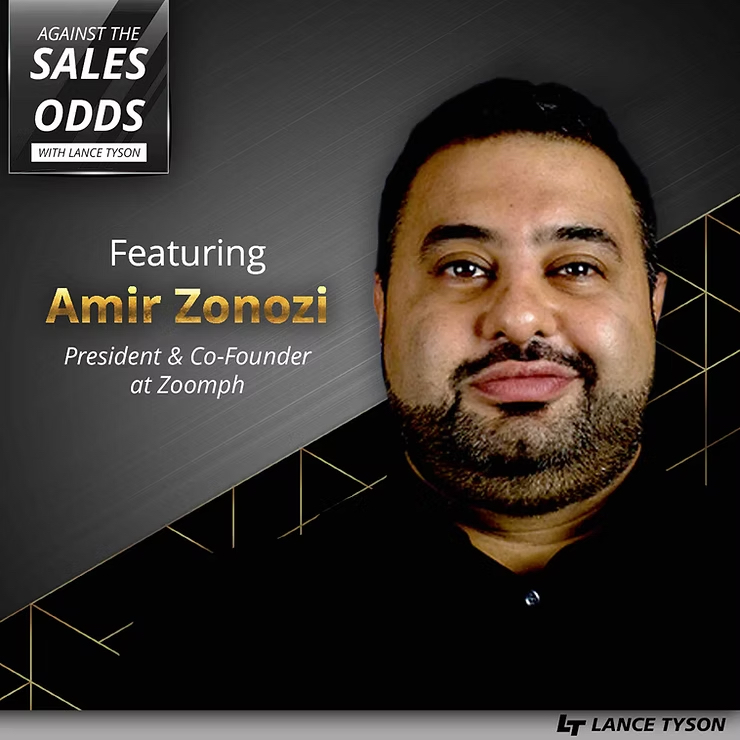
This episode of Against the Sales Odds podcast is an interview with Amir Zonozi, the President and Co-Founder of Zoomph. Lance Tyson and Amir talk about the intricate details of Zoomph, their partnerships, Amir’s story from college to his current professional career, and everything in between. Throughout this interview, Amir expands on Zoomph’s audience, partnerships, challenges, and day-to-day activities for his role.
Sign-up for Lance Tyson’s newsletter HERE.
—
Listen to the podcast here
How To Build A Better Brand With Co-Founder & President Of Zoomph: Amir Zonozi
I am pretty excited about this episode of the show. We have with us the President and Cofounder of Zoomph, Amir Zonozi. Our two organizations got together and are collaborating on a partnership with the things that Zoomph and the Tyson Groups do. I was excited to get this interview in play and this episode up and running. Tell the audience about yourself a little bit. What do you do? What’s your day-to-day? Talk about Zoomph for a little bit so everybody understands what it is, how it works, and why it’s important.
I am super pumped about this partnership and can nerd out about that in a little bit here. I am the Cofounder and President of Zoomph and a dad of three boys. With Zoomph, what we’re doing is helping these organizations and sports and entertainment understand what the value is of that branded exposure through the different activations that they’re doing with their partners. We provide these partner insights so that they can improve their partnerships or have better data to go reach out to the right people.
That’s been an exciting ride for us, but we didn’t start there. We had a long journey before we figured out what our product market fit was that allow us to unlock the growth that we have. At the end of the day, I am out here in D.C., enjoying life. I have a great team. I am excited about what we’re doing together for our partnership and having a conversation with you.
Let’s unpack that a little bit, a couple of things. First of all, I’m sure we’ll get to the three boys because I didn’t know that. I am a father of three boys, so that awesome was an interesting play. From a Zoomph standpoint, for the audience, and I want you to break this down for somebody who might not quite understand maybe outside the sports and media realm, Zoomph provides data so organizations can position themselves the right way. Am I saying that correctly? Can you expand that and go into more detail?
100%. What I love is you’re an icon when it comes to sales, sports partnerships, sports hospitality, and all the different interactions in a business that becomes within sports. Where we’ve come in is the sports media size of the business. We’re helping them understand that branded exposure provides partners, whether it’s broadcast on linear that they’re able to look at across these large audiences across the US and how that exposure asset that a brand might have with one of these teams, or we’re looking at YouTube and TikTok.
All of this exposure provides a ton of value, whether it’s making sure they’re right in front of the right audience. It is looking at their social data. If you’re trying to reach soccer moms, it’s about the propensity of soccer moms that you’re trying to reach as a brand. Maybe it’s not the LA Rams. Maybe it’s Angel City FC that you’re trying to align with. Every audience has a story to tell. We try to make it clear how to make those alignments happen. We work on both the brand side and the team side or the league side. We work with the media companies as well.
We’re processing this media content using AI. One, we are looking for logos. Two, we are looking for the assets. We can do auto-attribution. If you’re a Rakuten, you know exactly the value that you’re getting up until game 2 Lakers or game 3 Lakers and Warriors that’s going on that we’re talking. We put that all together so it’s very clear what your performance is. That data can also help you go sell and sold assets or it can help you find the right partners to go after.

Building A Better Brand: Data can help you sell assets or find the right partners to go after.
We provide insights when it comes to any of those questions to make those strong, powerful partnerships that provide value on both sides. Niches get riches. These are all niche pockets and groups of fans. Amir with his 3 boys is very different at 40 than Amir at 25 with his boys at the game trying to have fun. It’s all different in those experiences. We try to show those stories through to digital audiences that you hold.
Let’s unpack that for a second because it’s interesting. What I heard you say is you provide almost this avatar effect for a brand to make a decision on who they would partner with maybe on the sports and entertainment side. It would also help a sports team like Monumental down in D.C. who has the Wizards and the Caps make a better decision on how they would position their brand to certain audiences with other organizations you’re trying to do business with.
Conceptually, it is aim small, miss small with you guys. You’re trying to get whatever side of the business you’re working on, whether it be on the brand side or the sports side, to get them to aim small. That’s going to arm them to make better business decisions, or a salesperson to sell that better. Is that correct?
Yeah, exactly. We live in a business of uncertainty. We put a certain need to the performance that you’re getting and then what that ROI is for these brands. It is by them understanding, “If I’m DoorDash and I’m trying to reach an audience that prefers delivery of goods to me or food to me, maybe I want that differently than the Wizards or differently than how I activate with the Caps.” Each one of those will be able to give a better idea of how to move forward and what content makes sense. At the end of it, we’ll help recap what that valuation looks like, a cold dollar sign.
The event business is huge, but the way we’re looking at it, sports is not the product. It’s the platform. The product is the branded experiences that you build off sports as a platform. You look at the drive to survive and these long-form storytelling pieces and narratives that are allowing fans to understand the human component of these athletes.
These teams are getting smarter. The Jets do a wonderful series. It’s going to be exciting on YouTube with Aaron Rogers coming in and playing for them. These long-form content pieces are incredibly powerful in winning new fans over. We’re helping understand where these brands should be and what the value is of being told in this story. Whether it’s Ted Lasso holding up an iPhone or Eleven crushing a can of Coke, media is a storytelling platform.
Ads are becoming less effective. It’s about how you fit within the story. Think of us as a product placement company. Think of us as a branded exposure company. That’s where we come in. This is why I’m so excited to be talking to you. You inform these amazing people in the space like Al Guido, Scott O’Neill, and different people that have made a profound impact within the business. As media becomes a bigger solution for these iconic properties and organizations, we’re helping provide that infrastructure and framework, allowing us to make deals happen off this and understand what that business impact is.
It is a super exciting space to be in. I love that you’re using D.C. references. As a D.C. guy myself, I still call them the Bullets. It’s a very exciting space. We see fandom as our oxygen. Wherever there’s fandom, it gives us a place to go breathe, whether it’s film, sports, or entertainment. Originally, we didn’t start here. We started in the government connected to our D.C. stuff. We did impact before, during, and after speeches with the state department.
We got first involved with Monumental Sports in our original product. That was our gateway drug into sports. That was what got us so pumped and excited. We worked with all different kinds of projects from Instagram, Twitter, and Coca-Cola, but what we were focused on was fan engagement. We were the asset at that time. Over years of finding not quite takeaway success, we found every way that didn’t work, we learned it got smarter each year.
In 2018, the Cowboys came to us. They were like, “We don’t want to use any of our visuals. We want to use your platform to organize and grab these posts.” We said, “No.” They were like, “We’re the Cowboys. You can’t say no to us.” We’re like, “We’re for marketing. We’re not for partnerships. We’re not for sales.” They were like, “We’ve checked and looked. We think you guys are the best at this we can do in this way.” When we did it in that way, it opened up our eyes. We spun the platform all 2019 to focus on partnerships. The last couple of years for us have been a breakaway success with digital assets being one of the most used platforms out there. I’d be happy to go into more detail. I wanted to give a quick recap.
The bottom line for me is I’m listening to it and knowing what I know and thinking of our customers, sports is a platform. You help storytelling better around those things, if I was ever going to say it in a nutshell. I do know this as long as I’ve been in business. Stories sell and facts tell at the end of the day. Like anything else with the audience, we have execs that tune in to this and we have up-and-comers tuning in to it also. You’re the President and Cofounder. What does your day-to-day look like? I know what a president does. I am the president of my own company. I also know you probably wear a ton of hats. What does that look like? What are you running into every day in your world?
Being cofounder, you do wear a lot of hats. You celebrate every time you can fire yourself in a certain role that you suck at. You find someone better that can champion and grow to the next level. We originally were within an agency, MetroStar out in Reston. They work with all these amazing government entities. The CEO there, Ali Manouchehri, took a big chance on our team on some of the projects that we were doing. He allowed us to have nights and weekends to work on this. Once we split it out, we’ve been running and growing with it.
Being a co-founder, you wear a lot of hats, and you celebrate every time you can fire yourself in a certain role that you suck at and find someone better that can champion and grow to the next level.
There are three cofounders. There is Nick Cronan who’s our Jony Ive. He is our chief design officer. There is Ali Manouchehri who’s our chairman and CEO. He is instrumental in our investor conversations. He influences our product and our vision and where we’re going to go. My role is I flip the work chart upside down. I call myself a customer success for the company. Whatever is needed or whatever obstacle is in their way, it’s my job to understand how quickly we can help them get that out of their way. We hire the best and smartest and brightest people. They know what they’re doing. I’m out here to make sure that they get what they need.
I love interacting and engaging, probably a little too much on that side, with our customers.
I love working with our product team on how we need to get our features out the door and finalize the amazing innovation that they can do there. I am checking with customer success to see what issues we need to prioritize to eliminate obstacles. I am working with finance to make sure that we’re building an infrastructure vehicle that can continuously fund more people coming in, take care of our investors, and grow the current team that we have.
It’s a little all over the place, even the HR-related things I have to jump in on, but nothing gets me more excited to know that we impact 30 families in a better way. The parents of some of our employees engaging with us, retweeting, and sending us DMs and congrats is infectious for me. I love being on the client side. I love selling. I love telling the stories of what we’ve been able to do.
Early on, I used to think I was terrible at sales and would try to shy away from it, but where I found my ability to tell my story in the right way is I nerd out. I have so much passion for what we’re doing. If I’m able to unlock that and share with the customer in their eyes what we’re able to do together, that’s the way that we can grow. I’m constantly looking for what can we be better at and how we beat ourselves yesterday. If I had a theme song that I’m constantly listening to, it’s Eye of the Tiger by Survivor. Rocky Balboa is the main figure in my head of, “Keep getting back up when you keep getting knocked down.”
I love it. Let’s go backward then. Coming out of school when you were getting your first job, your first job was doing what? Let’s hit backward and come back to how you landed here. I’m listening to what you said and you were measuring impact for the state department. I want to get through that. How do you arrive at this? Where’d you start?
Do you see all those crazy guys that are all obsessed with Web3 and NFTs? That was me for social media when social media was becoming a thing. My background is I graduated undergrad with psychology. AIM was what fascinated me. This is a throwback for those that understand and say it is well-referenced. With how you frame certain signals and how the return signal is received, it fascinated me that you can get more responses to an away message first. You put it in one way and you get zero responses. I love playing with that.
I worked in inpatient and outpatient psychology units. I argue social media is more psychology than it is technology. I was lost at the time because social media wasn’t built there, but I did anything. I worked with pest control. I worked with senators, doing their social media community management. I was a freelancer. I was at a bar giving advice.
One of my friends was cousins with Ali. He was like, “We’re growing and building this new media team. You’ve got to come and have a conversation with him.” At that point, to even get into the program that I got into, which was Georgetown Communication, Culture, and Technology, I didn’t have the grades. What I did have was I was a music pirater. We had 200,000 people hit our website a month for pirating music, but we got shut down by the FBI.
That was the Napster time when all that stuff was going on.
Exactly. I was able to show that I knew what I was doing by generating audiences and creating web traffic and demand. I used those insights for the admissions. I had a meeting with them. I was like, “I don’t have the grades. I’m obsessed with social media.”
I’m going to stop you right there. Let’s unpack this for a second. You come out of school. You’re a psychology person. You got a psychology degree. You’re front end with AOL. When it was dialing, you could hear it. We would all wait three minutes. Our hearts would be pounding so we could message somebody. We had this whole friend list.
You were fascinated by people’s reactions when they were using that technology. That’s what I heard you say. That was your thing. You’re freelancing and then giving free advice to people or maybe getting paid to give the advice but probably out there selling yourself a little bit. Is that fair?

Building A Better Brand: The only reason we’re winning is because of our technology services.
100%. It didn’t matter what the job was. If it was around social media, I wanted to be doing it and working on it.
Did people even call it social media at that point? Was it even a thing? I remember Mike Ondrejko is the one that showed me YouTube. I remember I’m bringing the Cavs off. He goes, “This is YouTube.” I’m like, “What’s this?” He was showing me a coach rant and rave with somebody. I can remember the day I signed up for Twitter. I was like, “This is stupid, but I’ll sign up because everybody’s doing it.” Is that time?
Yeah. People were posting pictures of their lunch at the time. What I was looking at this is the next form of the telephone. Instead of one-to-one, it’s one-to-many. I knew that this could be a platform that can be taken to different degrees. The first thing was when I was working all these freelancing gigs, no one took me seriously. I was like, “I need something that makes me look official.”
You need some credibility. I love it. This is the same time when you were pirating music, too, so you had a side hustle going on also. I love it.
You nailed it. I went to Georgetown. I was like, “I know how to do this illegally. I want to do this the right way. I want Georgetown on the side of my rocket ship. No matter where I go, you guys will have that branded exposure if you believe in me.” They said, “You have to get a B-plus or higher.” I got straight A’s the entire time I was there. Every single report, they would roll their eyes and be like, “Let me guess. It’s on social media,” and it was.
In the second year of that, I started getting excited about the different entrepreneurship programs that they have in startup things. That’s when I was connecting with some friends. I was at a bar giving social media advice. Someone within that group knew Ali and connected Ali and me to work together. Ali had this project with the state department that was looking at speeches before, during, and after. Eventually, we got into social walls. For President Obama, we created a tweet wall for him.
Are you still in college at this point?
Yeah. I’m still in grad school. I would go straight from class to MestroStart to work on these different projects. At the time, there was a product there that they had built for the state department that was called MySTANLEY. That’s when I was like, “What could be done with this?” At that time, I was thinking of social listening, but it was like, “I could control this as one of our main users of what’s needed for social.” We started building on that and serving. Quickly, we moved out of federal work and into private work working with Monumental, Orioles, and the Giants. We had a bunch of sports businesses.
I always say I’m a foreigner in sports. I’ve never worked for a team. I have an accent. I don’t know what it’s like to do ticket sales and that grind, dedication, and persistence that you need on it, but I have other ways that I’ve gotten kicked in the ass to learn how to get smart about how I position and frame things. We grew in that. We knew it. Eventually, we kept listening to our customers. We never fully took off. We kept trying to do new things. As we started listening and condensing what we were doing on focusing on key specific things, that unlocked a lot of value for us.
Let’s go timeframe-wise, too. I want the audience to put a couple of things in perspective. You get out. You get your undergrad. You’re doing a side hustle 2 years or 1 year before you go to grad school. You’re doing your mirror slash Napster deal. How long is that time period?
It was about 2 to 3 years when I was working at inpatient and outpatient behavioral clinics. I was working with people with schizophrenia.
I forgot about that. You got a whole human side to you, too. You got to love that work to do it. You got to love people at some level to do that kind of work when you’re working with people that have challenges mentally and with all kinds of things that they’re suffering from.
It’s an audience that necessarily doesn’t want to be helped at times, too. You’ve got to overprepare yourself to embrace any type of thing that might come your way. For that, I loved the ability to be able to connect with somebody where we are even psychologically not as present in the same reality that we’re both in but still find a way to connect with one another.
You have to over-prepare yourself to embrace anything that might come your way.
There’s that connection then with the AOL stuff because you got that connection with people. You like to read them. You like to understand that.
I look at how we connect digitally. The pandemic forced the rest of the world to have this connection. I have friendships with people I’ve never met in real life before. That started back in those AIM days. As a younger shy, introverted dude connecting with friends or talking to significant others, it was easier for me to convey behind a keyboard than in person until I built that confidence where I could do that.
It’s not the same as being in person, but I looked at that connection and the ability to do it. If one is one-to-one, then one is one-to-many. I’m looking at social as this ability to connect with audiences at scale in different ways. That fascinates me. It fascinates me that if you say something that everyone agrees with, you’ll get more likes on social than you’ll get replies. If you say something that you know people will disagree with, you’ll get more replies and fewer likes, engagements, or retweets.
The game of putting a signal out and having someone receive that signal and understand the message, and then how you can tweak the signal to get a different reaction from the receiver fascinates the heck out of me. Whether it’s one-to-one or one-to-many, that’s where I nerd out. That’s where I get connected to where I am. That’s the foundation of it.
It sounds like this journey of persuasion and influence with an audience, group, or individual. You figured out, through grad school, “How do I get some credibility and become an expert in this?” From there, you start getting involved in an organization that’s trying to define itself at some level. You talk about what you’re doing with the MySTANLEY thing at some point and then how it started to evolve. What period of time did the product or the technology start to evolve from what you were doing with the state department to where it is? What’s the timeframe there?
The idea originated in 2011-ish. I graduated in 2012. No offense to Georgetown, but I learned more from the experience of MySTANLEY and Zoomph than I did at school. It was addicted to constantly building it and listening. We serve many verticals and many businesses. We went after an MRR in a B2C play where other organizations can use these social tools as social power tools, whether it’s putting stuff on your website like a widget that you’re monitoring in the post or on the jumbotron, what tweets or Instagrams you want to visualize.
2016 is when we split off from MetroStar. Those first early years was very great. We saw how tough it was to work with businesses at a small size. We quickly learned that we have to work with enterprise-based organizations that have the resources and ability to take this data and insights and drive it. We got into people, audience, and first-party data, which is exciting, but then, Cambridge Analytica happened. We were doing the same basic psychographics and understanding these audiences based on the social behavior that people are exhibiting.
If you follow a bunch of breweries, if you talk about an IPA or Saison, and there is a different beer-tasting app store out there, we look at that social behavior and aggregate. We collect these audiences based on their affinities. I already know what brands you’re into based on what you talk about, what you share, and what’s in your bio. My bio says rookie dad of three and lucky husband. As you see dad, you know that I’m a parent. As you see husband, you know I’m married, it’s not as simplistic as that, but we use that self-defined data. We structure people based on their social audience behavior and group it based on that.
That was in 2017 and 2018 that we were like, “This is not taking off the way that we had hoped.” It was 2018 when the Cowboys and MSG were both separate pilots that wanted to work with us on our data in different ways than our other customers did. That was our a-ha moment of like, “This is a no-brainer. We accidentally built a product for a platform for partnerships.”
For example, our platform is an open search engine. If you’re starting a sports partnership, that would be a stupid idea to do because it takes a lot of effort and money to build an open search engine. Since we brought that into the space, it allowed us to disrupt. For example, with WWE, they brought in Logan Paul. Our data helps tell that story. Was Logan Paul the right person to bring in? Does he have a de-duplicated audience? What kind of lookalike audience can you extend to? All of those data points are from past products and features that never took off. We rearranged in an interesting way to solve the challenges that partnerships have that allow all those failures to be a success in the aggregated way that we’ve collated it together, if that makes sense.

Building A Better Brand: It takes a lot of effort and money to build an open search engine, but because we brought that into the space, it allowed us to disrupt.
It does. What I want everybody to hear is through this journey from 2012 to 2018 to where you’re in ‘23, it sounds like you’ve had to define the product and define what the audience is. I want them to see that as a business leader, you’re constantly trying to sell the business and sell yourself and the credibility of it. You’re going through these iterations, and that’s difficult. That’s very hard. That entrepreneurial journey is as hard as any sales journey.
In some cases, they duplicate themselves, too, because there’s this constant fight of fighting the market and who the customer can be, defining the product and what it is and what it isn’t, selling the people who are going to invest in you, and then trying to win customers. It is four lanes at all times. They crisscross a little bit, but it is difficult. I want them to see that. Through that journey there to where you are, did your role change? It sounds like you were very much at the front lines of trying to win business at some level.
100%. My role originally was as a community manager. I kept taking responsibilities and they were kept handed to me because I had a high level of standards that I wanted to deliver, too. This is the way it is at Zoomph. I don’t know if it’s all other organizations. When you want something to get done, people will get out of your way to allow you to get that done if you put the right enough inertia into it.
When you really want something to get done, people will get out of your way to allow you to get it done if you put enough inertia into it.
My role originally was on the marketing side and helping us grow. I was our business development person for some time, too. I was our customer success person for some time. I came into it thinking I had to be a certain thing. I quickly learned that if you’re not authentic to yourself, then it’s a no-brainer you are going to suck. I never went to a business school in this aspect, but I read tons of books that are out there. I was constantly optimizing what I’m doing from different perspectives of, “How do I present this to the different audiences?”
My role is contact switching from 10,000 up to 30,000, up to 50,000, down to 10,000, whether it’s in the product, investor, or on a sales call of like, “I have to switch my context all the time.” That ADHD nature of mine of being able to move and get excited about these different things, it’s a superpower in this opportunity because I don’t get overwhelmed. For a lot of people coming into entrepreneurship, it’s very overwhelming the number of things that are on fire at any given time. You have to have that ability to persevere through and know and prioritize what things need to be done at what time and at what point.
It might seem juvenile, but I look at it all as a video game. When you get to the next level, the bosses get tougher. You’ve got better weapons to go up against. You’ve got a better team. I’m always looking to get to that next level. I have to define in my head what the next level is to organize our group or organize myself. You said it right. There are a lot of different audiences that you’re delivering messages to. I’m constantly translating between those different audiences of what we do, who we are, and what we’re not. You nailed it. What you say no to should make you more proud than what you say yes to.
There’s no doubt. You’re the cofounder. You have been in the trenches with other people. They might have a similar story or a little bit different perspective. What you say no to defines you because that’s not who you want to be. That won’t be great for the long-term growth of the business. The marketplace is fickle. The marketplace has an uncanny way of getting rid of things that don’t work. You’re found out pretty quickly.
You have all kinds of organizations that might not do exactly what you do but might potentially demonstrate that they do similar things. Sometimes, people can’t decipher that. Your opening of describing what Zoomph is and I kept feeding it back to you and you kept going, “Here’s what it is,” the marketplace tries to look at that even more simplistically. People choose to want to work for you. It’s then keeping clients. It’s all those things.
What I want everybody to understand is I don’t think Zoomph got to the spot very easily.
What they don’t see is all the customers lost, the customers that won, the investors that won, and the investors lost. The, “We’re going to decide to go here. It’s not fast enough. It’s not slow enough,” they don’t see all that. On top of that, which is important, you guys have had to build an organization around this. You’ve had to build a company, which in and of itself is trying to pour floaters on in Ocean City, Maryland on the sand sometimes. It moves.
Focus on yourself for a second. With your role inside the organization, you flipped the org chart upside down and said, “This is my role. What’s going on here?” You almost went more servant leader with your approach. What are the next hurdles for you personally? Then, talk about the next hurdles for Zoomph or direction.
It’s so clear the way that you distill the conversation into those actionable points. It takes one to know one. You’ve built these businesses. You understand how difficult it is. It’s weird, but one of the best feelings winning back a client that left you. It’s being able to see like, “We built something so good that someone might have told you something better but you went on the market and realized.” We lean into those obstacles. We ask every customer like, “Go tough on us. Point out what’s wrong. Bonus points if you stump us on a question.” We want them to walk out of it thinking, “This group knows what the heck they’re doing.” What we want out of it is we want you to be comfortable enough so we’re learning where we have to go and deliver, too.
We got humbled in the beginning. Jeff Gordon once quoted and retweeted us and said, “Numbers like these are going to ruin this industry.” At that moment, it’s like, “We’re done.” You’re so passionate and involved in it, but you have to have this emotionless ability to take these things and learn how to optimize them. I also play this external figure on behalf of our organization. What I’m realizing is every organization needs a personality that’s external to the brand itself to drive it where it needs to be. It is that human approach, much like you and your business. For me to be a bigger aspect of that, I need somebody internally to help me with the organizational infrastructure.
Every organization needs a personality that’s external to the brand itself to really drive it where it needs to be.
We have a team of 28. We go up against people of these giant companies that have a team of 72 developers. The reason we’re able to do that is we find the best people that have a chip on their shoulder and tell them, “You’re a gazelle in a grassy field. Go run. This is what you were put on this earth to do.” We allow them to be as good as what they do in what they do.
I would argue there, too, though. It’s small, agile, boutique-y, or however you put it. If that’s who you are, I would argue you guys probably have to have a superior process. People make decisions based on time, cost, and quality. You guys probably can do things at speed, which means you have to have a decent culture. There’s a whole other side to that that that the execs on the team realize, “That’s hard to do.”
If you don’t have the firepower, it’s a little bit like Ukraine’s fight with Russia. I don’t mean to stick my foot in politics. You would think Russia at this point would be crushing Ukraine based on history size and things like that. Being agile, there’s something to it. Having a superior process, there’s something to it. With that being said, you have to hire people and they have to have some freedom. Well done on that end.
Thank you. You nailed it. We’ve got the greatest team in the industry that’s off the field, Thomas Matthew, the Avengers have the Hulk, we have him, he’s our product chief product officer. Nick, our cofounder, is our Jony Ive. We’ve got Lindsey Pacatte who’s our financial person that we call our Joe Pesci. She comes from the Dallas Stars. If I’m a foreigner and I have an accent, we brought a lot of people that are native from the industry itself within our organization so we can connect better with that. We’re constantly reassessing our pipeline. We’re constantly reassessing our product roadmap.
What we’ve gotten great at is trusting one another, but also that ability to adapt. That’s what you nailed. We try to move like a jet ski, not like a crew cruise ship. We’re growing at such an alarming rate. We want to keep retaining that speed of delivery and the speed of innovating on behalf of the customer. We do have a lot of processes that we do around it. A lot of that I credit to Ali by us spinning out. I’m an intrapreneur, not an entrepreneur. Ali has been there from the beginning giving us this ability from the company that we spun out of to think like a much bigger company.
We are doing a series A. When we’re doing this in front of all these investors, they’re like, “You guys are so mature beyond your age. This is insane.” We had that guidance. One of the key things is having these mentors. It is having these people that are investing in you that know what they’re doing and who have had that experience that can be tough on you. Since we had that infrastructure, we should be delivering the way that we do, growing in the way that we do, and having a team that is moving as one. We tell interns if they correct us, that’s awesome. We’re going to high-five them and hug them. We want the idea to be the hierarchy. The top thing in this company is the ideas. We try to be nimble.
One of the key things is having mentors—these people who are investing in you, who know what they’re doing, and who have had that experience that can be tough on you.
There are challenges that we’re looking at. One is growing the team and retaining that culture. Two, what we are looking at in the company is the diversity of media content as it’s growing to other platforms. We’re on social and broadcast and doing some work on OTT with specific providers. We want to expand that view with audio as well. We’re looking for branded exposure.
We look at attention as currency, content as commerce, and audience as assets. How we connect that and understand what that branded value is is helping these organizations take content to the next level. Organic content is the place where product placement, we feel, is ripe for innovation. We’re seeing brands gravitate towards it.
You look at Apple and everything from different shows on Netflix. They have a YouTube premium subscription that removes ads. Twitter, I bet you with Elon and his crazy behavior, they’re going to move away from ads in some way with Twitter Blue as well. Organic content is going to be branded content in there. We got to move quickly to adapt to the new media sources. We hope we’re five minutes ahead and we’re moving and planning in that action. We’re always assessing what that next medium is of how we understand where that value comes from.
Getting to know you on this interview, you know who you are. The other thing is I heard somebody say one time that you better be fired with enthusiasm or you’ll be fired with enthusiasm. You’re enthusiastic about what you do. There’s something else with enthusiasm that people forget. The word enthus comes from the gift of the gods. In Latin, it means God from within. The last four letters of enthusiasm are I Am Sold Myself. Without a shadow of a doubt, you are sold on the mission and vision of where Zoomph is going, which is extremely exciting. As we bring this bird down for landing, I still have a couple of quick questions to get people to know you. If you had to gift a book that you read that had an impact on your life, what book would it be if you had to gift any book?
There are a couple of books. Selling is an Away Game and The Human Sales Factor, I know a good guy that’s written those two books there.
I appreciate the plug.
I’m sure your audience already read it. There are a couple of books. I usually do audiobooks with the boys. Extreme Ownership by Jocko Willink was something that opened up my eyes that it doesn’t matter if it’s not my responsibility or not. I need to take that responsibility and make it mine and create the vision that I need to see. That opened up my eyes that your ability to make an impact is bigger than what your lane is. It is eliminating that.
Extreme Ownership: How U.S. Navy SEALs Lead and Win
There is also Chris Voss, Never Split the Difference. There is Donald Miller, Building a StoryBrand, which sounds like a boring book, but he does a good job of breaking things down. The last book I read is Blue Ocean Strategy. It is about constantly rethinking how to deliver value and innovate on behalf of the customer outside of the product itself and how you deliver and build the product.
You are thinking with the two end caps. With Extreme Ownership, I would say you have extreme ownership. Blue Ocean Strategy is interesting because you’re looking at the business you’re in as a blue ocean. The analogy goes that the red ocean is shallow water, bloody, less fish, and lots of fishermen while the blue ocean is deeper water, more oxygen, and more fish. You are looking at Zoomph as a blue ocean strategy, not a red ocean strategy. There’s still the last question. You said you have kids. They’re all under five, the boys?
Yeah. The oldest is turning five, Hudson. The second one is turning three, Rocky, and then Maverick will be turning one.
There you go. Those are good branded names. At this point, you have three sons under five. Let’s say you have a niece or a nephew right around ten. It is right at that point where they start to understand life, let’s say 10 to 12. They said, “Uncle Amir, what does success mean to a 10 or 12-year-old?” Think about your audience because we’ll be there the whole time. How would you describe success to them?
It is doing what you love to do and being celebrated for it by your friends.
I like the celebration. I hear the doing what you love to do all the time, the celebration is important. Keeping score is important. I love it. This has been a wonderful interview. I’m looking forward to our partnership and getting this post out there. This is great. Thank you for the insight.
The pleasure is mine. Thanks for having me. No worries at all.
Important Links
Zoomph
Selling is an Away Game
The Human Sales Factor
Extreme Ownership
Never Split the Difference
Building a StoryBrand
Blue Ocean Strategy
About Amir Zonozi
Amir Zonozi is the co-founder and President of Zoomph, providing partnership insights across sports and entertainment for organizations like Golden State Warriors, Angel City FC, Invisalign & WWE. Amir is also a member of Ally’s Women’s Sports Club with Sports Innovation Lab and sits on the board for Women in Sports Tech. Outside work, Amir is an expert at crashing drones, recovering sneakerhead, and a proud father of 3 boys under 5.