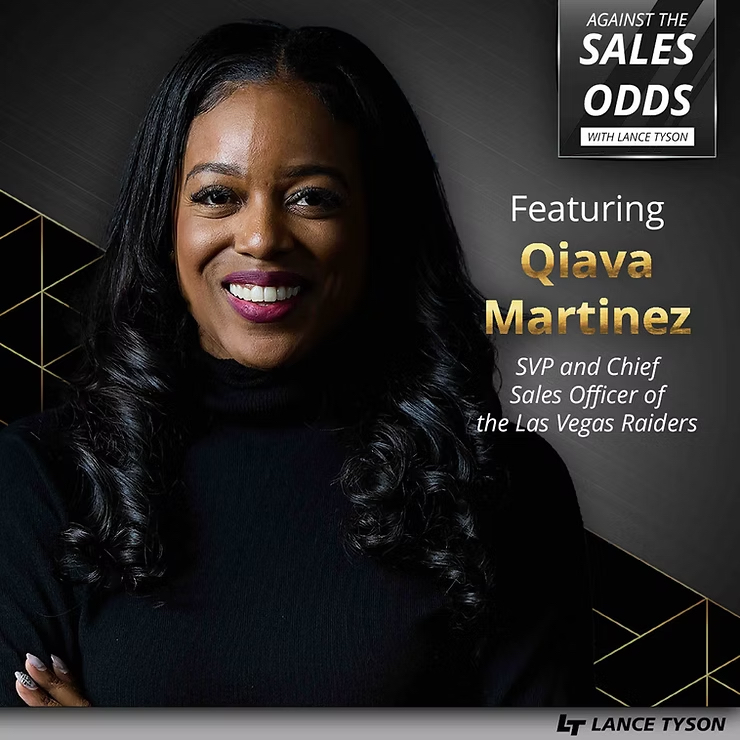
Stay Prepared: Stay the Course to Succeed with Qiava Martinez

In this Against the Sales Odds episode, Lance sits down with Qiava Martinez, Las Vegas Raiders SVP and Chief Sales Officer. Qiava brings us through her journey from her education to her current position in the professional sports realm. Qiava stresses how building relationships helps determine not only your team’s success but your organizational success as well. Even through major moves and life changes, she has kept the same mentality that helped her climb through the Raiders organization. From staying prepared to building relationships, Qiava gives us insight on how to stay the course to succeed. Grab your helmets and ride into her inspiring journey to success!

Listen to the podcast here

Staying Prepared And Ready: Stay The Course To Succeed With Qiava Martinez, SVP And Chief Sales Officer Of The Las Vegas Raiders

I am so excited about this episode. I was sitting in this person’s office. I would like to welcome Qiava Martinez. She’s the Senior Vice President, Chief Sales Officer for the Las Vegas Raiders. Welcome. I appreciate you being on.

I’m so happy to be here with you, Lance.

We were just together. I got a tour of the office and was blown away by the practice facility. You walked me around. I appreciate you being on. You’re with an NFL team. You’re standing with the shield there of one of the most iconic brands in all pro sports, the Raiders. It’s probably one of the best logos too because it’s always in black. Tell us. How did you get to Senior VP, Chief Sales Officer? Tell us about your role. How did you get to this point?

It has been a long journey. I started at the Raiders back in 2008. I was hired by Jarrod Dillon, who will always have a special place in my heart, and the inside sales manager at the time who was Robert Davis. This is my third career, believe it or not. I was an entrepreneur for the longest. When Silicon Valley had the whole shakeup, I was unemployed, depressed, and all kinds of things.

One of my brothers had me go to a career fair that the Sacramento Kings were hosting and I met Robert Davis there. I don’t know why I did it but I went to the Oakland Raiders office and interviewed for an inside sales position. That was part-time, making $10 an hour. Never turn your eyes at the small beginning because I wouldn’t change that for anything. That’s where I was put into the dungeon and was making sales.

I love Robert Davis or RD. We got RD and JD or Jarrod. We love him. Before we start at the beginning because I want to get back to that inside sales role, tell us your role as SVP, Chief Sales Officer. Give the audience an idea of what falls under your purview, that org chart, and that human talent that comes up underneath you.

I have one of the best positions within this organization. I have a wonderful team. I am responsible for our corporate partnership, sales, and activation that falls underneath me as well as ticketing, premium, and premium seating. All of the sales and service efforts within the organization fall under my jurisdiction. I have a team of about 42 individuals. They’re all hustlers and wonderful. I learn from them every single day.

Tell us about the leadership team that reports to you. You named 3 or 4 teams there. If we start with sponsorship and work left to right, you have a VP who reports under you.

I have a VP of Corporate Partnerships. That’s Christian Howard. We call him X. Everyone in the industry knows him as X. He is amazing. He had been selling before I was born. He has two senior directors who report under him. That’s Dana Geary and Scott Erdmann. They’re both fantastic. On the premium side, I have Panos Pappas. He is our Vice President of Premium Sales and Service. I have a young lady named Kylee Chandler. She is our Director of Premium Hospitality and Suite Service. I can’t forget about Adam Feldman. He’s our VP of Sales and Ticket Operations.

That’s quite a bit of organization underneath you. It’s a large team. You have senior leaders who report to you too. Let’s do the comparison. We go back to 2008. That’s when this all starts and arrives here. On top of that, for some of our audience who might not be that into sports, it’s not Oakland Raiders anymore. It’s the Las Vegas Raiders. We are at the spot. We have a brand new state-of-the-art stadium. You make this transition over this period from new branding or new way. Let’s talk about this journey. Let’s go back. Did you grow up in the Bay Area?

I am from the Bay Area 510 forever. I didn’t leave. I went to UC, Berkeley. I was a poli sci major. I thought I was going to be an attorney. Look where I am.

I didn’t know we had that in common. I went to Penn State. I was a history major and a poli sci minor. I wanted to go to law school but never got there.

Right out of college, I went and worked for Morrison Foerster for two years as a legal assistant. I was like, “This isn’t for me. There’s something else outside.”

I love the liberal arts education. They’re great thinkers. There you go. You went the law school route and thought about working in that industry. What was the change for you? What happened?

What happened was that I realized that I wanted to do more. I didn’t want to go back to school. I wanted to get my career started. I come from a family of entrepreneurs. My mom was the biggest one. I had decided that maybe the route for me was to start my business. That’s when I decided that legal wasn’t for me. There’s a lot of trying to find yourself during this period as well. I started my business and became a self-publisher of a teen magazine entitled Culture. It was nationally distributed. I had a youth board where they wrote about their life issues. I would take them to the BET Awards and NAACP Awards, and we would work the red carpets.

Here we go. Turn it over, Acorns. Let’s go. I did not see that coming at all.

I was very passionate about it. That’s why when I went to the career fair, I was depressed. My brother was trying to get me out of that. My magazine had folded because all of my backers were in the real estate industry. Even though I had subscriptions, it wasn’t enough to keep me afloat. I thought that I was going to be the next Oprah. I was going to be able to say, “You get a car,” but that’s not what the plan was for me at that moment.

That is how I ended up going to the career fair because my business didn’t succeed in the way that I wanted it to but I had received a letter from a young reader who had read one of our issues about teen suicide. The writer wrote about how one of her relatives had committed suicide and how it made her feel. The teen reader wrote me a letter saying that they had contemplated suicide. With that issue, they decided not to take their life because they didn’t realize how it would make their family members feel. If my magazine was only around for that one person, so be it.

To get something like that and know that you have that reach, then you know as well as anybody that you might as well multiply that by 5 from the 5X people you didn’t hear from that it did have an effect on. It was a piece of the information they had. I also love the entrepreneurial spirit piece because I look at entrepreneurs and salespeople and think they’re cousins. I’m going to have you self-evaluate at the end based on your understanding of publishing media at this point. What advice would you give to yourself? It sounds like you had to sell. The subscriptions come along but the big piece of it is sponsorship. I want to hear the transition but I’m going to come back to that question circling that.

That’s what helped me get the job at the Raiders because I had to sell not only subscriptions but I had to get my distribution. I had to get advertisement placement within the magazine and get the backers. I did that all on my own. Jarrod Dillon was like, “You may have done that part and you haven’t had a chance to do sports sales but come on board, and let’s see what you have.”

Your brother says, “Let’s get you there.” Older brother or younger brother?

Older brother. I have seven older brothers.

He gets you squared up. You interview with RD and JD. They said, “We’re going to take you on,” but you get a part-time role.

I got a part-time role. I set a goal for myself. I was like, “Let’s set yourself apart from everyone else.” I wasn’t at the top of the leaderboard. I was coming in a little bit later. There were some great sellers up in there. Every week, we would get a list of people we should call on. Someone else could have called on that same person a month ago. I have that entrepreneurial spirit. I love working with youth groups.

I did YellowPages.com and Oakland youth groups. I printed out all the Oakland youth groups within that area and called every single one of them, asking if they were interested in group tickets. That’s where my sales journey began. I was the top seller when it came to group tickets. I was able to get all of the nonprofits to come out. I went to RD and worked on a fundraising program. If they were a legitimate 501(c)(3), they were able to raise money for the tickets that they sold. Back then in Oakland, we had lots of tickets to sell.

If you’re not in pro sports, group sales is when you’re trying to target an organization that wants to get a team of people together to celebrate something or it’s something they do every year. You correct me if I’m wrong. It’s a very customizable sale too because you can customize talking points to the group more so than regular tickets. Here’s a question. What are the top three things that you carried over from starting the magazine into that sale?

Relationship building is at the very top. It’s being proactive. The third is being consistent. It’s relationship building, being proactive, and being consistent in everything that I would do. The goal I gave myself was three months. I said, “I’m going to only do this for three months and see what comes of it.” Within two months, they promoted me to full-time. When I got to full-time, I was like, “I’m going to hustle hard, be the one who makes the most calls, turn those calls into sales, and give myself six months in this position.”

A little under four months later, Jarrod Dillon came to me and said, “We want to build a group sales department and we want you to lead it.” I was responsible for building the group sales department for the then-Oakland Raiders. It was because I set some goals. I built a niche that I was passionate about and they saw that. I was serious about what I was doing. Don’t discredit small beginnings because all of that made me who I am now. I built the group sales department and did that for a little bit. I was then called on to oversee our premium department and help sell out suites.

Don’t discredit small beginnings because that made me who you are today.

What timeframe was that in? You’re inside six months from part-time to full-time. They didn’t focus much on group sales at that point so there was a niche sale.

At that time, we did not focus on group sales. We didn’t have any programming around it. Two other sellers and I focused on youth football and multicultural activations. We put some activations behind the group sale and rewarded the group leader. This was back in the day when people weren’t focusing on that.

You’re an event planner logistics. You’re trying to pull some things together but it can be a big hit. It’s good timing for you also.

It’s the right place at the right time.

I’m not discounting the fact that your signature is all over it. They see you. If you know Jarrod Dillon, Jarrod is all about execution and so is Robert Davis. You go into the premium space starting to lead. What’s interesting about you is you have practical sales experience based on the magazine. You start pulling it off there and then you’re into a leadership position. Tell me about the premium endeavor. How long was that?

I became the Director of Premium Seating. I believe that was back in 2013 or 2014. I was able to come on that side. We had so many suites to move in Oakland. We had about 172 if I’m not mistaken. That was a lot. We didn’t have many annuals. We had our work cut out for us. I didn’t want to do it. I was like, “I’m good. I’m comfortable over here on the group sales side of things,” but sometimes you have to get out of your comfort zone. It makes you better because once I went over to the premium side, our sales team on the season ticket side was able to sell out that stadium. I wouldn’t have had a position in group sales because there were no more group tickets to move.

Sometimes, you have to get out of your comfort zone. It makes you better.

That’s based on a need thing for everybody. Without knocking the Raiders’ heritage, I want to hear from you your best description of the stadium. You have to compare and contrast. You’re in the lack of luxury at this point but you talk about coming up through hard knocks with that stadium. I grew up with the Vet Stadium in Philly. They were the same age at that point.

It’s an old building. I don’t have anything bad to say about it because it taught me so much. I don’t think that I would be able to have an outlook on where I am without the time getting buckets for leaking ceilings and making sure that rats weren’t running throughout. That helped us form better relationships with our clients because they could have easily said, “We’re not doing this,” but because of the relationships that we established with each and every one of them, they were like, “We’re bought in.”

I’m happy that we’re here in Las Vegas and embracing not only Las Vegas, Oakland, and LA, the three places that the Raiders have lived in. It has made us and shaped us into who we are. There was a time when I was selling. I also decided, “I’m going to go out in the parking lot and upsell all of these people out here who are tailgating. If they have a half plan, I’m going to put them into a full season.” I used to call that my parking lot pimping days. I have nothing but fond memories of it.

The reason I asked is because when I have some friends over and I ask the question, it’s like, “That stadium is a spirit.” Nobody will ever know it’s a spirit. You said it perfectly. I had to connect with the human. Sales aren’t B2B or B2C. It’s human-to-human. That’s what it is.

There’s a saying out there, “Don’t take business personally.” You and I may have talked about this a little bit but I take business personally because if you’re in the relationship business, then it should be personable. Every single day, I get up and take it personally.

Staying Prepared: If you’re in the relationship business, then it should be personable.

The thing is they’re asking people to move these things and it’s taking people to do it. It is personal. It’s logical and emotional. It’s both. People justify logically but make decisions emotionally. That ties in. It runs out of inventory a little bit. We start selling more tickets, which narrows what you can sell in group sales. You’re tapped on the shoulder to say, “We need help premium-wise.” You have approximately 113 to 115 suites.

A key thing that people have to understand is these suites for the most part are a lot of B2B sales. There are some individuals who will but it’s somebody who can probably afford to do it. They’re private and wealthy individuals. You’re selling not as many annual suites, which is interesting because if we talked about the inventory at the new stadium, they’re all annuals. You’re being very transactional about them there. Tell us what the strategy was.

You brought up a great point right there because one thing we knew we didn’t want to be was transactional. We wanted to make sure of relationships. Oakland is different from Las Vegas. In Las Vegas, we do have game-by-game suite sales. We renovated and added sixteen new additional suites on our club level. There’s a wonderful sight of the field from there. We have sixteen plus a couple of other corners that we’re able to sell event by event, which is great because that’s helping us build our database of those people who may potentially turn into an annual if something happens down the road.

Is that a little bit of the nature of Vegas too? You have so many people coming into the city who are traveling there. A lot of teams do that. A lot of teams have some extra suites there.

My main responsibility when we started selling here in Las Vegas was to close out Oakland. I was still in the thick of it in Oakland. We had a wonderful team here in Las Vegas. They were responsible for selling our personal seat licenses and the annual suites in our low-seat products. That team was doing all of the sales. When I transitioned over here to Vegas, I was responsible for, “How are are going to build upon these relationships? What is the service strategy behind all of the people who we have sold here in this new town and new building? What is the communication plan?”

We had to be very intentional about how we were going to start to communicate to this new base that we knew nothing about. They may not know much about who the Raiders are. We were able to build a wonderful team on our service side. In year four of the building opening, we’re finally in a place where it feels like our season ticket members know who their season ticket reps are. Our suite owners have great relationships with our suite managers.

Going back to the strategy, we looked at, “This is a lot different than Oakland. We have a lot more businesses than individuals. How are we going to effectively communicate? The point of contact may not be the person that we need to satisfy.” You may not be able to talk to Bill Hornbuckle. Even MGM is a huge partner of ours and they also own a suite. How do we also take care of the day-to-day contact to make sure that they’re happy?

We have our communication for our day-to-day contacts and our Bill Hornbuckles. We have gifts for our day-to-day contacts and our Bill Hornbuckles because we wanted to make sure that any person who touched this account also felt like they were part of the Raiders organization. We didn’t want them to feel like, “You’re just the admin. Thank you. Can you make sure that so-and-so gets this?”

You thread that in. I’m curious. Go back because you said something interesting and that’s probably an important part of the journey. Circa 2015, you get the premium job. You start managing and building that out. You mentioned also, “I was on the team that had closed out the stadium.” You weren’t even on the ground here. You were there. Talk about those years for a second. Talk about the strategy and how you had to develop leadership there. Let’s advance that to what you mentioned with relationships.

Developed leadership in Oakland or Las Vegas?

Go back to 2015. You had to close the stadium out. What kind of leadership strategy started to formulate? What was an overall sales strategy too? Is there anything you want to talk about that? That’s an interesting timeframe.

The organization wanted to make sure that the last year played in Oakland was a great year for anyone who came in and experienced it. We also allowed all of our Oakland annuals to have first right of refusal here in Las Vegas. We also allowed anyone who purchased a suite in Oakland maybe a rental for three games. It didn’t matter. We also gave them an opportunity to get in over here in Las Vegas.

The strategy was even though we’re leaving Oakland and coming to Las Vegas, you’re still a part of this legacy and story no matter where we go. We didn’t want to make it seem as though, “We’re gone. See you later.” I’m glad that I was a part of the team that closed out Oakland because as you can imagine, here is a group of clients that continue to purchase with whatever the play on the field was.

They were your loyal base. We wanted to make sure that we took care of them but at the same time, communicating to them, “You have a part in Vegas as well that we would like for you to get in on.” We had a lot take part in that. We still communicate with our Oakland base which has not transitioned over here to Las Vegas. At our game, we had one of our longtime suite owners, Linda Cole, in Oakland. She didn’t purchase here but she was with us for a long time. She purchased a single game. When I, Panos, and Kylee went into her suite to visit her, she was overjoyed. She was like, “You didn’t have to do that.”

That’s who we are. We have a slogan, “Once a Raider, always a Raider.” We mean that for our base as well. We still communicate with them. Hopefully, they will find an opportunity to purchase. If it’s not a Raider game suite, maybe it’s a third-party event. For the Pro Bowl, we invited a lot of our Oakland annuals that did not purchase. We invited them and hosted them in a suite. We’re making sure that the base who supported us for such a long time doesn’t feel like they’re left out.

Once a Raider, always a Raider.

When you start looking at your leadership style from that standpoint, what were some obstacles you ran up against? What did you start to realize? At this point, you had a career change. You ran your business. You start to perform. You’re given the opportunity to start putting the strategy together and lead a team there. In that transition period, what did you realize about your leadership style?

There were some ups and downs but there were all great learning experiences. I had great leadership in Marc Badain who was our president and now Sandra Douglass Morgan. I’m still learning but my leadership style is more along the lines of servitude because if I can help develop someone from my tree, and they’re able to go on, get a position elsewhere, and grow, that makes me proud. I want to make sure that I give my team the best resources to succeed.

For example, I implemented leadership breakfasts where any single person on my team, it doesn’t matter if you’re a coordinator or a VP, has the opportunity to sit down with senior leadership and have breakfast. There’s no agenda. Sandra and all of the other SVPs and chiefs have sat down with my team, and we got to know them on a personal basis. We’re implementing more training for them.

I also have a group of senior managers. They’re the eyes and the ears of this department. They come to me. I meet with them once a month and they give me feedback on ways that we can get better, “What are our challenges? How do we get through this?” I had great leadership also from watching my parents growing up and that’s where I believe I get the servitude from.

They had a nonprofit organization where they helped youth and that’s probably where I get that from as well. It was Youth Achieving Destiny. My determination comes from my mom and my dad. My dad played in the NFL. He played for the San Francisco 49ers. It was part of the first Super Bowl. I learned a lot from them. I also learned that your title is your title but how you treat people is how they remember you. You have to treat people the way you want to be treated.

Staying Prepared: You have to treat people the way you want to be treated.

You talk about your employees like the service that you give a customer, which is interesting because you have internal customers and external customers. We talked about this before. You have to recruit your people twice, once to be here and once to stay. That’s so important. It’s servitude or service. It’s selfless leadership from some standpoint. It doesn’t always have to be your idea.

You have to walk the talk. I can’t say it and not do it. I’ve been in this business for quite a long time. I haven’t always made the right choices and that’s okay. The key is, “Did I learn from them?”

That is okay too.

I admit when I am wrong. That is also okay. If more leaders did that, we would have better teams. I feel as though the output that I receive from my team is they feel like they also have a seat at the table. I know what it feels like to not have a seat at the table. I like to tell people, “If you don’t have a seat, build your table and invite those to it.” I don’t want to be the one who has the only idea in the room. If we’re going to get to the best solution, it’s going to take diverse thought. That’s what you have to do. You have to make your people believe in themselves so that they have the courage to speak up.

It’s the other thing too. I always find that in great leaders, it doesn’t matter what industry. They break bread. That’s the first thing you went to, “Let’s break some bread and sit down. Let’s have dinner, lunch, or breakfast.” I’m always telling salespeople too, “Have breakfast because that’s usually the cheapest meal anyway. At least have breakfast with them. Everybody likes an Egg McMuffin at the end of the day.” You close out that stadium. What year? Talk about your role in the new building from there.

We closed out the building in 2019, moved to Las Vegas, and came over here. I was in the offices for about two months and then COVID happened.

It sounds like we were creeping up on that. You opened the office. You’re there for two months and then everything slams in everything.

I didn’t get an opportunity to get out into the community. I had a plan, “I’m going to go to this mixer, chamber event, and gala so that I can start meeting people. I want to have lunches with all of our suite owners.” All of that was shut down.

Were you still in the role of the premium side of the business when you came over?

I was on the premium side of the business. We had to become creative. There were all of the regulations. We couldn’t do anything. When social distancing came out, we had an idea. We wanted to make sure that our suite owners had the opportunity to see their suites. We hosted a couple of away-game viewing parties. Each suite owner was able to only invite 6 to 8 guests. They were in their little pod. They were able to watch the NFL game even though we had a year with no fans in the building.

We wanted them to still have the opportunity to experience it. They’re paying all this money. We wanted them to experience it. We hosted a draft party. We started to do little things around a smaller group of people where we could make touchpoints with them. Everything was lifted. People were still a little like, “I don’t know if I want to come to this event or meet with you for lunch.” I had so many lunches and breakfasts. I had to get a Peloton to help myself.

That’s a good investment. I’m with you on that one. Did you change anything about your style? You talk about compare and contrast. You were going from a certain marketplace that looked at the Raiders one way to this whole new market. Did you change anything? Was it more of the same or less? What was it?

I’m glad you asked that question because there’s a little voice inside each of us that tries to bring in that self-doubt. Coming to Las Vegas, I was like, “Maybe my tactic isn’t good enough. Maybe I should start looking at what all of these higher-end people are doing and latch on to them,” but then I was like, “At the end of the day, it’s relationships. I know I keep saying that. I am who I am and my style is what it is. That’s because there’s only one Qiava and I’m going to continue to be that person.” At the end of the day, I didn’t change anything.

Staying Prepared: I am who I am, and my style is what it is.

I didn’t suspect you. When I was in your offices not long ago, we had connected once before. I felt like I had known you for 100 years. We sat down and relaxed. If that’s any marker of how you are with your people and the customers, I was like, “Don’t do a damn thing differently.” Let’s get back to the top then because we have taken this journey. I congratulate you on this. Your name has come up in a ton of spots in the circles I run with. I admire the fact that you’ve run the course with the Raiders. There are not many people who have run the course.

Everybody goes through their seasons in their career, the falls, winters, springs, and summers. There probably have been plenty of opportunities but I admire the fact that you stayed there. You planted the seeds and look where you are inside sales. You talk about a journey. That’s a hell of a journey. When did you get tapped on the shoulder? When did they say, “Think of this role?” Was there an interim move between premiums? What was it?

We had some changes. There was the opportunity for the Raiders to look at bringing in a chief sales officer. During that time, I was over premium, sales, and service. I was tapped on the shoulder to interview for the chief sales officer position. I never thought that there would be an opportunity to do that.

Did they ever have a chief sales officer before that role came into play? Was there one before that?

They changed it. It was a chief revenue officer over to the chief sales officer. Underneath the chief revenue officer position was Raider Image retail but retail falls underneath our CFO. This one is strictly all of the sales efforts for the organization.

You were setting on a role that wasn’t there. There were parts of the role. Without going into it, there are a lot of changes you have to navigate politically as a leader and things like that. That’s always tough, especially when you’ve worked for those people. You have a healthy respect for legacy, which I admire. You got tapped on the shoulder to interview and got it.

I would tell everyone to make sure that you stay prepared. You stay ready so you don’t have to get ready. I took this to heart when I was tapped and I said, “I’m going to go for it and give it my all.” I put together a PowerPoint, a plan, and a strategy and then took it a step further. I said, “I’m okay with PowerPoint. Let me hire someone to make this PowerPoint look a certain way.”

Make sure that you stay prepared. Stay ready so you don’t have to get ready.

There’s something to be said about the presentation. If I’ve learned anything, the cover of a book matters.

I interviewed a couple of times, and then it was decided that we were going to make the position interim to allow the next president to make that decision. I did that for a couple of months and then Sandra was named president. I interviewed her and then she made her decision. It was the right choice.

This role becomes wide. I’m curious. I’m going to assume you have to take your personal philosophy. That philosophy has to become part of your strategy and then you have to embed that into your leaders. What was the biggest adjustment you made to all that?

I can do ticketing and premium on my sleep. I can do backflips and all of that. It was the corporate partnership piece that I was like, “This is new territory for me,” but I’m comfortable with saying, “I don’t know this side of the business. I want to sit here and learn from each one of you, which I do. I want to hear what the challenges are and where our opportunities are.” I did that.

Christian Howard is fantastic. He can sell a t-shirt off of a person. He’s that great. I was able to come on board and put some processes in place. We also have two wonderful sales directors. They were promoted. Karen Fontana and Holly have been in this industry for a while. I was able to evaluate and look at all of their strengths and say, “This is an opportunity for people to be promoted.” We have Dana who has been running our activations team and I was able to learn a lot from her. I have a better hold on this partnership piece of the business.

I’m going to go back to what you said. Stay ready to be ready. If I’m going to analyze your career, you were made for sponsorship, and here’s why. You go back to the magazine. To be able to draft the strategy for that and see how it was going to enter the market, that’s everything you do with partnerships. On top of that, you then go to groups, which you gravitate to. That’s more of a partnership sale than a ticket sale because when you sell premium, it’s a box. When you sell a group, it’s a concept. It’s different. You’re already made for it. I am going to say one thing. You’re a people-first leader. I don’t think anybody has ever accused you of micromanaging unless you were uncomfortable with the results.

There have been times when I was uncomfortable with the results.

Everything you’re saying though says, “I want to listen to what you have to say.” I didn’t hear, “I’m going to have my opinion,” because you’re not afraid to give your opinion. I know that but when you talk about customers and your people, you’re not the classic micromanager. I can tell when somebody is a micromanager because I deal with so many. That’s so interesting. I love this. If you want to be ready, you better stay ready. Now that you’ve added this bigger executive piece to mid-level management, what’s the core philosophy that you communicate to your leaders on a day-to-day basis? You want them doing what? What is that?

I want them to walk with a certain air of humility because there are people who are watching you who you may not know are watching you. It’s the person who wants to be the next Qiava or the person who’s going to be the next whatever. Walk with integrity and humility. There’s nothing beneath you. If you see a piece of trash in the stadium, pick it up. Don’t walk over it. Make sure that you’re communicating with your team and leading by example.

Your repetition is your reputation. I’m going to ask you a tough question because I was watching your body language and we’re going to bring this down for a landing. You can’t answer both because I’m going to dive in here with you. When you start to talk about your family, your brother, your mom, and your dad, you have to pick one. Mom and Dad or whoever is reading, this means nothing else but on the back end, who’s your person? Who has helped you the most? You have to pick one. I know it’s going to be hard for you. Go.

I have 7 brothers and 1 sister.

You have a big range. You have to go. Who’s your person? Who’s your plugin?

They all mean so much to me in so many different ways. They all help me and their stories are my stories.

Where are you in the mix?

I am the oldest girl but I’m number four. I’m going to have to say it’s my mom.

How come?

She is the Kris Jenner of this family. I went to lunch and called her up. She was like, “What’s next? What are you working on next?” She’s always pushing us to be better and have more than one income stream. She’s like, “This is great but what’s next?” She’s pushing us. At the age of 72, my mother, Roxane Harper, got a US patent.

For what? What are you getting a patent at 72 for?

She invented what she calls baby bumpers that you put over the furniture and then you could take it off.

It sounds like she has had people in her life who have run into stuff.

She had nine of us.

Maybe we’re going to have to get Roxane on the show.

We have to get Roxane on. If you make me choose, I’m going to have to go with her but my mom and dad are one. If you see my mom, you see my dad. He’s right there with her.

When I talk to leaders because there’s a decisiveness that has to go, I’m like, “Pick one. That’s the toughest one you have to pick when you got all those family members.” My wife has taught me the concept of who is your person.

It’s my mother.

That’s probably the person you call when you want to celebrate summer and there’s nothing wrong with that. That’s your person.

She’s my person when I want to celebrate, cry, and all of the above. She’s always pushing. My husband too. I have to give him a shout-out, Jonathan Martinez. I wouldn’t be where I am without his encouragement. He also motivates me. There was a time when I was like, “I’m going to change my leadership style. I’m not going to be as personable and let people know who I am.” He was like, “You can’t do that.”

That wouldn’t work for you in a million years. I wouldn’t even believe it. It wouldn’t even work. Here are the last couple of questions. The first one is you have to pick a song. You’re going in. Your team is going to do a monster deal. What’s that song playing in your head?

I’m a Boss.

You didn’t have to think about it. Next question, I’m going to assume with that many siblings, you probably have some nieces and nephews.

Lots of them.

Take your nieces and nephews. It doesn’t matter who it is. There are two of them who come up to you, one niece and one nephew. They say, “Auntie Qiava,” or how they refer to you. Most of mine call me LT. They’re between 7 and 9. Think of that age group. They say, “What does it mean to be successful?” You have to give it to them like that.

It means that you were able to do the best of your ability for the one thing that you love the most.

You can do the best of your ability for the one thing that you love the most.

Here’s the last one down for landing. I don’t know if you gift books but if you had to gift a book, of all the things that you read and experienced, what book would you gift?

God Heals Cancer and Everything Else

There are tons of industry books out there but the one that means the most to me is the book that my mother wrote. She wrote a book, God Heals Cancer and Everything Else. It’s her journey of being diagnosed with cancer and also not having it anymore. I appreciate that story the most because when she was diagnosed, that was years ago, and my mom is still here. My person is still here.

I knew we would have so much fun. I know so much more about you now. I’m so excited. Thank you for being on. Thank you for two things. Stay ready to be ready and talk about extreme candor. You can see it all over your face. Thank you so much. I appreciate you.

I appreciate you.

Important Links

Las Vegas Raiders YellowPages.com God Heals Cancer and Everything Else

About Qiava Martinez

Qiava Martinez is in her 15th year with the Raiders. As the SVP and Chief Sales Officer, Martinez is responsible for leading and managing all sales and customer retention efforts for the Raiders and Allegiant Stadium events through monetizing corporate partnerships, suites, and premium and season ticket sales. Prior to being named SVP and Chief Sales Officer, Martinez was Vice President of Premium Service and Guest Experience for the Las Vegas Raiders. During the Las Vegas relocation period, Martinez was part of the PSL, Suite, and Loge Seat sales sales strategy.

Martinez began her career with the Raiders in 2008 as an Inside Sales Ticket Representative, then was elevated to Director of Group Sales and Fundraising for three years. Shortly after, Martinez was promoted to the Vice President of Premium Seating and Service. In 2022, Martinez was awarded the Inspirational Woman in Sports from WISE Las Vegas. In 2016, Martinez was honored as one of the Powerful Women of the Bay Area. The award celebrates women passionate about educating, empowering, and connecting with women in business and the community.

Prior to pursuing a career in the sports industry, Martinez was the publisher and owner of Culture Magazine, an outlet used by teenage writers to express their life experiences. Martinez also served as Executive Director for Youth Achieving Destiny, a youth organization that served underprivileged youth by teaching entrepreneurship training and development. Born into a football family, Martinez’s father, Willie Harper, played in the NFL for 13 years (11 with the San Francisco 49ers).

Her brother, Matthew Harper, is the defensive backs coach for the 49ers. Her youngest brother, Josh Harper, was signed as an undrafted free agent by the Oakland Raiders in 2015. Martinez earned her Bachelor of Arts in political science from the University of California, Berkeley. She also received a Master’s in Business Administration from the University of Phoenix, Bay Area Chapter. She also sits on the following youth and sports-focused boards: Teach For America Las Vegas Chapter and the Icy Baby Foundation. She and her husband, Jonathan, reside in Henderson, NV, with their daughter, Harper.

Mastering the Financial Frontier: A Sales Leadership Guide

The financial realm is not for the faint-hearted. A dynamic blend of traditional tenets and modern disruptions, it presents a gauntlet of challenges that sales leaders must deftly navigate. As stakes run high and margins for error slim down, there’s a pressing need for a guide tailored to this intricate landscape.

If this echoes your sentiments as a sales leader in the financial sector, you’re not alone. Leveraging Tyson Group’s unparalleled expertise in sales training and consulting, we shed light on the pressing pain points of the industry, offering strategic pathways to overcome them.

1. Adapting to Regulatory Tides

A tide that’s constantly in flux, financial regulations demand unwavering vigilance. Keeping abreast and ensuring adherence becomes paramount.

Solution: Establish regular training intervals. Make compliance an ingrained part of your sales culture, where being updated isn’t an option but a norm. This proactive approach not only safeguards against missteps but also instills client confidence.

2. Cultivating a Trust-First Approach

In the world of finance, trust is currency. The intangibility of products makes building and nurturing this trust essential.

Solution: Champion transparency and authenticity. Equip your sales team to be clear communicators, always underscoring the ethos of putting client needs first. When trust is the foundation, client relationships flourish.

3. Dispelling Digital Myths

The digital age, while a boon, is also a breeding ground for misconceptions. Clients often come armed with half-baked information, posing a challenge for sales reps.

Solution: Be educators as much as salespeople. Ensure your team is trained to address misconceptions head-on, offering clarity and fostering informed decision-making.

4. Carving a Distinct Niche

In the sea of financial offerings, differentiation becomes key. How do you ensure your product or service doesn’t just become another face in the crowd?

Solution: Adopt a solution-centric approach. Train your team to delve deep into client needs, positioning your offerings as not just products, but tailor-made solutions that address specific pain points.

5. Embracing the Digital Shift

With finance going digital at a breakneck speed, adapting without losing the personal touch becomes a tightrope walk.

Solution: Marry technology with personalization. While adopting tools that enhance efficiency, emphasize the importance of maintaining human connections, ensuring clients feel valued, not just processed.

6. Making the Intangible Real

Selling something intangible like financial products requires a shift in approach, from mere explanation to evocative storytelling.

Solution: Foster a culture of narrative-driven selling. Encourage your team to weave compelling stories that make abstract financial concepts tangible, relatable, and enticing.

On the challenging battleground of the financial sector, sales leaders are the generals strategizing for victory. While the challenges are formidable, they’re not insurmountable, especially with the right insights and strategies at one’s disposal.

Tyson Group stands at the nexus of sales challenges and innovative solutions, especially curated for the financial industry. Our award-winning training and consulting paradigm ensures that sales leaders are not just ready but are ahead of the curve.

Remember, in the financial world, the blend of expertise, empathy, and evolution makes the difference. Rise to the challenge, and the rewards – both tangible and intangible – will be yours for the taking.

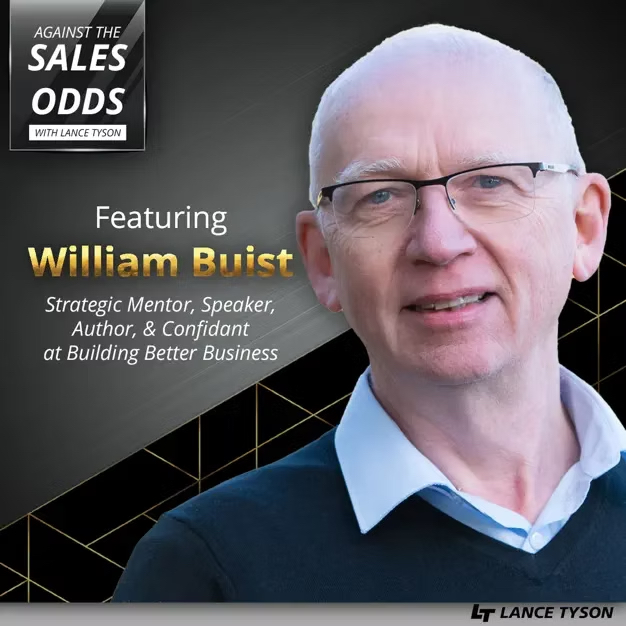
Intentional Mastery With William Buist: Mentor, Speaker, & Author

True mastery isn’t a destination, but a deliberate journey where expertise, purpose, and joy intertwine to build better businesses and a more fulfilling life. In this episode, host Lance Tyson sits down with William Buist— speaker, mentor, and the author of Intentional Mastery. Together, they discuss the art of intentional mastery and its profound impact on building better businesses. William’s latest book serves as the foundation of the discussion, where he explores the three distinct phases of intentional mastery – the beginning of mastery, masterful strategies, and mastering joy. William also brings us through his journey (the joy you have to find in it) and the meaning of powerful words such as purpose, communication, skill, and strategy. This episode is brought to you all the way from England! Tune in now to align passion with purpose on your journey of intentional mastery.

Listen to the podcast here

Intentional Mastery With William Buist: Mentor, Speaker, & Author

I’m really excited about this episode. I’d like to introduce William Buist. He’s a speaker and mentor. He wrote a book called Intentional Mastery. I thought having William on this episode would be important because so many of our clients at Tyson Group and people who tune in to our show are looking to grow their own businesses or lead their businesses to be more successful. It could even be some folks who are in sales who are looking to ultimately advance their career or journey.

William, welcome to the program. I appreciate you being on from the UK.

Thank you, Lance. It’s great to be here. I am looking forward to a fun conversation.

William and I were catching up. I was telling him I was sucked down a rabbit hole of watching the History Channel show Vikings for the second time. A lot of it is about the history of England and things like that. I was telling him I was familiarizing myself with different locations in England. You said you’re right between where again?

I’m in between Oxford and Newby, right in the middle of England. It is a little bit North of the M4, for those who know that major motorway across the country.

As we were talking about your speaking business and mentoring, and we’re going to get into your book, what got you to a spot where people were acquiring your services and your advice? What got you here to write a book?

I started my own business in 2004. It was after a career in the insurance industry where I’d been running some big projects and putting teams together within a large organization in one of the big British banks. I got to realize that running a big project in a large organization is like running a small business on your own. I found that quite exciting, so I set up my own business.

There was an awful lot to learn early on. There were lots of things from the outside that you think will be easy to do and they’re not that easy. You have to learn, do the miles, and get the experience under your belt. That got me curious about how people, developers, or business owners become the experts and masters of what they do. What do those things look like? What effort do they need to make to make those transitions? Through the years that I’ve been running my own business, I’ve been watching, listening, and asking questions about the businesses that I’ve worked with to understand that transition and that journey. I got to write it all down as well in the book. That was quite exciting, too.

I‘m always curious about titles, being an author myself, I always go back and forth. I’m like, “Is this the right title? Does this represent the pathway?” You chose intentional mastery. Why that?

You’re right. We went backward and forward with my publisher, to and fro, playing with different possible titles. All of them were related to mastery in some form or another. The two words are important. First of all, mastery is about something that’s more of an expertise. We’ve all probably met people who we can recognize have got something special in the area of knowledge that they are specialists in. They stand out. They’re not just an expert. They are probably the experts. They are the world experts or the ones who are right at the top of the game. It’s usually something very narrow. We were talking before the show. You had a great example of somebody who’s a specialist in looking after log cabins.

That’s right.

It’s possible to narrow down the niche to something really small but know everything there is to know about it and then become well-known for that.

The more I thought about the log cabin example in your business, especially the title of the book, what is interesting is you look at these people who are expert goalkeepers in sport. They’ve mastered that. It could be somebody who’s a speaker on botany and they get paid millions of dollars to go speak on botany. I’m making that up. In the US, there’s a saying called the riches are in the niches. We say niches in the US, but that’s niche. When you say niche, you’re right there. By intentional, do you mean on purpose?

The intentional part was a recognition that when I looked at the people who had become masters, it wasn’t something that happened accidentally. It happened because they made decisions early on as they were developing. They were thinking, “What do I need to do to get more knowledge, skill, and experience in this topic?” Also, they were intentional about narrowing it down.

Football is a great example. You look at the Premier League in the UK. This is soccer we’re talking about here. This is the round ball rather than the oval one. There are players who play the front and the attack or strikers. There are players like goalkeepers who are there to stop the other team from scoring. They’re very different skills. If you take a goalkeeper in the premier division, he’d be mediocre if he was out on the field because his expertise is in soccer but his mastery is at goalkeeping.

The other thing about mastery is things happen organically for a reason. As I was talking to you about how I was learning the map of England watching the show, I even thought about that show and thought about the trades and somebody who forged a sword. You talk about this in the book. You talk about the journey in the book. Mastery is not something you do. It’s something you arrive at through a journey.

If somebody was forging a sword, and not to genderfy this at all, you’d be an apprentice or journeyman, and then ultimately, you’d become a master. People would come to you because you were the master of making a sword a certain way. Is that where the mastery part came with the title also? It’s a strong word.

The intentional part is that you can’t make those choices about which niche to choose without being intentional about it or without making a conscious decision. If you’re a school kid playing football, you might play in all the positions. There’s a point at which you say, “If I’m going to be really good here, I need to make a choice. I’m going to be a goalkeeper. I’m going to be a forward.” That’s the intentional part, and then you develop.

Intentional Mastery: You can’t make those choices about which niche to choose without being intentional about it, without making a conscious decision.

The words you used are great. I talk about people who right at the beginning of the journey are explorers. They know nothing, so they’re looking for knowledge. As they get that knowledge, they start to develop a bit of the skill. They are what I call novices. Novices make lots of mistakes. They learn from those mistakes. They’re building and developing the skill in the first place then they become practitioners.

Most of what we do in most things will be at the practitioner level. Our employees in the businesses of teams are good at what they do in the context they do it. They’ve got skill and knowledge. They’re doing a great job every day. Maybe what they need to move to expertise is experience. It’s no surprise to me that those two words, experience and expertise, are closely linked in terms of the origins of the word. The experts will have used that experience to be able to take and do the job, whatever it is, in almost any circumstance.

I agree. It’s interesting that you’re saying that because I’m big on the meanings of words. Too many people throw words around and they don’t know what they mean. I was talking to a group of executives. We were talking about decisive. They kept throwing that around like, “We got to be decisive.” I said, “Do you know what that word means in Latin and Greek?” They said, “No.” I said, “That means to cut off from.” It’s very similar to the word incision. It means to cut from. When you make a decision, you’re cutting from any other possibility. The word is very strong. Are you ready to make a decision or are you toying around with this? Your use of words there is outstanding.

For the audience, as we were talking in our pregame, William and I were talking about an example. My wife and I had made an investment in a log cabin. I didn’t know anything about log cabins and quickly stated. I realized that every year, for three months of the year, we battle carpenter bees. I noticed there are holes in the cabins. I sought out somebody who was an expert in log cabins. I didn’t realize that was a whole business.

When I talked to that gentleman, he did something else. He built a log cabin and decided there was a better way and make these connections. He would practice and they gained the experience. He is the foremost expert or the master. There are probably only ten of them around the world when I researched. You happen to be close by. That is that journey. That’s a wonderful example. Nobody thinks through it that way. They think they’re going to arrive and be this expert or master. It doesn’t happen that way. It takes a while.

We can end up in a career where we are doing a great job for the business. We are part of a great team doing great stuff. We’re doing the same things every day. Unless we step out and start saying, “How do I get new experience? How do I do this? The fact that I’m doing it in a way that works doesn’t mean it’s the best way. How do I get new insight?”

One of the things with mastery as opposed to expertise is that the masters are bringing insight from other aspects of life and other things they come across. As an example, you were talking earlier about the Vikings and watching the program again and learning about European and British history. There will be some insights that will trigger a thought in you about selling the coaching that you do that enables you to think, “There’s an analogy here. I can draw something from the way the Vikings built swords and apply it in the context of making a decision.”

If you make a sword with a strong blade that is sharp and stays sharp, you can make more decisive decisions and make them last longer. There’s something around that. With what the masters do, they make those connections that help other people to get hold of the understanding that they need. Your expert in carpenter bees, I’m sure, was explaining to you what was happening, what they were doing, why you needed to take action, and what sort of action you could take but in the language, you could understand without the knowledge that he has from the years of work that he has done it. That’s a little piece of mastery, too.

That is a great lesson there. As I was looking at your book, I was reflecting on myself and where my business is. I announced to my executive team that I was going to start to take a little bit of a different role in the business. I called it the five Rs. I was going to focus on Revenue, Relationships, Recognition, Recruiting, and the last thing was Refinement. That was a refinement of the whole business.

As I decided that I had to master not being Lance the salesperson or the trainer, and I don’t do all of our training because I do probably less than 20%, I realized with some of that time being spent, I got to master scaling a business. You broke your book into three parts. The first part is the beginning of mastery, and then you said masterful strategies and then mastering joy. Talk a little bit about that first grouping. I like that you broke it up and there are chapters inside of each of those sections. There was a flow to me there that I noticed immediately.

I think of that first piece in the beginning of mastery. You said, “You have to decide that you’re going to build a better business because your audience is those small to mid-size businesses and the people that operate those,” so those masters. You talk about the concept of mastery and then you get into purpose. Talk about that section. If you’re me as Lance the business owner or the present CEO of a small to mid-size training company, talk to me about that first piece.

The first chapter is about building a better business. I want to make it clear that better isn’t something I’ve defined. I’m not saying that there is a form of better that everybody should aspire to. Better is a very personal thing. For some people, a better business is a bigger business. For other people, a better business is one that gets better reviews on Trustpilot from its customers. It might be one does better in environmental work. It could mean any number of things to a business owner.

The first part of that first section is encouraging people to step back and think, “What does better mean for me and my business?” You’ve touched on that. You said you wanted refinement. The piece of what you talked about is about making your business better. You want to refine it. That’s important. The second part of this is thinking about why that is important. What’s the purpose behind that better business? What skills does it need? What expertise or mastery does it need to make that change to make it a better business? That’s what that whole first section explores and encourages people to think about and challenge themselves to define it.

As I read that, I said to myself, “What I feel William is saying to me at this point is I have a current situation and there’s a desired situation. I have to address the fact that there’s a gap there.” If that current situation and the desired situation are close together, I’ll probably do nothing. That might not make me a master. That might make me an operator. If the current and desired have a gap there, I’ll want to make that journey. It’s the should-be or the could-be or however you say it. Would you agree with that at some level?

Yeah, I do. This is why purpose is so important. You won’t make that journey if it’s not important to you at an emotional level as well.

Purpose is so important because you won’t make that journey if it’s not important to you at an emotional level as well.

From there, I like the next grouping. I was listening to something. It was masterful strategies. I was watching an interview. There’s a military leader in the US. He has a really good and colorful name, which is Mad Dog Mattis. He was the Marine Commandant during the Trump administration. I don’t want to get into politics. He was the Secretary of Defense and had left the organization. He had a lot of good quotes. He wrote a book that is on my list that I’m going to read.

He said that strategy is about priorities. That struck me. I put it in my Evernote. I said, “Your strategy is about prioritization.” Everybody looks for those 1 or 2 things to make something complex very simple. You said masterful strategies have six components. One is strategy, self, skill, system, and sales. I jumped on this word, which is signposting. I was like, “What the heck is signposting?” I read it and I go, “That’s like marketing.” It was a different word than I heard. We were talking about the difference. Even though we both speak English, some words mean little things differently. Talk about those masterful strategies a little bit.

I’ll start with the signposting thing. It is marketing, but it’s more than that. It’s thinking about all of the ways that the business communicates with its stakeholders. That might be marketing to new prospects, but it’s also about how you construct your communications with customer service emails and all that stuff, too.

I talk about signposting because a lot of businesses try to tell their prospects everything all at once. If you imagine driving down a freeway as you would in the States or a motorway as we do in the UK, if every destination that you could go to on that freeway was on every sign, you would never be able to read them all. They’d be far too complicated.

What we have in the UK, we have signs that say things like, “The West,” on the M4. If you’re heading out of London towards the West Country, it says, “The West.” That’s telling a driver that they’re on the right road. If they’re intending to head West, they know they’re on the right road. That’s okay. They don’t need to know that it’s near Bristol until they’re near Bristol. What I’m talking about in that section of the book is thinking about your communication so that you tell people what they need to know, but importantly, you tell it to them when they need to know it.

That was a deeper dive for me. Talk about some of the other things. I get excited when you say sales. Anything around sales, I wag my tail. Talk a little bit about the other connections there.

A business without sales isn’t going to last that long, so it’s really important.

A business without sales isn’t going to last that long.

I tell my customers all the time, “Sales solves a lot of problems.” At the end of the day, make a sale and everybody is happy. We had the youngest person on our staff. Her name is Stacy. She’s one of our newest salespeople. She made the first big sale of her career by herself with no help. She was ecstatic. Sales cures a lot of ails.

She’ll remember that first one for a long time.

You’d be proud of us. We celebrated on Slack. We called her. She’s out in California and we’re here. She was pretty jacked up about it. It was good stuff.

That leads to one of the other strategies, which is about good systems and having the means in place in the business so that you can be consistent. Good systems will make sure that if you’ve got great customer service, every customer gets it because you’re finding the same pattern.

A predictable process yields predictable results. I say this a lot of times and some people don’t realize it. I go, “Isn’t it amazing that there’s a company out there that produces millions of dollars per store and it is run by teenagers?” Somebody says, “Who’s that?” I go, “McDonald’s. McDonald’s is run by teenagers. Every store is run by a teenager. Do you ever think of why they’re so successful?” I was saying to one of my sons, “It is because everybody that works there knows when the beep goes off to take the fries out of the bin and pour a little salt on the box.” The systems are predictable. It’s a franchised way to think, but I agree. The system drives success.

Whether you love McDonald’s or hate them, you know what you’re going to get. The systems thinking in a nutshell works really well. Two others then. Skill is clearly important. You need not just the skill that you are a master in, but a business needs a whole range of skills. It’s got to be able to sell. It’s got to do customer service. It’s got to have accounts, be able to collect money, and all of those other skills. We’re not going to be good at all of them. Doing an audit and cross-checking that you’ve got all the skills you need in the business or maybe you buy in and outsource with other companies to provide them is an important strategy to make sure that everything runs smoothly.

The last one is the most important. It’s about the business owner and the business leader themselves looking after their own emotional awareness, their physical well-being, and their mental resilience. If you’re running a business and you’re not there because you’re ill, the business isn’t going to run as well and might even fall apart completely. You’ve got to be reasonably fit and healthy. You’ve got to be looking after yourself. One of the things I’ve seen over the years I’ve been running my business is the businesses that are successful have got healthy people at the helm.

Intentional Mastery: The most important thing about the business owner or the business leader is looking after their own emotional awareness, their physical well-being, and their mental resilience.

I would agree with that. I talk a lot even with my own clients about how it is pretty hard to lead an organization if you can’t lead yourself. It’s almost stoic thinking. Seneca said it. You’re going to struggle leading other people if you can’t lead yourself. That’s a holistic approach. It’s health and mindset. I was saying something to one of my clients. She was upset about some things. She was upset about her dating life and what was going on internally.

She goes, “I can’t even get this right.” I said to her, “Sometimes, your mind is like a bad neighborhood. It’s not good to be alone in it sometimes. You might need to talk to some people more about all kinds of things than this because you get so hyper-focused. It’s offsetting your personal life.” That’s where she was going.

It’s a really important point. It’s important for all of us to have the opportunity to take time away. Some things will bring us stress. If you run a business, there will be times when it’s stressful. There’s no escaping that. You need that time to step away and say, “What gives me joy?” It leads us into the last part of the book as well.

I’m sure your clients are always looking at markers that drive success. There are very natural markers like what’s revenue, what’s our profit margins, and all those things. There are two simple questions. I always ask one question. What’s your brutal truth? You could be like, “What do you mean?” What’s your brutal truth is your business or however you want to answer it. I don’t care. That’s not positive or negative.

With the other thing I always ask, you probably know this. I don’t know if you’ve ever thought about this. It’s interesting. I rank my own business. I have successes. How long could I go on vacation before the business turned into Lord of the Flies? It’s easy to say to go, but can you leave because you have your fingers and everything? I ask decision-makers all the time, “Could you go away and relax?” I know for myself, it takes three days before I calm down and unplug. Would you agree with that at some level?

Absolutely. My partner and I both enjoy skiing so we take time in the winter to go away skiing. The first day or two, there was always this hangover from the business. It is like a hangover. It’s like having drank too much the night before. There are all these things in your mind that you think, “I wish I’d done that before I’d gone away. I wish I cleared that bit up. Don’t send that email.” Nobody is really that worried about it.

This one thing is not going to kill it. If everything is a priority, nothing is a priority at the end of the day. Let’s get into that joy. You said making a difference, sharing insight, and being yourself. There were concepts in that very third section. Talk about that piece. You picked a word there that when I looked at the word, I was like, “I don’t know if I love the word joy.” As I started to read it, I thought, “I can understand why he wrote it that way.” Talk about that.

I don’t think being masterful or being a master at something could ever happen if it wasn’t something that brought you a lot of joy as well. It’s knowing that you’ve done a great job. I can see from our conversations and reading your books how much sales means to you. You are getting to see the joy in that whole process and in helping people to become better at selling. You talked about the person in your business who has made their first sale. I could see the joy and the pleasure you were taking from their success. To me, that’s the piece around mastering joy. If you are bringing something to the world through your talent and the skill that you’ve developed over a lifetime, it sure as hell should be bringing you joy. Otherwise, what’s the point?

Being masterful or being a master at something may not ever happen if it wasn’t something that brought you a lot of joy as well.

Intentional Mastery: Step Beyond your Expertise and Build Better Business by William Buist

Would you type pride in work to that joy, too?

Absolutely. Sometimes, people look at people who are making a big deal of the great work they’re doing and might even think it’s a little bit arrogant. This is about recognizing the effort that you’ve put in to get there.

Also, as I read through this, I hate to be the 50-year-old who says, “When I was younger, etc.” I don’t buy into that. As we all get older, it looks a little different and feels a little different, so it had to be different. I look more at what’s the same every time than different. Even coming up through the ranks myself, you would look at somebody who was a master at something or successful at something, however you defined it, and think sometimes they arrived there. We don’t respect the journey. If you said the current situation is everything from now and what has happened in the past, the history, there is pride of ownership and in delivery.

The guy that did the log cabin, we’ll go back to that. I might have to throw his name out there. He had great joy in educating me. I know more about log cabins. I know what’s great about my log cabin because he took pride and joy in educating me about log cabins. It wasn’t a waste of time because he made it sound interesting. He was an expert. He was a master at that. He even said, “Your log cabins look like Lincoln logs. Do you know what that means?” I go, “No. What does that mean?” They were set like one log was engineering another. He goes, “This is a good log cabin. It was engineered really well.” I’m like, “That’s great. I made a good investment.” I felt good. He took that pride in things.

I love our conversation. As you’re reading, there are the beginnings of mastery of purpose and intentionality with the title, then there are strategies. The strategy I took is you have to be able to lead yourself at some level and then know the direction you’re going. That last thing is you make a difference and have joy about it and have pride about it, but that comes from the journey. You don’t arrive there one day because it’s all on purpose. I appreciate you being on. Where can my audience connect with you and buy your book? If they wanted to ask you a question, how would they do that?

Thanks, Lance. I have an unusual surname. You can find me on LinkedIn. There are only 1 or 2 others with that surname, so I’m quite easy to track down. WilliamBuist.com is my website. You can reach me there. As far as the book, you can get the book on my website. You can find links there to buy that or it’s available at Amazon. It’s on Audiobooks as well. You can have a few hours of me reading the book to you if that’s your favor. It’s on Kindle too.

William Buist, Intentional Mastery: Step Beyond Your Expertise and Build a Better Business, I appreciate our time. I’m sure we will stay connected. Thank you so much for being on the show.

That’s great. Thank you very much, Lance. It was lovely to talk to you.

Important Links

William Buist Intentional Mastery LinkedIn – William Buist

About William Buist

William Buist enables business owners to become the masters of their markets, operate more effectively, and stand out from all their competitors. With a strategic focus on building better business daily, his clients are at the heart of their work, making better decisions and empowered to excel.

William thrives at supporting his clients as they develop a better, resonant understanding of their strategic intentions to create a company that is more aligned with their purpose. He knows that by asking the right questions, effective decisions will result. Those judgments will be based on a deeper, more complete understanding because of an unbiased analysis of the appropriate elements.

William prides himself on his well-honed skill, posing questions that unlock blocks and barriers. William is a speaker, business mentor, and author of “Intentional Mastery: Step Beyond Your Expertise and Build Better Business.” He is a keen photographer, walker, and skier.

William Buist works with business owners so they become masters in their markets and stand out from competitors. Through a daily focus on building better businesses, clients make better decisions and are empowered to excel. William is a speaker, author, and business mentor and enjoys photography and skiing.

Cracking the Code of Sales Leadership in the Software Industry

In the high-paced world of software, sales leaders are feeling the heat. The industry’s rapid evolution, the emergence of cutting-edge technologies every other day, and the unparalleled competition are all factors that make the software business thrilling. Yet, for the leaders navigating this storm, it’s a constant battle against some daunting pain points.

If you’re a sales leader in the software realm, you’re probably nodding in agreement. Tyson Group has been on the frontline, helping sales teams increase productivity, lower sales cycle times, and increase close rates. Drawing from our award-winning experience in sales training and consulting, let’s dive into these pain points and throw light on how to tackle them.

1. The Ever-Evolving Software Landscape

The software world is in a perpetual state of flux. What’s cutting-edge today may be rendered obsolete tomorrow. For sales leaders, this means constantly staying updated and ensuring their teams are not just selling a product, but selling the most current and relevant solution.

Solution: Prioritize ongoing education. Invest in regular training, webinars, and workshops. And remember, it’s not just about product knowledge; it’s about understanding industry trends, emerging technologies, and potential market shifts.

2. Understanding the Tech-Savvy Buyer

Today’s software buyer is informed, tech-savvy, and has probably seen a dozen alternatives to what you’re offering. Pitching to them isn’t about listing features anymore; it’s about delivering solutions to their unique problems.

Solution: Adopt a consultative selling approach. Dive deep into understanding the prospects’ pain points, business objectives, and tailor your pitch accordingly. Your sales team should be adept at problem-solving, not just product-pushing.

3. The Talent Conundrum

Finding, training, and retaining the right talent has always been a challenge. In the software industry, it’s even more daunting, given the complex nature of products and the need for salespeople to possess a blend of technical knowledge and soft skills.

Solution: Focus on continuous skill enhancement. Partner with training organizations (like Tyson Group) to design customized training modules. Cultivate a culture of continuous learning and offer incentives for those who take initiative in their professional growth.

4. Managing Lengthy Sales Cycles

With software, especially enterprise solutions, the sales cycle can be long and arduous. Managing stakeholder expectations, navigating procurement processes, and handling legalities can stretch the cycle, leading to frustration and dwindling morale among sales reps.

Solution: Implement a robust CRM system and streamline the sales process. Establish clear milestones and celebrate small victories along the way. Regularly communicate with your team about the bigger picture and the value of persistence.

5. Navigating Price Wars

With a plethora of software solutions available, there’s an inevitable downward pressure on prices. While it’s tempting to slash prices to win a deal, it can be detrimental in the long run.

Solution: Position your product or service based on value, not price. Ensure your sales reps can articulate this value proposition compellingly. Train them to handle price objections by focusing on ROI, long-term benefits, and the unique advantages your solution offers.

6. The Blurred Line Between Sales and Customer Success

In the software industry, the job doesn’t end with a closed deal. Customer success has become an integral part of the sales process. Sales leaders now have to ensure smooth handoffs and continued client satisfaction post-sale.

Solution: Foster strong collaboration between sales and customer success teams. Encourage open communication, share feedback, and ensure that both teams are aligned in their objectives and strategies.

In the tempestuous seas of the software industry, sales leaders face challenges that can seem insurmountable. But with the right strategies, tools, and mindset, you can not only overcome these challenges but also thrive amidst them.

Tyson Group understands the unique struggles of sales leaders in this domain. Our award-winning training and consulting solutions are crafted to address these pain points head-on, offering actionable insights and results-driven strategies.

In the end, remember this: Every challenge is an opportunity in disguise. And in the world of software sales, those who adapt, learn, and evolve are the ones who come out on top. Don’t just sell software, champion solutions.

Dan Lefton On Calculating Risks And Putting People First

In this episode, Lance Tyson has a profound talk with Dan Lefton, Chief Revenue Officer and EVP of the Detroit Pistons. Dan walks us through his professional journey, from his time in Philadelphia, to what landed him in Detroit, and everything in between! He brings tremendous wisdom not only from his mentors but also from his own personal experiences, from calculating the right amount of risk to standing his ground on issues that matter. One of Dan’s highest priorities is making sure he and his team provide solution-based thinking for partners and clients, and always putting their needs first.

Listen to the podcast here

Dan Lefton On Calculating Risks And Putting People First

This is one of those episodes that I’m talking to somebody I’ve known for a while and we have a lot of laughs with each other. We both pride ourselves on being extremely good negotiators and we are always elbowing each other. I’d like to welcome Dan Lefton, Chief Revenue Officer for the Detroit Pistons, to the show. Dan, how are you doing?

I’m great, Lance. This is long overdue. I am looking forward to doing it.

We’re having dinner not long ago talking about this. I was like, “I can’t wait for this one.” I know the audience. Everybody knows what a chief revenue officer does, but my experience is different titles wear different hats. Tell everybody about your role now, how many people report up to you, the major goal of your job, and major KPI.

As you noted, there are a couple of traditional verticals that roll up to me, all revenue-driving. Our corporate partnerships department and engagement and service teams are under my purview. All ticketing, hospitality, and service as well. The one piece that might be a little bit different is that all of business intelligence is under my purview.

I love having that piece because our business intelligence unit is a couple of things that you might find interesting. One, that is one team within the Detroit Pistons that is 100% remote. When you think about coming out of the pandemic and what are some things that have changed, that team’s completely remote. We’ve got people from all over the US who are part of that team.

That team serves as an agency of record for the organization. Certainly, the majority of the time, they’re supporting revenue, helping with ticketing pricing, distribution strategy, the partnership side, providing research and insights, and then for the rest of the organization, whether it be finance, legal, or HR, providing support as well.

It sounds like the BI team or the Business Intelligence team is a little bit of a linchpin to help the organization turn or be agile.

The great part of it is with them having their proverbial hands within the organization and being sticky, it allows for that connectivity. Sometimes, you’ll find this in organizations, and we’re all guilty of this. As best as possible, it eliminates the silos that sometimes occur.

It does because you have real-time information and you’re making decisions not off of the field. The organization that owns the logistics and the strategy or the professionals that major in tactics are the amateurs. It definitely forces that. All in, how many souls report to you?

I’m lucky enough to have about 60 people under my purview.

How many direct reports up in your org chart, you personally?

It’s six that directly report to me, mainly the vice presidents of the different verticals.

You got to the Pistons in what year and in what role and then you’ve been named Chief Revenue Officer, correct?

As we go through my background, you’ll see a consistent theme that you can go home again. I had the pleasure of being at the Pistons when sports and entertainment were in ‘03 to ‘07. What you’re referring to now, back in June of 2021, is when I returned to the organization. When I joined the organization, I was Senior Vice President of Business Strategy. At that point, all the verticals I talked about at the outset were under my purview with the exception of the partnership team.

We’ll talk about that because you’re managing two different sales processes. One is a very consultative sale and the other is a B2B high-volume sale at some level, but it’s two distinct ways or places to sell. Let’s start off because you and I have known each other for many years at this point when I’m thinking back to New York, and we are both Philly guys, which is exciting. Coming out of school, how did you get into sports? What’s your first sales job? Is it a sales job? What does that look like?

I’ll dive into the background, but I thought you’d get a kick out of two stops in my sales career and sales being in my blood from the jump. One is junior year of high school, there’s a company called Junior Achievement. They broke the class into two different teams and you had to form your own company. I was fortunate enough to be voted President of the company. The name of the company, which I think you’re going to like, was called IBUSTTRAC. Early in my career, I’m already getting the acronyms in there. IBUSTTRAC stands for Intelligent But Unmotivated Students Trying To Run A Company. Sarcasm started it early for me.

At least you were in branding pretty early.

What we wanted to sell at the time was bottle openers that had our school logo. Right away, the principal shot that down. He’s like, “We’re not pushing beer products. Junior Achievement’s going to give us a grant. What are you guys thinking?” We then wanted t-shirts. The other company won the coin flip. Early in my career, I got comfortable with losing when it comes to luck, team performance, or any of that.

We wound up selling beach towels and we set the record for Junior Achievement. They couldn’t even produce the amount of towels that we sold in time. There were people who ordered towels. A year and a half later, and I’m in college at this point, and friends of my parents are like, “Was that a donation thing, or are we ever getting these beach towels?” That was my first foray into sales. I thought you’d appreciate that.

The second one was the summer of my sophomore year. I worked at a telemarketing firm. The reason I bring this up is twofold. One, what I was selling was 90-day trials for postage meters. Anyone who knows Lance on this show knows you hate sales scripts. On my first day, I was handed a 47-page sales script. I had to earn a few dollars so that I could go out and have some fun with my friends over the summer.

Now you got the Magna Carta.

“If they say this, then say that.” It was a foreign language. Fast forward, I decided, “No, I’m not doing this,” for a variety of reasons. I go, “This is summer. This isn’t school. I’m not studying.” What I was fascinated by was hearing the people around me and what they were saying on the phone. The ones that were following the script was click, next call.

There were 1 or 2 people. There was one guy. He was reclining in his chair. He had his feet up on the desk. He probably could have been a little bit more courteous to our manager walking the floor at the time, but he was breaking through and he was getting sales. Once you got a sale, all you needed to do was get somebody to say, “Yes, sign me up for the 90-day trial.” I went home that night and started tearing up the sales and I said, “It’s not a sales script. I need an outline. I need to do my homework. What are the reasons why someone could benefit from having a postage meter?”


Calculating Risk: Once you get a sale, all you need is to get somebody to sign up for your available trials.

I quickly found out none. All I needed to do was basically find a way to tell somebody, “This is a zero risk. Why don’t you sample it? That’s the best way you’re going to find out. I can tell you all these great benefits. I can do a needs analysis, but at the end of the day, why don’t you try it out? It doesn’t cost you anything.” I quickly became a top salesperson that summer alone. I outsold the person who had been there the year prior and was number one in the entire Northeast. I got that taste pretty early on.

Now, your original question. I started my career in college athletics, which I highly recommend in the sense that, akin to minor league sports, you’re doing everything. You run lean. My first job at Temple University was in marketing and promotions. It sounds glamorous. Most people out of school want to work in the marketing department. What I did for the first three months on the job was staple papers. I literally spent three months just stapling packets and making sure everyone in the office got one.

I said, “This is working in sports?” I step back and I go, “This is pretty good. When I’m out with friends, I can say I work in sports.” That job quickly pivoted to putting me on the phones. At the time, Temple University was going to be voted out of the East and the football program needed to average 20,000 fans a game. It didn’t matter if it was paid or comped.

We started a program called the Bobby Backer Bus Brigade. Bobby Wallace was the coach, highly touted, and had a lot of success at Division 1AA. I was calling people to send a free bus wherever they wanted to go and bring them to the game. The goal was to bring 50 buses to the game and we started having some success. There were some games where we were bringing 1,000 buses a game. You can imagine the expenses that rolled up, but that was my first job out of school. That transitioned in Temple University to ticket operations where I got my first taste of the box office and how important ticketing connectivity is in general.

How long were you at Temple?

I spent four and a half years at Temple University.

Were you an alum of Temple?

I wasn’t. I did my undergrad at Penn State. The great thing about working at Temple is they paid for my Master’s. I got my Master’s in Sports Education.

At the end of the day, you probably came out on the better end. I’m starting to see a theme here. You go back to your Pitney Bowes days, which is interesting, knowing you as a leader. With you, it’s always like a simple genius. What’s the most direct path? That obstacle sometimes is the way because that’s what you did with that script. It sounds like you’re also very mission-oriented too. When they hired Bobby Wallace, I was racking my brains thinking about it because I was like, “They finally got a good coach,” and it is Temple at the end of the day. No offense, Temple fans. I used to have Temple basketball tickets. I get it. I was always a big John Chaney fan.

When I was doing ticket operations, he wanted to make sure the only thing he cared about was that I didn’t mess up the four comps that he had behind the bench.

It’s important. You got to know where your bread’s butter is. From there, you go where? What’s the next move?

I was Director of Ticket Operations, which was an amazing opportunity given to me. In my mid-twenties, I’m running ticket operations. It sounds glamorous. I was a one-man band. I was a student worker. I knew I always had the dream of working in professional sports, especially the NBA. I had a great love for the game. I grew up a Sixers fan. I honed in on this website called Teamwork Online.

My boss at the time at Temple joked around and said, “Teamwork Online, that’s a resume graveyard.” You talk about being from Philly, the gentleman who called me when I applied to a bunch of different jobs, I applied for a job at Palace Sports Entertainment because I didn’t even know Detroit, Michigan. I was like, “I know Michigan football, but I didn’t know much about it.”

I applied online, and a guy by the name of Joe Barber called me because Joe grew up in the Northeast in New Jersey and was like, “It’d be cool to have somebody from the Northeast here.” I winded up getting hired in the group sales department working for a woman by the name of Sarah. I spent about four years at the Pistons and worked my way up to premium sales.

I had no clue that you had once worked for the Pistons. That’s news to me. Not that I’ve crept into your LinkedIn profile to see that, but I did not know that at all. You’re very familiar with Detroit. I didn’t realize you’ve lived there. Were Estes and Draco still at Powell’s at that point or they had exited?

They had left at that point. Tom Wilson was the President and CEO, one of the visionaries in this business.

Was Powell still in the Tampa Bay Lightning at that point?

Those guys were there. Correct.

You started group sales, which no offense to any group salespeople. Once dubbed a group salesperson, you never break your way out of that, which is interesting. What’s that transition look like at Palace?

In my career, as we go through some of the background stuff, I’ve been very fortunate to break some of the molds.

They’re box office people.

Sometimes, all the grumpy box office person. For me, it was learning another skillset and realizing how important it was understanding the connectivity.

Did you make the jump because of pay or were you ready from Temple?

I made the jump because I wanted to get into professional sports.

It was a career move. It wasn’t like, “I’m worried about pay. I’m worried about anything else.” You’re right, Detroit from Philly. It might as well be Mexico City, as far as I’m concerned. You’re not even thinking that on the East Coast.

You bring up a lot of good points. One, that move was two steps back to take the eventual one step forward. I was a Director at Temple, went in as an account executive, pretty junior. The only inside sales was “on the org chart” a little bit lower. The thought of from a pay standpoint, as a Director of Ticket Operations, I wasn’t independently wealthy. It was salary. It was no commission. Whereas I was going to a low-salary job and it was 90% commission.

It was a huge leap of faith not knowing anyone except for one person in Michigan. If you gave me a list of states, quite frankly at the time, and almost ignorantly, I probably would’ve put Michigan near the bottom of the list. The four years I spent there were some of the most rewarding and all the great things that Michigan and Detroit proper have to offer.

It’s interesting because I’ve trained more Millennials and Gen Z-ers than anybody could possibly imagine. I’m the guy who’s training all the younger folks. I think generations are more similar than they’re different. One thing about this generation is people want quick moves. At this point, you’re late twenties because you’re out of school and you’re over the midline. You take essentially a step backwards. At that point, a young Dan, is that a calculated risk? Were people telling you not to do it?

I need to bifurcate it into the family and friend circle versus industry people. The family and friend circle, “You’re going to be a plane ride away,” or, “What are you thinking?”

I got my Philly cup here. Especially Philly people, you talk about parochial, you move from Yeadon to Media. In Delaware County, you might as well move across state lines, so I can imagine.

Industry people were interesting. Dave O’Brien, the late athletic director and probably what turned into one of my first mentors in this industry, along with Chris who gave me my first start in sports, they both had a different take on it. They said, “Where do you want to go?” Dave said to me, “Do you want to be an athletic director? If you do, don’t leave.”

Chris said to me, “How much do you believe in you?” I said, “Excuse me, Chris?” He’s like, “How much do you believe in you?” It stuck with me because, at the end of the day, you got to bet on yourself. There’s going to be a lot of different times where you’re going to have options. One isn’t necessarily better than the other on paper. It’s more what’s best for you at that time.

There will be a lot of times when you will have options that aren’t necessarily better than the ones on paper.

For me, knowing that I wanted to get into professional sports, when I was at Temple, I sent out 126 resumes. I know people don’t send mail anymore, but that was every NFL, MLB, NHL team and NBA team. I heard back from 3 of them and 2 of them wanted to offer me an internship. You want to talk about taking a step back. The other one wanted to offer me a job where they were going to pay me $200 a week. Now I’m having the Pistons call me from applying online. I got to jump at this chance.

The other thing too, and I think it’s interesting if you’re reading this, is whether you’re in the pro sports industry or not, and this is not a knock on Dan, you’re on the pro sports side and you see somebody from the college side, it’s not necessarily, “Let me get somebody from pro sports. That’s a great move for us,” thus why he gets less than a 0.5% return rate on 143 prospecting emails or letters. That’s interesting.

I got a quick question for you in terms of your theory in sales because I want to get into Dan the sales guy in a second. You got the junior achievement stuff and you’ve moved from Temple, which is a massive move. It’s not Penn State. It’s not an easy sell. Are you more of a gambler or are you more of an odds guy?

It is where I’ve evolved. I started earlier in my career as much more of a gambler. Now, I truly believe in art and science. Maybe that’s the experience I’ve had on the BI side of things. Understanding where it can help support the sale, why not shrink the odds? The other thing being a gambler and what the science won’t always tell you is you got to always ask for the big sale. You talk about when we first met, I remember when you trained the first team ever when we worked together in terms of them starting at the top. Do your proper needs analysis and let them work you down, but don’t start in the middle or at a lower price. You don’t know anything. Don’t judge a book by its cover.

Always ask for the big sale.

Let’s go back to Palace. Group sales, four years there, what’s the trajectory? Start talking about Dan the sales guy there because no doubt you have to sell.

It was hard and I wasn’t great right out of the gate. I humbly bragged about IBUSTTRAC and Pitney Bowes. It was a real adjustment for me. I had Sarah Daniels as my manager. We had 6 other sellers, and interestingly enough, 4 of them were female sellers. I developed great relationships with all of them. Early on in the way the Palace was structured, it was a competitive environment to the point where in the beginning, I was going to lunch by myself. I’ve always been a real social person, always friends with everybody and diverse of friends that I had.

I remember it was being at a Boston market and I’d been at the job about 60 days or so. I go, “I have no friends. This is ridiculous.” I’m struggling a little bit with getting appointments. I remember thinking, “You’re blowing this. You’ve always wanted to work in professional sports.” All these are terrible excuses. “All the important categories are spoken for. I started in September. A lot of the fan experience packages that group sales are known for selling are booked. What are you doing? I’m blowing it.”

I remember thinking, “I got to reset my process. I got to stop looking at what others are doing. How am I going to define success? Let me win a day. Let me win a week. By the way, it might be nice if I socialize with some of the people there. They could rebuke me, but what am I standing on ceremony for people to come to my cube and talk to me? Who am I?” I put myself out there, allowed myself to be vulnerable, asked a lot of questions, and admitted things I didn’t know.

Calculating Risk: Learn how to put yourself out there and be vulnerable. Ask a lot of questions and admit to things you do not know.

This is the first a-ha leadership moment. Sarah Daniel was an empathetic leader who cared and wanted to make sure that I was comfortable in my chair. “How are you getting adjusted? What are you doing on the weekend,” and spending part of my one-on-one time not criticizing my lackluster sales numbers? Fast forward a year later, I’m the top group salesperson. Not only am I the top group salesperson, but I’m moving my way up the board and competing with some people who have been there for 10 to 15 years. They moved me over to premium sales, where I got my first glimpse into selling high-ticketed items, sweet leases, and premium tickets. I spent about two and a half years doing that at the Palace.

You make the decision to go. You get into some bad head space. I’m not a clinical psychologist but we’ve all been there. You looked in the mirror and said, “I better wake up because this isn’t going to bode well for me. It’s actually not who I am,” which is understandable. We all go through it, especially when you’re in a new spot like comfort zones, and then you move your way up.

At that point, what was it about your style, your personal signature on how you sell, and what’s still the same now for you? You sell ideas now, and I’m pretty sure like most chief revenue officers I know, you’re involved in enough deals at some point to bring it across, whether it’s coaching or FaceTime, so what’s the signature? What’s still the same about it?

It’s developing a process and being able to identify quickly what are things not to do. Don’t double down on those, move on quickly, and take each experience. For me, the principle that has worked and carried through now is developing relationships. Really care and listen. I know a lot of times people will say that, but more times than not, we’re in a situation where we politely shut up and then wait for our turn to speak. It’s taking and proving to the person on the other side not only have you listened, but you’ve got a thoughtful diagnosis for what they told you. When you follow up, you’re integrating some of that initial conversation. Ultimately, a lot of times, most people’s favorite topic is themselves or their or their family, or you and I are talking about our affinity for Philadelphia.

There will always be some bond that unites you with the person you’re trying to sell. That clicked for me and it became relationship selling. Sometimes, that can have a negative knock where it’s like, “Are you only a service person?” No, it’s relationship selling. When that person says, “You’ve been fantastic, how can I help you? What can I send you? Can I send you a gift card?” no. The best thing you can do is load me up with referrals or tell other people how great the experience with the organization and working with me is.

I was going to tag you with a follow-up question like relationship selling is cliché, but you blocked me off before I was going to do it because I think you said something there I’ve never heard before and I hope everybody read it. If you’re going to be in relationship selling, it’s a proving ground. I’ve never heard anybody say it like that before. You’re right. It’s not what you can do for me. It’s what I can do for you. It’s like that. It’s not a service mentality. It’s, “Let me prove to you that this could be valuable for you.” I like that concept.

It evolved over time, and it’s been honed and fine-tuned. You say “What is it that I still carry with me now?” It’s that aspect of it. It’s where people sometimes get tripped up that are good enough to get through the gatekeeper. They’re able to have that dialogue. They’re able to do the presentation. It’s asking for the sale. It’s saying, “Lance, based on everything we’ve discussed, this is a great fit. By the way, here’s what I want you to pay me. Here’s why you’re going to derive so much value from this investment. Think about it as an investment,” versus, “Here’s how much it’s going to cost on an annual basis.”

That’s the mix that you said before. Sales is half art and half science. I’m going to flip it over. You go back to those four years when you moved up the ladder. Before you take another step, group sales, which is a little bit different sales than selling a high-end premium item, is more of a customized and herding cat mentality because it takes a lot of logistics to do that. The other one is like, “I want you to buy something expensive that you might not need for your business but would augment it,” or you personally, what did you suck at? What were you bad at? Maybe even to this day, you’re like, “I struggle with that or I struggle with it then,” at least.

As I think about it, I smile and I go, “Maybe there’s more than one thing that I got to rethink this.” Where I always have to continually remind myself is to slow it down in terms of letting it breathe a little bit. I know I’m a good company here. One of the things that resonated with one of the times you were training, rolling up your sleeves, and getting on a call. You’re going back and forth. You’re battling objections, and all of a sudden, you pause and there’s dead air. I’m like, “What is Lance doing? Is he okay? Do I need to check on him?” All of a sudden, the person felt the need to go on more because you weren’t satisfied with what they told you.

This guy’s playing three-dimensional chess. That’s been an a-ha and something I constantly remind myself of. Let it breathe. Even if it’s a reaction that you don’t want to get, don’t negotiate against yourself. Sometimes we’re so anxious to prove we’re knowledgeable about our product, “Here’s 8,000 things I jotted down. I did all my research before calling you.” It will take time. If you’re not being rushed off the phone or you’re not being rushed through an appointment, let it breathe. My wife’s a big wine drinker. I don’t indulge in wine, but they tell you when you open a good bottle of wine, let it breathe for a little bit.

Don’t negotiate against yourself and be too anxious to prove your knowledge.

It’s interesting you said that. We’re going through massive growth at Tyson Group to the point we grew 66%. I told the team that 2023 is going to be the year of think of like Jake Tapper’s Bar Rescue. We’re going to stress-test ourselves. We came out like a bat out of hell the first month of the year and we’re debating on an org chart on a couple of things at the senior team.

I had one of my senior team members go, “Stop trying to sell me so hard.” I go, “I’m not actually trying to sell you anything right now. I’m trying to speed learn you a little bit on some things you’re not seeing, but it’s coming off heavy-handed.” Let it breathe, let it resonate. I should’ve given her 24 hours like, “I’m with you.” I still struggle. I get very excited and I get enthusiastic.

That’s what happens. I get excited too.

They want to move the needles. You’re there for four years. Where do you land at the Pistons and then what’s that next turn?

The Pistons were generous and knew more about the industry than I know now. The NBA does this annual sales and marketing meeting and it’s usually all sales leaders. For whatever reason, as a sales rep, I had indicated to my managers at the time that I had an interest in leadership. They brought me to the league meetings. You don’t see sales reps usually at these meetings. It’s usually candidly VP and above.

I met a gentleman by the name of Fred, well-known in the industry. I remember having a conversation with him and he said, “Let’s stay in touch,” that polite throwaway line where it’s like, “We’ve talked for ten minutes. There’s 8,000 other people here that I want to say hello to.” We actually did stay in touch. He had approached me about what working together could look like.

Later on, you might ask me, “What would I tell my younger self?” I wasn’t patient. Fred, we had had a conversation. There was a job that was open. He called me and he’s like, “You can interview for it. I don’t think you’re the right fit because there’s going to be something better down the line, but I need you to wait a couple of months. I need to navigate a few things.”

The Washington Commanders had an opening to sales sweeps. I went there, and six weeks into the job, Fred calls me and he’s like, “I created a job for you. Many people think of sales and service as separate. I’d love you to come in and be our assistant director of ticket services. I’d want you to manage all of our courtside accounts, but I also want you to help our director manage the department.” I just signed a lease on a place. I was working for Washington at the time. Early on, I knew that wasn’t going to be long-term for me where they were as an organization. To their credit, I raised it with my manager at the time and he was like, “If you think this is a great opportunity, you should explore it.”

I was in Washington for four months, which I don’t recommend people taking a job because the New Jersey Nets were such a great opportunity. Quite frankly, in September of 2007, when I joined the New Jersey Nets, one of the pitches was, “We’re going to be moving to Brooklyn in the next year or two,” which we can get into. Fast forward five years later, Brooklyn actually comes about. Working for the New Jersey Nets changed my life.

Now you’re in a risk move because you took a job with Washington. It can piss some people off because any of us in leadership now put ourselves in that position. You showed some impatience, but it came to fruition. You leave enough of an impression on Fred, who’s a great guy and then you come in at the Nets. You come as an assistant director. You’re managing a major book of accounts, I can imagine. The Nets, brand-wise, are not the Brooklyn Nets they are now. They’re out playing out Prudential.

We eventually played two seasons at Prudential, but we were playing at Continental Airlines arena.

I used to remember that airline. You got a little bit of a promise that you could be involved in something pretty new with the New Jersey Nets at the time moving up to Brooklyn.

It was fantastic. It allowed me to manage a staff, which I hadn’t done since my first job out of school. At the time, I was directly responsible for about 75% of the ticket revenue. It combined my love of sales and relationship selling, that stigma of service people. It was an a-ha moment that I carry with me now in terms of how I view service and retention roles and placing some of your best salespeople in there. Fred had told me, “One of the reasons we want you in this role is we’ve identified you as a high-level seller. We want to shift the mindset. We want to still provide best-in-class service, but we also want to be sales-minded when we do it.” That was a light bulb moment for me.

You’re quasi-leading or co-leading. You’re selling. What’s the first challenge around at the Nets’ end? There are two full-time jobs there.

Two very common challenges that young leaders will run into sometimes, especially those that are selling is that viewpoint of, “Are you competing against the people you’re managing? How do you show them that you’re putting their self-interest prior to your own but knowing that you have a number to hit?” Quite frankly, early on, I had a director, but a lot of my responsibilities were almost seen as co-directors and navigating that because it was a process where it was Fred and a few other people making that decision.

Calculating Risk: Young leaders usually make the mistake of competing against the people they are managing and failing to show that they are putting their interests prior to your own.

That dynamic with the director at the time was challenging because here I was viewed almost as Fred’s guy being brought in. My director at the time, who’s my direct boss, was showing me affording her the right level of respect, not if I’m getting emailed by other executives of the company, putting her in the copy line, or getting her the heads up. Some of it is ignorance or not realizing the cadence and, quite frankly, politics that exist in any corporate structure.

What’s interesting too is anytime you get a player-coach in sales, the hat you have to wear in sales is not the hat you wear in leadership because the obstacles are in the way, you got to get it done, you’re operating with speed, close the distance between lines. You have to navigate or negotiate the internal mechanisms of the cave drawings that you don’t know about that are in the dark and then what’s in front of you and how people act in front of you. It is not an easy way. It’s hard. You do that, and on top of that, you’re in a very live environment because there are a lot of leaders there. There’s a lot of things going on there at the Nets. What do you learn about yourself there? What’s the mirror moment for you?

The biggest one was I was introduced to one of my biggest mentors in the industry, Brett. For those who know Brett in the industry, Brett moves at a way different speed than anyone I’d ever been around. We’re talking warp speed. We’re talking race cars in the red at all times. I remember initially getting that audience with him and learning how to navigate managing up, but the importance is taking advantage of the opportunities and solutions-based thinking. I’ll never forget that huge mirror moment or a-ha for me. Fast forward a couple of years into my journey, at this point, I was a director overseeing the service department and being tapped to potentially be involved in the Brooklyn project, which is starting to come into focus a little bit. We have come off of 12 and 70 seasons and we’re thinking about renewals.

Is it about 2009?

2009 to 2010. It’s a Friday night. Brett burns the candle at both ends and it’s a full boardroom. There are people from marketing, sponsorship, and ticket sales, all leadership. Brett’s the only one in the room coming up with ideas from value adds on renewals to literally, “Let’s have Jerry West come to a game. Let’s have the Jonas Brothers perform in the atrium.” It is all things that, when you’re thinking to yourself, you’re like, “I don’t know. The Jonas Brothers are the most popular band in the world. They’re selling out stadiums. I don’t know if they’re going to do a private concert.”

Everything I was doing, I was being negative and I was shooting down ideas of the CEO. First of all, you have to learn how to unpack if you’re going to be a dissenting voice, but more important than that, provide solutions-based thinking. I remember Brett stopped the meeting and he gave it to me like no one’s ever given it to me before.

Lance, he lit me up. There were people who literally left the boardroom as he was going at me. I remember people were texting me afterward, “Are you okay?” Some people thought I was going to get fired. At 11:30 that night, Brett called me and said in a very calm tone, “You know how much I care about this business, how much I care about you, and you’ve got so much potential. I need to know that, number one, you’re all in.”

“Number two, if you’re ever in front of me and you disagree, you have the autonomy to do that. You better come up with your solutions. Don’t ever be in a situation where you’re shooting things down and you’ve got an empty holster.” It’s lived with me. It’s as impactful of a moment. It meant so much that he called me that night as well. It was the type of moment where I failed and took it as a valuable learning experience and a great lesson.

Don’t ever be in a situation where you shoot things down while having an empty holster.

There are a couple of things there. I don’t know a ton about Brett. I know him a little bit, but I do know there’s a lot of intent to what he does and I’m sure those heart and flower moments mean something when they come from him. That’s sincerity. There’s a lesson there. The second lesson is knowing how to play politics. Who’s in the room? That’s the next thing. The third thing that’s interesting about people that most of us don’t know is some people think out loud. You got to make sure you understand.

What it sounded like was he was trying to green light think, and that’s a business process that a lot of people weren’t even taught because you don’t red light think when you green light think so you don’t do judicial thinking when you’re green lighting. There are so many things that unpack there. At the end of the day, it comes down to sensory acuity, being acutely sensitive to your surroundings and what’s trying to be accomplished to make a decision. One of the things I’ve always loved about you, and that’s why I said mirror moment, is there are ten things to unpack right there. It’s lived with you for years.

It’s in my mind forever. I tell any person and any of my teammates to this day or anyone under my purview about that when they’re not providing solutions-based thinking. It was such a wildly impactful moment for me and made me significantly better in how I think about the business and even how I lead.

You’re now on both throes. It sounds like you’re starting to get to that point where you start being marked as one of the people who’s going to lead a big portion of the business. This is where we start talking. This is a start to meet. Brooklyn is now going to make the move. There’s a stadium going to be built, and then you get dubbed as one of the guys, if not the guy. Talk about that next transition for you.

I’m so appreciative as I look back now at direct managers and Fred and Brian who allowed me to author the ticketing business plan and so many amazing things come about.

Author or own?

I’d say author and co-owned because there were going to be several editors along the way. Certainly, both of them had a lot of experience, institutional knowledge, and understanding of the market. This thing from scratch, what is it going to look like? Brett had me partnered up with someone in the marketing department who was, at the time, owned by a woman by the name of Laura Castronovo. She now goes by the moniker of Laura Lefton.

We were working on this project. She was coming to it from a marketing lens and I was putting it together as a business plan for ticket sales strategy, knowing at the time lens that every team in the market was getting a new stadium or arena. Madison Square Garden was going through the restoration. You had both football teams getting new stadiums, both baseball teams, and we were going to be last to market.

We’re coming out of the recession too. It was great timing.

We needed to secure what would be similar to a PSL, a Personal Seat License, without doing a PSL. By the way, this was going to be a Frank Geary building and then it changed to more of an Ellerbe Beckett building that was going to model and take some of its cues from the Indiana Pacers Fieldhouse. At the time, it was Conseco Fieldhouse.

As I was putting this together with Laura at the time, the goalposts kept changing. One of the most rewarding things of my career was being able to make those adjustments and being able to lean on people like Brett, Fred, and Brian at the time for their insights and understanding of the true value of collaboration. From there, we created this all-access platform. As we opened the Barclay Center, we projected at the time 70% sellout to 90% sellout. We exceeded all of our projections and expectations at the time. The learnings, stops, and starts along the way were invaluable to have that experience and learn in real time.

I don’t know this, but I’m curious because there are those moments. Is this the point in your career that you start to get a seat at the table?

I have that mirror moment as you reflect and to still, fast forward, call it a year later, and be at the table with our general manager at the time and our CFO. Being the most junior person at that table was a remarkable thing and so beneficial and so many learnings along the way.

Some of my guests, I have some history with. Not every one of them. You and I do. We even had an infamous training on St. Patty’s Day on a Saturday. That was a serious commitment from everybody. I would call it extreme ownership from you, me, and all the salespeople. As a matter of fact, I was on the phone with Manny at Crypto.com, our old staples, and AEG and we’re talking about it. We’ll always have that Saturday morning at the end of the day.

I’m sure we’re going to talk about being culture-driven and what a culture guy I am. I’m such a culture guy. Saturday, a brand new team that I put together, only working with me for a month saying, “By the way, we’re going to work this Saturday.” It’s the biggest Saturday in Hoboken where a lot of them lived.

We’re on St. Patty’s Day. No doubt, but it was a serious commitment. You’re either compliant or committed and that’s it. I like that seat at the table because it felt that way. It felt like you were in the know. You knew what the objectives were. There were relationships going with the legends there and then there was that whole thing with Freddy and then Brett and you. I love that. Not many people can say they launched a stadium or an arena. You look at pro sports, not many. You launched that. I remember your career takes a turn then. With the next couple of years or year, you turn. You go somewhere else. Talk about that. That’s interesting.

It winds up being I’ve become less of a journeyman or a governor with four-year stints at these places. I spent six years, and the building opened. Being promoted to Vice President overseeing all premium seating, I decided that I was going to leave the team side and go out and start my own company with a former client of mine, Cole Rubin.

You’re how old at this point?

At that point, I’m 35.

For everybody that’s reading, if you’re an entrepreneur, you don’t usually go from a senior-level person. You’re usually very disgruntled and I know you weren’t disgruntled. You decide. You go from a job with a decent ladder with a net to a ladder and no net. That’s the move I look at when anybody makes that calculate risk or gamble.

It comes back to that. Lance, let me layer this on. It was spending all those years opening Barclay Center and crafting a sales plan. September 28th, 2012 when the building opened, my wife’s water broke. I’m not even there the night the building opens. I had a newborn and I’m going to leave. You’re right. I was wildly happy in Brooklyn. Did I want to own more things? Did I love the people that were there? Was there a chance to grow?

It would’ve been growing in place more than growing up the ladder, but I loved working with Brett. All the people there were terrific. They were in growth and expansion mode. At the time I’m leaving, two things happen. One, they make the infamous trade for Kevin Garnett and they determine that the Islanders are going to play there. There was a lot of opportunity. Here’s the a-ha moment, and we can transition into Dynasty Sports & Entertainment. The year that Barclay Center opened, I remember being at those NBA sales and marketing meetings.

There’s something about those meetings for me. I met Fred six years earlier, and then Commissioner Silver was talking about ticketing and the secondary market, one of the most brilliant minds in sports. I remember a lot of the things he was saying I disagreed with. I felt like the ticketing industry was ready for positive disruption.

What do I mean by positive disruption? This is where I have a fascination with Amazon and open distribution. Ticketing seemed like this gated off, hard to access, a lot of friction points, not to mention something as taboo as the secondary market and brokers being that person on the street that sometimes it’s selling you a real ticket, sometimes it’s selling you fake piece of paper. When I told the people in Brooklyn that I was going to leave, they were like, “What team are you going to?”

I said, “No, I’m going to start my own firm.” I called it a brokerage firm. Cole was like, “Don’t use the word broker.” Everyone was, “You’re leaving to be a ticket broker? Are you nuts?” As you’re saying earlier, are you taking that gamble? My wife at the time was at the NFL, the league office. I remember I kept asking her opinion because it was staying with Brooklyn.

I also had gotten another offer that was a lucrative offer in the market at Madison Square Garden. The third option was, do I do this new venture with Cole Rubin? I drove my wife crazy with this decision. Lance, you know me. I was very decisive and went back and forth. Brett was amazing during that time. Laura’s advice to me was, “You need to bet on yourself and trust your instincts.”

Calculating Risk: Bet on yourself and trust your instincts. Stop asking other people for their opinions.

She said, “You need to stop asking me my opinion. You have my blessing to do any 1 of the 3. Close your eyes. Fast forward a month. Fast forward six months. Fast forward two years from now. Which of the three is going to make you the happiest?” Lance, to this day, when people come to me and say they want to potentially leave or explore another opportunity, I have stolen Laura’s advice. I’ve made it my own. I’ve branded it Lefton’s advice. It was a decision that opened up a whole other part of the industry in business for me.

You go back to the original mentor and Laura, they meet in the middle, and say, “Bet on yourself,” because that’s what your guy at Temple told you. It’s interesting that the greatest investment you’ll ever make is in you. I love that. You’re at your new organization for how long?

I wind up being at Dynasty for almost five years.

2017, two years before the pandemic and then you wheel back again. I’m going to say this in a very nice way. You clear house a little bit at Brooklyn, right at Barclay. You come back as now you’re kind of the guy. If not kind of the guy but the guy.

There’s a guy by the name of Mike Zavodsky who calls me up and says he was about to be named Chief Revenue Officer. He said, “I don’t know anything about ticketing. I view you as an expert in this field. I’d love for you to be my partner and come back to Brooklyn. Come home. This is your chance. Business had sagged a little bit because of team performance and a variety of reasons.”

My initial reaction was, “Mike, I live five minutes from my office. Yes, I travel a decent amount for my job with Dynasty. I set my own hours. Cole had become not just a business partner but a dear and trusted friend. You’re crazy. I’ll help you find someone.” Mike is a hell of a seller and extremely persuasive. Brett had reached out to me as well.

What I appreciated was how transparent he was at the time about ownership and potentially there being a sale with the team and it could be accelerated but felt like this was a great opportunity. They can’t lose opportunity. What ultimately switched it for me was this, and it’s funny because I asked Laura again, “What do you think I should do? Here’s where my head is at.”

She goes, “It doesn’t matter what I think you should do. I know you’re already in Brooklyn.” I’m like, “What do you mean?” She goes, “You would not have even brought this up to me. It’s almost like a coach that goes into broadcasting. It’s in your DNA. You love being around large groups of people. You love leading, managing, coaching, and growing talent. This is checking every box.”

It was the type of thing where I thought about it and Mike was politely and patiently persistent. Basically, once I showed my hand, and you mentioned this earlier, the emotions were on my sleeve and I’m a pretty easy read. Once he knew that I had an interest, it was game over for him. He knew he was going to get me. You can negotiate, but at the end of the day, he knew that this touched on so many important things to me. I went back in January of 2018.

You’re back to center again and you’re there another 3 or 4 years, right up to the pandemic-ish.

Right through the pandemic and overseeing all ticketing hospitality. It was the first piece that I got of tasting analytics on the team side. It was ticket analytics for the organization.

From there, there was no other stop between there and Detroit.

There wasn’t. It’s an important thing to acknowledge, I got fired from Brooklyn. You’re in this industry long enough, you’re going to get fired from jobs. New ownership and leadership came in. Coming right out of the pandemic, a lot of organizations did that audit. What was tough wasn’t me getting let go. If you’re high enough up in an organization, you got to realize that people want to surround themselves with their own people.

There were eighteen of my colleagues who were also let go. In that time, a year earlier, Mike Zavodsky was named Chief Business Officer of the Detroit Pistons. Mike called me and asked me if I’d be interested in going to Detroit. As usual, my first answer to Mike was no way. After I get let go at Brooklyn, Mike calls me again and checks in on me as a friend. “Would you potentially have an interest in coming to Detroit?” What’s unique about this is the opportunity was amazing. It was being able to work for Mike, but being introduced to Arn Tellem, who’s our Vice Chairman and a legend in this industry. I wanted to try to make the opportunity work. However, with three kids and Laura being firmly established as a Vice President at the NFL, we’re not looking to relocate.

The real conversation became, “Could I commute and take the job?” Pre-pandemic, that probably sounds outrageous and crazy, but I now have been with the Pistons for a year and a half. Monday through Thursday, I fly in on Mondays, leave on Thursday nights, and work remotely on Fridays and did that 42 times.

As we land back in Detroit, I don’t know if you’ve ever thought about this, but it’s interesting. You took it upon yourself two times in your career to do some Junior Achievement and Dynasty. The other times in your career, you have gone back to the same spot that you started in twice. You did it with Detroit and you did it with Brooklyn, two different stints there.

There was only a little detour at the Commanders, which then were the Washington Redskins. Not one time, and I do a lot of these interviews, have I heard you talk about chasing a career. It was always this bet and a potential opportunity with no guarantee because each time you get to Detroit first, you got to wean your way up. You meet somebody.

The other thing that’s interesting is Dan’s not taking advice from a ton of people. He has a few people he’s mentioned in his life, 3 or 4 mentors. My dad used to say all five people you’re tight with, and I’m sure you take incomings from a lot, but you got some core folks there that you brought up. There’s this consistent trend. Each place you left, they brought you back. However you left it must’ve been pretty good. Not a lot of people get asked to come back a second time. Your reputation is good, especially in Detroit because there was distance between you were there the first time, but your reputation is usually your reputation at the end of the day.

Relationship business, Detroit is almost a completely different organization. Even Brooklyn coming back five years later looked completely different. You’re right. I have a lot of people that I feel affectionately about in this industry. It was a tight inner circle. You’ll be shocked to know that it’s usually a relationship and years of knowing the person. The only asterisk I put on that is David Levy, the legendary Turner Broadcasting CEO. He was CEO at BSE Global for 55 days. David is probably somebody in this industry I trust and respect as much as anybody.

He gave me a ton of advice and was an amazing human being, even as I was leaving Brooklyn. He never went more than 8 or 9 days without reaching out, whether via text or a phone call and consistently giving me advice and saying, “Don’t even talk. Great. Here’s the way you should be thinking about things and here’s the questions you need to ask yourself.” I’m fortunate in that instance to have him and Brett, both of them firmly in my corner but also providing amazing advice coupled with Laura, my wife, but also somebody who understands the ins and outs of this industry as well as anybody I’ve ever been around.

I think a couple of things as we bring this bird down for a landing. I love the journey. What I learned most about you is a lot of introspection that comes from you and a lot of understanding yourself. I talk about those mirror moments because I usually find somebody successful in sales or leadership has exceptional personal leadership because that’s where it all stems from. If you can’t lead you, you can’t do anything else.

At the end of the day, you can’t sell a concept because you’re not believable yourself. You definitely are, Dan. That’s why I love the interview because it was a deep thought and a deep progression that way. I know you have kids, but let’s say you have a niece or nephew come to you. We act differently sometimes. There is a little intensity with our kids. If you had to say to a niece and nephew that were 7 or 8 years old and they said, “Uncle Dan, what’s success mean?” what do you say to the 7, 8, or 9-year-old?

Your mirror talk is why people need to pick up your book because of ethos, pathos, and logos. I digress. I had one plug-in there.

I appreciate the plug. We’re here to sell books.

For me, success has so many different forms. It’s intertwined sometimes with happiness. For me, I’m fortunate. I’ve been in sales roles where there’s the proverbial scoreboard and you know whether you’ve won or lost in hitting numbers. As I’ve advanced in my career, success is legacy building. That’s what you’re able to do with the people that you’re fortunate enough to manage and lead.

Success is legacy building. It is all about what you can do with the people you are fortunate enough to manage and lead.

Also, being able to provide insights, counsel, and real teaching because people are complex, either diverse or unique. For me, part of that legacy, I’ve referenced the NBA meetings probably four different times. Hopefully, the league will appreciate it. One thing that’s been glaring throughout my career is the diversity of it and understanding having a wife who’s worked in the industry for over two decades and being intentional. It’s part of why I admire you so much in terms of the amount of female leaders you have in your organization.

Success for me now has taken on the tenor of being intentional and making sure that people who maybe weren’t afforded a lot of the opportunity. I’ve been fortunate with people giving me, calling me, and relationships that I forge, and, hopefully, some of the success is the reason, but being very intentional about providing a pathway for underrepresented people in revenue-generating roles. Still, in sports and entertainment, we’ve got a lot of catching up to do with the rest of the world.

Sometimes, people think sports entertainment is a real big industry, but it’s a very ancestral industry. Everybody knows everybody, and sometimes it looks like that too. It is being intentional. I talked to Kristin Bernert on the show and we talked a lot about that. I would concur. Second question, what’s your business song? What’s that song? You got Pearl Jam behind you. Did you go into a big deal? You’re going into an intense conversation. What’s that song in the back of your head? What are you playing in your iPhone headset?

Anyone watching for an extended period of time will say, “What does this background mean?” We can address the Pearl Jam thing. There’s a deep love of Pearl Jam. No matter what type of day I’m having, Pearl Jam is the soundtrack of my life. I even wanted to name one of my kids’ middle names to be Vedder, but my wife said, “No way. That’s where I’m drawing the line.” You can never go wrong with any Pearl Jam song. For me, it’s Rearview Mirror. It’s the ultimate. It’s the gamut of emotions that run in and it’s suitable for any moment.

Last question, you can’t say any of my books, but if you gift a book or if you do gift books, what book do you usually gift to somebody?

Your books are terrific and I won’t cheat, but in real life, I would take more of the Phil Jackson approach based on the person probably gifted, but if I had to be broader, I would say it would be Walter Isaacson’s biography of Steve Jobs.

Steve Jobs

I actually have his biography of Benjamin Franklin right up here.

It’s incredible. Jobs is a wildly fascinating human. A lot of what not to do in leadership. You can easily say he’s the Thomas Edison of our day. It’s like he was the king of think different, innovate or die. Apple and Blackberry used to be a real thing. If you remember in 2007, the market cap, right before the release of the iPhone, Blackberry was worth $60 billion. Apple was worth $75 billion. Their valuations now, Blackberry’s $4 billion, and Apple is $2.5 trillion. To me, that book is so raw and it talks about the psychology. I highly recommend it. It’s the type of thing where, to me, it’s the ultimate gift that you can give somebody.

I love Isaacson as an author, so I’m going to get that book. love this interview. This is awesome. I can’t wait to get this out into the world. Dan, thanks for being a good friend. Thanks for being on my show. I am looking forward to talking to you soon.

Likewise. Be well, Lance.

Important Links

Dan Lefton Crypto.com Kristin Bernert – Past Episode Steve Jobs Benjamin Franklin

About Dan Lefton

As Chief Revenue Officer, Dan Lefton provides oversight for all revenue, including partnership sales & activation, ticket sales & service, and business intelligence for the Detroit Pistons. In his 24-year career, Lefton has become an industry-leading ticket and hospitality sales expert, as well as being known for his strong leadership in growing and developing talent while building best-in-class culture.

Lefton has overseen record revenue growth and sustainability throughout his career and has established himself as a go-to leader and mentor throughout the sports and entertainment industry. Since returning to the Detroit Pistons in June 2021, Lefton has overseen historic revenue growth in both ticket sales and corporate partnerships.

Lefton was the visionary behind the Bet Rivers Backcourt Club, on-court suites, which allowed the team to create and sell two entitlements in addition to creating a one-of-a-kind premium experience. In addition to the revenue success, he has been instrumental in building out the business intelligence team for the organization. The BI team has also played a crucial role in providing data and analytic oversight of sales, marketing, finance, programming, and human resources.

Lefton previously worked at BSE Global (Brooklyn Nets) as Senior Vice President of Sales, where he oversaw record revenue and played a key role in the Nets’ move to Barclays Center. Lefton was the the architect behind the extremely successful “All-Access” program that led to record attendance and allowed the organization to exceed all ticket and suite projections.

Lefton also co-founded Dynasty Sports & Entertainment (DSE) in 2013, which provided a pricing, distribution and inventory management platform in the sports and entertainment space. Lefton successfully transformed DSE into the industry-leading secondary market partner and open distributor to various teams, venues, and ticket exchanges. Lefton has also previously worked for Palace Sports and Entertainment (Detroit Pistons) from 2003-2007 and began a distinguished career at Temple University in the Athletic Department.