
How to Determine Buying Motives and Make Every Sales Call Profitable

Buying Motives – Rocket Fuel for Driving Your Sales Process and Profits

Before we jump into buying motives and the buying process, let’s revisit the doctor’s office analogy for a review of the sales process.

When the doctor starts asking questions to diagnose your situation, the questions they ask are simple at the start. The questions they ask are based on their own general experience and their historical knowledge of you. For example, they might ask, “What’s your age? When was the last time you were seen by a doctor? How do you currently feel?”

The questions they ask get more specific and have more precision as the questioning process progresses. When the doctor is finished, they will perform an assessment of your responses to determine where the problems are and what might need fixing. Then, based on their experience, expertise, and assessment, they can arrive at a proper diagnosis and make the appropriate recommendations.

This is what we want to do in our questioning process to drive the sales process and profits.

In previous posts, we reviewed a questioning model that builds credibility and trust within the framework of the sales process. This questioning model has four outcomes it’s designed to identify:

  • Where the prospect or buyer is currently
  • Where the prospect of buyer wants to be or the goals they want to achieve
  • The obstructions that impede the buyer’s progress or prevent them from achieving their goal
  • The payout or what they will get when they achieve their goal

This framework provides an overall strategy for your salespeople when they are conducting their sales calls. However, there are additional pieces of information they will need before they will be able to move the sales forward. And these pieces of information need to be tied to the prospect’s buying process.

Identifying the 4 Categories That Govern the Prospect’s Buying Interest

As mentioned before, there are a few more additional pieces of information your salespeople will need to know as they move the sale forward to closure. We’ve already reviewed a strategy that will allow your salespeople to actively build their credibility and reinforce trust. Now, we are talking about generating buyer interest that will drive the sale forward.

There are four areas of buyer interest that we can consolidate this additional information under. Let’s quantify these four areas under the following headings:

  • Primary interests or the absolutes
  • Buying criteria
  • Buying motives
  • Additional considerations

Here’s a quick rundown of these four areas of interest.

The Primary Interests

During the sales diagnosis when your salespeople are running through their questioning strategy, they should be able to isolate and identify the main reason the buyer is meeting with them. They should also realize that this is rarely the thing our sales reps are selling.

Your sales reps’ buyers want a solution to their problem. Either that or they are looking for a new opportunity to put them in a new direction. Your salespeople’s buyers buy product and services not because of what they are. Rather, they buy the result of your products. They buy what your products and services can do for them.

Put another way, no one buys a drill bit because they want a drill bit. They buy the drill bit to create a hole.

The Buying Criteria

Buying criteria are the basic requirements necessary to move the sale to close. If your sales reps do not meet these minimum requirements, they cannot move the sale forward. If the primary interest is the thing that the prospect wants and what your product or service will provide, the buying criteria are the required elements that provide context.

As your sales reps move in the field and deal with buyers, they will discover that most, if not all of their competitors have products or services that have similar or the same buying criteria. These are not the elements that you can differentiate your products or service on. But these elements are extremely critical and basic to the prospect’s buying interests. They need to be met just to get their foot in the door.

Some examples of buying criteria could be a low price, specific loan terms, favorable interest rates, or whether the buyer can go forward with no money down. Certain financing options could come into play, ease of use, or an all-inclusive package.

At the end of the day, these are the must haves, the necessary conditions before your product or services are considered an option for the buyer.

The Buying Motives

Next, we consider the buying motives, or the reason a buyer wants something. This is the compelling emotional reason for the buyer to make the decision to purchase, either from your salespeople or from a competitor. Most decisions have one compelling motive to move the sale forward: self-fulfillment, self-preservation, acquisition, relationships or recognition.

Buying motives will typically conform in one way or another to Maslow’s Hierarchy of Needs – physical survival, safety, love and belonging, esteem and self-actualization—at some level. It’s a concept that has been around since the 1940s, and it’s usually shown as a pyramid, with basic physiological needs at the bottom, and above them, some higher-order psychological needs.

We’ll touch on this again at a later point but remember that people buy with emotion and justify their purchase with logic. Emotion powers the buying process.

Other Considerations

Lastly, there are the other considerations. These are areas of interest that influence the buyer’s decision. They are not typically requirements of the sale, but if your product or service can meet these considerations, they do play a role in influencing the decision maker. These are the elements that set our products or services apart from the competition. When we understand these factors, we give ourselves a competitive advantage to providing the buyer with a unique solution.

An Example of Leveraging Buying Motives to Magnify the Buyer’s Interest

Here’s an example of how these concepts come into play during the questioning phase of the sales process. Let’s go back to the earlier post where I was buying the Adidas AlphaBounces. Buying the sneakers, the AlphaBounces, was my primary interest. Those shoes were the primary reason I was at that store. White shoes was a strong buying criteria that I was wrestling with. The fact that the shoes had to be clean was another buying criteria although not as strong since it was everyone else who kept putting it in my face.

But the salesman pulled out the buying motive when he said, “Ooooh! These are those shoes” and then painted a very compelling picture heightening the feeling and my desire to make the purchase.

This is a good example of what I said earlier about people buying with emotion. We are all emotional beings, and a salesperson sells to people. People buy on emotion, but they justify their decision using logic. That’s why your salespeople must know those emotional driving factors. It’s not an exact science. But the questioning process your salespeople through during the evaluation process helps the salesperson put the jigsaw puzzle together. That’s why it’s crucial for your sales team to have a solid questioning strategy.

But just because people buy on emotion doesn’t mean you need to sell that way. In the sales process, your team should always use logic and reasoning when moving forward in the sales process.

You’ll find more ideas on creating and leveraging buying motives in your sales process in Lance Tyson’s book, Selling Is An Away Game: Close Business and Compete in a Complex World available on Amazon. Get your copy today!

How to Overcome the Mistakes of the Old Sales Closes

Previously, we reviewed a few of the classic sales closes and how they don’t work in our current sales environment. There are two other classic closes that we should review to understand how they fit into our new global sales environment.

The Opportunity Sales Close

Here’s a sales close that many organizations still use today. It goes by many names, such as the Impending Doom close, the Now or Never close, or the Opportunity Close. Or as I like to call it, the K-Mart shopper close: “Hey, K-Mart shoppers. Charmin toilet paper is on sale in aisle seven for the next forty-five minutes.  You can pick up a four pack for just forty-nine cents a roll.”

Often, organizations will try to pressure the prospect by giving them a tight time frame, or telling them if they act now, they will get a discount. Infomercials and timeshares are notorious for this kind of close. Our suggestion here is never to lead with this one, because it’s the most manipulative close that can you can use.

An Example of the Opportunity Close Gone Wrong

I once had somebody from a local Chamber of Commerce call me and try this close. We belonged to another chamber at the time, and she asked why we belonged to one chamber versus any of the other local chambers.

She had a great pitch. But I came back, and said, “Listen, doing business with you guys would be a little better with all the incentives you have. Essentially, though, if you can show me that I can get my health insurance like I do now through my current chamber, we’d definitely consider it.”

So, she comes back to me a couple days later, said it wasn’t a problem and asked, “Can we do this?”

It was around June at that time. I said, “Listen, we’re in. Our membership with this other chamber ends in December. We’re just not going to belong to two chambers at once, but I’ll send a letter, give my commitment, blah-blah-blah.”

She was cool about it. She came back in July. “Hey, I want to let you know that our chamber membership here starts August first.”

Then, she came back again in August. “Our chamber starts September first. I just had to let you know our membership fees are going up, and I really think you should take advantage of this.”

“That’s very thoughtful,” I said. “I really appreciate you thinking of me. We’re absolutely in. We’re just not going to belong to two chambers at once. It’s not responsible. We’re a small organization.”

She pushed back. “Lance, I really think this is a good deal.”

I said, “I do appreciate you thinking of me. I’m going to politely decline. We’re in the other chamber.”

What Went Wrong with this Opportunity Close

She came back a third time, but this time hard. I said, “Hey, are you open for some coaching?”

“Yeah.”

“Well, number one, I never gave you the price objection. The only thing I said was we shouldn’t belong to two chambers at once. I told you we’re in. You said we could do it. We’re going to do it. I just don’t want two memberships at once.”

She hits me again with, “I just think this is a great deal.”

“Whoa.” I said. “Stop. Now I’m kind of pissed off. What makes you think I won’t get this discount later.”

“Well, you won’t,” she said.

“Now that you’re challenging me, oh, trust me, I will get the discount when I sign up. Whether or not you get the deal will be completely up to how hard you push me one more time. But I’ll get the rates in December that you’re pitching me now.”

“I don’t think you will.”

“Well, I probably won’t be going through you, but I will call the chamber directly.”

The end of the story? I ended up getting the rates that I wanted. But the point is she just came in too hard with that Opportunity Close. Because the fact is, every objection isn’t over money. My objection wasn’t about money. It was about logistics.

This is why you need to listen to your prospect’s objections and focus less on trying to force the sale with fancy sales closes.

Don’t make this mistake. Download the objections playbook here and navigate sales objections with finesse.

The Balancing Close

The last close I’ll point out involves weighing competing points. It’s what we call a Balancing Close.  It’s also known as the Ben Franklin close because it’s right out of Ben Franklin’s playbook.  In fact. I can’t overstate that, next to Selling is An Away Game, the best sales book you’ll ever read is Ben Franklin’s autobiography. He’s the only American philosopher we had. And he’s one of our only inventors and philosophers.

How did Ben Franklin make decisions? Ultimately, he weighed things. He basically made decisions after considering all the pros and the cons. So, on any major decisions he needed to make, business or otherwise, he would make a T-chart and list the pros on one side and the cons on the other.

If the cons outweighed the pros, he wouldn’t do it. If the pros outweighed the cons, he would go forward.

Well, there’s something to be said about that in sales, because in sales, most decisions are made by weighing and balancing out the value of the outcomes against each other. Remember, people can’t establish value on what they can’t compare and contrast. When I , I compared the value of having them as opposed to not having them.

As salespeople, that’s one of our tools that gives us the high ground. It allows us to help our prospects go through the sales process and weigh options against one another. This works when selling to buying groups and it works when selling to individuals. Because that’s exactly how they’re going to make a decision.

Classic Sales Closes are Based on Decision-Making Tools

As pointed out earlier, these sales closes don’t work in today’s sales environment. Your prospects and clients have too many options, they have too much information, and unfortunately for us, they’ve already decided by the time they’ve contacted us.  So, trying to manipulate the prospect into buying at the end of the process will only insult them.

Consider this: The pros and cons list is a standard decision-making tool taught in management and sales leadership courses. Why not use this tool in the dialogue stage of the sales process or to resolve a sales objection where it can do some good? Why wait until the very end of the process to bring one of your most potent tools to bear?

These classic sales closes are based on standard management and leadership decision-making tools, packaged in a cutesy name and compiled into a big sales cookbook. These sales closes aren’t there to make the prospect’s life easier. They are there to make the salesperson’s life easier.  I submit to you that if you’re executing your sales process, and you can see things from the prospect’s point of view, you can use these tools to build momentum throughout the sales process all the way to its natural conclusion.

Remember, closing is based on the momentum you’ve built up until that point. And just like with the plane, it’s going to land. How smoothly it lands is all a matter of how well you did in guiding it toward the runway.

For more ideas on closing the sale, check out Lance Tyson’s book, Selling Is An Away Game, available on Amazon. Get your copy today!
Secrets of the Sales Close You Need to Know

In the last post, I recounted a study from Mutual of Omaha that examined and challenged this myth about the sales close.

If you recall, out of 1,000 really good leads who were poised to say “yes” to the deal, only about 7% closed because the salespeople didn’t ask for the sale.

Here’s the ugly truth: there is no skill in closing. Real closers, like fairies, pixies, and leprechauns, don’t exist. However, if you ever looked at the classifieds or online for sales jobs, companies are always looking to hire “closers”. It has become a mystical assumption that selling skills are all concentrated in the sales close.

Improve your close ratio by becoming a better presenter. Download Dynamic Sales Presentations for your sales team here.

The Sales Close is like a Plane Landing

Here’s an analogy that comes from my time on the road. I travel fifty times a year, and I don’t know much about the science of flight or what it takes to be a pilot. But I’ve noticed that there’s a lot of information to consider when a plane’s taking off. The plane has to have enough thrust, enough fuel, the pilot has to think about headwinds, and they have to have the right speed to get that plane to take off. And I always conclude that the pilot’s skill set is actually about getting that plane up in the air. In fact, I’m still amazed to this day that a two-ton piece of steel tubing can thrust itself through the air at hundreds of miles an hour and stay in the air while traveling from Columbus to San Francisco.

When I think about flying though, I also think about gravity. I know at some point, intentionally or not, that plane is going to come down because gravity is going to pull it down. Which means at the end of the journey, with the assistance of gravity, the plane is going to come down. The pilot is going to bring that plane down for a landing, but not without factoring in gravity.

I equate that process to sales, where the majority of the heavy lifting is done in the beginning to build momentum. At some basic level, sales is nothing more than a series of yesses. And most of the time the challenge with the sales close comes from inherent objections.

The Skills Involved in the Sales Close

As stated before, there are no special skills in closing. The sale is going to come to a freaking end. Now, It might not roll in your favor, you might not get the deal, or you might get a no. You may even get a maybe, which as we pointed out before, would really suck!  But the sales is going to end. And if you put in your work ahead of time to build momentum, then the amount of work you need to put in at the end to have a smooth landing will be minimal.

Recently, my VP of sales, Allison, and I were on the phone talking to Dave and Buster’s. Actually, I was invited to sit in on the call.  Allison had approached me and said, “Hey, I haven’t been on call with you in a while. Would you give me some feedback on this call?”

I said, “certainly.” So before long we were pitching one of the VPs  from Dave and Buster’s, named Jackie.

As the meeting neared the end, Allison was asking good questions. “So what are your thoughts moving forward?”

Jackie laid out how to follow up and said, “Give me a couple weeks. Let’s talk then.”

“That’s great,” replied Allison. “So we’ll kind of target the next two weeks.”

At that point I jumped in because I was waiting for Allison to say something specific, and she didn’t.

“Hey, Jackie,” I said. “You’re so busy. Why don’t we pencil in Monday the ninth? Say, one o’clock, so you’re not chasing us; we’re not chasing you. We just have it locked in. At that point we can  discuss whether or not we move forward with this pilot program.”

“That’s fine,” she said.

Overcoming Indecisiveness to Close the Sale

We got off the phone and Allison said, “You have some feedback?”

“Your opening was rock solid. I probably would have had her give her observations first. Remember, telling is not selling. And then the other thing is that you left the next steps open. You were way too casual with it.”

“What do you mean?” she asked.

“You were just going to leave it at, ‘Hey, let’s follow up in a couple weeks.’ And it was going so well, Allison,” I said. “I get why you were doing that. But sales is all about building momentum. You have to create next steps, close, and create decisiveness to move forward. Remember, if you’re dealing with indecisiveness, you need to be decisive, right? In Latin, that means to cut off from. You cut off other possibilities. That’s why you need a yes or no, and that’s why maybe sucks. So even in that situation, even though that was an incremental agreement to move forward, you have a next step locked in. If you didn’t have that locked in, it’s easier for her to put you off longer and not do business with you.”

Much of the fabled sales closing skills we hear about are nothing more than maintaining momentum until you are ready to “bring the plane in for a controlled descent” and then landing the plane. It’s no different from what you’ve done throughout the sales process.

The Sales Close is a Part of Your Sales Process

A while ago, when I ran several franchises, my now Director of Technology pointed out something to me. Back then, all members of my team had to have sales training and experience selling. After one of my internal sales training sessions, he handed me a book by Dan Kennedy about direct marketing and said, “You have to see this. It’s exactly what you just trained us on, closing the sale.”

The passage he highlighted is reflective of my philosophy towards sales since I started selling. It simply read that if you, as the salesperson, consistently execute your sales process, then the sales close won’t be forced, but will follow as a natural extension of your sales process.

So remember, if you want to be a “good sales closer”, then open your sales call with power, build momentum throughout the sales process, and remember to ask for the sale.

To get a better handle on making your case and presenting your ideas , download the playbook, Persuasive Sales Presentations here and present your ideas with power and passion!

Why ‘Maybe’ Is The Worst Sales Response You Can Get

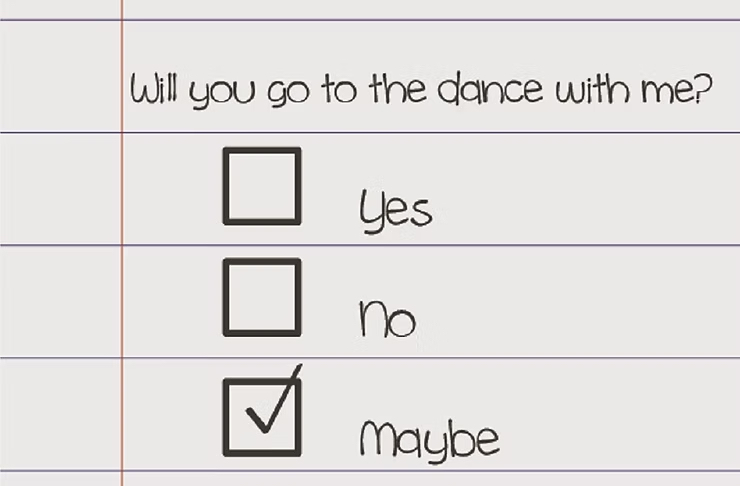
  1. Yes
  2. Maybe
  3. No
    Now, in this situation, as a 14 year-old boy, you want the Yes.  The No is bad for your self-esteem. But the Maybe gives you hope.

    I’ll reveal what she said at the end of the post, but for now, let’s talk about how this same situation is a problem for you in your sales activity.

The Challenge of Becoming a Prisoner of Hope
First, an observation: we have too many “maybe” sales responses. Way too many, in fact.

This biggest challenge in B2B selling today is best explained by how every salesperson should conceptualize a pipeline. In general:

  1. ⅓  of your pipeline will buy from you in the near future
  2. ⅓  of your pipeline will buy in the far future
  3. ⅓  of your pipeline will never buy from you — even if you offered them something worth $1 for 90 cents
    Sometimes I call sales reps Prisoners of Hope because they don’t ask for the order.  In sales, a Prisoner of Hope is someone who continues to accept the maybe response.  They spend too much time misinterpreting buying and warning signals, making their sales cycles too long. Or they carry on forever and then just die of attrition in the end.

Click here, download our playbook on resolving objections and get the responses that turn leads into customers.
We’ve all seen these kinds of situations. And some of us have even been in them! They always look and feel like the following with the prospect saying something like:

  1. “I don’t want to talk right now. But in three months, we can talk…”
  2. “We need a lot of internal stakeholders to agree before we can commit…”
  3. “Send me your materials and I’ll take a look…”
  4. A prospect says, “I’m interested, let’s talk later” and then turns into a ghost. This leaves you resorting to stalking, creeping, doing fly-bys on social media, and calling from unlisted numbers.
    Your prospects are being nice. They feel bad about saying no, so they don’t. Instead, they string you along with hope for an uncertain future.

Take Control by Asking for the Order
But here’s the deal: we can’t change them. The only person we can change is ourselves.

Go back to these bullets right above here. See how the first three sales responses end with ellipses? It’s your prospect trailing off. That usually means “no” in reality, but the trail off implies some hope for the sales rep. You become a Prisoner of Hope. You keep your prospects in your pipeline way too long, and they almost never close. 90 percent or more of these Prisoner of Hope situations go nowhere.

All these leads are checking Maybe on your 8th grade note pass. You’ve got hope — but you’ve got no dance card.

No matter how you slice it, this isn’t the best approach in terms of sales tactics. So sales managers, leaders, trainers, and coaches need to start working with sales reps to help them stop accepting maybe as a viable sales response. We need to get them to start asking for the order.

But why? Why am I saying some not-yet-seasoned sales rep should be asking for the order from a potentially big client?

Because of the power of ”No.”

The Power of a “No” Sales Response
Here’s the deal: asking for the order is the beginning phase of getting an objection. You need the objection, the “no”, in order to move to the next step. Conflict drives everything, and that’s especially true in sales.

There’s a famous sales study from the 1970s, done by Mutual of Omaha. The set-up is this: they went to their home market (Omaha) and targeted some folks who would be good customers for them. They picked about 1,000 people and said they’d give them insurance premiums (up to $500,000) for a year, but they had to meet with Mutual’s salespeople in order to get this offer. At the same time, they told 150 sales people that there were 1,000 available leads. The whole transaction was contingent on the salespeople asking a specific closing question. Unless that question was asked, nothing was triggered. There was no close.

So, out of these 1,000 really good, vetted leads — what percentage do you think closed?

It was about 7 percent. About 70 of 1,000 people. And why? Because the salespeople weren’t asking the question. They left about 930 leads on the table because they didn’t ask. That’s amazing!

When your sales reps aren’t asking for the order, they’re not selling strong. Sending a LinkedIn message? That’s not selling strong.  Remember, LinkedIn ain’t selling!

So how do you move your sales reps to ask for the order? How do they ask? How do they sell strong?

Three Ideas to Help Your Team Sell Strong
Here are three quick tips:

Be in the moment:
I like scripts and call flows as much as the next guy and I’ve trained people on scripts, working with checklists, and boxes to check. That’s all well and good. But people with purchasing authority in organizations are seasoned. They’ve been around the block and they know the tactics and the angles. They’re going to respond more to a real conversation with ups and downs, small talk and commonalities rather than being sold from a script. Let’s say you go in to see a prospect and you want to sell a season ticket package. You’ve got a whole plan of sales tactics to get there. At minute 3 of this interaction, the guy wants to talk about his vacation to Mo’orea. You’ve never been to Mo’orea and have no idea where it is. So what do you do now? You get in the moment. Listen. Maybe Google a few things about Mo’orea. Talk about how you want to go now too. Sounds awesome! You have to read your prospect and respond in kind. You can go in with a baseline plan, but what happens in the moment matters.

Ask good closing questions:
There are millions of studies about the power of asking good questions. If I tried to link them all here, you’d be reading this post for two weeks. The point is: there are lots of good questions. You need to get to them to make the close. In general, yes/no questions don’t get you as far. If your prospect  is busy, yes/no can detach them from the sales process, because they’re just giving you quick, one-word answers. You want to engage your prospect. Make them think. They need to be talking about their pain points and what your solution is going to do for that problem. Remember: some products are sold because they are needed, and some are sold as an opportunity.

Don’t be afraid to ask:
We’ve all been around the guy or gal who can approach a stranger at a bar completely sober and start a conversation. And we know people who need five drinks to make that first move. Confidence varies, and that’s part of the “Prisoner of Hope” problem I described earlier. But you must jump over the confidence hurdle and ask. It’s the only way to receive. What’s the worst that happens? The prospect says no? If they say no, there’s the conflict! You can drive forward from there.
This is my baseline approach to the sales strategy of the power of no, and using conflict to drive forward. We need to get to high ground and shut down the idea of artificial harmony quickly. Use conflict to drive sales forward and get to the close.

By the way, the girl said maybe.

To get a better handle on resolving objections, download the playbook, Seven Steps to Resolving Sales Objections here and make objections work for you!

How To Buy Sales Training

Through the years, a variety of executives and managers have asked me, “How do you buy sales training?”

In early 2000, a very savvy HR Executive, Sheila Ireland, asked me this very question. At that time, I was Sales Training in Philadelphia. I had all of my training models, like the Kirkpatrick model which measures ROI (Return on Investment), and I was ready to share my 4-step behavior model.

As I prepared to answer, Sheila put her index finger over her lips and said, “Shhh. I purchase millions of dollars of training each year. Let me show you how I buy.” Sheila then explained to me that she considered three main factors when she purchased any type of training:

  • Content
  • Process
  • Methodology

Sales Training Content is Available everywhere.

You can google anything and find what you’re looking for. You can find videos on YouTube, and even presentations on Slideshare, but that doesn’t necessarily mean it’s a good thing. All content should be supported and validated by other sources.

You need to consider these questions:

  • Is the content one man or company’s opinion?
  • Has the content been tested or vetted?
  • Are you a guinea pig for the content?
  • Are they delivering a second hand version of someone else’s original material?
  • Or have you hired someone to show up, throw up and deliver?


In order for the information you’re gathering to be valid, all content should be supported by a process.

Validating the Sales Training Process

Here are some thing to consider when you’re validating the process. Look at the number of steps included in the sales process or the negotiation process. Review the number of steps to close? If the trainer can’t support the content with this level of detail, then you’re working with a firm that is teaching how THEY sell, not teaching how TO sell. This type of approach is based on opinion and is style-based, and not based on a solid foundation.

Buying sales training is about predictability. A predictable process yields predictable results!

The key is to know whether the process is easy to implement and re-create eternally.

You need to know the difference between whether the person you are bringing in is going to educate your team, which would be to teach something new, or whether you’re bringing in someone to train your team, which would be to enhance and take action. These two processes are vastly different and knowing this is crucial to your team.

Sales Training Methodology is a More Complex Issue.

Methodology requires the buyer to ask the right questions of the trainer. It’s how the trainer is going to deliver the content to the participants.

I recently spoke to an existing customer who chose to use a new vendor. Obviously this is the last thing you want to hear from a customer. So, I responded that I was respectful of their decision as to how they needed to spend their budget. Now, just to be clear, we call this type of response a cushion. A cushion isn’t an agreement or a disagreement. It’s simply a buffer acknowledging that you heard them.

Then I asked if they could tell me a little more about how they arrived at their decision. That’s when he told me one of our competitors was offering more of a one-on-one coaching process. I thought he gave a fair response. So I asked if there was anything else and to my surprise that was it. Never deter from finding out why a client is considering a new vendor, you never know how you can sweeten that same offer. I asked him if we offered the same level of coaching would he re-consider looking back in our direction. His response, “Tell me more!” Bazinga! I had him.

However, I still needed to dig a little deeper. So, I asked, “If you want more coaching, what is the real issue?” He took a moment, and then replied that his team needed more one-on-one time. That’s when I asked him whether this was a training issue or a sales management issue. Because ultimately, coaching isn’t training, it’s a critical part of sales management. After some reflection, we both agreed that, in addition to training, he needed to adjust his sales management strategy. And that’s exactly what we did.

Questions to Ask When Determining Methodology

So, how do you determine if the proposed methodology is right for your organization? Consider the following:

  • What is the training company’s process for assessing your team?
  • Will they customize or tailor the content to your needs, or will they use off-the-shelf delivery methods? The right solution for the wrong problem is worse than the wrong solutions for the right problem.
  • Most adult learning experts agree that there are 21 ways to train an adult and change a behavior. Which methods will they use? Make them explain their approach in detail.
  • Ask for the training outline.

Once you understand the content, process, and methodology, it’s time to talk pricing.

Are they the lowest option?

What are their terms?

How do they resolve your objections?

Do you really want the lowest price provider training your people?

Hammer them on price and see how they respond and resolve the objection.

The final consideration should be their approach. Review how they sold you. How did they present and communicate to you? In the end, that is the example of what you are purchasing for your people.

Lance Tyson

Overlooked Secrets to Resolving Sales Objections

three steps to resolving sales objections and in doing so, we brought the sales process closer to achieving a commitment. Those 3 steps were:

  1. Remind them of their need.
  2. Remind them that your offering addresses their need.
  3. Create a colorful description of them experiencing the benefits provided by your offering.
    Now, here’s the kicker when resolving sales  objections: The more specific the objection you’re facing, the better chance you have of resolving it!

Here’s what I mean.When you get an objection like “your price is too high,” your prospect can take that in any direction the wind blows. We’ve already shown that most of your prospects will use price, cost, budget, and value interchangeably.

Click here to get our playbook on resolving sales objections and discover how to quickly identify your prospect’s real objections.
But when you get them to identify meaningful specifics, they are actually trying out your offering mentally in their environment and they can see where it doesn’t quite fit just yet. That’s a good thing! You can work to resolve a specific issue or challenge.  But first, you have to help your prospect identify those specific issues and challenges, and get them to identify the importance of each one.

In Resolving Sales Objections, Specificity is Key
At this stage, we are rooting out specific things that your prospects are objecting to. And this is where many salespeople fail. For instance, let’s say you are selling software and you positioned everything perfectly, used your facts and benefits, nailed that visual and said, “So, what are your thoughts on these reports?”

Let’s say the prospect comes back and says, “You know, I’m still concerned about the pricing of this and the timing.”  You have to be able to accept their position and identify the specifics of the objection. Don’t hide from it like a cast member of The Walking Dead running from a zombie horde.  Cushion the response. Then, get your prospect to define, defend and explain it, as outlined here.

As their salesperson, you need to be good at creating a verbal cushion between their objection and your challenge. In the end, you have to be able to categorize that objection: Is it a put off? Is it genuine? Is it a misconception? Are they giving you something that is biased, or is it something that is half-baked? Categorizing the objection allows you to determine how and when to respond to that objection.

Here’s something else you want to remember.  When it comes to resolving sales objections, the absolute lowest ground a salesperson can take is to be reactive and address it in the moment.

Resolve sales objections before they actually come up.
So what’s the highest ground? To address an objection before it actually ever comes up. The second highest ground for a salesperson to take is to bring up objections themselves. During your process, ask your prospect, “What are some of your concerns? What are some things you don’t like about what we presented here? What are some things you do like?”

Use Your Process to Acknowledge and Clarify when Resolving Sales Objections
When it comes to resolving sales objections, we need to resolve them whether they are voiced or not. We need to at least ask for them. And chances are good that we have dealt with the objection a little bit before it’s voiced, because most salespeople get the same objection in different incarnations. Believe it or not, there are only so many kinds of objections salespeople get. Here’s the key: Don’t agree or disagree with the objection. Acknowledge it. Then ask another question to clarify.

Click here to get our playbook on resolving sales objections and
move more deals through your sales process.
For instance, “Tell me a little bit more about it, give me an example.” Force it back on the buyer to define, defend and explain it. Then ask another question: “What else besides that is causing you to hesitate?” Chances are probably nothing. “Well, if we can address that would you at least be willing to move forward?” At this point you’ve maneuvered the buyer into a yes or no decision point. Or they might say: “No, I didn’t say that,” which would prompt: “Geez, sounds like there’s something else causing your hesitation.”

Use your questioning model to clarify the objections so you’re not playing whack-a-mole. There’s always a chance that you might not be able to resolve an objection. But after you know where they stand, you have to decide what kind of evidence or other assistance you need. Maybe you need to bargain a little bit, go deeper, or get more evidence.

Remember, the objective here  is to move to the close stage and get the commitment.

Good Selling!

Stop being a prisoner of hope and get a better handle on resolving objections. Download the playbook, Seven Steps to Resolving Sales Objections here and start making objections work for you today!

Tyson Group selected as a Finalist for Excellence in Sales Training

Tyson Group selected as a Finalist in the Sales Training Category by the IES 9th Annual Sales Excellence Awards

Tyson Group has been named as a finalist for the IES 9th Annual Institute for Excellence in Sales (IES) Awards in the Sales Training category .

This award caps a banner year marked by extraordinary growth, stemming to the increasing demand for Tyson Group’s tailored training solutions and on-going coaching, which are designed to provide a deeper overall strategy for handling day-to-day sales situations.

We are passionate about coaching, training, and consulting with sales leaders and their teams to compete in a complex world. What motivates us most is the opportunity to successfully rev the sales engines of some of the most successful organizations in the country, including the Dallas Cowboys, Cleveland Browns, New York Yankees, Miami Dolphins, Tampa Bay Lightning, Topgolf, and Legends, among others.

Selling premium seats or suites is one of the biggest challenges in the business of sports. Fans don’t need a premium seat to watch the game live, so this sale requires convincing ever-skeptical buyers of the worth of premium seating, even when they know they can see the game for less.

The Houston Rockets engaged us to assess their team, train them to implement a new sales process, change perceptions, and prospect for new business.  Our Away-Game Selling model yielded in-depth analysis of individual strengths, higher confidence for individual team members, better prospecting for new business development, and higher YOY results.

“Lance Tyson brings a unique style to the world of sales training,” said Al Guido, President, San Francisco 49ers.  “His passion, knowledge of the business, and ability to relate to the sales representatives is second to none. What I love most about Lance is his willingness to jump into the mix with his team. I have spent over fifteen years in the world of sports, and I have never seen another trainer pick up a  phone or write an email on behalf of a salesperson like Lance does. If you have not hired him already, give him a call today. Your sales team and business will thank you later.”

It is thrilling to be recognized by IES, and we believe that we share this honor with our clients.  Thank you for helping us to make our vision into a reality!

If your organization wants to increase sales production, shorten sales cycles, reduce the cost of sale, negotiations and closing, and develop sales leadership talent, call us today at 800.659.1080 or email us at sales@tysongroup.com.

3 Steps to Resolving Objections and Winning the High Ground

The words you use help frame the situation. And how you frame the situation will either expand or limit your options in resolving objections and mastering negotiations.

Consider the negotiation process. There’s plenty of phraseology out there that highlights “battling” an objection. Now, if I’m trying to do business with you, I don’t know if we are necessarily going to do battle. I think the wiser choice is to first find out where we both agree.

I’ve watched a lot of high-level negotiators in my life. We’ve watched many sponsorships and naming-rights deals being done with stadiums. I can honestly say I’ve never seen high-level lawyers and salespeople battle with the client or customer. Our observations are that they find points of agreement.

Click here to get our playbook on resolving objections and learn how to quickly navigate to your prospect’s real objections.

In many cases, I think there’s a lot of positioning that goes on, but that’s not a battle. If we’re going to do business with each other for a long period of time, battling doesn’t help either party.

When addressing an objection, we must first find points of agreement. We want to overcome the prospect’s indecision. Therefore, we need to create a compelling reason or a story to move ahead. If you don’t have a compelling reason for them to move forward, they aren’t going to move anywhere.

To Resolve Objections, You Need to Meet People in Their World

We don’t deal with objections, we deal with people. We resolve objections. In resolving the objection and creating a compelling reason for the prospect to move forward, we need to recognize that people process visual information faster than other information. So, we need to create a visual representation of the prospect’s issue resolved. But first we need to remind the prospect of their need. Then we need to remind them that our product or service can resolve  their need. Finally, after establishing these two pillars, we can create a visually compelling reason for moving forward.

We don’t deal with objections, we deal with people. We resolve objections.

Here’s an example. Let’s say you’re the general manager of a hotel, and you’re looking to do a lot of restoration, big capital expenditure kind of stuff. You know you’re going to renovate all of the rooms, their fixtures, and appliances. Well, at some point, you’re going to have to deal with the carpet. But the carpet is a major capital investment. You aren’t going to start with the carpet, because you’re going to do so much construction that it might get damaged in the process. And the carpet isn’t necessarily bad. It needs to be improved, but it isn’t nasty.

Let’s say the biggest carpeted areas in your hotel are your banquet areas. And say, for instance, I was there selling you chairs. The chairs have to be updated, because they are the oldest items in your building, and they get the most wear from your guests. If I am selling you chairs and I find out that you want to replace the carpet over time while you are doing other capital investments, I could tie my sale of catering chairs to the overall project.

Leveraging the Diagnosis in Resolving Objections

I might say, “I learned in my evaluation diagnosis that you’re currently making some capital investments. In our conversation, you also prioritized your projects for the hotel. You want to update the furniture first, and then perform the construction projects. But you’re hoping to get at least two to three more years out of the carpets, because that’s the last thing you’re going to invest in. Plus, there’s going to be a lot of traffic on them as you work through the construction projects.”

You would naturally agree, because I’m just talking facts at that point. I proceed and say, “Let me show you a few of these chairs. What’s interesting about this particular chair is that it has a forty-five minute cushion on it. That means after about forty-five minutes, your guests will probably have to get up and re situate themselves. The really interesting thing, though, is that these chairs have four stainless steel discs at the bottom that actually rotate 360 degrees. They are also multi-directional, based on how you’re leaning when you’re in them. The four stainless steel discs allow the chair to glide across the carpet, almost like ice. It has less friction, which will cause your carpet less wear and tear. Let me show you how that works.”

At this point, I’ve answered the basic questions like what the chair is and how it works. And since I tied it to saving the carpet, I also made the chair a long-term capital investment, thereby answering why it’s important.

3 Steps to Resolving Objections and Gaining Commitment

Now, when I’m ready to negotiate, I’ll begin by restating your challenge as you see it and remind you of your need. Next, I will remind you that my product will address your needs. Lastly, I’ll create a visual presentation of you enjoying the benefits of the end result.

So, for the above example, when I’m ready to move to obtain a commitment, these are the steps I’ll take:

Remind Them of Their Need.

“You’re really looking to keep these carpets a little longer, right?

Remind Them That Your Product or Service Can Actually Address That Want, Need, or Gap.
“Would you agree that with some of the seating solutions we put in front of you, you’d be able to do that?”

Paint That Word Picture.

“So, let me recap, just making sure we’re on the same page. What you’re looking to do is give a thousand guests in this double-banquet hall here a great time, along with some chairs that endure a lot of ups and downs and being pulled in and out. What you’ll want to see after having this place filled with guests for three months in a row, is very little carpet wear during your busy season. And some stellar reports back from your maintenance people, is that right?”

I need to be able to use these visuals to make sure I’m on the same page with the prospect. That’s gaining the high ground.

Remember, this is not a zero-sum game. Your prospect is not looking for the same things you are seeking. So there is no need to go to battle over them. Instead, find  points of agreement that you can leverage. Then use these three steps to resolve the objection and move them to commitment.

To get a better understanding of navigating and resolving objections, download the playbook, Seven Steps to Resolving Objections here and make objections work for you!

And Check out Lance Tyson’s book, Selling Is An Away Game, available on Amazon, for additional ideas on streamlining your sales process. Get your copy today!

How to Build Better Responses to Sales Objections

When Addressing Sales Objections You Need to Define, Defend and Explain

In time the salesperson was able to re-engage the buyer. One day he approached him and just laid it out there.

“What happened?” asked the salesman. “You said you had concerns about the value of what we were offering, so we got the price down.”

“Yeah, the original price was a little higher than what we wanted,” agreed the president of the company. “But when you came back with the new package, you actually took out the thing that was most valuable to me.”

“What was that?” asked the salesman.

“The player visits.”

That’s when the salesperson realized he didn’t ask the prospect to force-rank which things were most important. He took out the thing that was least expensive for the team, which was the easiest thing for them to do as it held the least value on their end. But the prospect had ranked the player visit as the thing that held the most value.

That knee-jerk move devalued the whole deal in the eyes of the prospect.

It’s our job as salespeople to get a clear understanding of what the buyer is saying. And if you look at those marketplace-driven objections we talked about previously, everybody defines those words differently and uses them interchangeably. We’re obligated as salespeople to have a dialogue about what those objections are, not to make assumptions.

Learn how to navigate sales objections using this simple 7-step process.

Sales Objections Happen Throughout the Sales Process There are inherent objections that come into play throughout the sales process.

For example, buyers are constantly preoccupied. With everything vying for their attention, they become easily disinterested in things that don’t hold their attention. In an environment where your biggest competitor can be the paperwork on your prospect’s desk, you always need to address preoccupation during the sales process by engaging the disinterested prospect and holding their attention.

You’ll encounter objections based on perception, credibility and bias. Your prospect will question what you say, and you’ll need to use various forms of evidence to address their objections. You’ll run into objections in the form of procrastination, stalls and indecision where the prospect is trying to regain control of the sales process by slowing it down.

You will even encounter half-baked objections because your prospect hasn’t clearly thought things through.

We must deal with all of these at different times in the sales process, but no more importantly than after we prescribe a solution.

We’ve got to create a dialogue that causes that prospect to feel comfortable talking to us. Our questioning needs to be fantastic. If they’re not candid and giving us a half-baked objection, it’s because they haven’t thought through our solution.

We must have the right strategy when dealing with objections in the dialogue stage. We need to clarify the objection, find points of agreement, and then create a compelling prescription to move forward.

The lowest ground we can take as a salesperson is being reactive.

Stop Reacting, Take Control, and Respond to Sales Objections

When addressing sales objections in the dialogue stage, you’re faced with a choice. And many sales reps choose poorly. Consider this. When faced with an objection, you can start negotiating and bargaining. But, just because you can start to negotiate doesn’t mean you should. Unfortunately, this is where many salespeople start. They don’t assess the situation, and they don’t get the buyer to define their objection. They don’t respond, they react.  And the lowest ground we can take as a salesperson is being reactive.

Like the sales rep in my example at the start of this post, once a salesperson hears any kind of objection, especially ones involving money and financing, they start discounting in an attempt to throw a better deal at the prospect before they get the prospect to defend and define their real concerns.

You can’t negotiate if you’re blind. Yet that’s exactly what many salespeople do. They start the negotiation process before they have a clear picture of the objection as defined by the prospect. They react immediately to the objection, and they end up playing a game of whack-a-mole, jumping on everything as it pops up.

The Relationship Between Negotiation and Sales Objections So, when we consider sales objections and negotiations in the dialogue stage, we need to think about those processes. Let’s create an analogy to improve our understanding. Let’s equate an objection to an obstacle. And let’s say the word negotiate is synonymous with navigate. I can navigate my car around obstacles into a parking space, but only if I can clearly see the obstacles. I navigate my boat carefully around a series of obstacles into a dock, but only if I have a clear view of those obstacles.

Now, negotiation and sales objections go hand in hand. We negotiate around objections but only when we have clearly identified and defined the objections. And we do that as we navigate the conversation with our prospect, getting them to defend, define, and explain their objection.

Now that’s a real dialogue.

Get the upper hand in resolving objections. Download the manual, Seven Steps to Resolving Objections here and navigate objections like a boss!

And Check out Lance Tyson’s book, Selling Is An Away Game, available on Amazon, for additional methods on resolving sales objections. Get your copy today!

How to Resolve The Top 4 Financial Sales Objections

Facing Adversity and Assessing Objections

Sometimes the best opportunities come out of facing adversity and assessing objections. Today, you find Tabasco in most fine restaurants and probably in every supermarket in the country, if not the world. It’s an extremely well-known brand.

In every single sale, be it complex or simple, there comes a time where you’re going to have to have a dialogue and assess what your buyer is thinking. Are they in or out? What do they like or dislike?

In our sales calls, we often hear things that make us think a sale is going pretty well. We can feel the momentum building towards a deal. And suddenly, brake lights! Everything comes to a screeching halt. Your prospect says:

Your price is too high….

It’s not in our budget…

I’m not sure about the cost…

I’m not sure if your product or solution really has value in my situation.

Just like the McIlhenny family, our job is to assess the objections and get the buyer to see opportunities instead.

Understanding the Difference Between Cost, Price, Budget and Value

Cost.

Value.

Budget.

Price.

All those words mean very different things. And in a complex or simple sale, we need to understand the difference between those terms by putting a definition to those marketplace-driven objections we run into.  On the surface, those words, and the financial objections derived from them, all seem like they’re the same thing. But in reality, they’re very different animals. The first thing we need to do is dig in and really understand those differences.

Common Objection We Hear Concerning PriceTo consistently resolve objections, you need a process. You’ll find a 7-step process for resolving objections here in our manual:

Seven Steps to Resolving Objections. Let’s start by asking: What does price mean? A lot of people say price is defined as the cost of somebody doing something. Fair enough. Sounds logical. The question then becomes: If price is the cost of doing something, then what is cost? If you asked most people, they would say It’s the price. See what I mean? Those words are used interchangeably, but there is a difference.

So let’s define price as what the market will bear to pay for a good or service. Take Amazon for instance. The number you see when you look at a product on their site is the price. If people buy it, then that’s the price they’re willing to pay. That’s evidence of what the market will bear.

The Difference Between Price and Cost

Now if somebody says that the cost is too high, do they actually mean cost, or do they mean price? Let’s define the word cost. Cost is the overhead that goes along with a product or service because of ownership. So if I pay a certain price for a home, my costs are things like maintenance, repair, water service, electric service, sewer… These are all costs associated with having a home. If I buy a car, regular replacement of the tires is a cost. Changing oil is a cost. Gasoline is a cost. Maintenance is a cost. Insurance is a cost.

Price and cost are clearly two different things. But the marketplace uses those words interchangeably. When our prospect uses these words in an objection, you need to get them to define what they mean before you can engage them in a dialogue about their objection.

The Budget Objection

Another objection that comes up in more complex sales is: it’s not in the budget. The questions you need to ask yourself at that point is: is my prospect referring to a number? Well, budget means a lot of things to different people. Budget is defined as an estimate of income and expenditure for a set period of time, a past performance that usually dictates future spending. But you have to ask yourself, “is my prospect using this as another way of saying that the price is too high? So you might need to educate your prospect to clear up the objection.

Determining the Value in Your Offer

Now, if somebody says, “I don’t see the value,” that’s a whole different story. The budget objection seems addressable if you can get them to identify what it is. But now we are talking about value. What we know about value is it’s defined as it’s perceived. It is truly in the eye of the beholder. And people can’t value what they can’t compare and contrast.

Money objections and financial objections can be the toughest objections to address. It’s our job as sales professionals to get the prospect to define and explain as much as possible about their objection. Once you’ve clarified the language the prospect is using and you have “gently encouraged” them to reflect on their real concerns, then are you ready to address your prospect’s objection.

In summary, before you assume you know what your prospect means when they say “your cost is too high,” stop and remember, price, cost, budget, and value all have different meanings. It’s up to you to respond to your prospect and get them to define and explain what their real challenges are before addressing their concerns.

Check out Lance Tyson’s book, Selling Is An Away Game, available on Amazon, for additional methods on resolving sales objections. Get your copy today!