Research: Use With Caution!

Find Balance in Prospecting Research to Improve Your Team’s Sales Metrics

I know a sports executive who has been president of an NBA team and an NHL team. With all the heavy lifting this person has to do—running marketing, sales, business operations, building a new stadium—sometimes social media isn’t number one on their priority list. I know it took over nine months for that person to change their role on LinkedIn. If you were trying to do business with either of those teams—or that person individually—you’d get very conflicting information on LinkedIn as opposed to Googling them. Not to mention, the individual who took that person’s job would have the same title. Imagine trying to prospect that business and asking for someone who’s no longer there. Would you lose credibility? Probably.

High-performing salespeople know that although research isn’t our job, it’s part of what we do. It can tee-up an opportunity. But we can also get lured into the Medusa’s eye and paralyzed by the amount of infor­mation we can find. Studies have shown that 82 percent of executives feel their sales reps are challenged by the amount of time it takes to research prospects just to make the initial cold call. To be frank, Google and LinkedIn have become purgatory for inefficient sales reps.

On the other side of the coin, we have to be careful because Marketing Sherpas research shows that B2B data decays at a rate of 2.1 percent per month. That’s an annualized rate of 22.5 percent! I’m not saying to completely discount research. It’s a necessary tool in the sales playbook. I’m just saying: find that balance between accuracy and efficiency.

What a Sales Methodology Is and Why Yours Should Be Gold-Medal Worthy?

What is a Sales Methodology and Why Your Team Needs One

Back when I ran several training franchises, I encouraged my people to go after anything and everything. I gave them a solid sales process to work, but back then we didn’t have a well-defined sales methodology. In fact, those frameworks we call sales methodologies today were simply called selling back then, such as relationship selling, or SPIN selling.

After a while I noticed that the team started separating into distinct groups. One group was producing results a lot faster than other members of the team. Meanwhile, another group  was slower at getting results but was also closing deals that were considerably larger in size.

I discovered that the reps who were producing results quicker were focusing on transactional sales to individuals. Those who were taking longer were focusing on selling to accounts. Same general sales process. But these team members had tweaked the process by focusing on the elements that would produce the kind of sale they were trying to achieve. And it also impacted how they prospected, how they opened the call, how often they took notes, and even how they closed their deals.

Today, we call the framework that connects everything together the sales methodology. A sales methodology is a philosophy or set of principles that govern how your sales team conducts every aspect of the sales process. And it touches on how you hire your sales talent, how you train and coach them, your product lines, and even your target market.

Understanding the Sales Methodology Through Another Olympic Games Analogy

One of the most anticipated races on the track during the Tokyo Olympic Games, aside from the 400 metres race with Alison Felix, was the 800 metres race. America had been in a middle-distance drought since 1968. So you can imagine the excitement from the sports community when the American team fielded a promising 19 year old prodigy named Athing Mu.

Mu had decimated the field during the Olympic trials. No one was even close to her when she finished. And during the final heat at the trials, another runner accidentally clipped her. Mu found herself running from the back after stumbling. Yet, she still won the final heat. So, she entered the Tokyo Games with a lot of expectations riding on her shoulders. And she did not disappoint, easily taking the gold.

But, as usual, what I found insightful was all of the training activity leading up to the race in Tokyo.

A Coaching Methodology That Encompassed More Than Running

I find these races at the Olympic Games are like the close in the sales process. Everyone focuses on them and gives them all the attention. No one pays any attention to the hard work, the prep, and the training that goes into getting the final result.

For example, Athing Mu’s grooming started about a decade before the Tokyo Games when her coach in Trenton NJ, Bernice Mitchel, recognized her talent and conveyed a general philosophy to her. Mitchell said, “You can either be the rabbit, or you can be the fox.

Establish what you are as soon as you step up to the starting line, and do not waver. If you decide to be the fox, then go eat. If you decide to be the rabbit, don’t get eaten.” While Mu typically runs from the front and pushes the pace hard, the Olympic trials showed that she knows how to hunt from the back of the pack as well.

But it wasn’t just her raw talent or that running philosophy. Mitchell also advised her to focus on one distance. Mitchell told her to choose one race and own it. So Mu decided very early to focus on the 800 metres distance and she spent her time sharpening her specialty.

Mu’s coach didn’t just stick to the track either. She also focused on preparing Mu for interviews and coached her on how to conduct herself on social media. Mitchell touched on a lot more than the “on the field” stuff. She groomed Mu for off the field activities as well. The result is an athlete who has talent, confidence, poise, and knows how to present herself on and off the track.

What We Can Learn About Sales Methodology from Athing Mu and Her Running Experience

Like the holistic process that took a kid with raw talent and turned her into an Olympic superstar, your sales methodology will help your salespeople become champions. When aligned, your sales methodology will help your salespeople identify your target contacts as well as providing a framework for prospecting. It will help them capitalize on the power in their sales process.

As I stated earlier, a sales methodology is a set of governing principles, guidelines, or rules for how your salespeople sell your products or services to your customers. It will govern how your team approaches prospecting, who they are targeting, and the type of language they will use to engage their contacts. Your sales methodology will govern how you approach every aspect of your sales process. It determines how your salespeople will do what needs to be done.

There are several commercial sales methodologies available and there’s been a lot of ink spilled detailing them. I’m not going to review them here when there are a number of decent articles outlining the characteristics of several popular sales methodologies, like this resource on HubSpot.

However, here are two observations. First, most of them are B2B oriented. And second, they have been developed by consultants and training vendors who have spent a lot of time and resources examining common traits in high performing sales teams and researching how they conduct business.

Aligning Sales Methodology With the Rest of Your Drivers of High Performing Sales Teams

When you consider all you have to accomplish within the time frame you have established, you realize that your sales methodology will have to align with the rest of your drivers in order to create the dynamic sales champions every sales leader wants.

Think back to what Athing Mu was able to accomplish. She has the talent (sales talent). But raw talent isn’t enough. To help her along, it took a coach with vision (sales leadership) who could plot out challenging goals for her (sales management).

It took a coach with discipline to help her focus on one particular race instead of running everything at every meet, create a training plan for that race, and plot out the events to attend that supported that race (sales process).

It took a coach with compassion who would spend the time grooming her for interviews, creating her public persona, and tying it all together with a general philosophy that kept her on point (sales methodology).

Yes, I’m sure there was some shoe technology involved as well (sales enablement). After all, just before the Tokyo Olympic Games, she signed on with Nike for an estimated $500,000-$750,000 per year. And she’s only 19!

That’s why we ask questions in the Sales Team Science Assessment about alignment and review. Because if your team is going to perform like the champions they are, all of these elements need to work together, not grinding against each other. And all of them have to be reviewed regularly to make sure they are adjusted for changes brought on by new environmental or economic factors.

So, set aside some time and take the Sales Team Science Assessment. Review the results and determine where you and your team can use more development and alignment between these six drivers. Then, let’s talk about developing a game plan that takes your team to the next performance level.

The cost is about 30 minutes of your time. The results, a performance worthy of a gold medal.

Your sales methodology needs to be defined and aligned with the rest of your sales process to produce gold medal performances. Ensure your team is firing on all cylinders. Take the Sales Team Science Assessment here.


Want More Sales? Sell Less

Increase Sales Metrics by Targeting Solutions

A buyer’s inherent objection that all high-performing salespeople deal with is doubt. I don’t mean doubt in the salesperson’s abilities or solution necessarily, though that certainly is a real factor. I’m talking about the buyer, the prospect, the patient, doubting whether or not they even have an issue that needs solving, a gap that needs filling. Be mindful, change is hard. At the end of the day, we as salespeople often sell change.

So, the prescription given has to deal with the specific situation. It must be targeted. Just like a doctor isn’t going to prescribe you every medicine ever invented, you can’t necessarily pitch everything in your product arsenal. Yet most salespeople have a tendency to throw a bunch of solutions up on the wall and hope something sticks.

Recently, we were talking with a group from Adobe. They said one of the biggest issues they have is when they’re selling their software to measure the impact of certain advertising return on investment (ROI), their salespeople have a tendency to spit out all the benefits of what the software does.

When you just spit out a bunch of benefits or oppor­tunities and say something like, “Hey, here are some of the outcomes that you can achieve,” it actually causes more doubt. Ulti­mately, what we’re trying to do is give somebody specific enough information and just enough to help them make a buying decision. That means more is not always better.

So if you want to sell more, give them less.

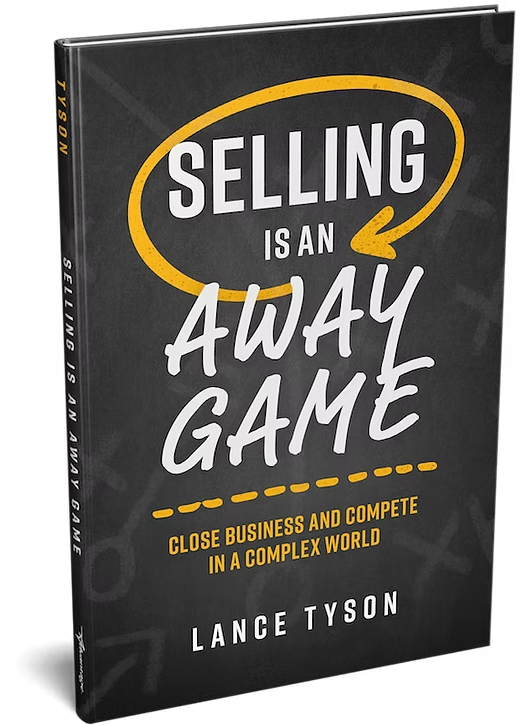
If you’re in need of additional ideas for selling to the gap and targeting solutions, get your copy of Selling is an Away Game, available online at Amazon.

Land the Plane Already!

Increasing Sales Performance Means Asking the Question to Close

There was a famous sales study from the 1970s done by Mutual of Omaha that you may have heard about. The set-up was this: they went to their home market in Omaha and targeted some folks who would be good customers for them. They picked about 1,000 people and said they’d give them insurance premiums (up to $500,000) for a year, but potential customers had to meet with Mutual’s salespeople in order to get this offer.

At the same time, they told 150 salespeople that there were 1,000 available leads. The whole transaction was contingent on the salespeople asking a specific closing question. Unless that question was asked, nothing was triggered. There would be no close. So, out of these 1,000 really good, vetted leads, what percentage do you think closed?

Around 7 percent. Only seventy out of 1,000 people!

Why? Because the salespeople weren’t asking a closing question. They left about 930 leads on the table simply because they didn’t land the plane. The fact is there’s no skill in closing. The sale has to come to a freaking end. The dice might not roll in your favor. You might get a no. But if you did your job and followed the Sales Playbook along the way, it’s just a matter of landing the airplane.

Always ask the prospect if they are in or out. I call this the Nike Close: just do it.

Learn how the masters effortlessly bring their deals to a close. Get your copy of Selling is an Away Game, available online at Amazon.

Oh Yeah? Prove it!

Drive Sales Effectiveness by Using Evidence

Once a salesperson has diagnosed the buyer’s problem correctly, he or she needs to present the right prescription in such a way that it persuades the buyer to see value in the solution or opportunity. A high-performing sales team knows they need to gain the high ground in order to overcome doubt quickly and effectively. And what inherently overcomes doubt?  Evidence.

Early in my career, a moving company that specialized in moving older furniture wanted to boost the effectiveness of their salespeople. The biggest objection they got was price, as they were 15-20 percent higher than their competitors. The thing was, they specialized in moving fine furniture and antiques. And they had a lower rate of damage than the competition.

I sat forward. “Can you prove it?”

The owner proudly stepped up. “Well, we have specially manufactured shocks on our trucks that protect the contents around the cobblestones streets and winding roads of Philly.”

“Show me how,” I said.

The owner pulled out a balloon and blew it up halfway. “Our shock system is like this balloon. If we hit any bumps or turns, our system absorbs all these blows and actually reduces damage significantly. We’ll put our money on it.”

My jaw dropped. “Do your salespeople sell like that?”

“Well, they talk about it.”

“No. Do they show people like you just showed me?”

He laughed. “No. They tell me it’s old-school.”

“You guys need to start doing that in your presentations every time, without fail,” I said.

That’s using evidence and being persuasive. That’s the salesperson deliv­ering a prescription in a way meant to convince. That’s gaining the high ground.

Want more ways of using evidence to improve sales effectiveness?  Get your copy of Selling is an Away Game, available online at Amazon.

Dial in on the Diagnosis

Improve Sales Metrics by Confirming Your Prospect’s Needs

While you are browsing the new and used models on a car lot, you typically have your buying criteria in mind and the reason you’re buying a car. Maybe that reason is to get to work, or to taxi your family around town. You also have absolutes—a certain budget, plus a list of must-have features.

This information is extremely valuable to high-performing salespeople. It allows them to talk specifically to the buyer’s needs—what we call in the sales playbook: diagnosing. If the prospect’s priority is family, you are likely going to forget about the convertible and recommend a model with a set of headrest displays for the backseat to make road trips more enjoyable.

The fact is, however, that most buyers don’t go into a sales situation always realizing that they have these issues or opportunities the salesperson is diagnosing. So that means diagnosing is about a salesperson saying, “Based on what you’re saying, you’re trying to address X, which will allow you to achieve Y.” Diagnosing means dialing in, and is based on our best-educated guess.

It’s up to the salesperson to get the buyer to acknowledge that the factors they outlined are correct, and then get the buyer to a point where they are willing to listen to specific suggestions for addressing those factors. The diagnosis is about getting a prospect to say, “Yes, I’ll allow you to present further, because what you say makes sense to me.”

After all, the right solution for the wrong problem is worse than the wrong solution to the right problem.

For more ideas on performing a sales diagnosis with you prospects, get your copy of Selling is an Away Game, available online at Amazon.

Achieve Success: It’s as Easy as DDE

Be Proactive with Objections to Drive Sales Metrics

When we consider some of the toughest objections we deal with as salespeople, financial objections have to be on the top of the list. Budget and cost are difficult things to combat. I mean, either the money exists for your product or service, or it doesn’t, right? Well, not necessarily. Not if you use the DDE strategy from the Sales Playbook.

DDE stands for Define, Defend, Explain. Oftentimes, once a salesperson hears any kind of objection, especially a financial one, they start to throw better deals at the buyer before they get the buyer to define, defend, or explain the objection. They react to objections as soon as they hear them and end up playing the game of Whack-A-Mole.

Just because you have the ability to start negotiating/bargaining, doesn’t mean you have to. But this is where a lot of salespeople start because they don’t read the situation right. They react instead of asking questions and being proactive. And the lowest ground we can take as a salesperson is being reactive.

You can’t bargain if you’re blind. So it’s our job as salespeople to really get a clear understanding of what the buyer is saying. Maybe they think the cost is too high, but don’t realize the long-term value. Cost, value, budget—everybody defines those words very differently, and uses them interchangeably. That’s why we’re obligated as salespeople to have a dialogue about what those objections are, not to make assumptions.

Don’t miss out. Be sure to download your copy  of Seven Steps to Resolving Objections below.

The Myth about Legendary Closers

Trust Your High-Performing Sales Team To Close

Legendary closers are like Bigfoot, like leprechauns. They just don’t exist. But if you look at the classifieds under sales jobs, companies are always looking to hire skilled closers. Somehow, closing has become some kind of mythical skillset only a handful of enlightened beings have mastered.

I’ve said it before, and I’ll say it again: there is no skill in closing. Zero. Zip. Nada. If you can form sentences, you can close. Why? Because all the heavy lifting is done at the front end of the sales process. The fact is, there are only six variants in closing:

  1. Direct Close
  2. Alternate-Choice Close
  3. Minor-Point Close
  4. Balancing Close
  5. Next-Step Close
  6. Opportunity Close

Though the Direct Close is always preferred, you can always go for an Alternate-Choice Close: Do you want option A or B? Do you want to go with the three-year contract or the seven-year contract? Or you can opt for the Balancing Close: Here are the pros and cons…looks like moving forward makes a lot of sense, right?

See what I mean? There’s really no skill involved. These aren’t deep questions.

Take the Minor-Point Close, for instance. When I first bought club seats to watch the Cleveland Cavaliers, they were going for about $20,000 per year.

The salesperson began the close with: “So what are your thoughts on moving forward?”

I said, “I gotta think about this.”

Then he Minor-Pointed me. “Well, do you want the names on the seats in your name or your company’s name?”

I stared at him. “What do you mean?”

“There’s a little placard in the seats at the club level, and they have your personal name or your company’s.”

Game over. He had me. He used the Minor-Point Close to gauge my interest.

Whichever technique you use, you might end up fleshing out other objections. You might go back to negotiating again. But the process has to come to an end at some point. So stop looking under shamrocks and wearing night vision goggles to find closers.

If you have a high-performing sales team, you already have legendary closers.

If you want to build a legendary sales team that can close business, make sure they have their sales process down to a science. Get your team Selling is an Away Game today.  Available online at Amazon.

Never Battle With the Buyer

Resolve Objections With Points of Agreement to Increase Sales Performance

If you look at any negotiation process, there’s a lot of wording out there about battling an objection. Now I’ve watched a lot of high-level negotiators in my life. But I’ve never seen high-level lawyers or high-performing salespeople battle.

When Eric Sudol was negotiating the naming rights for AT&T Stadium, I didn’t see him necessarily battling it out with AT&T. Even when watching the Cleveland Browns come up with a beer deal for FirstEnergy Stadium with Anheuser-Busch, I never saw them battling with the beer giant. Of course, there definitely is a lot of positioning that goes on. But it’s not a battle, because if we’re trying to ultimately do business with someone for a long period of time, battling doesn’t do anybody justice.

Our job as a member of a high-performing sales team when dealing with objections is to find points of agreement. This is because we’re trying to overcome a preoccupation of someone being indeci­sive. That means we need to create a compelling reason or story to move ahead. And if there’s not a compelling reason to move ahead, nobody wins.

Bottom line: We don’t deal with objections; we deal with people. And we don’t battle objections, we find points of agreement and resolve them.

Watch Eric Sudol’s full interview on Lance Tyson’s Against the Sales Odds series here and get additional ideas on sales leadership and tips to enhance your sales career.

They Didn’t Put Him on the $100 Bill for Nothing

Increase Sales Metrics by Using the Balance Close

One of the best sales books you’ll ever read is Ben Franklin’s autobiography. He’s really the only American philosopher we had. And he’s one of our only inventors and philosophers.   What made Ben Franklin such an expert in sales? The way he made decisions. For any business transaction, or when considering anything major that would require his time or money (or both), he’d make a t-chart and weigh his options from a pros versus cons standpoint.

If the cons outweighed the pros, he wouldn’t do it. If the pros outweighed the cons, he would. In sales, most decisions made are weighed or balanced against each other. When I buy a pair of sneakers or a new iPad, I weighed the benefits of having them versus not having them.

High-performing salespeople know that’s one of the tools in our arsenal—to take the high ground, to really help a buyer go backwards through the process and weigh options against one another. This works with selling to buying groups. This works when selling to individuals. Because that’s exactly how they’re going to make a decision.

You could have seven feathers against something and three rocks for something. Which would weigh more? It’s not necessarily the quantity of pros or cons, but the quality. It sounds simple because it is simple. But salespeople often forget this technique. We call it the Balance Close, and it comes right out of Ben Franklin’s sales playbook.

They didn’t put him on the $100 bill for nothing!


Looking for more decision making tools to help your team close more deals? Get your copy of Selling is an Away Game, available online at Amazon.