Most sales organizations think they have a sales methodology. In reality, they’re operating with a mix of disconnected tactics, and it’s costing them.
In this episode, Lance Tyson sits down with Dr. Adam Rapp, Vice President of Research Integration at Tyson Group, to unpack the critical difference between sales methodology and sales process and why confusing the two leads to inconsistent performance, poor adoption, and missed revenue.
You’ll learn how to clearly define each, align your team around the right framework, and build a system that actually drives results.
👉 If you’re looking to elevate your selling strategy, shift your perspective, and compete where the decision actually happens, this episode is a must-listen.
Check out Tyson Group’s Open Enrollment Programs: https://www.tysongroup.com/openenrollment
Check out Lance’s Bestseller Books:
The Human Sales Factor – https://tysongroup.com/books#thehumansalesfactor
Selling is an Away Game – https://tysongroup.com/books#sellingisanawaygame
Download our playbooks: https://www.tysongroup.com/sales-playbooks
Schedule a call with one of Tyson Group’s member: https://bit.ly/41YJW7K
Subscribe to our Newsletter: https://tysongroup.com/#weeklynewsletter
Follow Lance across Social Media:
LinkedIn – https://www.linkedin.com/in/lancetyson/
Instagram – https://www.instagram.com/lance_tyson_1/
🎧 Tune in as Lance shares the mindset, behaviors, and tactics that separate average reps from elite performers.
Love the show? Subscribe, rate, review, and share! https://www.tysongroup.com/podcast
—
Listen to the podcast here
Sales Methodology Vs. Sales Process: The Costly Mistake Most Sales Teams Make With Dr. Adam Rapp
Introduction Of Sales Team Science & Dr. Rapp’s Role
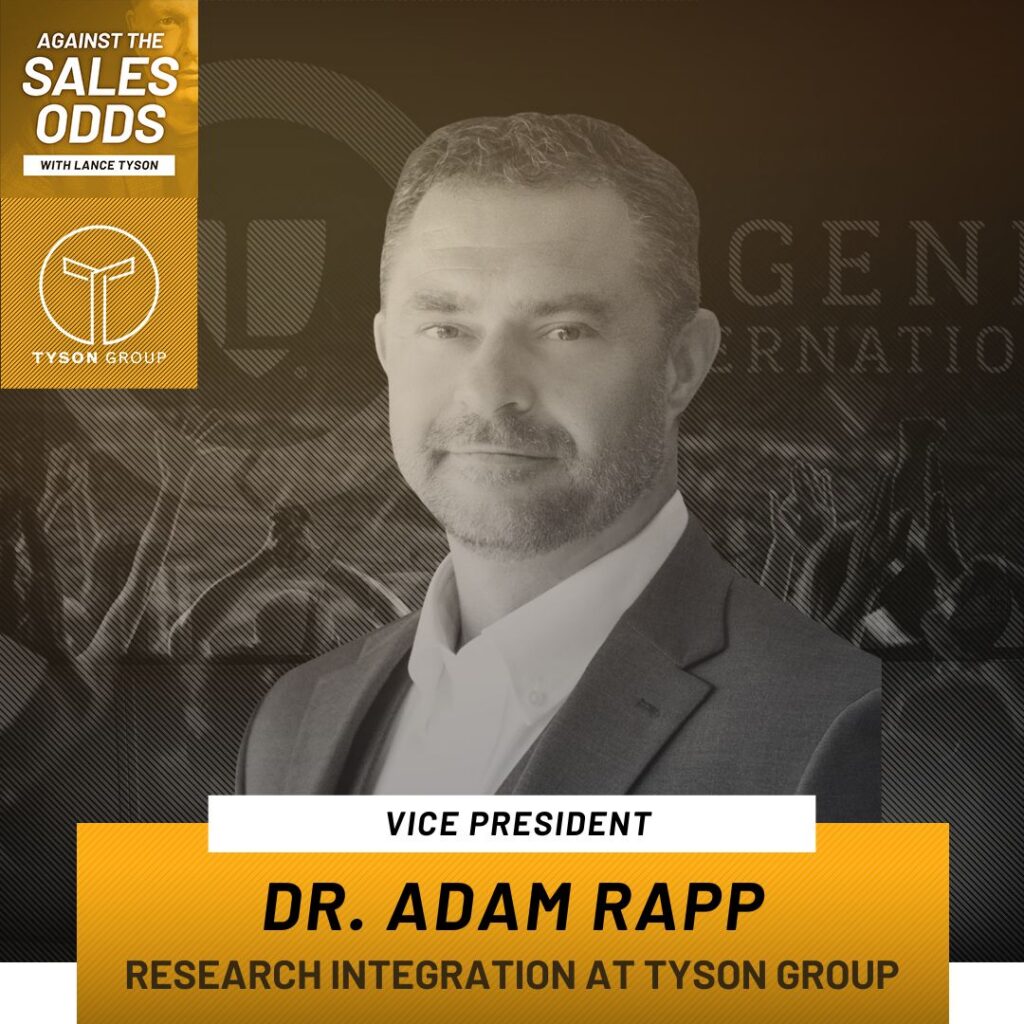
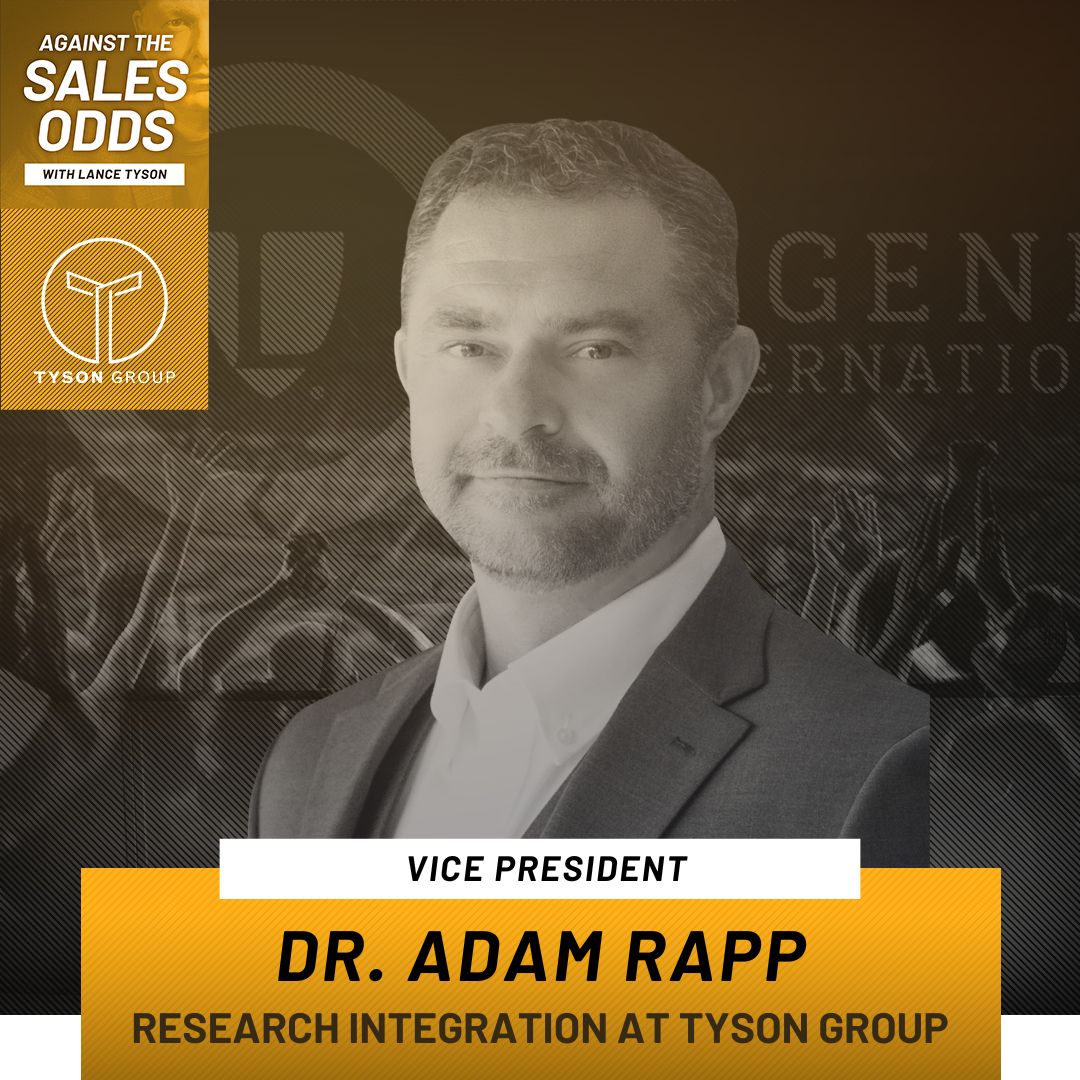
I’m so excited about this episode because I’m ready to introduce a guy that’s been integral inside the Tyson Group and who I have on with us is Dr. Adam Rapp. Let me give you a little bit about Dr. Rapp’s background. He currently runs the Luci Schey Sales Center at Ohio University. He is a top-five sales researcher worldwide. He’s also Tyson Group’s Vice President of Research Integration. I love that title too. I think we came up with that and we branded that whole thing. I love it.
Dr. Rapp inside of Tyson Group has been instrumental in building out our sales competency assessment that I would put up against anyone in the world, which helped really looks at business acumen, sales performance, and sales acumen, and just personal traits and really helps coach and develop a salesperson.
Dr. Rapp and I are going to talk about a concept we’ve been working on called Sales Team Science. It’s a framework that the best sales organizations look at to perform in things like leadership and their management, sales process, and sales methodology, enablement, talent. We’re going to focus on methodology because there seems to be a lot of debates about methodology. A lot of leaders Dr. Rapp and I are talking to sometimes confuse process with methodology. Dr. Rapp, you’re going to be on once a month now. You’re my cohost, so welcome to the show.
Thanks. Excited to be here. Ready to dive into it.
Give a little bit more background as we introduce this of your journey. How the hell did you end up as teaching in academia and in business people how to sell and plan and win market share? That’s really what life’s about.
Sure, absolutely. I graduated college back in the late 1900s, as my kids would say, 1997. I got a job in market research services. One day, people asked me to go on a sales call, and I had a chance to go on a sales call. Obviously, didn’t know anything about it. For our older readers out there, in 1997, there was no Google. I just had a chance to go meet with a potential customer, a prospect, and I knew two things. I knew that people like to talk about themselves the most, and I know the best way to do that is to ask them questions, and that’s literally all I knew.
I had a chance to sit with a woman and ask her about some market research services she needed, and I realized that I knew a lot about the product and I could actually help her, I could solve her problem. She said to me when we get all done, she asked me if I was going to do the hard sell. I laughed a little bit because at the time I didn’t even know what that meant, and I told her. I said, “No, I just want to see how we can help you and what services we can provide.”
She said to me, “It’s so refreshing to have a salesperson that actually cares about me.” That has stuck with me for many years now, Lance, because that’s all I wanted to do, is I want to help customers, I want to help students, and I think it’s a it’s a good intrinsic feeling and I can get paid to do that. The next day, I moved from market research services to outside sales, and from there moved on to get my PhD, started working in the sales area with Dr. Michael Ahearne, who’s the number one guy in the world in sales research, who really trained me up. Since 2002 I’ve taught university sales, I’ve run sales programs, and I’ve been here at Ohio University for many years now.
The Gap In Sales Education
Dr. Rapp, talk for a minute too because I think our audience at Against the Sales Odds, and we were talking about this in the pre-game we got about half our audience is are salespeople, and half our audience are sales leaders. I know we didn’t do prep on this but as you were talking about on this piece is where does the marketplace, because there’s not a lot of academic institutions that teach sales or have the credibility.
You just happen to run one of the best in the world because there’s not every school teaches sales. They teach marketing, they’ll talk about sales. You’re also working on a sales training company like Tyson Group and you’ve owned your own sales training company at one point. Where’s the gap? Where’s the miss in in learning academia even in training organizations with prepping salespeople?
The biggest criticism, Lance, is that people look at sales as vocational. They look at it as a training program, and so a lot of people always challenge sales in higher education and academia because they’re like, “It’s not theoretical and it shouldn’t be something that you’re teaching in the classroom the hallowed halls of academia and the ivory towers of this stuff, we shouldn’t be doing sales.”
People see sales as vocational rather than academic. Many in higher education argue it doesn’t belong in the classroom or the ivory towers.
What we’re seeing in the transitioning is so much is about career readiness and career placement that sales is the number one job for graduates across the entire university to the tune of 47% of students graduate and take a sales job no matter what their major is. It’s 70% in the college of business, 90% in marketing, and so we’re moving to a world where universities are seeing the value in getting students ready, career ready.
We’re seeing more, but realistically there’s only about 100, 150 schools in the US that offer more than just a sales class, that actually offer some type of sales program. I think we’re seeing more, but realistically there’s just not enough people to really operate in this space and to teach the classes and support the university.
I love that stat you threw out, you’re right, you said across the university, any university, 47% of students are going to be in some sales role. I think Daniel Pink said in his book To Sell Is Human that 5 out of every 9 professionals in the marketplace right now are involved in some something that either is selling or supports selling. We can use every analogy in the world but we’re all selling something.
I like how you said it was they look at it as more vocational and it’s not and there’s and I think what we’re going to get to a little bit because when you look at our framework Sales Team Science which is like I said we’ve been in this debate before and Victor on our that runs our diagnostics or VP of Diagnostics sales is a team sport, sales is a strategy.
We can go back and forth about that and what you and I both know it is the lifeblood of the organization, it’s more than vocational, it’s there’s a whole strategy. When you look at the leadership, how you manage a sales organization, what is the sales process, what’s baked into the CRM if a company’s even using a CRM. I was in a conversation with a with a company and they use it still as a Rolodex. I’m like, “How do you survive?” However, that’s interesting. The sales methodology, how do we hire, retain, keep the best salespeople and then what’s our tech stack look at?
That’s our enablement. What we’re doing right now, we’re talking on a Microsoft Teams call, a lot of people have to sell. This is part of that enablement tool. You got your PhD. Where’d you get your PhD from? Dr. Rapp and I were on Penn State together. We’re convinced that we ran into each other at some point, so we’re both there together. Where did you get your PhD from?
University of Connecticut. I did Penn State and then Villanova for MBA, then University of Connecticut PhD, and then I went to University of Houston for a year and a half post-Doctoral because they had the number one program in the country, arguably, and I wanted to learn from the best. I went down there as an apprentice, if you will, journeyman, just to learn about how to build sales programs, how to work with companies and corporate partners, and their team was just top notch, so I spent a year and a half down there.
You then went you went to Alabama from there?
I went to Kent State first, 3 years, Clemson for 2, recruited to Alabama for 4, Ohio for 11.
That’s where Dr. Rapp and I met. I was running another company at the time called Improspects and we’d met and we found ourselves again as Tyson Group started to build. The thing I respect most about Dr. Rapp’s opinion is I think it exists in altitudes and I want to talk about that a little bit as we tie this to the sales methodology. Dr. Rapp has a tendency to look at the marketplace.
That’s let’s say 10,000 foot and then he says, “How are we going to approach the marketplace? How do I take our sales whole sales organization and approach that?” Maybe that becomes the process and the methodology and then how are we going to build our team? That’s how when he came in the first thing he did is build our assessment product and really built it out.
The data we collect is amazing and then how do we have the right talent? Even he’s now completely embedded on what this young talent looks like coming up. These Z-ers and whatever the next generations we’re calling it. Let’s talk about like the marketplace and what do you see as the difference between sales methodology and sales process? I think people get confused.
Defining Sales Methodology Vs. Sales Process
It’s a pretty common misnomer. People interchange the terms and the words a lot. I don’t want to get caught up in the names of them, I want to go I want to talk more about what they do and what the purpose of each is. I’m going to give a couple different examples. If you think about it, if you do a go to market strategy, you are absolutely going to build a plan, build a strategy, do market research, understand the market. You’re going to do a lot of different things before you actually introduce something into the marketplace.
In that scenario, think of your go to market strategy as your sales methodology. Understanding your environment, understanding your customers, how are we going to engage with them, what are we going to do. Sales process is the tactical piece, it’s the actual going out and doing it. It’s selling, it’s engaging. The sales methodology is more of the philosophy or the framework that that guides the behaviors within the process of the within the stages of the sales process.
If I’m subscribing to a certain strategy or philosophy on maybe it’s a value-based sale, how can I incorporate aspects of value in every step of the process? I think another good example is if you’re a sports fanatic, think about it. On game day, on Saturday college football, you’re playing the game. That’s the sales process. That’s the execution. There’s a massive build up to that Saturday game. There’s looking at tape, looking at film, determining what offense you’re going to run, what strategy you’re going to put into place, and then we actually put that into place on that Saturday.
That’s methodology, is the planning and the preparation. A lot of times, those terms get interchanged and we’re like well, we’re just going to we’re going to subscribe to this methodology because it’s got a certain name to it, but that’s not actually process, and process isn’t strategy either. I would say strategy versus tactics.
Let’s dive down this. In our pre-game, we talked a little bit and I used the analogy. I said when I’ve tried to talk to salespeople and sales executives, sales methodology becomes like your North Star. That that’s being very mission oriented and it has to be off your go to market because you got your markets out here. How are you going to address the market? If you have something like COVID that hits or like one of our big clients is in manufacturing right now, plastics manufacturer, that is driven by fuel costs, it’s driven by shipping, it’s driven by trade.
Their North Star now and approach, like you said getting up to the game, might have to change a little bit based off market circumstances. Might need to shift. We also know there is a anywhere from an 18% to 30% 30-degree difference between magnetic and true North. True North is our approach and we might need to adjust based off of magnetic North is the marketplace. Give some examples. You and I kid around here and I’ll say it, like I think a lot of these methodologies and how many did methodologies have you taught our team that there are roughly?
I look at 20 to 25 bigger brand names, larger ones people would be familiar with.
No doubt. I’ll just throw them out there if you’re wondering, like I talk to leaders and I was talking to a banking executive not long ago from Bank of America and he goes, “We need to be trusted advisors.” I go “What’s that mean? What’s being a trusted advisor mean?” He says “We want to be able to give advice.” I said, “You want to like consult.” He goes “Yeah.” I go, “It’s like consultative methodology?” He goes, “Yes.” I go, “Trusted advisor, consultative? Look, man, wouldn’t you agree, the sexier the word, the more the word describes what you want to be?” He goes “Yes.” I said “Inside banking, what are you doing to be a trusted advisor? That becomes your process or execution.” Is that true?
Yes, what are you doing. I like how you said what are you doing, the behaviors, what behaviors are you enacting to actually implement this strategy or philosophy.
No doubt. We’ve done a lot of work with employee benefit firms and I was talking to one we installed some practices into to this one firm here in the Midwest right around when Obamacare came out. If you know anything about employee benefits, I’m not here to argue health insurance, but when you look at the reams of paper when Obamacare came out of all the laws you had to abide by, you not only became an expert on health insurance, you had to become a legal expert, you had to become a lot of things.
One of the things we installed was this thing called attention document. If you had a first meeting, you put a document together that caused some tension. That’s still installed. They said, “Why are we doing that?” I said, “You’re going to have to be a solutions-based seller too, because your attention document’s going to have to show a gap analysis in the very beginning of the process.”
Solution selling, and then you get competitors out there like Challenger Sale. It sounds sexy. What’s that mean, though? What is Challenger methodology? Does that mean you’re being disruptive, are you challenging their thinking, challenge the market? How do you actually then do that is the question. Would you agree with that?
Yes, and that’s where in a lot of these sales transformations when people or firms try to adopt a new methodology, there’s a massive failure rate because people interchange methodology and process and what we’ll use let’s say Challenger for example or you know one everybody’s familiar with SPIN. Everybody’s familiar with SPIN from the 80s, Neil Rackham. People that’s a methodology and people say, “We’re going to implement SPIN.” I’m like, “That’s great.”

That’s a questioning philosophy on how we’re going to create pain. Really bring that pain and those implications and negative consequences to the surface so we can go in and rescue them and help them. That needs payoff. That’s what it is. If you buy into SPIN and say we’re now a SPIN selling firm, that’s one step of the process. The research component, the attention component, that’s good for discovery and questioning.
How do I present value, how do I overcome objection? None of that’s covered. That’s the best example I think of the difference between methodology and process because they’re all similar, like Challenger, Challenger’s a philosophy or strategy, but it doesn’t get to the nuanced levels of how do I engage with that customer.
It’s like here’s a philosophy, here’s the idea of insight, you mentioned tension, teaching and tailoring content. Great, love it, but the actual implementation of those pieces, that that’s not there. A lot of firms will adopt one of these methodologies and it’s not the silver bullet because there’s a whole other piece that needs to go with it to implement it.
Customization & The High Failure Rate Of Transformations
You think about that if you took any of those methodologies and you took a salesperson that was selling OEM equipment like in the manufacture I was talking about, how do they have a SPIN conversation? How do they challenge when they have like a they’re a salesperson that’s really developing accounts and sell maintenance? How do you challenge that? How does the salesperson actually execute that?
That becomes a problem because you can take these methodologies, but if it can’t get down to like here’s how you run the play, here’s the reverse option, here’s the triple threat, if you can’t and you can’t run a complex play unless you can run a basic play. Talk a little bit about like how organizations take a methodology and integrate it into like process.
There’s a couple different ways to do it. I’ve seen firms that have done it well, I’ve seen firms have not done it very well at all and really had some challenges. The first thing is really to you mentioned it earlier, understand the marketplace. This sounds silly, but you need to understand the marketplace, you need to understand your customers, you need to understand what you’re trying to accomplish and achieve before doing anything. A lot of firms will go after and they’ll chase that that new brand, that new title, that new book that came out. I think Challenger’s a good example of that.
Now it may not be the best fit for the organization or anything a consultative selling, value-based selling, solution, whatever it is. It may not be the best, but like we’re going to put this in the place. The firm needs to first understand their market and see what’s going to make sense for our customer base and what we’re trying to accomplish. Once they do that, once they if that’s the approach they take adopting that methodology, then they have to build out that supporting sales process.
These things go in tandem. If we’re changing one, these things need to move together. My argument is a lot of firms will say, “Here’s our process but we’re going to do this methodology,” and they may not align, or vice versa or they have one and not the other. Realistically, the best way to do it is to actually analyze your customer base, look at what you need to do to be successful, and then build what I call a customized methodology. Build something that’s going to suit your organization. Honestly, there isn’t a one size fits all.
SPIN selling could be great, Sandler could be great for part of it, but then for another part you say, you know what MEDDIC. MEDDIC is really great for qualification and pre-call research and there’s some pieces there. I argue the best way to implement this is to build a customized one to see what’s best for your organization.
You know what’s even interesting too and when you take SPIN, SPIN’s been out there for a long time. It’s been out since Neil Rackham put it in like late ‘80s early ‘90s. If you don’t if you’re not familiar SPIN, decent book to go read, the it’s an acronym for how they ask questions. What’s the current situation, problem, implication if you don’t solve the problem, and need payoff. If you do, what happens?
Spoiler alert here, that’s just the front end of any planning process. What’s the current situation, what’s the desired situation. There’s your gap. What’s the obstacles in between current and desire and if you solve it what’s it look like. That’s baseline problem solving, that’s a questioning process. You would you agree that some methodologies are overrated because somebody wrote a great title for a book?
Yes.
Would I be leading the witness right now?
Yes, you would be. Some firms have done a phenomenal job branding. They’ve branded this and I see it quite a bit because people say, “We heard about this, we read this, we adopted it, it’s not working.” I got to pull back the curtain in the conversation. I’m not going to say you were sold a bad bill of goods but there’s a little bit of a gap between what you thought you got versus what you actually got. That’s where the process piece is missing.
I always say my ultimate job in life if I had a job would be to work for OPI nail polish. I’d like to be the guy or the gal that named the nail polish. My wife came in with like a reddish maroon color. I said “What’s color is that?” I said “What kind is it?” She goes “That’s OPI.” I go “What color’s that?” She goes “It’s called Midnight in Moscow.” I go “Let’s go.” sometimes a book cover sells, sometimes the color of the book sells, sometimes the title does, because as I start to work with you the last couple of years, what I appreciated you and I’ve gotten in some very intense conversations about this.
There are some core methodologies. Strategic selling, which there’s a lot written on it, strategic selling is that go to market and approach understand your customer. Consultative advice giving, there’s a certain way you need to give advice. There are baseline principles that apply. As you’re saying, embedded in all these methodologies are things that are done in every sales process, from winning appointments to closing a sale. You have a quote that I always I’m going to see if I can get it right. Your sales methodology is it feeds or tell how do you say that? Say that for me.
A sales methodology should inform your sales process. What I mean by that is your methodology should inform the process you’re going to engage in and then the behaviors and how you enact the steps of the process. Let’s say discovery, questioning, needs examination, whatever you call it at your organization. There are different ways to go about that. SPIN is one example. If I’m going with a Challenger approach, for example, a big piece of that is leading with some insight, some knowledge to set the hook, get their attention to look up. You may start a question with some insight or knowledge.
A sales methodology should guide your sales process, shaping the steps you take and the behaviors you use to execute them.
Doesn’t good salespeople always do crap like that?
They should be. There are certain places where it hits harder. The thing is, certain organizations, it’s just going to be a better fit based on the knowledge and information, insight information that you have to offer. You may have a lot more of that where you can offer, “Here’s a lot of knowledge I have based on the competitive industry we’re in. Let me lead with some of that to demonstrate that I’m an expert.”
You say, “Trusted advisor, demonstrate my expertise and credibility so then when I ask a question, you’ll be more likely to give me information because I’m not a rookie.” I’m not a person who’s just trying to hack my way through this like, “Tell me about your business.” I’m actually giving something for something in return.
I got three questions lined up in a row. If we go back to the analogy, if the sales methodology informs the process, then the thought of true North, magnetic North, the compass then is a good analogy because the compass informs, if that’s methodology, true North informs your route. Right?
For sure. Where should I be hiking, what direction should I be going, yes.
Am I moving in the right direction? Second question. If I’m a leader then and I’m listening to you, I’m sitting there going, “I need to understand the circumstances of going in.” As a sales leader, I have a go to market strategy. If I’m a regional sales person regional leader, I’m running a company, I’m scaling up. I need to know who we need to be as a company, what my company needs are, what the markets needs are and who am I prospects, and that informs the process. That ties into it. As a seller. Let’s go altitudes. If I’m a seller reading this, methodology means what to a seller? Frontline.
If I’m frontline, what I’m going to do is more than likely salespeople say, and this this is my experience, working hundreds of companies, thousands of reps. I got a process in place, I’m just going to do my process. What the methodology should do from a seller’s standpoint, that methodology should help me adapt my process based on the current market situation.
If there’s things happening, if there’s things changing in the marketplace and we change, we adopt a new methodology, we have a new sales transformation implementation, whatever it is, it should give me the direction to say, “How do I change my attention and my opening step? How do I deliver value differently than I did previously based on the market changes?” From a salesperson’s standpoint, the methodology should to your compass example, it should provide me more guidance and direction than anything else.
I agree with that. I think on top of that you also have it should shape the persona a little bit of how you behave. I need to become that trusted advisor, I need to become that consult. I need to be able to recommend a solution.
It should shape that buyer engagement. It should be, “Here’s how I engage.”
Bedside manner too, a little bit. Really well said. Could you give some examples, you touched on this, do they actually need different methodologies or different processes?
Both because let’s take the actual let’s go B2B versus B2C, let’s go transactional versus relational. Similar concepts. B2C transactional, not exact, I know, but realistically the process is going to be different, it’s going to be faster. The methodology there is probably going to be one where you’re trying to get to the close more quickly because it’s transactional and it’s moving.
If we’re doing relational, if we’re doing more complex B2B, that sales process is going to be longer, there’s going to be more people in that buying center. What I mean by that is more people we have to talk to and interact to move that deal forward. We may have to revisit the same person multiple times throughout this process. In that situation, the process, the methodology could be dramatically different. That’s the reason when I said about building the customized, at a minimum, realize that just buying something off the shelf isn’t going to be the best fit for your organization. Parts of it might be. I think we’ve alluded to that.
Yeah, there could be fundamentals of resolving objections and things like that that need skill built that might be fun.
Even in the same organization. Think about it. You start at an organization, a lot of time, we’re starting SDR BDR inside sales, we’re moving to some type of outside sales, maybe into an enterprise selling role, and then into a key account role. Even then, that process, method like what we’re doing is going to be different, the methodologies we use can be different as well. These are important things I really think to consider as a leader in the organization.
The Effect Of AI On Sales Methodology & Process
Talk about the effect AI’s going to have on methodology and process, to change course because at this point, it’s going to direct but then you got this whole tech thing over here where or this this thinking process that can speed something up, slow it down, improve effectiveness. How does that tie into the whole thing?
Sure. The first thing with AI, there still needs to be human judgment. It’s not going to do everything for us. That’s the first piece of this. Not now at least. Maybe in a few years, but not now. I think that AI could actually make methodology more important because using AI tools, we can actually enforce some process discipline, if you will to make sure that we’re executing on some of these sales steps. If we’re talking like we talk about CRM and you talked enablement earlier. The idea of looking at these stage gates, are we doing this? AI could help us track some of this, it could help us enforce but at a minimum monitor and give direction.
Methodology could actually we could use that to educate the AI, the AI tool on what we’re trying to get done and then the AI could subscribe back to if it’s a value-based selling, how are we pulling value into this step and making sure that that’s happening? Methodology could become more powerful with AI to make sure that these steps are happening the way we need them to happen.
It feels and the more we’ve dove into this and the more we’ve run Sales Team Science, I agree with your assessment with the human judgment on AI. It’s going to inform, it will help you adjust, it can take some labor out of some things, it can help your thinking too. I think with AI you’re thinking about your market, though, your competition and your potential prospects have AI too. That’s where the human judgment comes in because it can come up with the perfect script, the perfect game plan, but it doesn’t do perfect execution.
That’s why we still matter.
You may need less people, but I think that’s where it becomes a little bit more of a team sport. Are you saying, as we bring this birdie down to a landing, it feels like you’re saying methodologies are overrated a little bit, some of them or the amount of time we put into them.
Methodologies Vs Adaptive Selling
No, I think they are, man. I think the idea of methodology, it needs to be just a look at strategy first. People ask me all the time and it’s a funny question when I get it like, “What’s your favorite methodology?” or “What’s your favorite go to market?” I’m like “My favorite? I don’t necessarily have one. It’s not like my favorite football team. It’s not like my favorite offense.”
I’m a Steelers guy from Pittsburgh. I want my Steelers to play the offense that’s going to win the game. Whether it’s smash mouth football, whether they’re throwing it down the field, whatever it is, that doesn’t matter to me, I want them to win the game. If they have to change from week to week, so be it. When people say “What’s your favorite methodology?” I’m like “My question is well what do you do?” for me to blindly say, “Here’s the one,” I’d be a terrible educator if I did that. I do think they’re a little overrated.
I think it’s interesting too because one of the first projects you got working on with Tyson Group with the manufacturing company was they had private equity backing. That has to be part of the go to market strategy because private equity is asking for double digit growth. Part of the methodology, that company, we had to put in overdrive. They needed a methodology that dealt with how they had to go to market because they needed a high-octane offense to meet internal funding. You then have the market that wasn’t growing with double digit.
As you just said, methodologies are overrated, what needs to be very specific about here, I’m reading between the lines here, you have to be mission oriented in the game. If I have to change my offense to if I have to go to a two-minute offense or I have to go to a run, I have to have the ability, like you said earlier to be adaptive, agile, and pliable at all times. My whole sales organization. I’m going to have to turn on a dime when I need to turn on a dime.
If somebody forced me to pick one methodology and there is no idea, like we’ve heard about adaptive selling for decades, I would take some type of adaptive or agile methodology. The idea that I can change based on my customer, the idea that that depending on the market situation, depending on the person I’m talking to whether it be the gatekeeper or the buyer or the whoever it is, I can change and adapt in that situation. Also based on communication styles, that would be my go-to. That’s not a standard one that we hear.

It’s not a standard one, and you and I’ve talked about it and we’ve started to do some research on this and plan a lot, it’s a read offense or a read situation like when you’re in your car. You adapt to the circumstances, the conditions on the road. Your sales team with technology, with the changes of the market, with shifts in the marketplace that are happening so fast, if you don’t have a sales team that’s agile, pliable, adaptable, in situational, you got to be able to make decisions quick.
Move quick because there’s not time anymore, you don’t have the time and space. Talking about AI, that’s why I threw it in there, was that’s going to force you to make very quick moves and accelerate at pace. Let’s talk about elite salespeople, let’s go back down levels. The best salespeople, do they follow methodology or are they more like we just said?
Elite Salespeople Rely On Internalized & Adaptive Principles
It’s more like we said, most of them have internalized principles. Most of your very best salespeople have built some type of internal methodology somewhere to approach and engage with the market based on past success or knowledge that they have and they’re doing that. I think that’s a big piece of it. Your elite salespeople, in research, we talk about substitutes for leadership. If you have a bad leader or non-existent or an absent leader, then then your best people in the organization will find substitutes for that.
They will build their own their own networks, they will build their own strategies on how to be successful in that firm. I think your salespeople do the same thing. They will figure out how to get the job done and be successful and so they have a methodology that they may have built and developed themselves. I’m not saying that your elite salespeople don’t necessarily have a methodology to their firm, there may be one, but either way your best salespeople are going to figure it out, like they’re going to cherry pick the best pieces of it they’re going to implement what works through trial and error. They’re going to get it done.
I was talking to a salesperson, one of the best salespeople I know, his name’s Tim. He’s here in Ohio and he works for an employee benefit firm, and he’s really hard to copy because he’s a marathon runner he just works hard. He just out outwork everybody, it’s hard to that’s hard to duplicate. He has a very specific way he prospects.
Talking to him and now I’ve watched how he evolved where you know face to face stuff was really important how he’s taking that hard work into dialing this up. Talking via Zoom and through technology and once again he’s one of the best I know he’s adapting. What would appear to be rigid at times, he’s being adaptable, exploiting what’s in front of him, so you may need a couple plays in your playbook. That’s what the best people do, I agree. They have a few different plays or a couple different options.
Last big question. What do you think the wrong methodology cost an or like a mid-sized organization or a sales team of 30-plus or more? You can answer a couple ways. You can say implications of growth and loss of talent or competition. What do you think? I don’t you have any stats off the top of your head or you have any final thoughts? I didn’t tell you I was going to even ask this.
I do know that in sales transformation, anytime the organization makes a big move in the sales part of the company, these methodology implementations or changes would be part of a sales transformation. We know 70% of them fail, and research shows that. Failure can mean a lot of things, but I think everything you named is spot on. If I adopt the wrong methodology and I go in and try to push it on my customers, like I use SPIN as an example.
I teach it in my classes, I educate my students because I’m like, “You’re going to see this at some point in your life in sales. You’re going to come across this.” I’ll be the first one to tell them that as a young sales rep, I do not recommend this approach because as a 23 year old kid going out and selling, if I’m going in there and Lance, you’re a business owner, if I go in and try to dig into your problems and your implications and your consequences and I’m a 23-year-old kid, you are going to light me up.
The wrong methodology can have huge ramifications. All of the things, lost revenue, lost customers, as a new seller I can get frustrated because I don’t understand it because it’s not working. It can lead to confusion. We talk about role overload and burnout because I don’t know what to do, you gave me this new philosophy and strategy you didn’t tell me how to use it, you’re like, “Here it is. Here’s the overarching view. I don’t know what to do. I don’t know how to implement it.” You may be measuring my success and my KPIs based off of this new strategy that I can’t implement. Huge implications.
No, you’re right, 70% of them fail and I think it’s so interesting from a macro level that’s missed opportunities in the marketplace, that’s failure to launch, that’s missing a hot market. That could be missing you miss one month of your numbers. All of a sudden, you’re down a big portion of the quarter. If you’re down a quarter then you jeopardize 2 quarters, then 3 quarters then the year. You’re off your growth patterns and everything else.
That’s why if we go back, most organizations probably need a custom methodology to what they’re going through, because it’s just not market needs, it’s internal needs too. They have to run at speed, and they got to take into consideration, like you just said with even like a questioning process like SPIN. You can’t just send somebody in with that methodology and not work on how somebody facilitates a call. You could we could get young people up there if you spent a lot of time with them on how they facilitate a call, how they earn the right to ask questions because if not, you run a questioning process like SPIN and there’s a couple others out there, you sound like a like a Cincinnati homicide detective.
You you’re asking questions and if people don’t understand what the context or the benefit to them asking questions, it doesn’t go well it comes off wrong and the intent was right. These are the things we need to find out by asking these questions but if you can’t do all the things around it, it doesn’t come off. Especially somebody younger that maybe doesn’t have the business acumen. By the way, there’s plenty of 30-, 40-, and 50-year-olds that pull the same thing. Yeah, no doubt. I love it.
We’ll bring this bird down since you’re going to be on many more of these episodes, we’d love to hear back from any of you on this like hit us up on things you want us to talk about because this is just one thing that our team is running up against and a lot of people are asking us for design work and advice on this stuff. Since your first time on, I always ask my guests this. You’re going into a big deal and considering the last week, you just got a really big deal done. What’s that song you’re playing in your head before you go get that big deal done? This should be really good.
If I’m doing a walkout song, if I’m doing a something to hype up, I’m going to go a little heavier, I’m probably going to go a little metal, I think for the sake of the audience, I’ll probably go AC/DC, some old school AC/DC. Realistically, I like to go pretty heavy and pretty hard.
Give us the heavy one. I want to hear it.
Maybe like a Sepultura or some something pretty heavy that just gets me there.
Besides any of the books you wrote or any of the books I wrote, what book do you gift people the most?
You mentioned Pink earlier, Daniel Pink, I do recommend his book To Sell Is Human quite a bit. Also, I’ll do a couple. For younger people, I go old school and I’ll go Stephen Covey, The 7 Habits of Highly Effective People. I’ll talk The One Minute Manager, I like some of the old original stuff.
I have both on my shelf, I love them.
I go some of that. Some of the newer stuff, I like a lot of Cialdini stuff on Persuasion and Pre-Suasion. I like his principles of social influence. I think they’re incredibly relevant for the world that we live in and so those would be my probably my go to.
Guy’s a genius. Cialdini, he’s a genius, he is. Dr. Rapp, been fun. I’m excited about our next webinar and excited about our us having more of these conversations, so I appreciate you being on the show.
I loved it. Looking forward to the next one. Thanks, Lance.
Thanks, bud.
Important Links
- Dr. Adam Rapp on LinkedIn
- To Sell Is Human
- The 7 Habits of Highly Effective People
- The One Minute Manager
- Pre-Suasion
- Check out Tyson Group’s Open Enrollment Programs
- The Human Sales Factor
- Selling is an Away Game
- Download our playbooks
- Schedule a call with one of Tyson Group’s member
- Subscribe to our Newsletter
- Lance Tyson on LinkedIn
- Lance Tyson on Instagram
- Lance Tyson on X