In this episode of In-Sights, Lance Tyson breaks down one of the core principles behind high-performance selling: selling is an away game. Most salespeople prepare as if the game is played on their terms. But the truth is, every deal is won or lost on the buyer’s field — their needs, their environment, their rules, and their buying process. Lance unpacks what it really means to step into the buyer’s world, how top sellers adapt their approach, and why mastering the “away game” mindset leads to more trust, stronger conversations, and better outcomes.
👉If you’re looking to elevate your selling strategy, shift your perspective, and compete where the decision actually happens, this episode is a must-listen.
🎧 Tune in as Lance shares the mindset, behaviors, and tactics that separate average reps from elite performers.
—
Listen to the podcast here
In-Sights: Selling Is An Away Game
I would definitely write this down. I am not an email marketer. Yes, not. I would not even argue with one bit that your buyers ask you to send stuff all the time to them. Your first sale is the sale of time. Your KPI is to present. Abe’s comment about Norman was like, “Look, you have a place to sell. You have a beautiful building to sell to, and that visual’s there.”
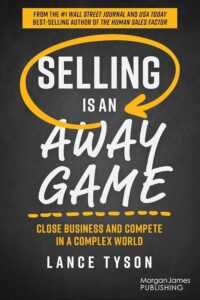
If you can’t convince somebody to take 15, 20, 30, or 40 minutes of their time to meet with you, how are you ever going to sell them a dollar product? That’s the first sale, but you have to have ways that you do that. No pun intended. I promised Jennifer I would actually bring in another concept. My first book I ever wrote, was called Selling Is An Away Game.
Selling Is An Away Game
Selling is an Away Game: Close Business and Compete in a Complex World
Does anybody here play sports? Would you prefer you played high school or college sports to play at home or would you prefer to play an away game? Why? You got home-field advantage or something. You know where the divots are on the field. You know where to bounce the basketball, where to hit the puck off the boards.
Our premise is that selling isn’t a way of the game. It ties back to something we talked about earlier, because it actually happens in the mindset of the buyer. The way the game happens in their mind. Your ability to engage the mind of buyer willingly. Now they’re profiled. You know who buys from you. You know what that profile is, or you have a few different IBO prospect profiles.
People who can afford it, like Abe said, maybe they’re writing a check, maybe there are other types of buyers that buy from you, but ultimately, you know who they are and what they’re about. Their ability to share with you their opinion, their thoughts, their agreements or disagreements allows you to advance the ball.
Does that make sense? Selling’s no way you can get into what happens to the milder buyer. I’m going to share some concepts from this that will give you a pathway, like a Waze or Google Map would. There’s not a lot new in sales processes. I would tell you the sales process that you follow. I’m a history major.
Selling only begins when you can get into the buyer’s mind.
The Original Sales Process
All my sons are history majors. I don’t know what that got us, but I am standing up on the stage giving business advice to do something new or something. I like studying business. The first sales process ever rolled out was the one that founded NCR, National Cash Register. That’s the sales process you all should follow.
Picture this. Some dude invents this giant machine that’s about this tall. You put your money in it, and then it calculates the ledger. Now imagine that happening in the late 1800s. You’re not going to advertise this monster machine in some catalog. I don’t even think the mail system was working that good at that time.
There’s no internet, there’s no phone. It was all show and tell. Think about this. You’re a salesperson for National Cash Register. Should you load this up in your horse’s buggy? You’re heading out to Walnut Grove to meet Mr. or Mrs. Ingalls. Nellie’s parents, who run the local, whatever you call that, the mercantile. They’re running a mercantile.
Don’t even call mercantiles. You’ve got to go in and open and say, “Do you spend a lot of time balancing your books? Are you always recounting your money?” Somebody would pull out a shotgun and go, “Why are you asking me about my money?” That’s the process you still follow. It was some kind of introduction, some presentation, some objections, and a close. You follow a very similar process. Nothing’s really changed.
A lot of people are throwing things and making side bets, but there’s really only one game happening. Everything else is just a side bet. That’s what sales really is.
We get leads a little bit quicker and stuff like that, but there are some parts of the process that we spend time with, like we talked about earlier, you would actually increase your odds, like you would on the casino floor, because we actually want you playing craps. Does anybody here play craps? See, look, I got one person who plays craps. Who plays sluts? Who goes with the slots? They’ll get all the hands now. Who plays poker?
Little poker, blackjack? Less. Not as many as craps or not the least amount of craps. See, the problem with craps, if you were up to the craft table, you’d sit there. I play craps, I don’t gamble a lot, I like odds, but I’ll gamble every once in a while. We do a lot of stuff in Vegas. I even have to spend a little time taking the game in for a moment because there’s a lot of action.
There’s so much action at the craps tables. I was with my brother one time at the ARIA in Vegas. He’s rolling his dice. He goes, “Mama needs a new pair of shoes.” I’m like, “Who? What is it? Where’d you get that?” He’s buying people free drinks and stuff like that. There is all kinds of stuff going on. A lot of action is going on.
The Craps Table Analogy (Action Vs. Game)
A lot of people are throwing things and making side bets. There’s really only one game going on. They’re all side bets. That’s really what sales is. There’s a lot of action going on right now. A lot of noise. You’re getting a lot of emails. You’re getting a lot of texts. You’re getting fragmented phone calls. You’re getting half information here, half information there. You end up presenting and dealing with things on different medium.
You’ve got to take the cruxes of what you do, they’re the intersections, and make sure you’re really disciplined in intersections. For instance, I was talking to Joel as a break. We got to spend a lot of time in maybe what you would call discovery or needs analysis. There are a lot of words for it. I go back to the Starbucks stuff. Let’s call it what they are. Language is important there. You get pulled in a lot of directions, and you’re distracted, so it becomes like a craps game. You need to understand the game to get your best odds.
In this episode, Lance Tyson sits down with Ryan Norys, Chief Revenue Officer at Tottenham Hotspur, to uncover what it takes to build and lead a world-class sales organization in one of football’s most iconic clubs.
Ryan shares his journey across different organizations, the lessons learned from early challenges, and how he developed a sales philosophy grounded in integrity, curiosity, and continuous learning. He opens up about leading a high-performing team with heart, navigating his transition to Tottenham Hotspur, and driving remarkable commercial revenue growth for the club.
Whether you’re a sales leader or just starting your career, Ryan’s insights on leadership, culture, and success will leave you inspired to elevate your own game.
Leading With Curiosity: Ryan Norys On Sales, Leadership, And Success
Sales odds. I have an old friend and someone we’ve done business with for a long time. We did business together in a lot of different places. Ryan Norys is the chief revenue officer forTottenham Hotspur. The first thing I asked him was, “Am I saying that right?” My Premier League knowledge base sometimes struggles. Other than what I watch on Ted Lasso, just kidding. Ryan, thanks for coming on, man.
I appreciate it, man. It’s always good to connect with you, and glad that we’re able to do this. A bit informally, but also formally as well to learn more.
Global Vs. Regional Sales: Navigating Different Business Climates
I was telling you in the pregame that our audience is a senior leadership audience, but it’s also an audience of folks who are in sales. Give everybody some perspective with a Premier League team, what your responsibilities are, what reports up to you, what you’re trying to drive for the organization.
Effectively, I’m a part of the executive team for the football club as well as the stadium. We have the benefit of playing in arguably probably one of the best stadiums in the world, definitely in Britain, which allows us to have a plethora of different events, from we just had the NFL here this past weekend, rugby concerts, big boxing match coming on. I say that because it’s important, because it’s slightly different than maybe your traditional Premier League or even European football club.
From a responsibility perspective, effectively, anything that drives revenue across the Cleveland Stadium reports to me. This is anywhere from sponsorship to monetizing digital content to premium sales, tours, retail, major stadium events like the ones I just mentioned, our pre-season tours, and friendlies as well. Anything that drives revenue essentially reports to me across the board.
From a headcount standpoint, how big is your organization?
The whole club is probably close to 700 people now. I’d say from mine, when you factor in the global football development teams, we have global coaches all over the world, as well as the retail team. You’re probably looking at on any given day anywhere from 350 people. Give or take maybe 375. Around that range.
Real quick on the revenue stream. You started to mention that you have a partnership, you mentioned digital content, but you also have hospitality sales, tour sales, all those things. How many direct sellers report to you? I know there’s a massive group that supports the revenue efforts. What are the sales from the Seller?
If you look at all of those, I would call either revenue products or channels. I have effectively six direct reports that come to me, and each one of them is more or less responsible for that particular vertical and business unit. Obviously, they vary in size because you’re going to have a larger sponsorship team than maybe your stadium tours or your major stadium events as well.
We’ll get into this as we go through your trajectory. You, as a salesperson, or a great salesperson, and over yourself. You’ve got some big deals done that I personally know about over the years. What are you seeing? What’s the difference in the business climate between the UK and what you did in the US?
The biggest thing is that any US property that you have, let’s call it a regional limitation, as to where your marketing can go. I remember at the NFL, we had a 75-mile radius around our stadium. When you come and work for a club like Tottenham, we have almost over 620 million fans across the world. Obviously, we play in the UK, but that’s probably our 5th or 6th largest market. Just in terms of our fan base and where we’re targeting.
We’re truly operating on a global landscape. That’s been one of the things that I feel like I’ve excelled in. One of the things I enjoy the most is that I’ve done deals and done business in China, Japan, Africa, Latin America, all across multiple countries in Southeast Asia, Korea, Australia, you name it. There’s not really necessarily a country that doesn’t have an interest in the Premier League or European football. The landscape and the net that you’re extending are quite significant.
It’s a global sale.
It is. It goes anywhere from we’ll regionalize certain categories across different regions to maximize the category. In some cases, we’ll go and try to do a global deal if we find the right brand and the right partner.
From Selling Tickets To Stadium Naming Rights: Ryan’s Career Journey
That’s interesting. What I say, I’ve gotten asked earlier when we start to do how we facilitate this conversation, everybody always asks. How did you get here? Where did you start? Where are you from? Where’d you start? What was that first sales job? What’s that look like? That didn’t even have to be in sports.
World-Class Organization: At that time, the revenue and money we were asking for was larger than probably at least half of the Major League Baseball teams.
I’ll start on the sports shop. If you look at my CV, I’ve had a lot of jobs, which is, in some cases, good because I’ve had a lot of experience and I’ve met a lot of exceptional people. I’ve had the benefit of working for several, what I would call, probably the best leaders across sports and even arguably in business. My first job, and this is one of them, was at AEG. I was selling tickets for the Los Angeles Kings. It was I just passed that area where they moved into inside sales. I started as an account executive. I was a bit fortunate at that level. I spent time there.
That was at Staples Center, then?
It was, yeah. To put it into context for those that are tuning in, if you will, at that time, we were selling the Kings and the Galaxy and the venue. You were all together. This was pre-segregation, even though my main focus was on the Kings. I had the benefit of moving into CSLMG, which, at the time, was pre-legends, but they would eventually become legends.
I didn’t realize you were a CSL then.
With Ben Wrigley and Bill Rhoda.
I just talked to Bill. That must have been fun.
It was, yeah. I came in halfway through the Yankees project, and this was right after the market crashed. Your first few phone calls, you’re asking people for $850,000 for a suite or $200,000 for two seats above the dugout at a time when they’re losing their homes and the markets are going down. It’s a super difficult sales environment.
What year was that?
That was going into 2009.
When the market crashed. That was the mortgage crash.
In January of 2009, we just moved into the new stadium. I had the benefit of not having to make that transition from the old stadium to the new one. It was a super competitive environment. I did that. It was successful.
Early Sales Days: Learning To Work Smarter, Not Harder
Before you go there, a real quick question. When you were at AEG, you literally went to two major markets and two big organizations. What’d you realize about, like, what was your sales process then as you went from one team to the other? What was Ryan as a seller like when you’re hawking like sweets and tickets and stuff like that? What’d that look like?
From being completely honest, I would say it’s funny when I look back on it now, because I see some of the either the approach or the attitude or the mentality that I had at such a young age, and you wish you can go back because I see people here and across my career and I’m like, “Man, I remember when that was me.”
I would say AEG was very much like learning. I was a bit too lazy to work smarter, not necessarily harder. I utilized the tools around me, which was probably a good skill set there.
I was 1, 2, or 3. I was talking to Chad Estis, one of the first ones I went to, “Where were you on the board of the Cavs?” He goes, “I was a solid 5, 6, or 7.” I was at the point where I was going to quit. I had told so many people I was going to succeed, I couldn’t even quit. I appreciate you saying that you’re like, “I’m not right at the top, but I was there.”
There’s not really necessarily a country that doesn’t have an interest in the Premier League or European football. The landscape and the net that you’re extending are quite significant.
I was like, just good enough to be annoying because they’re like, “What you’re doing is what we don’t want other people to do. You’re like, you’re messing us up a bit here.”
That’s a relative success, but we don’t want people to copy what you’re doing.
That started to happen. When I look back on it now, I’m like, I know that they placed X, Y, Z person in there to basically set the tone. First in, first out. Eventually, he ended up being the top salesperson, but initially, he wasn’t, so I’d look at it and say, “This dude’s making 50 calls a day, but I’m making ten.”
“My sales are higher. My closing issue is good. What are you talking about?” I love that.
The Power Of Big Asks: Overcoming Fear Of Large Numbers In Sales
It shifted to jump back into the Yankees, because this is somewhat of a redemption story for me. When I went to the Yankees, it was because of the way the room was set up as well. We’re in this office, and we’re sitting side by side, and we had some heavy hitters in that room. When you look at today, where they are in the industry, they’ve all had great careers, but there was no hiding. You couldn’t just sit there like that, and I basically was like, mentally, I got to make 50 calls a day.
This locker room was pushing the locker room.
Yeah, it was also the youngest one in the room. The second piece of it was that I knew Bill and Ben were part of my ability was availability. You’re in the sense that I was in New York looking for a job. It happened to be at that time when I wouldn’t say I was desperate, but I knew that I needed the job certainly more than they needed me.
I had to man up in a sense and be like, “I’m just going to hit these 50 calls a day.”
Have you ever considered, because you were young then, and how that really set the tone for it’s in his big ass, and you’ve done some monster deals that probably trained you really early not to be afraid of those big numbers.
Eighteen months. It wasn’t a long time. That was you’re selling group tickets, season ticket sales, you’re not asking for big numbers. It got me comfortable, but even more importantly, it fast-tracked me into putting myself in a position to move into sponsorship. I was able to do it a few years later. I used it, and everybody is going for jobs. Just because you may have been in this one, there are a lot of things that you probably were exposed to that you didn’t. It’s all about how you adjust that to every role.
Apex Hunter Mentality: Strategic Career Moves And Capitalizing On Opportunities
It makes sense because you never shied away, even when you were working at that fundraising thing that one time. You’re never afraid to ask for big numbers, which I’ve always appreciated. It’s like Apex Hunters. I didn’t mean to cut you, go back to the matter of lands, because that was your first bump up in the leadership there, correct?
Yeah, so it was more scope and responsibility, and focused responsibility on me because I was person 1A for CSLMG on the project. Obviously, they gave me a chance. I didn’t want to let them down, but this was in an environment where, again, you’re selling for both teams. Both teams have different markets. They market to their team, to their fans, differently. They have different ways of operating. I think this helped me learn at an early age, also the politics of how to manage, I guess, two properties, but also not only the egos that come with them, but also how and what information you can and cannot share. More importantly, how they want to receive information. That was the first foray.
That’s internal politics and what the play looks like internally.
We were in Switzerland. I could go in and have a conversation with the brand, and I’m going through my needs analysis. They may be a better fit for the Giants, but the price point may be better for the Jets. How do I also not lose a sale, but find a way to make a sale, but doing so by not upsetting the Giants, but by also delivering for the other client. You had to walk a fine line, but basically, I think that’s where you also really made sure you had to do a proper needs analysis and understand the objectives from the brand and what they needed to make a decision.
Where did you go from there? How long were you at that project? That’s when Legends started to come in with CSL.
Usually, when you think about a job, you’re either running away from something or you’re running towards something.
Legends started to come in, and I’d say the whole Legends experience, if you will, was probably around a little over three years, across a couple of different projects and properties. I think what makes me probably the most unique is that we talked about it a little bit in pregame, but I think I’m coming on either just over nine years of working in Europe and the UK, across London, Rome, etc. My first foray into it was when I was being recruited to go to Manchester City.
I’ve managed to leverage, I worked at Ink Stadium, MetLife Stadium, as well as the first couple of months on Levi Stadium with Al Guido and Michael Drake, and those guys. Gina as well, who you know. I was able to turn that into, “I knew I wanted to get into the sponsorship.” I didn’t have the experience, but I think I was in the right place at the right time and was willing to make that jump to move to England, sight unseen.
I’m glad you’re on that Man City or Man United? Go back to one thing, because this gets often overlooked. No matter where you’ve been, you’ve gotten the job done. Even when you were, we’ll talk in a minute about this, but I always admired that you’ve kept your career path, also where you’ve capitalized on opportunities in the best ways, where people are like, “How does somebody get opportunities like that?” You’re playing chess. It’s not a checkers, not to use too much metaphor there, but like talk about that a little bit. Were you always eyeing some upward that came to you because you were getting the job done?
Most of the opportunities that have come to me have come organically, have come through a relationship or a network. They come, and it’s something that I’m like, “This is actually worth running into or running to. It usually accomplishes some goal that I have.” I can jump ahead quite quickly, but when I was at the Prudential Center and going into the Dolphins, my primary reason for the Dolphins was that I looked at the sports landscape.
I’m like, “There’s probably ten people who have had the opportunity to sell naming rights, and a majority of them are all in an agency. This opportunity is, they’re not hiring an agency. It’s going to be a fast fail, but if Todd and I are successful. We can now be one of the, let’s call it, almost uncountable on two hands of people that have sold naming rights. I was facing a big deal, which is why I was there.
Hard Rock Stadium: A Landmark Naming Rights Deal
Everybody here is tuning in. I just want to clarify for the audience, what Ryan’s talking about is the naming rights for Hard Rock Stadium in Miami.
That’s correct.
That’s right. The corners are there, too. I’m sorry to interrupt, but people who maybe aren’t in sports follow, which is a massive deal.
We generated in less than three years, like 450 million of COI. It was a massive revenue story. In that case, going back to your question, I was chasing or running towards something. That’s what led to that. If you look at it from a career perspective, just to circle back and finalize the answer to your question, I’ve always just moved only if I was running towards something.
I love that. A lot of times, when I’m doing these, there is a strategy to it. It’s like you said, I’m trying to accomplish a goal. I see an opportunity that wasn’t there, and it could lend to my credibility, but I have to be credible to even get the opportunity. I’ll hit the rewind. From Levi’s Stadium, you get your first shot at Europe with Man City. What’s the role? Is that with Legends or is that with?
No, there’s not with Legends. In a way brought Legends into it from a catering perspective. I don’t want to say it’s probably a couple of months into it. This was back when Legends was still on the rise, right now. Obviously, they have a big European business, and they’ve managed to turn that into not only what started as maybe a catering relationship. I think they even did quite a bit of hospitality and sales with them at that time.
I actually reached out to Al, who connected me to Dave Checketts and organized a meeting with him. This dates you and goes back to where we were. I was actually hired in sponsorship, the first American to join the football club at Manchester City. They were nowhere near what they are today. I always say to people that we were wearing Umbro. It was like the right time, right place, you know what I mean, in terms of joining a club.
Looking back on it today, it was probably my favorite experience of all time in terms of my career, just because there was a sense of innocence, but just pride and collaboration and teamwork. Everyone was really just so proud of working at the club. We all just came at the right time and came together quite quickly. Initially, I was actually identified and hired to build the club in the US. Very quickly after realizing, and this was before NBC took over.
I did 2 to 3 months of research, consulting on different things, and realized, “I don’t think we’re going to find any dollars here.” I actually went back to the leadership team at the time, and I said, “If I just look at Facebook and Twitter,” and this is the time when Facebook and Twitter were like the social networks, “I was basically the top 4 or 5 markets of our fans are all in Southeast Asia.”
They were like, “You should go there.” In some cases, it was quite funny because you had an American who didn’t really know much about soccer, not an English club, but being tasked with growing the brand and driving revenue across Southeast Asia and Japan. Essentially, I was doing it with one slide. I knew the challenges that we had were a challenge club at the time. I knew how to sell against the other properties.
World-Class Organization: One thing I’m proud of in my career is going to a place and just getting the job done.
Going back to what you’re saying, one of the things that I’ve been proud of in my career is going to a place and just getting the job done. It was very similar to that. There’s no blueprint. There’s no playbook for it. No one was telling me what to do or how to do it. It was just giving me the opportunity to say, “Here’s an entire region of the world where people love football.” Man City is not one of their top 5 or 6 favorite clubs at this time, but go sort it out.
You had a lot of architecture going on there. That makes total sense. How long were you there, Ryan?
At City, known in various roles across the club, for roughly three and a half years.
I didn’t realize that you’ve been nine now, but I didn’t realize you had a stint before.
I didn’t realize that at all.
From there, you went where?
Building A High-Performing Culture: Leadership Lessons From The Devils
I had the opportunity, which I’m very fortunate to have, to work for Scott O’Neill. He had just bought, I guess they just closed in on Harris Blitzer Sports & Entertainment. I think they were maybe on day 30 of buying the Devils, if you will, and met with Adam Davis and effectively were like, “I’m City here. They have me in the New York office. They’re now in this position where they’ve created City Football Group. They want me to move to Singapore. I’m in New York. I got my friends. I’m living in Tribeca.” The dating scene is in the right place.
“My life’s in a good situation right now.”
Like, “I don’t need to go to Singapore.” I also knew what I needed from taking it back somewhat seriously. I knew what I was lacking in my career. At this point, I had said, “I got my foray into sponsorship. I’ve done deals in 6 or 7 different markets. I have this unique selling point from a personal brand perspective. I’ve always been trying to be very conscientious about that.” The one thing I lacked was that I had no leadership skills or experience.
Maybe I have the skills, but I don’t have the experience. I saw this as an opportunity where they were building a team. I got to learn under Scott O’Neill and Adam. At that point, you’re looking at it, you’re like, “There’s probably not a better scenario in sports.” In terms of this time of opportunity, where I was in my career, and what I need to do. I always say that I was very grateful. I think I was only there for maybe 15 or 16 months because this is what drove me to Miami.
That’s where I look back and I’m like, “I got my MBA there.” I learned how to build a team and manage that team. In fact, if you look at those three people that I first hired, I’ve either hired them again, they’re still best friends with them, and/or still consulting with them and helping them navigate their career. I’m trying to always pay it forward in that sense. I also really learned how to manage up. Wholeheartedly, I struggled at the beginning because I was thrown into an executive team.
That is where Scott’s sharing is at this point. At times, we’d have to present to the owners. Very quickly, I had to learn this. I think it probably took me 2 to 3 meetings, where I think one of the last ones, Scott was like, “You’ve got to sort this out.” Through that time period is that’s where I learned, one, how an organization should run.
This goes to earlier in the conversation, when you go to Miami, with the name rights there, and then you hook up with Todd Klein. He’s in a similar role you’re in.
He’s in a similar role you’re in. He’s the president of the commercial. We have a valuable list currently there and then figure out what we need to build to be successful. Not only that, when I described that experience, you have to be able to chew gum and walk at the same time. We’re driving down a freeway, while I’m also trying to change our tires, because you have the current team and property deals that you have to do.
You also have, what I estimated and discussed previously, around the new stadium, which is not a new stadium, it’s basically, they rebuilt, reinvested into new areas of the stadium in the building. You had to do both. We very quickly, because we had not worked together, I think you’re looking back on it, Todd was like, he’s got international experience, he was trained by AG.
World-Class Organization: Develop a high-performing culture with heart. We need incredibly high standards and expectations, and with the right people in the right direction, we can achieve it.
He spent some time with Scott, so I know he’s going to come in well-coached. Now it’s about how quickly we can gel and then how quickly we can work together to say, “how do we divide and conquer to make sure we’re successful? The biggest takeaway is that there was no ego involved.
Very quickly, we aligned what we needed to accomplish. Either I would take a meeting or Todd would take a meeting. We quickly identified that we cannot be in the same place at the same time. I was responsible for trying to set the organization up for success. Those trains run on time, while we are also always keeping an eye on how we drive revenue in these big assets.
Leading With Empathy: Fostering Growth And Success In Your Team
You talked about before, and we haven’t touched on this, but I think it’s interesting for the next couple of stops as we start bringing some for a landing. You talked about managing up. You definitely have a sales philosophy that if you’re not paying attention to what Ryan’s saying, it’s to establish credibility, create opportunities where they didn’t exist, or capitalize on opportunities in front of you. What did you start to realize about your leadership philosophy, and how did it start to evolve, because that carries you into where you are right now?
I think very quickly, I realized like, I touched on the ego thing, but I never move with ego. I try to move with purpose. Everything that I do comes from a place of growth or with an eye on growth. I obviously want what’s best for myself. Most importantly, I want what’s best for everyone around me. Sometimes that can be uncomfortable if you don’t have people on board. The thing I enjoy the most about my job, more than doing a big deal, going into a game or a match, is really trying to empower the people around me and put them in positions to be successful and watching them grow.
Watching them develop those skills. A lot of times, like, “I’m not afraid, I’m a doer by nature.” I’m not afraid to roll my sleeves up and also do the work. Also, I try to lead with empathy. I’m going to steal something from a couple of different people. I always say I try to develop a high-performing culture with a heart in the sense that we need to have an incredibly high standard and high expectations. I also believe that if you can get the right people going in the right direction, you can achieve that.
That’s really well said. As you look at your next like quartile of like experience, you went from Miami. You guys got the job done there. Anybody flying over Miami or going to Hard Rock, that’s Ryan and getting that deal done. Where’d you go from there? What did it look like, because now you’ve got the last ten years almost from there?
I’d say some people may look at it and say it’s a slight left turn, which is probably true, but also, when I bring it back to today, there are some things that I’ve been able to implement at Tottenham that have stemmed directly from that experience. I went to work for a company called Omaze.
Please describe for those who don’t know.
It’s essentially a company that raises money and awareness for charity. They do so by creating experiences. Initially, with athletes, celebrities, we moved into cars, houses, travel, sneakers, etc. We could do a whole podcast just in that experience alone. The irony of it is, I was there for a little bit. I was doing quite well, making some waves and some moves around there. At the same time, one was at the Dodgers. They had like $80 million or something up for renewal. He was like, “Come and help me do this.” I was like, “I really want to keep this job as well for a while.” I was doing both.
I remember that.
I don’t know that I’d recommend it, but I was able to manage through it. Obviously, something had to give, and then Omaze asked me to come and basically lead their entire business development piece. When I look at it now, one, I surrounded myself with people who were significantly smarter than me, coming from Harvard, from Penn with MBAs and masters and various assets of things.
The biggest thing when I take it back on is the way they solved and approached problems. I brought a lot of that with me. Also, I’ve learned the value of a customer and not only what it costs to acquire them, but what it means to assess or assign a value to a customer. As we enter now into this cookie list world, the importance of a CRM, or let’s call it first-party data, because that it funnels your cycle across every revenue channel and product.
It helps sponsorship, helps premium, helps retail, helps e-commerce, and helps everything in your ecosystem. It really was a nice combination of tying that in, along with when you look at a sports property and you’re like, actually, they’re not too much different. We just need to view it as a fan because they’re going to care about slightly different things. At the end of the day, we cannot forget that they are a customer.
The Customer Is King: Understanding Value In A Cookie-less World
It’s a great perspective. I remember that time with you, too, because I was like, “I’m already trying to explain to myself.” Like, “I’m here and I’m there. It was vague.” I’m like, “Okay.” The Omaze thing was interesting. I remember being out there and the way they had to tell the story and things like that. It was almost like a reverse sail from what I can remember.
Transparency was key. You had to learn how to very quickly explain what you do. This is where I perfected the elevator speech, whereas now, from all the different things I learned, someone asked me, “What’s the proposition at the top?” I could do it in seconds. I learned it because I had to take a very complex, unheard of project and be able to explain it to someone as if speaking to a kindergarten class in a way.
Have the discipline to do it every day. Keep trying to get better — that’s what learning is.
I remember because you spent a lot of time with me. After all, I’m like, “Huh?” We had a reverse engineer. I go, “Now I get it.” From there, at that point, that’s when you start to move back overseas again. You went to Italy for a minute.
I had a brief stop at WME, which would probably have been significantly longer had COVID not hit, just because Todd and I rejoined to basically build a property sales team. We also had the talent sales in terms of as well of the team that was selling across some of the athletes that reported into us. That was the primary focus of the role.
Obviously, a lot of events shut down. We were in a lot of ways very fortunate and lucky to be able to still have a lot of talent and athletes and celebrities to sell for because that’s when those personal endorsements and creating content and tying brands into it and integrating it were really hot. It was very much on topic. We ended up doing, not just myself and Todd, but across the team, almost like 300 plus deals that year.
It’s very transactional, but you were doing the high frequency. About it’s almost a combination of premium sales and suites and stuff, but doing it in that area. Through that experience and while at WME, I started consulting for AS Roma under the IMD umbrella. I’d moved from LA to Austin, where my wife now was, but at the time wasn’t my wife, where she was living and working for Metta.
Basically it’s just a bit of a coincidence and just being in the right place at the right time again, where The Freakins, which are Dan and Ryan who own AS Roma, they were based, their family office and just overall infrastructure was based in Houston, short drive from Austin, had the opportunity to spend quite a bit of time with them and a guy called Brian Walker who’s on the project. About 6 or 7 months, they’re like, “You should really come and be the CRO for the club.”
Fast forward, and it took a few months to get there. I got married and then, within two weeks, had moved to Rome. A big experience. Again, only American at the club, reporting for American owners, living and working in Italy was two different things. Working had its challenges, living in Rome and Italy is an experience that I’ll never forget and never take for granted. It was unbelievable.
You remember you’re getting a Lamborghini with Omaze.
Yeah, with Omaze.
I remember talking one time, and you’re pitching Lamborghini at the Italian club.
The first one at Omaze was when I met the Pope.
That’s what it was.
That’s what it tied together.
That was amazing. I remember talking to you right before that, too. You’re like, “I got a meeting with the Pope and it’s with Lamborghini.” I’m like, “Huh?”
That was one of those deals that, like always remember for so many reasons, but it was a great experience
We get back to now, you leave there and then bring it to like where you’re right now. What was that from there? You stayed in Europe pretty much since.
It’s very hard to beat someone who doesn’t stop and doesn’t quit.
I did. I went from there to Tottenham. Again, I’ve been here a little over three years. I think we were talking about before, this was very much a club that had tremendous success in terms of, from a history and heritage perspective, it moved into a beautiful new building, somewhat impacted by COVID, but really, they were a club on the rise.
They were always in this sixth position, even from a commercial perspective. There was a tremendous opportunity. I had the opportunity to come in and basically start from scratch. I built a phenomenal team. I would say, probably, in my entire career of the most talented team now. Again, as we’re talking about, we’ve gone in phases.
I’ve learned that some of the people I initially hired were amazing in getting us to this point. When we needed to level up, we needed to change the formation, the dynamic. The same way that a football coach says, “We’re going to be a run-pass offense, where now we need to be a bit more defensive. You need to change personnel. You need to change information on how you’re going to market, what’s needed, what’s required.”
The architecture.
Yeah. That’s where we are. I’m very pleased to say that we are, we have the fourth highest commercial revenue now across the Premier League. We’ve surpassed both Arsenal and Chelsea. Also, in the past three years, we’ve had the highest percentage growth against any other Premier League club, including Manchester City, Liverpool, and United. It’s a massive accomplishment. Again, I’d love to take credit myself. Again, as I said, I have a phenomenal team, and we’re again in one of the best buildings in the world. We have the benefit of being able to leverage that.
Tottenham Hotspur’s Rise: A Philosophy Of Competitive Growth And Coachability
As you look across the last nine years in Europe, how would you sum up your philosophy of leadership, and then you definitely have a philosophy of sales. Speak to those two things. I love the move with purpose. High-performance culture with heart. How does that tie into your leadership philosophy? Break that down a little bit.
I’ve touched on a lot. I would say one of the things that I look for and try to build across the team is maybe a slightly different position I would take. I want people who are competitive and have discipline, but have their own self-determination. They know we’re not competing against the Chelseas and Arsenal’s of the world, even though I named them or F1. We’re essentially competing with ourselves, and how do we get better every single day?
I think that’s something that I just tried to instill. The second thing is, everybody needs to be coachable, including myself. That teachable spirit, questions before answers. I want people to be good teammates. I always go back to portraying it as friends. If you have a good friend, you want to be a good friend to them, and you want them to be a good friend to you. It’s no different. Be the team.
The biggest thing, TK and I have talked about this a lot because I think it’s one of the things we keep going back and for reference, TK is Todd Klein, those who know him well. Basically, it’s having the discipline to just do it anyway. We’re going to do it. Every day, you just have to try to get better. That’s learning. Never stop learning.
Don’t listen so much to what people tell you. It was a lot of times that people told you what to do. Those people don’t have the results you have. Usually, if you follow that, it’s a terrible decision. We’ve just talked about it consistently. We call it a test day. There are test days that come, and those days come, and you have to just get through them and do it tired. I’d say that’s probably the biggest thing.
I think from a personal perspective, and this is particular to sales as well, is that like every emotion is okay, and then we lose it. We get upset. It’s okay to mess up and make a mistake. Every behavior is not. As I look at what I consider myself or try to become, let’s call it an elite performer, it’s not acting on impulse. It’s how do I regulate that? How do I reset? How do I make a plan and go with intention?
I love that. So much insight. As I bring this down for a landing, I love how you look at opportunities. Move with purpose, move toward the opportunity. You’re thinking of the result you have to get, of course, for whoever you’re working with, but also at the same time, that personal brand building. It’s so important, and you have to see the whole field. How can I benefit somebody that I’m going to work with?
What can I bring to the table? I wrote that down three times. The last couple of things that you and Todd talked about resonate with me because I need to be around competitive people, and you have to be a good teammate. In sales, sometimes it takes a team to make a sale, but at times somebody has to run the ball or win that heat.
We all know that. I always look at you like that, Apex Hunter, man. You just always have been, you talk about the big deals, and if you’re listening to Ryan right now, I’ve seen him in different spots. His calmness in this is exactly who he is. Even when we would have tough conversations in Miami about talent, that’s exactly who he and I always are. I always remember working with you when he says he’s coachable. I’ve coached him directly. I know when I’m getting resistant versus people resisting coaching, you’ve never resisted.
I would always say probably the word I use with you, you’re always more curious than anything else. Why do you say that? Tell me more about that. There was always more of that. I was thinking of the boardroom. Later questions as we bring this bird down for landing. If you had to play any song in your head before you’re going to get big, if you had to go redo that naming rights deal in Miami or wherever, what song are you playing in your head? What’s that music? It’s always an interesting question.
It’s a good one. I don’t know that there’s a song. I know that’s a bit of a cop out. I don’t know that there’s a, there’s a specific song. I definitely listened to much more hip hop music, so it can be a bit much at times, but it’s more about getting into that vibe. It’s one of those things, like it’s more of that. I listened to it to prepare for confidence because it’s the most confidence you can have, and it’s that self-belief.
World-Class Organization: Always do the right thing. You can never go wrong by doing right and being naturally curious because it’ll always put you in the right rooms.
There are times when I literally will tell myself like, “I’m the best.” No one’s going to tell me I’m not. Even though in my mind I know, “There are certainly definitely better people than me.” You have to whatever songs or vibe or music that’s playing, that’s what I usually try to get into it, where I come out and I’m like, “There’s actually no one better than me.” It’s because it’s very hard to beat someone who doesn’t stop and doesn’t quit. That’s the mentality that I try to drive through whatever song or music I’m playing in my head.
I literally like you were like, “I cannot lose, man.” I was like, “I cannot lose.” I mean, “You’re not going to beat me.” It’s like, “I’m with you.” We don’t talk enough about that in sales. Everybody has a lot of kumbaya. It’s like, where’s that positive self-talk? You’ve got to walk in yourself. There’s a team behind you, but I’m not going to be beaten.
The Books That Shaped A Leader: Recommendations For Success
My wife and I invested in a wedding venue, and I was in the final negotiations yesterday. I’m like, “This guy’s going to have to beat me.” This is not going to happen. No way. That guy’s pretty savvy, and I’m like, “I got this.” Besides my book, of course, which I actually wrote about Ryan in my book. There’s a whole conversation about one sneakers. There is a whole section of my book about Ryan at a U2 concert. If you had to gift a book, what book would you gift?
Both are literally behind me. Good to great. I’m with you on both books. Well said.
I talk about that one a lot. We’ll reference that one quite a bit.
The enemy of the great man. Period. It’s not too good as the enemy to great or the hedgehog.
Last thing. You say you have a niece or nephew left, 7 or 8 years old, on your side. You’re sitting at the end of a dock over there in London somewhere, right on a little lake. They say, “ Uncle Ryan, what does it mean to be successful?” I remember, you’re like a 7-year-old or 8-year-old, and you got to communicate success to them at that age, go.
The biggest thing that I tell them is to have high integrity. That goes a long way. We both know a lot of people in the industry and even outside of it. I feel like you can have a lot of other things. You can be super talented. You can have enthusiasm, intelligence, etc. If you don’t have integrity, the other two are quite dangerous. It would be, be integrity.
The second thing is, and you mentioned it, is to have that natural curiosity. Those people like that are asking why, from a sales perspective, you said on the coachable side of things, that is probably why I’m good at sales. There are other salespeople who certainly are a bit more aggressive, but I genuinely try to understand how they make money, why they’re doing this.
If I know that if I unlock that, and you’ll notice, like there is no greater feeling than after you’re in a meeting and halfway through. Even when you leave, you’re like, I don’t know, I can find a reason why they shouldn’t do this. That’s when you’re playing with house money at that point. I would tell them, “Always do the right thing. You can never go wrong by doing right and being naturally curious because it’ll always put you in the right rooms.”
I love it. Ryan, I so appreciate your time today. This is one of the better interviews. I actually learned a bunch about you that I didn’t. I learned more about your mindset than anything else. We don’t talk every week, but we certainly have been around each other in different scenarios. I appreciate it.
In this In-Sights episode of Against the Sales Odds, Lance breaks down one of the most common traps in sales — buying signals. Too often, salespeople jump in with what they think instead of paying attention to what the buyer is signaling. Lance explains how to identify real buying cues, when to speak, and when to step back — so every conversation moves you closer to a close.
👉 Tune in now and rediscover why the first steps in sales are the most powerful.
It’s Not About Selling Harder. It’s About Listening Smarter
First of all, I wanted to talk about the power of personal brands. What’s that personal brand for you? It’s a part of the sales process of the employee. I would say the other thing. When you focus on two, their knowledge is power, having the opinions baked into how you sell. The last thing I want to say about my opinion even stronger is, it’s important to write this down and I’ll give you an example of this, too. Are you giving them a strong opinion? Are you giving them your opinion?
Why Strong Opinions Are Needed In Sales
I was watching a bunch of sales presentations. I was talking about Buffalo. There’s a sales guy and his name is Dustin Campbell. Dustin’s had a long trip in his sales career and he did a demo. He worked for the bills. He just moved up. He’s worked for the Cleveland Cavaliers and for the Miami Dolphins. He’s worked all over the place and we had been doing about 40 pitchers in a row. They were pitching some hospitality. I said, “Dustin, why don’t you get up and pitch?” He did a mock pitch and it’s not a role play. It was like him just talking like he was talking to a buyer. I’m not into role playing things because it’s not the best way to train adults.
When he made his recommendation, he basically said something like this, “Based off of what you’re saying, I strongly recommend this product because of why.” Everybody else had given all the options and almost confused it. Dustin gave the advice. I think knowledge is power and you give people opinions, your strong opinions will last. That’s another thing I’m seeing changes in sales. You should get there because that’s what people are looking for from you, because that’s the trusted advisor.
Knowledge is power. Giving people your strong opinions is becoming a big thing in sales.
How To Start Reading Buying Signals
When I go to Tom Simon about the investment. He’s my CPA, but he also does a lot of our family financial planning. He’ll say, “I recommend this to the portfolio because of X, Y, and Z.” He’ll make the recommendation and I appreciate that because I don’t have the time to go study everything. I want his recommendation. In your spot, you should look at that. Let’s look at how you communicate now and when you’re giving some of these opinions.
We’re still at a high level. I don’t know if you’ve ever thought about this. When you’re communicating, you start off at 9:00. You’re sending a message to somebody and you’re going back and forth in a meeting. As you’re sending the message, your message goes through your filter. Your filters are your assumptions, history, and biography. Anything that has to do with it, you communicate from your filter. The message is then received through somebody else’s filter. That’s their assumptions and their background.
By the time you send a message, especially in selling. For instance, let’s say, I’m on my worst days yet. They are right there smackdown. Let’s say I’m walking Daisy through. I’m walking her through like a center. I in different spots ask, “What’s your thoughts on this? What’s your opinion on this?” As I’m presenting, I’m constantly asking her for feedback on different things. I’m cupcake testing all the way through. Now, here’s what’s important for all of you. Why don’t you think about this first second? What’s important is that you can buy signals. I’m pitching Daisy and I’m sitting across from her. I’m like, “What’s this mean?”
This could be a cold. This could mean I need a shave. You love watching the pundits up there when somebody likes a newscaster and they’ll go, “It was clearly up the stand. I was thinking X, Y, and Z based on their posture and everything else.” You’re like, “Shut up. You have no freaking clue what they were thinking.” That’s what I’m arguing against. You got to know what a buying signal is. A buying signal is anything a buyer says or does or doesn’t say or doesn’t do that indicates interest.
It can be an action or a statement, or they don’t say or don’t do that to indicate interest. You know you’ve given some pitches and they didn’t ask any questions. You’re like, “I think I got them.” Jennifer calls you up and she asks, “How’s the appointment?” You go, “It was awesome.” Are you going to get it? Absolutely. That’s always the answer, isn’t it? You have an appointment. You’re going to get the sale. I got it. Why didn’t you get it yet? Not a good time but I was going to get it. Everything’s great.
Buying Signals: You have to form an opinion to close the sale, and the only way to read warning signals is to ask.
We have a tendency when we sell to look when we pitch. We have a tendency to look at all indicators that cause or contribute to our bias. It’s called contribution bias. When you go buy a new product or service. Say you’re going to get a new iPhone or you’re going to buy a new suit or new bag or whatever you’re buying. You look at all the factors that contribute to your bias. There’s all the reasons I should have this. We pitch a lot of times.
We look at our bias. They’re going to buy more because of X. They all have to be tested. You can’t just assume you know what it means. Remember, if we go back to the first principle, you haven’t sold them before. It doesn’t matter what your experience is if you haven’t sold to them. Your experience guides you but it doesn’t always make a decision for you. Everything has to be better. We have tested it. That being a trial close. What are your thoughts about this? What’s your opinion here?
How To Watch Out For Warning Signals
People can’t value what they can’t compare and contrast. What do you like about this? What do you hate about it? What do you hate about it? What do you like about it? You’d ask all these questions because you have to form an opinion to close the sale. You have to read buy warning signals and the only way to read buy warning signals is to ask. That’s the remedy. What’s a warning signal? A warning signal is just the opposite. It’s anything a buyer says or does or doesn’t say or doesn’t do that indicates disinterest. It’s just the opposite.
How do you identify a warning signal? The same remedy. Right back to the cupcake. Right back to the toothpick and the cake. What’s an objection? Objection is anything the buyer says or does or doesn’t say or doesn’t do. It is a hesitation to move forward with the sale, but it’s just bigger than buying a warning signal.
In this episode of Against the Sales Odds, Lance Tyson breaks down the very first sales process — the foundation every deal is built on. Too often, sales is overcomplicated with jargon, shortcuts, and “hacks.” But at its core, sales is a simple game of following the basics. Lance shares how top performers win not by reinventing the wheel, but by executing the fundamentals with consistency: building trust, asking the right questions, and moving prospects through a proven process. Whether you’re a new rep or a seasoned leader, this episode is a reminder that success in sales doesn’t come from complexity — it comes from discipline, clarity, and sticking to the process.
👉 Tune in now and rediscover why the first steps in sales are the most powerful.
My first book I wrote was called Selling is an Away Game. If anybody here plays sports, would you prefer if you played high school or college sports to play at home or would you prefer to play an away game? Away would be perfect. Why? You got a home field manager. You know where the divots are on the field. You know where to bounce the basketball or not or where to pick off the boards. Our premise is selling is in a way game because it ties back to someone we talked about because it happens in the mindset of the buyer.
The away game happens in their mind. Your ability to engage the mind and the buyer willingly. Now, they’re profiled. You know who buys from you. You know what that profile is or you have a few different ideal prospect profiles. People that can afford games set. Maybe they’re stuck in a check or other types of buyers that buy from you but ultimately, you know who they are and what they’re about. Their ability to share with you their opinion, thoughts, agreements or disagreements allows you to advance the ball. Does that make sense?
Following The Same-Old Sales Processes
I’m going to share some concepts out of this that will give you a pathway like Waze or Google Map will. There’s not a lot new in sales processes. I would tell you the sales process that you follow. I’m a Penn State, History major and all my sons are history majors. I don’t know what that got us, but I have to stand up on stage and give business advice that has something to do with something. I like studying business. The first sales process ever rolled out was the guy that founded NCR or national cash register. That’s a sales process you all should follow.
Selling always ties back to someone. It happens in the mindset of the buyer.
Picture this. Some dude in this giant machine that’s tall. You put your money in it and then it calculates the ledger. Imagine that happening in the late 1800s. You’re not going to advertise this monster machine in some catalog. Not even the mail system was working that good at that time. There’s no internet. There’s no phone. It was all show and tell. Think about this. You’re a salesperson for the national cash register. You load this up and your horse is buggy. You’re heading out the Walnut Grove to meet Mr. And Mrs. Ingles and Nellie’s parents who run the local, whatever you call that, the mercantile. It’s a mercantile. They’re running a mercantile.
You got to go in and open and say, “You spend a lot of time balancing your books. Are you always recounting your money?” Somebody would pull out a shotgun and go, “Why are you asking me about my money?” That’s the process you still follow now. It was some introductions, presentations, objections and clothes. You followed a very similar process. Nothing’s changed and we get leads a little bit quicker and stuff like that.
There are some parts of the process that we spent time with like we talked about. You would increase your odds like you would on the casino floor, but because we want you playing craps. The problem with craps, if you roll up to the crap table. You’d sit there. I play craps. I don’t gamble a lot. I like odds but I’;; gamble every once in a while. We do a lot of stuff in Vegas and I even have to spend a little time taking the game in for a moment because there’s a lot of action. There’s so much action at the craps tables. I was with my brother one time at the ARIA in Vegas.
He goes, “Mama needs a new pair of shoes.” I’m like, “Who? Where’d you get that?” He’s buying people free drinks and stuff like that. There’s a lot of action going on. A lot of people throw things and make side bets because there’s only one game I’m going to play there. They’re all side bets. That’s what sales is. There’s a lot of action going on. A lot of noise. You’re getting a lot of emails and texts. You’re getting fragmented phone calls. You’re getting half information here and half information there. You end up presenting and dealing with the same things in different media.
Sales Lessons From Mouse Traps
You got to take the crux of what you do. They’re the intersections and make sure you’re disciplined in intersections. For instance, I was talking to Jules. We got to spend a lot of time on what you would call discovery or needs analysis. There’s a lot of words for it. I go back to the Starbucks stuff. Let’s call them what they are. Language is important there. You get pulled in a lot of directions and distracted, so it becomes a craps game. You need to understand the game to get your best odds. As simple as genius. Has anybody live in the city and does anybody here deal with mice? Who’s dealt with mice in their life?
Sales Process: There is a lot of action and noise in sales. You have to take the crux of what you do and remain disciplined.
I went into a Kroger. Kroger is a big thing out in Ohio. I went in one day and I asked for help at Kroger, which is like finding somebody in the lost and found. I said to this manager, “I’m looking to buy a mouse trap. I want to know your best mouse trap.” I did it at Lowe’s and at Home Depot. He showed me the wall of mouse traps. They all have 4 or 5 of them and even grocery stores. He showed me one that was like a little sticky pad.
I don’t know about you. I’m a big guy but I don’t want to deal with the pissed off mouse on a sticky pad. What are you doing? You’re bending over and kicking it and it’s alive. There’s ones that look like little bear traps. They don’t do anything. That’s things wiggle around and moving and stuff. I go, “What is the bestseller? Which one sells?” He goes, “This is the one that sells.” This is full collateral damage. We have come a long way with how we feel about animals and stuff like that. That is the 1800s. That has not changed. The most popular mouse trap company in the countries of Lancaster, Pennsylvania, Victor mouse trap. It’s a piece of wood, high-powered strength.
You know that you ever load one of those up, you load that thing back a little peanut butter on there. You don’t hurt your finger because that thing goes boom and it’s all over you. You got to be careful but that’s the one that sells. I asked myself, “Why does that one sell?” When somebody first introduced that mouse trap, that became the standard of all mouse traps going forward. It was sold as the mouse trap and still the mouse trap. It is the oldest trademark of mouse traps.
I look at sales as a very simple process. I don’t think complicated problems require complicated solutions. It’s simple and it’s probably the only thing I do linearly in my life, because I understand the front and back. I don’t even think I give it to the dentist every once in a while. It’s like, “Do you go up and down or back and forth?” Every dentist has an opinion. Sometimes I do it before the shower or after shower. I don’t do anything in order but I do sales process in order.
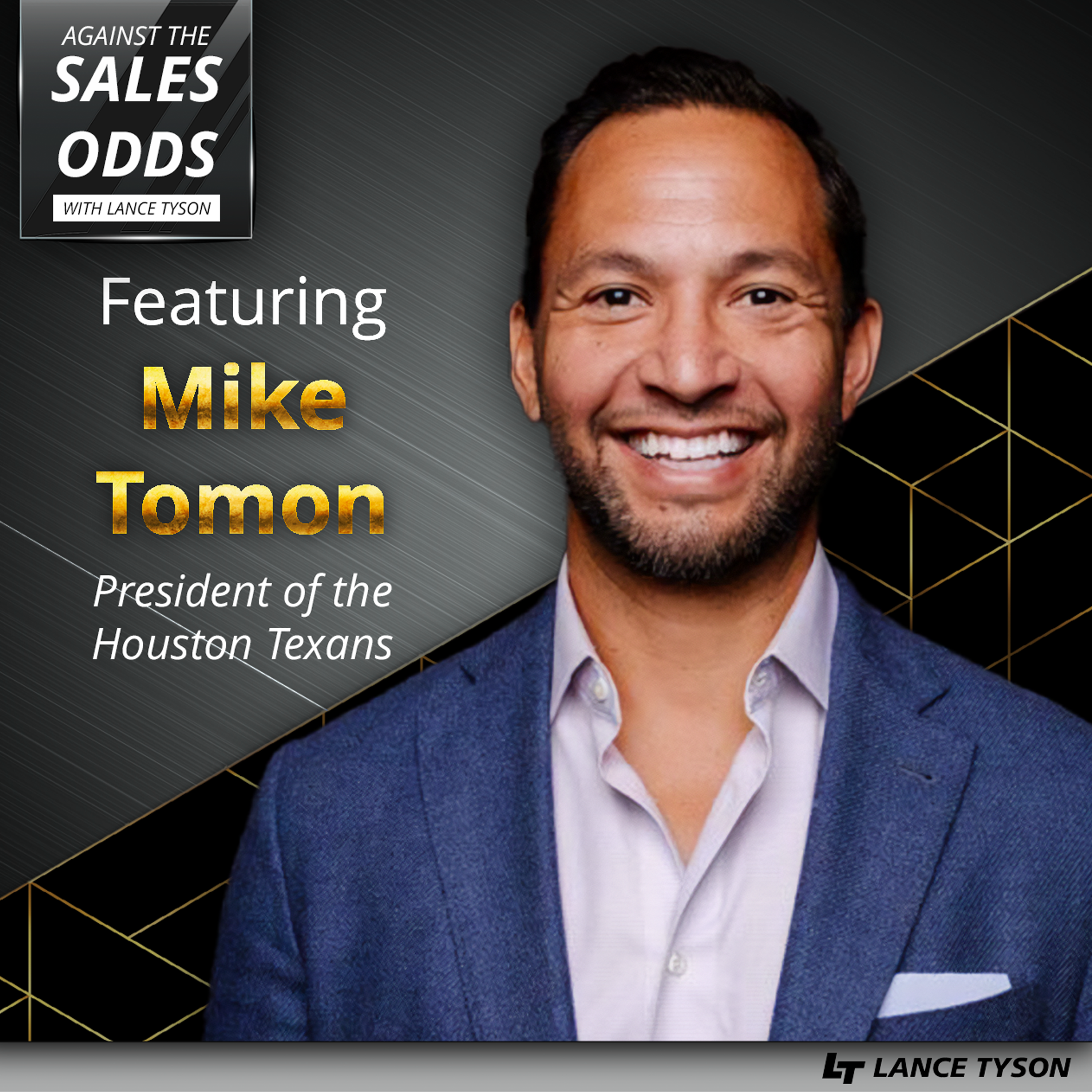
In this episode, Lance Tyson sits down with Mike Tomon, President of the Houston Texans, to explore what it takes to lead a world-class sports organization on and off the field.
Mike shares how his role spans sales, marketing, community impact, legal, HR, communications, data, event operations, and guest experience—all with one goal: enabling the Texans to deliver the best product on game day.
From his early start at IMG and sales stints with the Cleveland Cavaliers, Phoenix Suns, and Charlotte Bobcats to senior roles at AEG and Legends, Mike’s career is a masterclass in building teams, scaling organizations, and navigating transformative moments.
Key insights include:
Crafting a clear vision, alignment, and communication across every level of an organization
Rebuilding culture and productivity in challenging markets
Lessons from global growth at Legends and premium revenue strategies at AEG
Preparing for the Texans’ next chapter, including future facilities and fan experience
Whether you’re in sports, sales, or leadership, Mike’s journey is packed with practical wisdom on building strong teams, scaling with intention, and staying authentic as a leader.
Building Championship Culture: Leadership & Growth With Mike Tomon Of The Houston Texans
The Ohio Mafia: From Past To Present
I’m excited about this episode because this person I have a history with, and like me, part of the Ohio Mafia. Also, Ohio guys all stick together.Mike Tomon, President of the Houston Texans. I am so excited you’re here. It’s been a hot minute.
Thank you for having me on.
I certainly know what the president of a sports team does in a major market, just audiences, sales and leadership that reads this. As President of the Texans, talk about what your org chart looks like underneath you and day to day what hats you’re wearing.
Yeah, lot of hats. I guess it depends on the day, but at a real high level, it’s overseeing the business operation. Think about anything that does to make sure the team is focused on winning and putting out the best product on the field. How do we support all of that? Everything from certainly sales and revenue generation, sponsorships, tickets, etc., to marketing such a big play for us these days is one of the most important ways that we can expand the brand and get closer with our fans, all the way to community aspects.
Our Texans Foundation, we have big aspirations as an organization. We have our Lone Star sports and entertainment, how we bring world-class events to NRG, which we feel as our role as the Texans is important for the city of Houston. Certainly, when you start thinking about how you ultimately make the rest of the business work, and that’s everything from legal to HR, communications data insights, event operations, guest relations, etc. Really, the entire ecosystem of the business is my focus on the day-to-day.
What am I doing on a day to day and why I say a lot of different hats, we’re in a pretty special place here in Houston with the Texans. We have a business that we’re excited to launch. We feel the team’s in a great spot. We have some transformative moments coming our way. We’re having great conversations with what our training facility can be in the future.
We’re seven years out from our lease expiring at NRG stadium. What does that mean? That means you really get to think about what would be a world-class experience as the home of the Texans going forward. What does that look like? We spend a lot of time on all those fronts. A lot of different hats, I guess, is the punchline.
If some of the audience haven’t followed, you’ve been president now for how long? It sounds like you’re a seasoned vet, but how long have you been there?
The great thing is, sometimes some days it feels like a seasoned vet and some days I’m excited that I just know where the bathroom is. I’ve stopped counting how many days.
I knew you when you were running sales teams in the NBA. That’s a spread from legal HR all the way across the op. Is there a magnet part of the organization that you’re like, “This is just easiest for me to go here.” You either have to swing it over here because you get pulled. What’s the part that pulls you? Is it marketing
I think the great thing is I love the whole ecosystem because I think there are fundamentals in any business segment that, depending on what those fundamentals are, but if you can really get to the core of it, especially in sales, there’s fundamentals that just apply across the business. There’s not picking a favorite child it, but I can honestly say that I’m excited on whatever the engagement is. If we’re talking from communications to event experience to operations, to marketing partnerships, whatever it happens to be, really believe passionately in the fundamentals on how we operate and how they apply.
Championship Culture: At its core, especially in sales, there are fundamentals that apply across the business.
That’s something I think we get to too, because one of the things I learned from your early is I remember sitting in your office at the Cavs and you talk, you teach, and I feel I know a lot about management and leadership and fundamentals. I remember going through your pillars. I remember the day in the glass and you’re like, “Lance, these are my pillars and whatever we do together, they have to line up.”
You brought those pillars to all the places. To me, that’s the fun. Those pillars are always the fundamentals that you exposed me to. Now I’m going to ask, this is what everybody wondered when I said this in the pre-game. How did you get here? How are you now there? Bring us through your journey a little bit. Coming out of school, first job. What’s all that look like?
From Intern To Law School Drop-Out: The Unexpected Path
I think the high-level cliff notes would be, I’ve been really fortunate. I have had the chance to work under and with some of the best leaders in the business. Candidly, Lance, as you know, when you’re 22 years old or however old you are when you get out of school and you really have to start thinking about a career, you don’t have the real influence to actually pick your leader. You could try. “I’m going to work with this person.”
I was really lucky I had great leaders all the way out. I came out of school, knew I wanted to be in sports knew I wanted to be successful. That was about it. That was as crystal as the vision was at that point. I do a lot of learning real time as I was going through that. I would share, I went through a little quarter-life crisis right out of the gates when you’re like, “What do I want to do? How do I want to do it?” I know I want to be successful. I know I’m going to put everything against it, but what is it? What am I putting it against? I came out of school. I interned at IMG which turned into some tiny payments to stay on longer. That was great too. I had a chance to see that side of the world and learn.
Was the IMG headquarters in Cleveland at the time? Is that where you got the internship from? You’re originally from Ohio, but Cleveland, correct?
That’s right on all counts. The world centers around Cleveland. I was joking with Cal, our owner, because we have a number of people from Northeast Ohio here, including our GM. We always joke on, at least I joke, that it all comes back to Northeast Ohio. Cleveland, it was where I was with IMG and there was two pieces of advice I got at that stage, one which I took and one which I have took and then turned away from.
The one that I took was get some sales experience. Whether you’re going to be in sales or not, understand how commerce works, understand how the business works and if you can be associated with driving the business from a growth standpoint, it’s a great thing. Learn that. I was like, “Great, I’m going to go get sales experience. I’d run out the door.” The other thing they said was, “Go get your Law degree.” I like to tease our general counsel here that I like to remind him that I went to three months of law school. I have that.
Where did you go? Three months, though. Where was it?
Cleveland Marshall.
I was going to go Case Western or Cleveland-Marshall. I was right there.
Case started later. I took my LSAT. Case started later. Cleveland-Marshall started earlier.
I did not know this.
That was when I was working for the Cavs in sales at the same time. I was doing both. When I talk about being fortunate to have great leaders, I had a leader at that time, Chad Estes, who really afforded me an opportunity to go do both. He was like, “If you think you can handle both full-time, we’ll let you do it full-time.” I set off to go do that. When you put that type of pressure on, you usually get to an answer quicker. That really expedited, “What am I really trying to do with this?”
More importantly, as I tell anybody, is the why. You have a goal in your mind. It’s interesting, if you really try to dive into the why, sometimes you find out it’s like, “Maybe that’s not the right goal,” because once I got to the why, it’s like, that’s not what I was trying to accomplish.
It’s interesting if you have a goal in mind. If you dive into the ‘why,’ you sometimes find that it’s not the right goal.
The why is the fastest way to get to a vision. Interestingly enough, too, a side note for everybody, if you don’t follow sports all, I think you were working at IMG when Mark McCormack was actually still alive. It was right about that time.
He wasn’t working there, but he was alive. Yes, right around that time.
For everybody, that’s the guy who figured out how to get the Rolex watch at Wimbledon. One of the first people in sponsorship at the end of the day. I think that’s almost it.
It obviously is a Hall of Famer from a sports industry standpoint. He went to school with Arnold Palmer, and that’s really where they started.
If you have ever looked up his books, he has great titles. That’s why they always sold so well. There’s one with something with a pig in it. It was can’t put lipstick on a pig or something. I can’t remember the title.
They were just great titles, bestselling titles. From there, did you go to the Cavs? Was that the next drop for you?
Yeah. I was moving through and, as I shared, I was set on getting my Law degree. I was at the Cavs. I was getting the sales experience. I was really fortunate because I didn’t seek out the calves. I was going to law school and there was only so many sports teams and I was able to get in and get some a sales role. I thought I was really fortunate on the process I learned and how to go about it and how to conduct a sales process at a high level.
I have to tell you, Lance, I just loved it. It was like the first time I got bit by the bug on the team side of the business. I love the team atmosphere. I love the competition. I love that it’s merit-based. What you put in is what you got out of it. Those things really stayed with me. It started me looking at the team side of the business versus the player representation side. That was the first jump on that side. I was going in with the Cavs, learning that side.
Pre-LeBron Cavaliers: Building A Sales Foundation In Challenging Times
That was pre-LeBron, though. I just want everybody to know. You were blue seats when you started, yes?
Blue ugly seats, I would like to say.
It was done too for all you people out there. It was like pre-LeBron everything.
It was a 32-win season and then a 17-win season. There’s a way that I like to take credit for my presence being there for getting LeBron. You had to be that bad to be able to get the draft pick.
I tell a lot of reps too. I was like, “It’s not hard to sell the Golden State Warriors where they’re winning. The hard thing is to figure out how to sell when they’re not with it.” How long were you there? How’d you do in sales? What’d you learn about your sales was and what was the length of time you were there?
I was probably there about a little over a year, under 18 months, 14 months, somewhere thereabouts because I had started out in Suite Services and then went into sales. I think one of the bigger takeaways for me was actually the next time I got fit by the so-called bug was I had gotten promoted. I was back and forth 1 and 2 from the entry-level sales. I’m pretty sure I ended on one. Troy Tuck might say he was one and he might be right, but I was right in there.
Neither of you were competitive. Knowing both of you, it’s not like either of you were competitive. You need a competitive person.
If his car is here at 7:30, I’ll be there at 7:15. If his car is there at 7:15, I’ll be there at 7:00. You need that. It was such a great partnership. I think the world of him and he is doing so well now. It’s fun to talk about those things. I think going into it, I went onto the senior level sales staff and I just remember there was a person that I really wanted to have joined the senior level sales staff. I went into the VP’s office and I was like, “We’ve got to get him on our team. He is exactly what we need at senior level.” Great leaders. He gave me the feedback on the things that he thought that person was missing.
The “Management Bug”: Discovering A Passion For Growth
I left his office set out to go work on it with him. “Here are the things you need to get better on. By the way, my day is from 7:00 to 8:00. If you’re willing to work on it before 7:00 or after 8:00, I’m willing to spend the time with you.” Credit to him, he was, and he did. I just remember walking down sales row and I was walking past him and he was doing the one technique we were talking about, and it worked. It was almost like I could see a glow. I could see the light go off for him. That was the next time, Lance, I got bit by the bug. I was like, “I love this.”
Whatever this is, if it can be an actual job, an actual role, then I’m all in. That was management. That to me was how do you put your energy into someone else and see them grow. I really started focusing in on I want to be on the management path. I was lucky enough to go from the Cavs and get a management job with the Phoenix Suns and start their entry-level sales staff. I was there for about 4 or 5 years, grew my responsibilities from entry-level sales, senior-level sales.
Did they have an inside team before you got there or did you just build it out? You were right around those crews. Inside sales wasn’t around for a very long time. I’m not saying it was brand new, but it was starting to get through the NBA a little bit. There’s more inside teams, right?
You’re exactly right. It was really brand new. It had existed the year before. There was a season before and we came in and took a fresh look at it and again, just had great leaders there. It was a great time. We grew the sales business. I took on service and guest relations. I also was lucky enough to take on some responsibilities with the Mercury. Little known fact that I was president of the Phoenix Roadrunners as well. True story.
Great story. I was sitting in my office, I think I am like 24 or 25 years old, sitting in my office. The Roadrunners just had a playoff game and right before the playoffs, we had gotten rid of the president and our coach. I’m really running revenue and I have some operational responsibilities and service. The owner, Robert Sarver, pops in my office, sits down and he’s like, “Mike, what’d you think of the game last night?”
I think he’s asking me revenue numbers. I’m pulling up my arctics and I’m pulling on audit and I’m like, “I thought it was great, Robert. We beat budget by this. Our drop was this.” I’m just going through the stats. He’s like, “Yeah, no, not that. What’d you think of the game?” I was like, “I thought it was great.” He’s like, “Yeah, I did too. What do you think if you ran the whole thing?” I’m like, “Uh.”
He like, “Yeah, you run the whole thing. You run hockey, you hire the coach. You already do a lot on the business side. You just put everything.” One of the smartest things that I ever said at that moment was like, “Robert, I don’t know the first thing about hockey.” He just gets up and he slaps me on the back and he is like, “That’s okay, you’ll learn.” He walks out the door. It was a great experience. We had great leaders there. We had Drew Cloud, John Walker.
Phoenix To Charlotte: Rebuilding Cultures And Teams
You’re in Phoenix for 4 or 5 years. You get a hold a lot of the ticket revenue and you’re running their minor league property. What was your sales philosophy when you were selling and you moved quick in the leadership? Talk about how you started to form that management leadership philosophy.
Championship Culture: Alignment is one of the most important things in leadership philosophy.
One of the most important things is alignment. I’d even start before the philosophy, and we talk a lot about that here at the Texans. Great companies, like the truly great ones, are aligned. There’s a clear vision on where we’re going and there’s a clear communication and conversation on how we’re going to get there. Everybody in the entire organization knows when they show up, here’s how I contribute to that. The why. Why is that good for me? All this works together. When you can get there across the board, you can do something so special. You just separate yourself as an organization.
You don’t necessarily have to agree on everything to be aligned either, which is so critical. We’re all in the same direction and it’s not going this way or this way. It’s this way.
If you think about it, you need friction to move. If there was no friction, you wouldn’t be able to move. You just got to float. To be able to have that dialogue on here’s our lighthouse, this is where we need to go, but how do we get there? That’s really important. That was the leadership philosophy at a really high level was where are the lighthouses? What are the pillars you referenced? What are the things that we value?
You need friction to move.
Once we establish what the things we value are, it’s important. You need the friction. It’s important to make sure that people can make it their own. People are very smart. If it’s not authentic, then it’s not going to influence people the way you want because they’re going to see that it’s disingenuous and there’s going to be a break on how well you can influence. Here is what the pillars are, here’s what the values are, and las long as they’re aligned, let people authentically interpret it so that they can take that out. Certainly, in my opinion, that is one of the most powerful ways.
You referenced that you’ve got to see the value in people to get alignment because if you’re burning through people, then you’re never going to get the alignment. It’s so critical.
I think in any business, you say, “I have to identify what my best asset is.” Following that, once you identify what your best asset is, you’re going to put the most amount of energy into it because it’s going to give you the best return. I believe very much that people are our best asset. You put the most amount of energy into it, you’re going to get the best return.
Championship Culture: People are our best asset. Invest the most energy there, and you’ll get the best return.
We had a huddle, which is our entire organization getting together and talking through at that moment where we’re going. I want to make sure we have connectivity and there’s transparency. We talked about one of our big rocks as an organization is the people big rock. If I was putting on the business school hat, you call it human capital management, but it’s the people big rock. We just shared the thoughts. If everybody just gets a couple of percentage points better now, there’s a multiple behind that because if everybody did that across the organization, think of the map on the productivity.
It’s compounding interest on it too. You go from Phoenix to where? Where’s the next trip for you?
I’m at Phoenix and get an opportunity to go to Charlotte. I’m going to date myself. Bobcats. They were the Bobcats at one point. I went to Charlotte to oversee their sales service operations and database marketing.
You were leaving Phoenix and getting in Charlotte. Was it night and day? Did they need a lot of work? What was the impetus there?
Night and day. I was leaving something in Phoenix that was established as a real best practice factory in a lot of the different facets that it touched. It was humming. It was a fun car to drive. I think you’re coming to Charlotte, that’s a rebuild. It’s a tear down and a rebuild in a lot of respects, not all respects. That was a different experience to go in and say, “We have a culture we don’t like. We have a culture that needs to change.” How do you go about doing that?
It was one of the best times in my career, spending time on going through that process, rebuilding a culture, getting it to a great spot, having the productivity finish it, and again, had some great leaders there as well. I had had Fred Whitfield. There’s a guy named Michael Jordan. Michael and I weren’t going through business plans every day.
Did you have Mark Jackson there too at that point?
My team was stellar there. We were stellar. We had Mark Jackson, Bill Fagan, and Jake Reid. We had some athletes, which was so important, to find, and in a lot of those cases, bring in. To find that alignment, had people who understood the vision, believed in the vision, and had the ability to go execute. One of the things I like to say is there are two components when you’re assessing a new org. One, do they believe? Do they buy in? Assuming you’ve done what you need to do, do they believe in, do they buy in? Two, can they make all the plays? You also have to be able to make the plays as well. We had that. We had a team that bought in.
How long were you there? Three, four years again or shorter?
A cup of coffee.
It was a quick move.
I think that was definitely under two years.
The Lonely Road Of Leadership: Embracing Change And Confidence
What did you realize really quickly there? Am I accurate to say your next move was you were back at Cleveland again? You came full circle from there. In Charlotte, you realized what? From a leadership, entrepreneurial, and executive standpoint, what’d you realize there?
That leadership is lonely, especially when you are changing things. It is making sure you have the confidence to sit with yourself on the decisions that you know need to be made. As you go through it, the leaders or those who are aspiring to be leaders, when you have that moment, when you’re feeling lonely, embrace that. That means that you’re probably doing something that needs to be done. The reason it needs to be done is because it hasn’t been done before.
For aspiring leaders, embrace moments of loneliness; it often signifies you’re on the right path.
You might not be the most popular person either. That’s part of it because it can go several ways. I met you in Cleveland. You’re then right back full circle. You’ve done this. You’re on the spin. You’re about a decade into it at this point, by the time you get to Cleveland, maybe a little bit less?
Yeah, that math sounds right.
You come in Cleveland and now LeBron’s there for a little tiny bit and then you decide to get rid of them again. You get to Cleveland, talk about that, and then you make some really quantum leaps in your career because then you go to a really big brand and then you go to the startup that’s become this monster that you helped build. Now you’re the president of an NFL team. How long you in Cleveland? What was that role?
I was in Cleveland probably about four years, SVP, essentially more the revenues on the Cavs. Sales service, operations data. We would scale our operations to touch on the monsters. I think one of the best experiences that I had there, and again, just staying true to the theme, I had great leaders, it was my introduction into true entrepreneurial approach to the world. It was like an introduction to my little mini M&A. We acquired Flash Sheets ticketing.
I spent a year or two there. We also acquired the Canton Charge. We bought a D League team and brought that to Canton and I was responsible for the overall operation. How do you get that standing up? How do you get a basketball team running there? That was such a great experience just to be in those conversations and go through and see what a vision is, bring it to life, how many times you stumble and then bring it to fruition. As you probably remember, we even did like the political thing for the casinos.
I remember sitting in a room with you guys when there was going to be a lockout and we were war gaming how we were going to handle a lockout, just planning budgets and what to do with the staff? Remember that whole thing that there was going to be that lockout that year? We were just sitting in that big room with Len.
There was the lockout, there was LeBron leaving. I remember being in the training facility that night with Chris Grant and some of the front office guys there. We walked out after LeBron made his announcement decision on TV. There were two things. I remember walking out, and it’s lonely. It’s dark. We were walking in the parking lot. Carrie and I looked at each other and we smiled. We’re like, “Let’s do this.” We showed up the next morning.
I remember talking to Nick Barlage, who’s now the CEO of the Cavs. It was those guys who were relishing in the fact that this is going to be earned. Everything that we do now is going to be earned. We got the group together the next morning and I just credit that group so much. The energy was there. People turned. We put up some of the highest watermarks to that point that had been posted that following year. It was a great experience there.
I got a call from Shervin Mirhashemi about this little project called Farmers Field, which was AEG’s approach to have the NFL come to Los Angeles. I remember saying, “I appreciate it. I’m good.” If you have ever met Sher, one of the best revenue generators out there. One of the best executives out there, but one of the best revenue generators. He was like, “Just come to LA. We’ll have lunch. We’ll get a chance to meet. What’s the harm in that?”
In Cleveland, it’s freezing cold. It’s February. I’m like, “Yeah, what’s the harm in that?” Ultimately, I went out to AEG to oversee their global premium revenues for global partnerships, including the NFL asset, which didn’t come to be. That was my first real approach to managing a platform. We had multiple assets internationally. There were like ten P&L assets that we had. They operated in a disparate fashion.
I remember you traveling all over the place. That’s where you introduced me to a Brazilian necktie. To paint the picture for everybody here, you had venues or P&Ls all over the world. You had your jewel, which is nowCrypto.com. They had all these other venues and your group sold all the assets in inside those venues, correct?
Yeah, that’s right. I can’t thank you enough because when I talk about alignment and having fundamentals, you came in to help get us our fundamentals on our sales approach and process, and we talk about leadership. It was really important when you have people coming from different geographic regions and different overall business cultures, different culture period, coming together to find a baseline is really important.
How did you have to change your philosophy or your leadership for that? What was the adjustment you had to make?
I think you have to go to your core. You might get caught on some pieces that you’re like, “This is what we’re about.” It might not be what you’re about. You might have to go back more towards the core. You’re dealing with, as I said, different cultures, different time zones, etc. I was a very control all your controllables, make sure you dress a certain way. You have to appreciate the different business cultures on people, how they function. If you get too focused on some of those things, you’ll miss the big picture. The big picture is be prepared and make the conversation about the product and the customer, not yourself. That was paring it down. It had nothing to do with like how to dress.
Championship Culture: Be prepared. Make the conversation about the product and the customer, not yourself.
The Entrepreneurial Masterclass: Scaling A Global Business At Legends
It goes back to this core of those fundamentals. I knew when I was interacting with you there, I was like, “This guy’s gone from being buckled up in Cleveland to now he is this global workforce.” You could be going all kinds of different directions, but I remember when you had that big summit that day, you said, back to what you said before, “Here’s our why. Here’s our fundamentals, our pillars, whatever we’re calling them. Here’s the core. We got to operate out of that center first.” Interesting enough for everybody reading, it’s actually very stoic. If you follow any stoic philosophy, control your controllables, be proactive. That’s the first creation. That’s what it’s all about because I remember the big summit you put together.
I think I still have notes from it. I keep all my notes for years. I have my Evernote. You go from there, have success, and now, there’s some quantum leaps here. Smaller team Charlotte gets a lot more responsibility. You said you got some M&A experience in Cleveland and watched LeBron walk out, and then he goes to a global stage. After that, you make another move, which is interesting. Everybody’s like, “How do people get from here to here to here, get the job done and stay networked?” Where do you go?
I think the first thing I’d always emphasize is get the job done. Stay focused on the job. If you can just stay focused on the job, then other opportunities can come. You can decide you want to look at them or not. At that point, actually, Shervin, who was my leader at the time at AEG, left and he went to Legends, which was a smaller third-party service company at the time. It was predominantly food and beverage for the Cowboys and Yankees and had sales. We had just gotten San Francisco
It was like a little bit of Rose Bowl there. They were the first two projects maybe Rose Bowl and San Fran.
I was really enjoying AEG. Another big takeaway from that was learning how to be scalable. How do you scale the business? Got a call from Sherv and as we started talking because we’d always talk, but then talking more about what Legends was doing, and it was like one of those things where every step leads to the next one.
Every step leads to the next one.
As I’d gone through that process, I really got to understand, I really like the entrepreneurial spirit. I like the growth engine. I like seeing a landscape not for what it is, but what it can be, and being empowered to go after it that way. I really felt that with great ownership, they had a great cap table. They had great people I knew all like Chad, Drake. There are just so many great people over there that was like, “Yeah, I want to go do that. Let’s go grow this thing.”
For everybody reading that knows some of the names he is dropping, a couple of those names were people we worked with in Cleveland when Mike started his career. It’s not who. It’s who wants to know you. Things come full circle with people that you’ve worked with. It ends up being a small business world. Shervin brings you in, and then you’re reconnected with Chad, who was with you in your second job. That business grows. Just give the trajectory. You ended up being the president of Legends, and talk a little bit about the growth. This is pretty well documented if you want to look it up, but the growth was with good people, but also good product and great names.
I was really fortunate. It was a great run. Jokingly, it was like Sher and I, and there were others of course. We were in Century City. It was like two of us, an assistant and a fish. We were able to grow it. We grew it. I think we’re like $12 million to $18 million EBITDA at the time. After eleven years, we became a global company in the hundreds of millions of dollars of EBITDA.
You and I still look exactly the same as we did fifteen years ago.
By the way, this is a serious comment. Maybe you’re a little more gray. I know my forehead was not this big.
My forehead’s always been this big. I’ve always had a billboard. When you start thinking about that, what’s a leadership lesson in those eleven years? How did you evolve as a leader? Assume back to your core, everything was always about your core. Even when I was doing negotiation work, like, “Here’s what we stand for,” when you brought me in for that, what evolved in your purview or what did you add to the toolbox there?
I think a couple of the pieces that pop to the top are, one, I was so lucky in that stage because our team was a number of top-level executives. You really had presidents managing different segments of a business. The way that I wouldn’t even say you manage, I’d say you partner with someone of that level is different. Everyone engages differently. Can you be approachable for everybody at that stage?
The communications, the cadence were all different with all of them. There are always fundamentals on how we did things, but the one-to-one connection is the most important. Being as genuine and authentic, you always want to do that. I think from a legend standpoint, that was put out in the front. I would say it was a masterclass and being an entrepreneur in a corporate structure.
You guys had to. You were inventing markets. You’re in so much uncharted territory and you had a pull in that mothership of F&B, and then you’re yanking in global sales. That’s a monster and it’s a complicated business too, because the operating environment for a lot of the business you were doing, it’s inside a time capsule. A lot of the work you guys had to do is in a 48, 72-month, and you guys got to operate and you’ve got to move it. It’s a fast-paced business if you’re what a case study on movement and a big ship moving quick.
I think, one, it’s a cultural thing. As you think about your business, what do you want to be? We really wrapped arms around being anti-bureaucratic and being nimble, even though when you get 70,000 employees, how do you do that? I think the other side that was a great takeaway for me at that stage of my career, not just at Legends, is your vantage points that you have going through your career, they can really separate you. Unique enough coming into Legends, living on the team asset side and the platform asset side, and then going to the third-party service side, you could sit there and say, “What was the customer thinking? What did I think when I engaged third party service provider?”
As you guys grew it, though, the front line of introducing Legends, you executives were always pitching Legends. It’s not like you ever really left the grind of selling something. From Atlanta to Notre Dame, you guys were all pitching all the time. You were operating, but you guys were all pitching at all times too. It was a sales job all the way through.
As I went to the beginning, like when we first started, just learning commerce and understanding growth, that is key in it in any facet.
Landing The Plane: Core Principles, Success, And Yacht Rock
As we bring this bird down for a landing, so, one, didn’t go to law school, which did not how to sell. Two, all of this back to the core, and every single time you got somewhere else was back to that core. What I took out this and there’s a couple of stops I didn’t even realize you made. At some level, by keeping to the core and keeping it to the why, maybe this is overstated, that’s where simple is genius. You don’t have to get over complicated. If you got your North star, like you talked about the lighthouse and the pillars, what’s the guide link? What’s the why? It’s amazing. I got three questions for you. Ready?
Ready.
All right, here we go. First question. You’re going into close a big deal. Think about whatever you got going on, coming up with the Texans, big naming rights, you’re going to go pitch, you’re in a new market. Getting out of your car, good news is Mike and I both went through midlife crisis so we both had big pickups at one time in the same exact one. We won’t go into what it is. We’ve sent pictures to each other. Getting out of that big truck of the big car you got, big pitch, what song is blaring as you get out of the car? What are you playing to get ready to go?
I’m so eclectic on my music. I’ve been listening to yacht rock right now. It just depends.
Fleetwood Mac or something?
You get a little Doobie, you get a little Christopher Cross. I would say the way that I actually think about it, because I would be playing whatever, is making sure, one, my music’s not blasting, and two, that I parked in the back so they can’t see me look all awkward getting out of the car.
The Philosophy Of Happiness: More Than Just Balance
All right, second question. I know you have kids, but say you have your niece or nephew and they’re like 7 or 8 years old and you’re sitting on the edge of a dock, the nephew’s on one side and the niece is on the other side. They go, “What does it mean to be successful?” What do you say?
I was actually just thinking which niece or nephew might ask that. I would say it’s to be happy. I think one of the ways that you really achieve happiness is, it’s not through balance, because I think balance, people are like, “That means take it easy on this side.” It’s understanding. I got this, again, great leadership of out my life from a high school coach.
The human spirit is capable of everything. Anything and everything. You can be great at everything. You can be great at your family, you can be great at your work, you can be great at your social life, you can be great at your spiritual life. You can be great at all those things. I think when you are able to use all your talents all the time in all those spaces, you can find real happiness.
The human spirit is capable of everything. When you use all your talents, all the time, in all spaces, you find real happiness.
Last question. Besides my books, if you were going to gift a book, what book would you gift or what good book do you gift?
I gift them your number. I’d probably go Outliers and I’d probably highlight the chapter in Outliers called 10,000 Hours. I’d highlight that one in my card on why I sent you this. There are a couple of main takeaways. Control your controllables, basically, and you’ll be successful.
Michael, it’s been awesome. Thank you so much for being on. I’m so glad I finally got you on and good luck with everything at the Texans and a lot of the lessons here. I have a whole page of notes. I was taking down what you’re saying, so that’s how I write my notes. It was fantastic. I appreciate it.
Lance, you’re the best. Those notes look like a beautiful mind.
In today’s episode of the In-Sights series, we discuss the three-step sales process of Facilitate. Present. Sell. This is your masterclass on turning conversations into conversions. Whether you are a seasoned pro looking to sharpen your edge or a rising sales leader ready to level up, you will get actionable strategies, real-world stories, and expert insights to help you command the room and win more business. Learn how to engage your audience, influence decisions, and master the critical skills every high-performing seller needs in today’s competitive landscape.
Lance is the bestselling author of Selling Is An Away Game and The Human Sales Factor.
Every day I’m home, I go to Tim Horton’s in Dublin, Ohio. Dublin, Ohio, Timmy Hohos. Does anybody know what Timmy Horton’s is? Tim Horton’s. Alright. I go to Tim Horton’s about 7:30, 8:00. I usually have Bella with me. Bella’s my bulldog. She gets very excited about going to Tim Horton’s because she gets Timbits and she likes DQ. She is very verbal when she knows I’m going. I usually pull up, I get an extra-large cup of coffee, 3 creams, 2 Equals. Helen, for the last fifteen years, has served me, “The 3 creams, 2 Equal guy.” That’s who I’m referred to. I call her Trouble. I go, “What’s up, Trouble?” I wouldn’t say we have a relationship. I think we have an active rapport going for the last fifteen years.
Facilitating The Conversation
I don’t think I’m getting invited to Helen’s family picnics. I’m not inviting Helen to mine. Does that make me a bad person or her? No. That just means we have an active rapport. I’m a customer. She provides a service. That’s something you can do. Don’t go further than you need to because it’s just not about rapport. I’m going to get into that in a little bit. It’s also about credibility. Somebody brought up here is, those docs look at us as a waste of what? I would write this down, every one of you. If you are going to sell a $1 million product, a $500,000 product, a $50,000 product, you better be getting good at two things. Selling time is one thing. Do you know what the most expensive pieces of jewelry are typically? Rings and watches. Do you know what they both represent? Commitment to time.
Sales Process: Do not go further than you need to.
I can tell you, my ring, it’s heavy. I’m married to Lisa. If we’re on a ferry or something, and that ferry goes down, don’t hang on to me. I’m going to the bottom. It’s a heavy ring. My shoulders pulled out a little bit. I’ve been married to Lisa for 27 years and she’s been married to me for 27 years. That’s times two. Because I have 27 in and she has 27 in. That’s 54. See, we’re not good at math. Fifty-four years, commitment to time.
You all have to get good at selling time. You also have to get good at first principles with time, especially with those docs. Let’s think about first. This is not anywhere on the slide. Here are your first principles, though. If you were selling the doc, when you do meet with them, and I think it’s an admissions, I think it’s when you sell the other two products too, or services too. First principle one is selling is can you facilitate the conversation so it doesn’t look like you’re wasting time?
Have you ever gone into a sales call and in the beginning, you start to ask questions? That’s part of your job. You’ve got to ask some questions. Has anybody ever told you there’s no stupid questions? They lied to you. There are dumb questions. There are stupid questions out there. I’ve heard thousands of them asked by salespeople. There are stupid questions. Do you want me to give you one?
I was with some salesperson and he let me know very quickly that he was an undergrad from Princeton and he got his Master’s from Georgetown. His question in a role-play, modeled-out session was he was asking a tech company how they made money. I go, “You’re asking that tech exec how they make money?” He goes, “Yeah.” I go, “What are you trying to find out? Nobody’s going to answer that question.”
He goes, “Yes, they will.” I go, “Nobody’s going to answer that question. That’s a financial statement question. What are you trying to seek, Mr. Georgetown?” “I want to know about their sales process.” I go, “Why don’t you just ask them what the prospect journey is, what the customer journey is?” That would get there. How they make money is a financial question. Stupid question.
I didn’t call him stupid. I didn’t make him feel good about his education, but I’m kidding. We’ve got to sell time. You’re going to be able to facilitate a conversation. All of you have to facilitate so it doesn’t look like you’re wasting time. What I brought the question up for, have you ever asked questions in the beginning of a conversation, they’re answering all your questions. As you ask more questions, their answers get shorter and shorter? You’re all shaking your head. You’re starting to behave like a bad homicide detective down here in Atlantic City. You’re like, “Where were you? What’s your opinion of this?” Typically, we don’t facilitate the conversation while they don’t know why you’re asking questions or you haven’t stated a benefit for them to ask questions.
I was on a sales call with one of my salespeople and I try not to sell. I try to evaluate when I go on sales calls because I’m like an addict when I sell. I have to open my mouth, I have to sell. I can’t help myself. I’m like a shark. He’s just getting walloped by this guy. The guy opened up and he just goes, “I don’t have a lot of time.” It was like a trucking company. “I don’t have a lot of time. Just show us what you got.”
John, my sales guy, he starts ripping off everything we do. I say, “Wait. Listen, how much time do you have?” The VP on the other side says, “I have about fifteen minutes.” I said, “We don’t want to take your time and waste your time with a lot of information you may or may not need. Why don’t you let us ask you 3 or 4 questions, then we can hone in the information and give you exactly what you’re looking for. Is that fair?” That totally makes sense. Now, all of a sudden, we weren’t dumping information. We weren’t showing up and throwing up or like Michael Clark Duncan in The Green Mile, like, “Ah.”
You know what some of you do? You get into some of those calls and you’re just dumping information out. Who’s been there before? “I can’t help myself. I’m still talking.” Repeat after me. Ready. The more I talk, the less credible I am. I need to learn to shut up. Everybody with me. You know you get those calls, too and you’re looking at yourself on film. You’re like, “I just went off.”
The more you talk, the less credible you are. Learn to shut up.
Responding To Opinions
It’s usually the ones that you’re not prepared for either like it came hot off of another one and you just go. That’s because you’ve got to get them involved, because think about what you do. If I have to facilitate a conversation, that would include some evaluation or discovery because chances are, every one of your buyers has done some homework on you.
It’s too readily available. They read the reports, they looked you up, they went online, they know somebody, they got an opinion. You’ve got to assume they’re going to have an opinion. The sooner you get their opinion out, the more you can respond to their opinion and sell into it. It’s facilitate, present and sell.
What’s selling? It’s not presenting. Selling’s actually an exchange of ideas. Think about it this way. Anybody here bake? Who bakes? Who eats baked goods? Okay, we can apply it. It’s good. Any of my bakers out there, this would be mindset of the buyer. Mindset of the buyer is if I have to facilitate, present, sell, mindset of the buyer, they probably might see me as a waste of time. They might already have information that I don’t have. I need to know where they stand. I need to bake. That’s selling.
If you’re baking, and say you’re baking some cupcakes, how would you know if the cupcakes are done? What do you do to the cupcakes to make sure they’re done? Toothpick. You put that toothpick in there and you pull it out and it got gunk on it. What does that mean? It’s not done. Sometimes, we underdo our prospects. What if you open the oven, stick the toothpick in and it breaks upon entry? What does that mean? Sometimes, we overdo prospects. Our job is to really think about what the mindset of the buyer is. We think of our strategies. What’s going to be my approach?
In this episode, we unpack a powerful concept: the way you buy often mirrors the way you sell. Are your own habits holding you back from closing deals? Lance Tyson breaks it down with real-world examples and actionable insights. Plus, discover proven sales techniques that top performers use to adapt, influence, and win in today’s market. Whether you are a seasoned pro or just starting out, this episode will challenge your mindset and sharpen your approach.
Lance is the bestselling author of Selling Is An Away Game and The Human Sales Factor.
Who hates to be sold? Raise your hand. I’ve never told my wife this. I had my Journeyman Plumber’s card in Philly, going through college, and stuff like that. I’ve never told her I can do any plumbing at all. I swear I’ve never done any in my house at all. There is no way. I worked for my uncle for a little while. In Philly, you have to use black iron pipe. He used to make me cut it, not with one of those rigid tools that were automatic, but by hand. That sucked. As I did that, I used to watch him sell a lot. He didn’t like to use the word sales at all. I learned over time. I would always get a maintenance contract.
I have one with Atlas Butler. One of their guys came in for a maintenance contract. They come in with their maintenance contract, they look at your air conditioner, and everything else. As soon as he walked in, I looked at him. I said, “I know you’re going to tell me something is wrong with my heater. You’re going to tell me how old it is. Before you start and bring your little pictures to me and show me where it’s cracked or where it’s starting to crack or seam, I don’t want you to try and sell me anything.” He looked at me, and he stopped.
I went, “They didn’t teach you one for that, did you? I’m assuming you’re going to sell me something.” He went, “No.” I went, “Do you want to know how to get around that?” He went, “Yes.” I went, “Why don’t you just tell me that you’re here to identify problems, potentially some prevention, and maybe some opportunities? Why don’t you plant some seeds with me instead of hardcore selling to me?” He went, “That’s a good idea. That’s what I would do anyway.” I said, “It’s all about the opening at the end of the day.”
If something were wrong, I would probably buy from them. I like to be first in line. Some pump went. One guy came in. We have two sump pumps. I live over in Dublin. One sump pump went. The other guy came to me. He went, “What do you think about the other one?” I went, “What should I be thinking about the other one?” He went, “They’re probably the same age. If one goes, the other one is going to go.” I said, “Are you saying I should get the other sump pump?” He went, “Yes.”
That’s what you all do, but nobody wants to be sold. If nobody wants to be sold, do you want to be a buyer, though? You don’t want to be sold. You want to be able to buy something. Would you all agree with that? Let’s think about this a little bit. Think about your business. I was talking to Sean. I’ve had my roof done twice at this point, living on it just off insurance work. A storm comes through and flips up one of the shingles. I have had a buddy for a while who was in the roofing industry. He came in and said, “I’d get you a new roof for almost nothing.” That was his pitch.
That’s what you all do, but nobody wants to be sold. If nobody wants to be sold, do you want to be a buyer, though? You don’t want to be sold. You want to be able to buy something. Would you all agree with that? Let’s think about this a little bit. Think about your business. I was talking to Sean. I’ve had my roof done twice at this point, living on it just off insurance work. A storm comes through and flips up one of the shingles. I have had a buddy for a while who was in the roofing industry. He came in and said, “I’d get you a new roof for almost nothing.” That was his pitch.
Sell How You Buy
As we walk through this, most of you probably sell how you buy. Sometimes, there’s nothing wrong with that, but sometimes, there is something wrong with that. I’ll say it again. Most of you sell how you buy. For instance, in your personal life, if you look for a bargain with things most of the time, and there’s nothing wrong with looking for a bargain, you approach things that way, too. If you’re sensitive to price, and you should be frugal with your money, you probably pitch that way, too. I want you to consider a couple of things.
There is nothing wrong with looking for a bargain.
Let’s go here for a second because I switched my opening. We’re talking about donuts. Sean was talking about coffee. We’re talking about the Der Dutchman and things like that. Let me start with coffee. Let’s start here. Who here has ever been to Starbucks? Raise your hand. Who has an addiction to Starbucks, or knows somebody who has an addiction to Starbucks? There are some zealots out there. You got your order. Sean, what do you order? Do you know somebody, or is that you? My wife was sick. She would send me to Starbucks to get this thing called a medicine ball. I’m like, “Do you think this thing for $15 is curing you because it’s called a medicine ball?” It has steamed lemonade in it. I’m like, “Dude, it is not solving anything in life.”
Let’s go here for a second. Let’s tee off on Starbucks. Let’s go opposite of what they tell you to probably do in sales school. What do people hate about Starbucks? Let’s tee off on that right away. What do people hate about Starbucks? They charge you for everything, like the price. Somebody else way back here, what do you got?
It is the long line. They do have a good mobile app, though. Every time I ask this question, everybody is like, “Their mobile app is solid.” What else do they hate about Starbucks? They try to play you that they’re not corporate. Anything else? They do spend a lot of time. Let’s flip it over. What do people like about Starbucks? It could be you in the audience here. What do you like? It has a good feel. It has a good vibe.
They try not to be corporate, but you get the answer that it is corporate. That was the whole play to begin with when they formed the company. Let’s have this cool Seattle vibe. Let’s listen to Pearl Jam and do our thing. Let’s listen to Soundgarden, or whoever we’re listening to. What else do people love about Starbucks? Some people say it tastes good, but you know what? Over time, I started drinking wine, and I act like I know what I’m doing. I’m like, “It tastes good.”
I still think all stuff tastes the same. At the end of the day, some people say it tastes good if you’re a connoisseur of coffee. I like my Timmy Ho-Ho’s at the end of the day. I flew in from LA. My wife and I tried to skip some traffic around 270. I drove through Westerville. I did see a Dunkin’ opening up. I was like, “Let’s go. Now, we’ve got some competition,” but I still don’t like Dunkin’. I’m all Timmy Ho’s at the end of the day. What else do people love about Starbucks? They have a good loyalty program. They certainly do.
A Study On Opportunity Cost
What else? It’s like McDonald’s, the Catholic Church, and Starbucks on every corner. I have three sons. They all played college hockey. One played pro. Hockey moms used to have like a Starbucks logo, but it was hockey sticks or whatever. You can affiliate with something. People recognize that brand. Somebody said earlier what they don’t like about Starbucks. Somebody said the line.
A few years ago, Starbucks did a study on lost opportunity cost. We’re going to get into it later because all you have to think about is how many times do you go out to somebody’s house? You do a pitch. You spend some time. What’s your closing rate? Out of four, how many do you get? Do you get one out of four? Do you get one out of five? Do you get one out of ten? You all know if you’re going to take the time to go to somebody’s house, knock on their door, do a presentation, or meet and greet, maybe some of you have a better closing ratio than that. Maybe some teams here have some closers.
We’re going to talk about that. What’s that closing ratio? Who are the owners here in the room? You know what your lost opportunity cost is. We send people out all of a sudden. I do. We have seven salespeople all in. I know who my closers are. One of them is back here, John. He’s one of my closers. He needs more appointments, but he’s one of my closers. I need him in front of more people. That was just a sales management shot for the back room. It’s always good when you do it in an audience.
Starbucks is looking at lost opportunity cost, too. It comes around the line. There’s a Starbucks in Sawmill. There’s a craft store over there. I can’t think about it. My wife’s always in there. It is Michael’s or something like that. I went in there one time. My mom was in town. I was getting my mom something. I was getting my wife something. They were in a store like DSW down the street. I sat in line. I said, “I’m not sitting in this line. You guys are going to have to be good with Tim Hortons because they can get me through quickly.”
Sell: The marketplace wants to feel that your product or service is custom-made for them.
What Starbucks realized was that in a busy Starbucks like the one over here at Polaris, they would lose almost 10% of their line who would just walk. That’s the opposite of what we had happen. We have people go out to folks’ homes. We lost a sale. We don’t know why we didn’t get it. They had a lost opportunity cost. It was interesting. They didn’t know how to solve it. What causes their long lines? In general, they have an effectiveness problem.
What about their business? They are doing a lot of business, but they do something every time they take an order. What do they do to the order? Every single time, it’s custom orders. FYI, for every single one of you in here, you’ve got to think about your business this way. The marketplace wants to feel that your product or service is custom for them. When you go see a doc, you don’t want to hear that the doc has 10,000 patients. You want to think you’re the only one.
Forget ‘needs analysis’ – it’s all about opportunity-based sales. In this episode, Lance Tyson tackles why salespeople often dodge new business conversations. He reveals how to reframe pitches as ‘nitrous oxide’ for brands, not just fulfilling needs. Discover the real goal of that first meeting (hint: it’s not closing the deal) and how ‘tactical spends’ can be your Trojan Horse to bigger wins. We’re diving into why sales meetings often get stuck on existing business and how to shift that focus back to landing those fresh opportunities.
Lance is the bestselling author of Selling Is An Away Game and The Human Sales Factor.
In-Sights: Most Sales People Hate To Talk About New Business
Needs Analysis Is Dead! Unlock Opportunity-Based Sales
You don’t want to be calling your first meetings, needs analysis, because your salespeople don’t sell anything anybody needs. I don’t care if you’ve called it that for the last 50 years. It doesn’t matter. It’s not a solution-based sale. It’s an opportunity-based sale. It’s a consultative approach. Remember, if Jeff is a young salesperson and I tell him he needs to go in there and do a needs analysis, he’ll think he needs to ask needs-based questions, and he doesn’t.
Branding opportunities and marketing opportunities are opportunity-based. Nobody needs what you have. Nobody needs anything you bring to the table. Your properties augment their brands at best. You’re maybe nitrous oxide. That’s it. Every company you do business with already has a marketing engine. They don’t need what you bring to the table. Am I in a credibility meeting? Am I in a capability meeting? That may be important to Jeff because he’s coming across a wide swath of brands.
New Business: The only goal of meeting one is to get to meeting two. There is no other reason
The Meeting One Trap: How To Secure Meeting Two & Avoid Deal Deaths
I’m at a local level with Adam or Brandon. I’m like, “Who am I meeting with?” This is the first meeting. What am I trying to accomplish? I still don’t know, and maybe somebody can pull this from me. Maybe we’ll find out. How many meeting ones do your people go to and never get a meeting two? The only goal of meeting one is to get to meeting two. There is no other reason if it were a brand-new logo.
I get that you get teammates who are very easy to work with. We’ve got to teach them part of the sales process. All the folks at Dover, Knowles, and things like that, you don’t need to teach them a lot of prospecting. Some campaigning, how to get in touch with people, even voicemails and stuff, but the only goal of meeting one is to get to meeting two. Some brands should be difficult. Maybe they need a 1.5. Maybe they didn’t get enough discovery done or evaluation done, and you do 1.5.
Most salespeople hate to talk about new business.
If you guys aren’t looking at a local level, let’s say Brandon has three people who met with Safelite in Columbus, Ohio. They’re headquartered there. Let’s say the CEO is a Kentucky alum. I don’t know that. Maybe they are. We do business with them, Brandon, so maybe. It’s not very far, three hours from you. He finds out that there’s a meeting one, and his salesperson gets to the VP of marketing level, but then over a period of the next couple of weeks, there’s no traction. It’s six months later that they meet. That deal died. Anything that was going on that died.
Tactical Spends as Trojan Horses: Breaking Through to Bigger Deals
That salesperson might come back. As Brandon is talking to them, they come back from that meeting one, and they said, “They’re blown out of budget.” Brandon is smart enough to know, he’s been around the block, that they probably have stuff they can spend this year, some tactical spends. Safelite always looks into driving some leads to their partners.
That’s the other thing. Even though we’re planning for next year, there are some tactical spins. We see that all the time. I was with the Minnesota Timberwolves, and we had a whole pipeline session on tactical spends with some of their major brands. I think they found half a million dollars with 3M, just on tactical spends, those band aids. I’d rather get a tactical spend to get a bigger deal than get no deal to try to get the bigger deal. It’s kind of a Trojan Horse. It’s a siege game. I don’t want to play a siege game itself. I want to get in, and that’s a philosophy we need to have.
New Business: I’d rather get a tactical spend to get a bigger deal than get no deal to try to get the bigger deal.
That goes back to what you guys see at that sales meeting, a new business meeting. I had almost tried to add meetings to your thing. I would bet some money, though, that you’re more interesting conversations at your sales meeting happen around existing business as opposed to new business. You know how salespeople act. It’s like when we were all in high school and we got a substitute teacher. The first thing you do as substitute teachers is to ask some questions about them personally, and try to see how far we can get into the class before they turn any work on us.
Most salespeople hate to talk about new business. You’ve got to dual roles. My salespeople have dual roles. They renew and they sell new business. We don’t let them talk about renewals in the sales meeting. That would gobble up all our time because that’s where the drama exists. I would challenge all of you to make sure you’re doing that.
In this episode of the In-Sights series, we dive into Lance Tyson’s powerful Read Offense Strategy. Learn how to anticipate your buyer’s moves, adapt your approach on the fly, and close deals smarter, not harder. Perfect for sales pros ready to elevate their game and win on every play.
Lance is the bestselling author of Selling Is An Away Game and The Human Sales Factor.
Decoding The Read Offense: Sales Strategies From Elite Performers
Concept called The Read Offense. If you think about all what you’re saying, there’s Florida State did a study on really what makes a successful salesperson. There’s a good book out there that was written about fifteen years ago. It’s actually a competitor of ours. It was called The Challenger Sale. The guy that runs the sales center at Florida State, his name is Leff Bonney. He was trying to challenge the study that was done by this book.
What they did is they surveyed 783 salespeople across a bunch of industries. They talked to the salespeople about what their preferred sales methodology was. They said, “A methodology for all of you is what’s your approach. How do you take the plane off the aircraft carrier?” They start to find an outlier of what the top people were doing. They did a second study, and they tested the outlier claim. I had an article in Fast Company about it, but here’s how it breaks down.
Basically, what they start to see is the top salespeople do, and they still do it in every industry, is it’s called The Read Offense. I am not a Tom Brady fan, and I am not a Bucs fan. I have some graphic artists on my team that thinks they’re funny. I haven’t gone back, so just don’t get offended by the team there. No offense given. None should be taken.
Read Offense Strategy: Following up on leads often requires six to eight touches, even after initial inquiry, just to
get them back on the phone.
If you’re a quarterback, you get a play called in and the offense coordinator, whoever calls the play, then you get up to the line of scrimmage and then you look at the defense and you go, “That play’s not going to work. I’m going to call them audible. I’m going to change it up because what they’re giving me is not going to work.”
I have this situational awareness. All of you need that also. In order to change the play, you have to have some fundamentals down, fighter pilots. There’s something that fighter pilots are taught in dogfighting. It’s called an OODA loop. All of our modern combat troops are taught OODA loops. It’s situational decision-making.
An OODA loop stands for Observe, Orient, Decide, and Act, OODA. You’ve got to be in the moment. I think Emma brought up the thing with Sarah in Memphis that was OODA looping. Sarah is trying to find nine seats together as opposed to orienting herself to the situation and go, “Why the hell am I doing this? Why is this person even calling? Why now? Why the Sixers?”
How Did SEAL Teams Succeed? The Power Of Prepared Scenarios In Sales
That’s situational awareness. On a podcast I was on a couple of years ago was with a guy that like SEAL Team 3 or something. He and I were going back and forth and the pregame. I said to him, “When you were on SEAL teams, what was the success rate of SEAL Team 3 when you were on it?” He goes, “We were 80% successful in our missions.”
You cannot deal with sales with blinders on.
I go, “When you prepared for a mission, how many scenarios did you practice for?” He said, “Our prep for is 6:00 to 8:00.” I said, “What percentage of time did what you practiced actually was the mission itself?” He goes, “Less than 30.” Why? It’s all situational awareness. Same in an operating room. You’re a Doc and you’re doing like a knee replacement or you’re doing a shoulder surgery or whatever it is, or like a routine operation.
Navigating “Maybe”: The Key Questions For Effective Sales Follow-Up
You’re going to deal with somebody’s health or the situation, maybe an artery gets nicked or something, or somebody’s blood pressure drops, you got to make a decision right there to change it up. I know the fundamentals. Does that make sense to everybody? This is what you’re being asked to do. You cannot deal with these things as blind with blinders on, even Adam and his example saying, “I got this here. It is not working here.” I’m not saying it’s a massive problem.
I don’t want to exploit what he said, but he’s going like, “This isn’t matching up. I might have to have some other situational awareness here to change what I’m doing in the moment.” All of you know, and you can apply this, here’s what we know, even when you’re following up on leads pre pandemic, whether you’re a prospecting or following up on leads, there’s a certain amount of attempts you need to take to make to get somebody to respond to you. Would you agree with that?
Most of the time following up at leads, we find it’s taken 6 to 8 touches, even if somebody inquired to us to even get them back on the phone, or even in a conversation. You guys are like playing M&M all the time, you’re getting one shot, one opportunity to deal with somebody. You’ve got to make a decision in the moment because, go back to what somebody said earlier, I’m in this perpetual follow-up loop, if not. Yes or no?
You have to have situational awareness and the fundamentals down to make a move.
Even in your current situation, you have to have situational awareness. You have to have the fundamentals down to make a move. If somebody says, “Naomi, I’m interested in this.” You’ve got to have situational awareness. What are some specific things that are causing you to be interested on the flip side? Why wouldn’t you do it? You’ve got to be okay with asking that question, because you might not get them back on the phone again, or somebody says to Zoe, or says to Luke, “This sounds good. Let’s follow up in a week or so.”
Ready To Close? Pre-Planning And The Art Of The Sales Ask
Are you going to go over? Are you just going to land on the fact that it sounds really good and you’re going to follow up? What are you following up on? Are you following up on a decision? I have a call right after this. I got the lead from Rock. It’s the company that does video boards in stadiums, and companies called ANC. I already have a plan with our salesperson at noon, what I’m specifically going to ask them, and how I’m going to ask them.
We’ve already pitched them. I’m literally going in and going, my first question out of the gate, I’m not even going to any room at all. I’m just going to say, “What are your thoughts on moving forward with this?” I’m going to make him dance from there. That’s my come-out question. He’s going to have to react to me because he’s not going to be ready for it early. He’s going to be thinking like, we’re going to do a lot of like back and forth.
I’m going to ask, I’m going to come out and just say, “How much time do you have today? I know you’re really busy, I’m going to kind of play it up.” FYI, too, when you hear me talk, I don’t sound as crass as I probably do now when I sell. Don’t get caught up with the 55-year-old grumpy guy on the phone here. When I sell, I put it on. I layered on, I got my good people skills. I’m thinking that I’m coming across with human relation principles is like all you should but I have a certain thing I’m going to do. I’ve already taken Brandon on my team, who’s on that call with me.
Read Offense Strategy: High performers have a dominant style—but it shifts based on the situation. They change
strategy to get the best odds. High performers are agile.
Brandon has the same experience you do. He’s worked at the cabs, he’s worked at the Devils, he worked at MSG, and he was in sales and leadership. We talked right before this and said, “Guys, what’s the plan?” I said, “The plan is we know he’s looking at the proposal. We know what today is, we’re going to ask him for the order.” The only objection we’ve gotten to this point is that he has to talk to his stakeholders internally.
I’m to ask for the order. I’m going to be ready to ask any concerns they have if I need it. I already have a plan. That’s how I got to have that situational awareness. All of you do because numbers don’t mean anything. It’s just you get time with people, you get to know where you’re to go. That’s your OODA loop or your read offense. Now, here’s what we know as salespeople, all of you need. If you look at high performers in any industry, high performers have a dominant style that’s based on the situation.
When loss rates when accounting for in both situations and strategy, salespeople know what they’re doing. High performers are likely to change their strategy based on that they’re going to get them the best odds. High performers and agile, bottom line, in that study, agile and situational sellers. That means when you approach a sale, you’re going to be agile.
In this episode, Lance Tyson sits down with serial entrepreneur Michael Papay to discuss the emotional and strategic journey of selling a company, navigating the transition, and embracing new ventures. Michael shares his experience leading Waggle through acquisition, the challenges of letting go, and the inspiration behind launching Sageful AI. They dive into the power of AI in driving behavior change, the importance of company culture, and why great entrepreneurs must balance innovation with deeply rooted values. If you’re an entrepreneur, business leader, or anyone passionate about scaling ideas and building lasting impact, this conversation is packed with insights you won’t want to miss.
The Entrepreneur’s Journey: Selling, Letting Go, And Building Again With Michael Papay
I am so excited about this episode of Against The Sales Odds because this might be one of my oldest relationships in business. I first learned to become an instructor for sales training. That’s one of the first highs in my sales training. We go way back. I’m so excited to have Michael Papay on. He is the founder and CEO of Sageful AI. Michael. Welcome to the show.
I’m super excited to be here, Lance. Who would have thought we were doing it this way 25 years later? The great thing is we both look exactly the same. Neither of us age or anything like that. I can consider each one of these gray hairs to be a deal.
That’s a lot of deals done. For a lot of people listening to us, this is the Michael Papay. I was telling Michael on the pregame that anytime we’ve done sales training over the years that I’ve been involved in, we have to go build a B2B target. I’d always make Michael the target, him and the company he was with. Some people didn’t even think he was real. I’m like, “Michael Papay is real. He is a real person.”
You help me build my network.
You said one time you were wondering why you were getting all these hits from the Dallas Cowboys one day and it was because I was doing training there.
I thought they were looking me out for a trial or something and making me a quarterback.
There are East Coast guys. Michael, tell everybody how you got here.
I’m super excited. We’re building an AI conversational coach. I think something like $360 billion is spent on training and development in the US. Typically, only about 20% of people take action in a way that improves performance. We know coaching is effective to be able to improve that throughput, but it’s not always accessible. What we’ve built is a tool called Sagey. It’s a conversational AI engine that plugs into Slack, Team, and text messages, and helps provide the support, discipline, structure, and accountability to move that learner to get to performance improvement.
Ultimately, why the organizations are investing is to get performance gains. We’re able to both support the learner and do it in a way where we can document and show evidence of business value and creation. We formed the company about a year and a half ago with AI. We felt like this was an incredible culmination of technology and my background and co-founders’ background put a dent in this challenge. I’m excited to be partnered with the Tyson Group and with the amazing work that you all do.
When Michael came to us with the opportunity, we jumped at it and wanted to become a part of it because of the work. As Michael said, there are so many ways to leverage training, learning, and coaching. Supplementing it with something like Sagey is wonderful. As long as I’ve known, you’ve been entrepreneurial and your families are entrepreneurial. This isn’t even your first venture. This is your third or fourth successful venture that you’ve been involved with. Take us back early in your career. Where are you from?
A lot of this starts at home around the dinner table. My parents were entrepreneurial in spirit. I was an only child. You sit around dinner and you talk about margin and your brand.
What did your mom and dad do? I didn’t even know this about you.
My mom had an antique store and she also had an advertising business. She had a couple of different businesses growing up. My dad had a cardboard factory and a building supply company. That was my source of summer jobs.
My dad was an entrepreneur and I’m one of three boys. He owned his own businesses, and he still. My brothers are successful in their careers, but I was the one that followed his tracks. I have my own business. I didn’t know we even had that in common. It’s probably why we’ve gotten along so well over the years.
Later in life, I believe there needs to be more work to be done on equitable entrepreneurship. Not everybody has the opportunity to get that exposure.
Describe that. What do you mean by that?
To be an entrepreneur is a privilege, and not everybody has access to that dinner table conversation. Unfortunately, I went to Babson College. They’ve been number one in the country for entrepreneurship. If you look at business colleges and it’s for entrepreneurialism, it is Babson. That’s a privilege to be able to go to school like that and get that exposure. I’m also in the Bay Area. It’s a privilege to be able to have access to technology, pioneers, advisors, and board members. I look across the country and not everybody has that accessibility. At some point in life, maybe after this Sageful endeavor, that’s a place where I like to give back a little bit more, do a little bit more mentoring and advising, helping people with their own entrepreneurial journey because it takes a lot of grit, but it also takes some know-how.
Serial Entrepreneur: Being an entrepreneur is a privilege. Not everybody should be given access to that dinner
table conversation.
I usually say that to salespeople working on their clients. There’s a lot of synergy between how you have to sell sometimes, especially in a complex, and lonely B2B sale. There’s a lot of synergy there. The eEquitable piece with entrepreneurship is interesting too. I wouldn’t be as successful as I am unless my partner in life has supported me because there are a lot of trials and tribulations. Your whole family, even your wife now, is an entrepreneur also. I know this is about you but I’m sure she’s supporting you in your endeavors.
My wife has been almost fifteen years with a company called Freda Salvador. She started out from scratch with a business partner. It’s a high-end women’s apparel and shoe company.
You should invite me to the dinner table. I might learn more from talking about you. I can imagine that conversation supporting you, just like your mom and dad. At my dinner table in my house, my mom was very involved in my dad’s business to the point where she advised him at times.
That’s a good boil down to it’s not an individual sport. It’s a team sport, entrepreneurship. Fortunately, I got to play a lot of team sports growing up. I played lacrosse at Babson College and to be able to work and organize within a team is important. My wife is super creative, so she runs all the creative for Freda Salvador. I extract so much inspiration from that with a brand like Sagey or my previous company Waggl. There’s a great opportunity for a consumer-like brand in the enterprise space. That’s an example of something where she supported me on the creative side of it. I support her on the business side. I’m on the board of the company. I look at the financials and the P&L, and it’s all my Babson education on that side of things. It’s a team sport for sure.
Entrepreneurship is not an individual sport. It is a team sport.
I think you’re a perfect blend of understanding how you build an organization on the finance side. I talked about numbers but you’re good at the sales side which sometimes you don’t get. A lot of entrepreneurs come up with concepts, but sometimes they don’t realize the concept has to be sold. They’re usually product-heavy sales- poor.
Playing The Long And Infinite Game
Another thing you said that is interesting as it relates to a game with entrepreneurship, and I didn’t even know this was going to take this turn because it’s something I’m passionate about. I’ve worked with certain companies since I was 27 years old. I have been a partner in some firms and had some good partners. It’s an infinite game too. You have to almost have the mindset of money follows. It doesn’t lead if you’re doing this for that quick buck. There are success stories but for most businesses, it’s a long game.
Waggl was almost a ten-year build and I can talk about that business as well. I always joke that it’s another overnight success. People see these outcomes and then think that happened overnight. The reality was somebody was toiling with the idea before the business was even formulated, then it’s a year or two of grinding to get the product market fit, then you start hiring some people. Before you know it, a decade or two decades go by. Unfortunately, we hold up to the Zuckerberg’s stories like, “Check out this guy at Harvard. He dropped out and started Facebook.” That’s not the normal path.
I’m sure if you talked to him, he would say, “Look, you think this is lightning in a bottle and it wasn’t” We tend to look at what made it look easy. That’s when they start to put it out there. You didn’t see what got them to the point to put it out there. They didn’t slay a ten of the vault. Go back to something you said about foundational elements.
In college, I identified that to run a business, I needed to understand finance, so I majored in entrepreneurship and finance because I wanted to get that building block. About a year or two out of college, my best friend’s father called me up and he’d been doing management and leadership development for twenty-some years. He said, “People attend these leadership programs and nothing ever happens. There’s no change. Would you be interested in helping me start this company?” We started a company called Fort Hill. We’re talking 1999.
Were you a partner in that company?
Yeah. I was an early founding team member, employee number two. It blurs the line between founding team members and co-founders. He was the genesis behind the idea. I helped him with the business plan and built it from there. We built a web-based tool. It ultimately was used by close to a million people. Great partners like Ken Blanchard and the Center for Creative Leadership. It became clear, we had to go sell the product and I was like, “I don’t know anything about sales.” Sam Iorio showed up in my office.
That’s Sam Iorio who ran the leadership institute Dale Carnegie Training in Lehigh Valley in Philadelphia. Were you guys down in Delaware?
In Delaware. I didn’t have a prayer with him in the office. He closed me on the spot and so.
He may be the greatest salesperson in history. He sold me to stay with him. I was moving to Saint Louis and he convinced me. He asked me one question. He goes, “You’re going to be successful in Saint Louis. If you are going to be successful, you stay here.” I was going to go to work for another operator and he said, “Do you want to be more successful closer to your family or further away?” I’m like, “Are you serious?” It’s the greatest line ever. I’ll never forget that.
After work, I get in the car. I drove up to Conshohocken and lo and behold, Lance Tyson was my coach and facilitator. I remember the first session like yesterday. You threw the easel over and did a commando crawl and said, “You can’t spray and pray, guys. Every day and every way we get a little better.”
I spoke in front of a very large senior living home business from Boston down to Maryland. I said, “You couldn’t spray and pray. Some things never lose juice. It’s almost the same, but I didn’t throw the easel down.
These things stick. What’s nice about that learning is it was space. You had the opportunity to go back, transfer, apply it, and practice it. I remember I went in for a close. We’re talking maybe Union Pacific Railroad. I went in and said, “We’ve been talking a fair amount about this. Would you be up for trying to Pilot?” The guy said sure and I was like, “Really? What’s the next step? Is there an order form?” He was like, “Yeah, this stuff works.”
In my first book, I was there was no skill in closing. There’s no skill and asking for the order. It’s usually confidence.
You have to know where you are in the process. Have you understood their pain? Have you built a solution to marry to it? Do you understand their buying process, and where they are? Once you get that little bit of muscle memory and some confidence, now have the trust to be able to ask that question. I feel incredibly fortunate to get that sales muscle early on from people like yourself because there’s no way to build a company without it. Everything you do is sales. You’re selling somebody to come and join you on the team. You’re selling a board member to trade your time to come sit on my board. You’re selling investors, you’re selling customers. Everywhere is a sale and there are a lot of components to it but it’s building confidence.
Asking For Seed Money
Sales is facilitating a conversation and know the audience. That’s the first principle. The second principle is whether you can present and it is a presentation tailored to the audience. The third principle would be selling, and selling is soliciting people’s opinions and being able to respond to their opinions. When you have facilitation, presentation, and selling in line, it doesn’t matter if you’re asking for venture money or recruiting somebody, it’s the same move at the end of the day. Fort Hill, how did that company grow? How long were you there? What size?
Maybe a little over a decade and ultimately, that company spawned into a couple of other companies. The Six Disciplines of Breakthrough Learning was a book and Consulting Methodology was built. Now it’s still a freestanding consulting shop out there. I moved out to California to build out our West Coast presence for Fort Hill. Our technology was being coached on by Performance Management Systems LMSs and we’re talking 2010, something like that.
It was clear that we needed to build an innovation. We came up with the concept of a tool called Waggl and a product called Waggl. Organizations needed a more agile way to get feedback from their people. The survey from my perspective is the act of continuing to keep a secret. It’s asymmetric. People asking the questions can decide what they want to do with it and we wanted to flip that whole model on his head. We had the idea inside of Fort Hill. We worked it out with Fort Hill to maintain an ownership stake in Waggl, but it was clear that we needed to go out, build our board, and raise our course of financing. We were able to get a group of Bay Area technologists on board for advising.
What year was that? Give us context. You started Fort Hill in 1999.
It’s probably 2014 or something like that when we started in on Waggl. Maybe 10 or 15 years at Fort Hill, started in Waggl. We raised maybe about $1.5 million in a seed round and that got staked enough to be able to launch it as its own.
Talk about that seed round. What is that? I’ve been involved at some level with a couple of Investments. One at Waggl, in terms of exchange of services, and then this one. What does that look like? Who do you approach? How do you approach that sale a little bit when you’re asking for seed money and going out? You’re targeting people that you know.
It’s like a giant sales funnel. You need a lot of the top to be able to drop the right amount through the box.
It’s a gravity play. A good salesforce is a gravity play.
I was fortunate to have a gentleman by the name of Jeff Snipes. He had started a company called Ninth House and raised a lot of money. He is a successful entrepreneur. I had a loose connection with him and I reached out to him. I was like, “I have this idea and I know you’ve raised a lot of venture in the past. You have a lot of experience here.” He’s a YPO guy in the Bay Area. “Would you like to grab a coffee?” At 11:00 at night, I wrote him on LinkedIn. He pinged me back the next morning. He was like, “Sure, let’s get together.”
You’re telling me there’s some prospecting involved in this too. For all of you who want to be entrepreneurs out there and think you’re going to get away from prospecting, you don’t. It’s the same thing. I hope you’re all listening to that right now. It’s hard. What’s important is you have to care enough about it to run through any wall in front of you.
To win a business deal, you need to care about it enough to run through any wall in front of you.
You have to be committed, hell or high water, to make this thing work. If that means talking to 500 people, you’re going to talk to 500 people. I got Jeff excited. He opened up his YPO network with lots of successful tech entrepreneurs. We’re talking about a decade ago, he had one of those little speedsters, Tesla, two-seaters, and we’re ripping across the Golden Gate Bridge, and he took me through a circuit of pitches. He was like, “Pitch this guy.” He took me around to his buddies and I pitched him. About half of them were like, “I like the idea. I like the scale. I’ll throw in a little bit of money and time.” That was our nucleus to get things outside of Fort Hill to get to the initial stage. That was the nucleus.
When you’re targeting somebody, do you talk to them about their investment philosophy first, and then you pitch something like Waggl? What’s the order? I have always been curious.
They want to know initially a little bit about you, what’s your background. You have to sell yourself a little credibility and rapport, then what problem are you trying to solve? With Waggl, there was so much transformation and change. The old employee engagement survey is not getting it done. We think there’s a new way to do it. These analysts out there are agreeing with us.
The Josh persons of the world bring in some third-party credibility. Here’s how it works. A few minutes on the how. Here are some social proof points. We got Domino’s Pizza to use it and asked a question what’s one thing you’re doing to improve load time, which is how to get product in the oven in two minutes or less? They were crowdsourcing answers with Waggl. We got a quote and testimonial from them. They said it was fantastic.
They were able to compress load time across a lot of their franchises/ That was written up. Anything? I’m sharing here has been published. We got some proof points showing that we’re getting a little bit of traction. and then at the end, they’re like, “Send me over your slides. I’ll think about it” type of thing, then you got to follow it up like a dog being chased down.
Journey With Waggl
You mentioned it at first. Out of Fort Hill, you got this idea with Waggl. Explain that in an analogy from the big picture. Waggle is most that concept. 2014 is when you started to start to pitch Waggl. I got involved and we worked with you guys in 2015 and 2017. Explain Waggl one more time.
It was a web-based product and it’s still a part of a bigger platform. We had an exit, which I can talk about. It’s a web-based tool that allows for easy pulsing of questions to employees. Initially, we’re like, “I’m having a big town hall meeting and I want to ask the employees, “What do you want me to cover at the Town Hall?” You could ask that question. The employees would answer it.
Unlike a survey, they could vote on each other’s answers. Do you like answers A or B? We built this voting experience and then we made it immediately transparent. Here are the top ten things your people are saying. That was the initial route. We started to migrate it when we had some metric questions and pulsing. We effectively started replacing the employee engagement survey. That annual survey that happens once a year, let’s do it in a more agile actionable way.
Also, more real-time.
What I found in the B2B world is you have to find a recurring problem. That town hall, some of those other use cases like the Domino’s, it was like a spot use. It’s not something they were doing every quarter, every year. We ultimately had to track ourselves into a repeatable business process to get that higher-quality sticky revenue. That was the business. Fort Hill was about a ten-year journey. We got that initial seed round and started to get some early customers.
The key is you get those early proof points of customers, and then you get to hold them up. You got to be like, “Look at Lance. Lance is getting great results on Waggl. You can do it too. You start celebrating your success, promoting a little bit more. One begets the other. You slowly start building a whole business around it. We raise venture. We did an A round and that’s a whole sales process too. It’s a whole separate funnel. It’s a different animal. In the first run, you did the Angel round, and then the A round venture.
We did a couple of different slices of the A round over time. What you’re looking for is somebody to lead the round. We probably talked to 50 venture groups over time. When we are running more of a structured process, we dragged some lines for a couple of years and built some relationships like, “We had chatted a year ago.” I would keep them apprised of how we’re doing because you want to build some trust, credibility, and track record.
You benched around a long game. You’ve already planted seeds.
We planted the seed, then say this is where we’re going to go, and then show people that you’ve gotten there. That shows a lot of credibility along the way.
You get involved in Fort Hill as a founding member of the team. You build it out, a couple of companies offshoot from there, then you start taking some stuff you have there and say, “I think this becomes a business.” You see an opportunity, you see a gap. You start testing the product and service out. You get some money involved, and that starts to grow. You’re starting to show at this point in your career that not only can you innovate, but you can also sell.
Michael’s Entrepreneurship Story
You can sell the idea of the company because there are two sales. The first sales get the money to do it, then second sales you have to sell the sell the product or service. You start building that team at Waggl start with an entrepreneur. because you had a pretty formidable team there. I remember we got involved to help you at the top of the funnel. We had a company prospect at that time called PRSPX that we use to help you set up appointments and lead generation. Top of the funnel. That’s what we’re doing.
We were selling smaller deals like $2,000 and $5,000. A $10,000 deal was exciting and then we brought in a gentleman by the name of Tony Mitchell who I referred to as our evangelist. He sat and listened. He had helped Jeff Snipes build his business, the Ninth House. He joined for a couple of months as a consultant, listening to sales calls, and taking a lot of notes. He would join in some calls and not say that much.
We are on this one call. I won’t name the company, but it was the chief learning officer. She was talking about the culture like, “The only reason I took this conversation was because your advisor referred me to you and your advisor is amazing. We’ll take a conversation on his credibility, but our culture is so bad here. A product like Waggl is not going to work.” She was going on and on. Tony leads in for the first time and he’s like, “Can I say something?” She’s like, “Sure.” He’s like, “You’re the chief learning officer there and you got a tough culture. The way I see it is you should either do something about that or quit.”
He challenged her and she’s like, “I don’t think I’ve ever been spoken to like that by a salesperson.” He’s like, “It’s hard to argue with it. It’s the core of the job, and then they started to build a rapport. My other co-founder was on the call and I had a call coming up with a big hotel chain and I had a peel. I was like, “I’m going to leave Tony to this one. I think he’s got it under control.” My co-founder was like, “You’re going to leave him on the call?” I was like, “Yeah, I think he’s got it.” Long story short, that became our first almost six-figure deal a couple of months later. It was that confidence to step in and challenge the status quo. That’s an important part of the process too.
The other thing you’re saying is we could get deals done. If we were going to grow those deals, how to look different? The ideal prospect profile is probably going to have another look and sometimes people can make the leap over to do that. Sometimes it’s a process issue and more times, it’s a mix of both and you start to realize, “We might need some different types of players here to start getting some deals done.”
It is a combination of different players and a different motion, a little different sales motion, where you’re not just playing for that smaller deal but you’re playing for something that’s going to have a systemic impact on the organization and you’re thinking bigger.
Serial Entrepreneur: Entrepreneurship is a combination of different players with different motions.
You’re probably having more conversations about the outcome than you are about how something works. I think that becomes a big part of it. You’re going to run with Waggl and we sent at least one employee who was working for us over to you because it was time for him to go for a better role with you. How big did you get Waggl? Whatever you’re comfortable sharing, revenue, people size, what that looks like, and what was the exit there? What did that look like?
We grew the business. We raised a total of maybe about $15 million and all this is out there in the public domain. Something between $15 million and $17 million. We did some debt alongside that. Sometimes when you raise venture, you can get some venture debt to increase the resources that you have access to. We grew the team up over 50 employees.
We have people across the US, who probably had a couple of hundred customers at our peak. We were doing some bigger deals. A large segment of the VA was using Waggl to be able to listen to those VA systems and make operational improvements. That’s work that we are proud of. We moved the platform to become Fed ramp certified, like a federal instance of aversion in the cloud there.
That was quite an undertaking. We did some work with the Department of Defense. Those were some government larger-scale works. We did some work with a large-scale transformation at PepsiCo. This was featured in The Wall Street Journal. It’s pretty cool. They had a new CEO. They want to get people focused and make work simpler, so they can focus on the new vision, mission, and values. They asked one question on Waggl, what is one beer credit process that’s getting in the way of you doing great work here at PepsiCo?”
That went out to 270,000, people around the globe, different languages, different business units. In a matter of a week., they were able to parse that all down, boil it up at the executive level, and start taking action to the point where they were implementing new beverage categories. That was featured in The Wall Street Journal.
We’re proud of some great work that we did. Ultimately, at some point during the pandemic, we had a few people knocking on our doors over time. I felt like the timing was such that it made sense to Listen and talk about what a deeper partner or an acquisition might look like. There’s a group called Technology Crossover Ventures. They’ve been behind a lot of big platforms like Airbnb and Legal Zoom. One of their portfolio companies was Perceptyx, a big survey platform that a lot of large-scale companies use.
We started talking to their CEO. We talked once and then he came back to it about six months later. These seeds that you plant take time to germinate. He came back around. Think it’s time to start in earnest in these acquisition conversations. It was probably about a six-month undertaking. We were acquired three years ago by Technology Crossover Ventures on behalf of their portfolio company. Waggl became part of that.
Was that a sales pitch selling it or were you pitching them as much as they were?
That’s like your marriage partner there. It’s a mutual fit, but the initial conversation was with the private equity. They want to talk. What do you guys about this, and how are you differentiated? They’re out there thinking about their portfolio companies and have an initial chat, then you talk to the CEO, and then the CEO brings the CRO on board and the CTO. You got a lot of pitches. You probably got two dozen various meetings and pitches, which is less probably about a pitch. It’s more about whether this is a good fit. You’re trying to understand whether what you bring to the table is a good fit. At the end of the day, everything is sales, how you carry yourself, how you’re positioning your customer story and your momentum. It’s a lot of stories and, numbers, and positioning. It’s sales at the end of the day for sure.
How long does it take you to sell an organization like that? What does that process look like?
It was about a six-month process from the time it started. Maybe it took a couple of months to get a term sheet nailed down. Some of that is like now that you got VCs, we had VCs in our company, you got a lot of different stakeholders. You have to get stakeholders on your side on board like, “I think this is the right move. I think it’s the right time. This feels like a good partner.” The board’s continual pushes like this could be a distraction. We need to be focused on execution. You have to look for your windows and be pretty sure as to building that internal support. You get to stay for a while too after the deal.
I can speak to that too. Your turn sheet probably took a few months of intense diligence, when you have 5,200 customers who got to look at every customer agreement, we’ll get every employee agreement. You need some good hygiene in terms of your record keeping and all your data room. Every little thing is gone through with a fine-tooth comb. Your code interview with your team and your people. That diligence process takes a couple of months and then it takes a couple of months to paper it out. That’s where a lot of the little negotiation happened.
Some things are worth defining in the original term sheet. There are a lot of little things. We were fortunate that the whole team was able to come over. Everybody was able to keep their job and that’s something to discuss and negotiate the healthcare being at least equivalent to what they had. These are little details that are little compared to the overall deal but are huge to each employee who trusts you to make that leap across to the other side.
The whole thing was about six months, and then I was on board at Perceptyx for about two years. I headed up partnerships and alliance work, which is great for me. I was able to take a pause from being the guy in the seat as the operator and stay connected to what was happening at a macro level, which set up this next endeavor well. I was out talking about hundreds of different groups and forming some partnerships.
As the founder of something and co-founder, I had a couple of other founders in the mix as well. I went through a little bit of a depressed state like you sold your brand. Once that paperwork is signed, your board is disbanded. You don’t have a board of directors anymore. It vaporizes. You don’t have access to your legal counsel or your accounting team. Your executive team in the way this was rolled in or executive team moved into the organization into different roles. This world that you built from scratch overnight changes and a lot of your identity is wrapped up.
I never thought about it that way. You’re almost like barring something. What most people don’t realize from an entrepreneurial standpoint is it’s almost like a ship. Most ships are named. Most ships have a baptism. The ship has a soul. I think businesses have souls too. They house all these belly buttons. It’s an entity. It’s a thing. Good entrepreneurs know that.
There’s a little bit of grieving and change and letting go. Ultimately, they rebranded Waggl and rolled it into the platform. Initially, that was hard to take because the brand had a lot of energy and life for us. Those moves over time. Marshall Goldsmith, the executive coach, is an amazing guy out there. He works with the top CEOs. He did the front cover of my book. He’s got one thing like, “Take a deep breath. Let it go.” You got some stuff you have to let go. It’s easier said than done.
You have to know when to let go of things.
Starting Sageful AI
You decided to give birth to a new one. How did you come up with the idea for Sageful AI?
I love entrepreneurship. I know the HR tech space well. I love doing it with a group of people that I’ve had success with. I love the idea of creation and building. I’m probably not the best person suited to work inside a big machine. I’m not probably the best with authority. I like to generate new ideas and bring things to life. I had that in my belly in terms of drive and energy. When you see what was happening like with Open AI coming out with Chad GPT, you see this world of AI opening up.
It took me all the way back to when Cal called me at Fort Hill. He had an early prototype. I was working for a big healthcare company at the time, doing acquisitions. He was in Italy and he updated his goal like this is what I’ve done. This is the action. I’m in Kennett Square Pennsylvania. I logged in and I was able to see Cal’s progress on his goal from Italy.
I don’t know much about the world of leadership development training and performance management, but I know this is game-changing. I can be on a website and see what somebody else is doing. This light bulb went off and I was like, “I need to jump in here and be part of it.” I had that feeling with AI like this is transformative. I don’t think ever in our life, we’re going to see something that both changes the game and disrupts, but on the flip side of that coin, creates massive opportunity. I had this burned.
Serial Entrepreneur: AI changes and disrupts while creating massive opportunities.
Everybody has the opportunity to add to it.
Yeah. It’s open. That’s what I got excited about when you Cal called me. You can harness that and turn it into a tool that can augment how people are coached and trained and the accountability that goes along with it dialed in. It’s like a nitrous oxide at some level. It’s infinitely scalable. We can look at a cohort of 25 learners. We could also look at a company of 25,000 people trying to drive a specific change.
Let’s say a company is trying to change the way they’re having conversations with their patients. It’s a healthcare company. We want to have a very different conversation with our patients that looks like X, Y, and Z. In the old days, maybe you send a survey. You’ve got managers checking in on it and coaching how you get the analytics on whether or not that’s rooting. In this new world, you could deploy Sagey, follow that up with all those managers, make sure that they have the resources and support to change that conversation, and do it in a way where you can boil all the information up.
The Chief Operating Officer or the CEO can say, “We’re changing the game and I have visibility into that right now.” The scalability of it is wild. It was a process as well. I got together with my former co-founder Drew Batshaw on the technical side. He’s the builder of the tech. He’s the genius behind the code and the product.
We started having lunch and we said why don’t we talk about making another run at building a company. What we got down to is where our expertise. Where do we have passion and expertise? We netted it down into behavior change and organizational change. We’ve spent 25 years helping people change behavior, which is hard. We all know that. We set our New Year’s resolution. We’re now three months into the year. I don’t know how everybody’s doing here, but it’s hard to change behavior. It’s even harder for companies to change.
I feel like we had expertise there. Drew ran the machine learning and AI teams for Perceptyx for a couple of years. He had worked with 30 or 40-person teams, getting down into this new world. It’s a new age. Building software and tech these days is a fraction of what it took resource-wise. You need to know how and you need the ingenuity to put things together, and you have to know what problem you’re trying to solve.
There’s a lot of road to hell to be able to bring something to market. From a sheer technology perspective, it’s so much easier than it was 10 or 20 years ago to put parts together and you’re using AI to enable things. Let alone using AI to help assist in coding now too. As an entrepreneur, I think like nitrous. AI is like nitrous for today’s entrepreneurs.
It is and what it consists of with things like that. All three of the organizations that you’ve been involved with innovating, creating, and founding are at some level nitrous for each of those Industries Fort Hill was and so is with Waggl, in terms of speed of getting a pulse on something with this AI tool. I now see with the story the innovation and the speed of what you’ve done.
That is a through line. It’s the efficiency and speed to do a process better, then it’s also the effectiveness. It’s also the regard for the employee. At Waggl, we believed everybody deserved to be heard. That was our belief and we wanted to give employees that voice. That was our mission and drive. That’s why we’re working so hard. At Sageful AI, we believe amazing change can happen through conversation and dialogue with a little bit of nudging, support, and dialogue.
Focusing on how you make that employee experience better leads to some good things. It also teased up the fact of what I believe about building companies, which is it’s an inside-out experience. We’re in the HR tech space. We have to do this stuff well internally. Let’s build great cultures. Let’s live our values. Let’s have a mission worth driving towards and ultimately, some basic human dignity and tendencies of respect and flexibility. If you create a great employee experience, great things then can emanate from there. Your customers are treated great and you’re shareholders get returned. There has to be an inside-out experience. At least that’s my point of view of how you build these organizations.
Serial Entrepreneur: We are in the HR tech space. We have to build great cultures, live out our values, and have
some basic human dignity and tendencies of respect and flexibility.
A couple of years ago when we were bantering back and forth, you wrote a white paper or blog post on culture. I think you used an NBA team. It was a comparison between the Cavs and Golden State. Remember that paper?
Yeah.
That article felt like it was that inside-out philosophy that you’re talking about with leadership.
I remember when I came and visited, you’re all at Prospects. It was Thomas Adams. That was the guy that we were working with. I think he’s out here doing well, but we rolled up to a Cavaliers game and we got to see LeBron there. That was exciting for me because he came back to Cleveland. He had a real purpose and drive of wanting to bring a championship back. That was insurmountable. He was able to knock out the Golden State team, arguably with the greatest record in the team ever. It was that incredible purpose, care for your teammates, and care for the community that had him break through there.
When you bring this conversation, what you’re talking about is when you have to be entrepreneurial with the product or service, you have to believe in it. There has to be a belief there and enthusiasm. The last four letters in enthusiasm are “iasm.” You have to be sold yourself. That enthusiasm also has to carry how you tell the story. You ask for money to grow the business or how you hire people and then how you lead. You have to know those values and you have to understand that and be deeply committed to that. Going back to early in the conversation is the whole entrepreneurial conversation. It is an infinite game. If you don’t know your values, you’re not going to be able to play that long game. That’s what that comes down to.
Amazingly, values become sales tools. We would put that into people’s employment letters like these are the things we believe. Many former employees would be like, “I believe those things too. I want to fight for those things.” Even show them the sales cycle, “This is who we are as an organization. This is what we stand for and this is how we work and treat one another.” Sometimes when you lead with your purpose and values, it becomes a big magnet.
It does become like a magnet. It’s a full flush, not a push. As we bring this down for landing, you know that there’s a difference between true north and magnetic north. There is a 15-degree difference or something like that. I could be wrong. I have to go back and look. You have to know both. A magnetic. North is what it pulls to, but you have to know the direction you’re going also, and you have to be true to that. There’s no doubt, but if you don’t know either, you have a problem. You can’t just know one. You got to know that there’s a magnetic north and there’s a true north.
As we landed this, I was taking notes about the different realms and what that looks like. Not that I’m interested in selling my company, but I deal with a lot of private equity firms. I’m always talking about people coming to me and pitching a lot of things. It’s interesting your thought process there. I think the biggest thing that’s interesting is you got to jump in with both feet and sometimes you don’t know how deep the water is. You don’t know what the weather is but you have to navigate. Interestingly enough, this didn’t come up, but most people don’t know that you have a sailboat.
Yeah. I’ve been doing sailing since I was knee-high.
Michael’s Pump-Up Song And Book Recommendations
I asked this to all my guests. First question, you’ve done a lot of big deals. You’ve raised capital and sold big deals. If you had a play one song in your head before a big deal, like a pump-up song. You’re pulling up, you’re going for a big freaking ask. What song is playing in your head? What is your jam playing in the car? It’s always an interesting answer.
I haven’t given that a lot of thought. There was a little wrap song, Let’s Go. The lyrics might be a little elicit. When we closed deals, we all had our walk-up music. That was my music.
Do you remember the artist?
No, but I do remember right before I got on this call with you I played a little Aerosmith, Sweet Emotion.
There you go. Besides mine, what book would you gift?
It depends on the context and timing but some books that I’ve read for fun lately, going back to the navigation, The Old Man and the Sea is great. The Sea Wolf by Jack London was written right out here.
There’s a little Jack London Square down there in Oakland. I think the Oakland A’s office was right there. There are little bars right there too.
I’m a big fan of the Scaling Up methodology. For people who are in a little bit later stage, it’s nice to have an operating blueprint, so going up with Verne Harnish.
We go through Verne’s Program. That’s good.
It’s a sponsored program.
Michael’s Advice On Achieving Success
That’s more like a Christmas present. That’s like Santa bringing you something special. If you had to advise on success to a 7 or 8-year-old niece or nephew, what would you say?
That’s a hard one but You know. At the end of the day, you have to want it. You have to care about something. If you’re 7 or 8, I’d say to get out there and have a lot of experience. Go experience things. What I say to my daughter is to put yourself in a position of optionality. As you go through life, doors start to close and shut down for you. If you work your tail off, you do well in school or playing sports, you treat people well. You have more and more optionality in life. I approach business that way too. It feels empowering to have a business that has options. I would say a youngster. Have a lot of experience. Keep all your doors open and have optionality. When you find something, you have to want it. You have to go after it and don’t let anyone tell you can’t do it.
As you go through life, doors start to close and shut for you. But if you work hard, do good at school or in sports, and treat people well, you will have more optionality in life.
I love it. Michael, it’s been a fun hour. I definitely have some insight as long as I’ve known you. The thing I appreciate about you most is you have short-term priorities and execution but you’re always thinking about the long game which I love. I sometimes don’t think that way. I need to be around people like that.
That goes both ways. I feel like you bring out the best in me and and tens of thousands of people that you’ve supported. We’re appreciative of the partnership and the magic that is out there. Thank you for that.
Michael is a visionary leader in HR technology with 25 years of experience building and scaling businesses that drive meaningful change in the workplace. As CEO & Co-Founder of Sageful AI, he is at the forefront of transforming how organizations leverage AI to enhance learning, leadership, and change management.