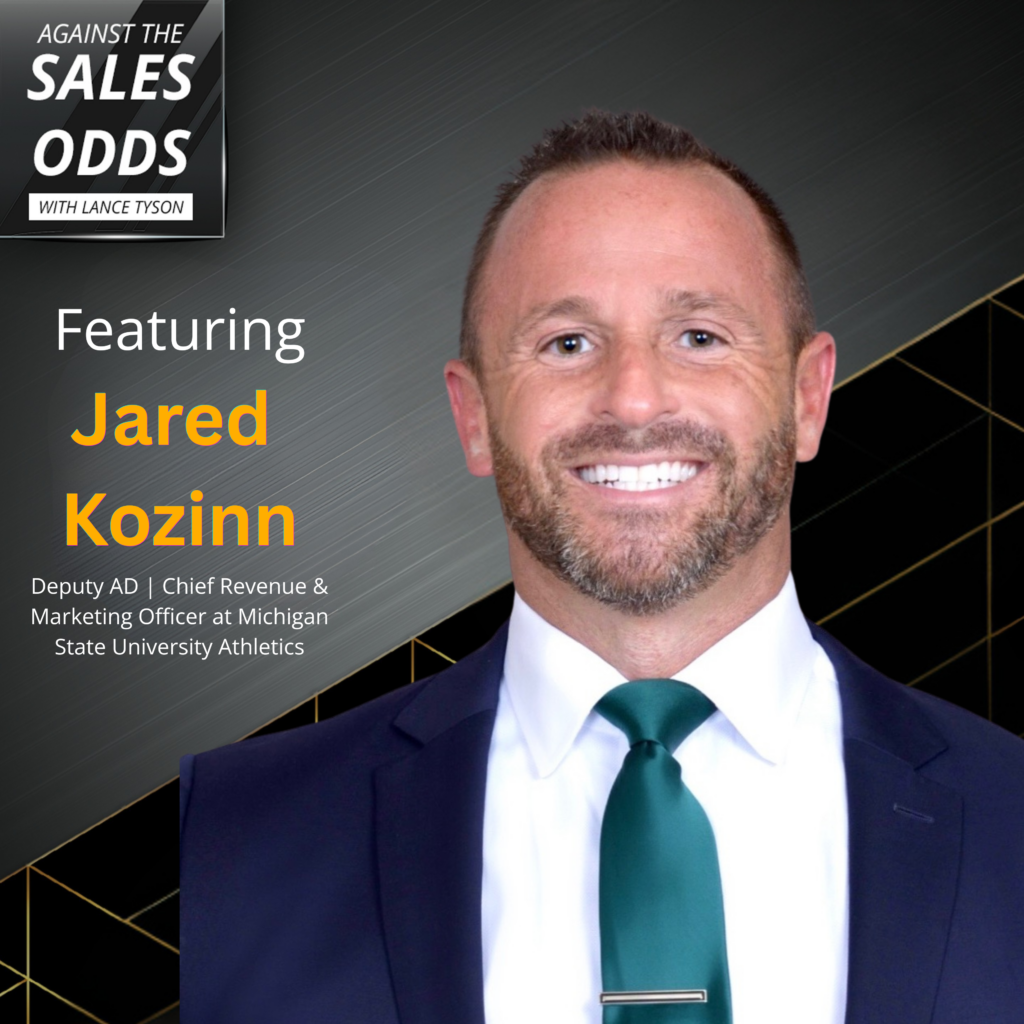
In this episode of Against the Sales Odds, Lance Tyson sits down with Jared Kozinn, Deputy Athletic Director and Chief Revenue & Marketing Officer at Michigan State Athletics, to discuss his journey from law school graduate to one of the leading revenue executives in sports.
Jared shares lessons learned throughout his career with organizations including the St. Louis Blues, Kansas City Royals, San Francisco 49ers, Milwaukee Brewers, Detroit Lions, Arizona Coyotes, Pittsburgh Pirates, and now Michigan State Athletics.
The conversation explores:
- How sports organizations are evolving into sophisticated revenue businesses
- Why culture, structure, and process are essential for sustainable growth
- Building consultative, value-driven sales teams
- Leadership lessons learned through adversity and organizational change
- Strategies behind premium sales, sponsorship growth, and venue revenue optimization
- The importance of adaptability, mentorship, and continuous development
Lance and Jared also discuss the changing landscape of college athletics, leadership philosophies that drive high-performing teams, and the mindset required to succeed in competitive sales environments.
Whether you work in sports, sales, or leadership, this episode offers practical insights on building teams, driving revenue, and leading through change.
👉 If you’re looking to elevate your selling strategy, shift your perspective, and compete where the decision actually happens, this episode is a must-listen.
Check out Tyson Group’s Open Enrollment Programs: https://www.tysongroup.com/openenrollment
Check out Lance’s Bestseller Books:
The Human Sales Factor – https://tysongroup.com/books#thehumansalesfactor
Selling is an Away Game – https://tysongroup.com/books#sellingisanawaygame
Download our playbooks: https://www.tysongroup.com/sales-playbooks
Schedule a call with one of Tyson Group’s member: https://bit.ly/41YJW7K
Subscribe to our Newsletter: https://tysongroup.com/#weeklynewsletter
Follow Lance across Social Media:
LinkedIn – https://www.linkedin.com/in/lancetyson/
Instagram – https://www.instagram.com/lance_tyson_1/
🎧 Tune in as Lance shares the mindset, behaviors, and tactics that separate average reps from elite performers.
Love the show? Subscribe, rate, review, and share! https://www.tysongroup.com/podcast
—
Listen to the podcast here
Culture, Structure, And Process: What Builds High-Performing Sales Teams With Jared Kozinn
I am excited about this episode of the show. This person and I go way back, and I always think of a great steak dinner. There is always a good steak dinner, but we had a great steak dinner one time in Atlanta. I would like to welcome Jared Kozinn. Jared, you are running revenue for the CRO for Michigan State, the Big Ten, right? That is the title.
Deputy Athletic Director, Chief Revenue And Marketing Officer
Athletic titles are a little bit different. My official title is Deputy Athletic Director, Chief Revenue and Marketing Officer for Michigan State Athletics.
How do you get all that on a business card?
It is lengthy. A couple of lines.
I love that. Just for the audience, you are at Michigan State, but you are a Big Ten guy, but you did not go to Michigan State, did you?
I did not. I did go to a Big Ten school. I went to the University of Wisconsin undergrad. I have gladly changed all my red to green.
I was going to say that. How does it feel to wear the green now?
It is a super easy, super easy transition. Thrilled to be here and make no mistake, I bleed green now.
I love it. We talked about in the pregame that there are a lot of people who are tuning in to this who are in leadership, who are in sales. Tell people what your role is. What does that mean?
Revenue Vertical Streams And Creative Arm Oversight
We have a couple of different revenue vertical streams similar to my work in professional sports. We have our ticket sales service and operations group, so I oversee that group. We outsource our MMR rights. We partner with Playfly, so I oversee and work with our Playfly team from an MMR corporate partnerships perspective. We have marketing and fan engagement. We have our Spartan Vision team, which is really our creative arm. Any content we are creating, whether it is social, digital, or in-game content, is all done through Spartan Vision. I oversee our sports communications team as well.
Talk a little bit about when you look at all that responsibility. What does headcount look like to you, or what kind of relationships are you managing there, too? It is a complex web.
The headcount is evolving. It is not a secret. We announced recently that we were going to be launching Spartan Ventures, and really, that is the focus of our commercial arm to be able to move nimbly and quickly in this ever-evolving college landscape to maximize and optimize revenue for Michigan State athletics. Part of that is going to be taking a look at our current headcount, and as we look to grow within some of these verticals, how are we going to be most effective to be able to make sure we are putting ourselves in the best position structurally to maximize revenue?
Just real quick from a business end, and we are going to dive into your career and how you even got here. It sounds like people love to talk about sports. People love to talk about college sports. That landscape has changed drastically. Ten years ago, would a role like yours even really exist at some level?
Maybe, but it would have been called something different. The traditional term in college athletics previously was external relations. Now you are seeing the professional commercialized sports titles of chief revenue officer and chief marketing officer come up. You are seeing a VP of ticket sales instead of maybe an assistant director of ticket sales. The titles that you are seeing in sports are more reflective of a more commercialized approach. That approach is necessary. I just look at the landscape and what the stadiums look like in college athletics.
It used to be about how many people could fit in a stadium, right? As you know, bleacher seats and a lack of premium which is what most college venues have. You can maximize a lot more people, and you are watching all these stadiums now evolve where there is more product diversity from a seating perspective. In a lot of those cases, you have chairbacks now instead of bleacher seats. You have more of a focus on not the maximum number of people, but on how to have revenue optimization. That all ties back to the changing landscape of college athletics.
Stadiums are evolving with greater seating diversity—from bleachers to chairbacks—and a shift away from maximizing capacity toward optimizing revenue, reflecting the changing landscape of college athletics.
That is the reason I brought that up because your role, the way it sounds, just talking to you, since you moved into this role, it is an emerging market. It is a lot of strategy. That is a good jump-off point. How did you get here? One thing the audience should know is not to hold this against Jared. He is a hockey player, was a hockey player in school, and played a little hockey. You grew up in Buffalo, right?
I did, yeah, hockey and baseball.
Bills Mafia are there?
Growing up in Buffalo, sports are so much of a fabric of the community in both good and bad ways. When the Bills lose a game on Sunday, your week is ruined if you are a Buffaloian. Growing up in Buffalo, when we call it imprinting from a sports marketing perspective. Being a kid from the time I was 8 to 12 years old, those were the years that the Bills were going to four straight Super Bowls. That was impactful for me. The Sabres were phenomenal at that point. They had Mogilny, LaFontaine, Andreychuk, and Dominik Hašek. There was great hockey in Buffalo, and everything about that town rallied behind the sports teams.
It probably changed how important sports were on a day-to-day basis for me. It makes it very natural to be in an environment like Michigan State, where sports are so woven into the fabric of our community. It is with our student athletes, with our alumni base. Lance, it is rare that you meet somebody who went to Michigan State and is not a diehard Spartans fan. They are very proud of where they went to school, and they are very proud Spartans. That is a Big Ten thing. That is a community of East Lansing things. That is very natural.
Is that how you grew up?
That is how I grew up. It is very natural.
Let us talk about that quickly. One thing you might want to know is, Jared, you went to law school. My son just got accepted to law school, and you went to law school, too. I should probably have him talk to you. You came right out of school. Where did you go to school? You went right to law school? Is that true?
I did my undergrad at the University of Wisconsin. I am very proud of Wisconsin. It was a great place for me to go to school. It gave me a real appreciation and feel for Big Ten sports and what it meant to be part of a community like that. I have always been an intellectually curious guy. One of the lines I stole from your teachings is that leaders are readers. I like reading a lot of books, and I have always been intellectually curious about how I can get better. How do I improve my sales acumen? How do I improve my body, my workouts, and my focus, and all of these things?
Law school was just something that was always intriguing to me. My grandfather went to law school. One of the things I learned from my grandfather, Harvey, he said, “When I was going to law school, people graduated, and they joined a firm, or they hung a shingle and started practicing law.” The law can lead to so many different career paths now. It is not just linear. I went to law school, and now I practice law.
Now it is a way of thinking, it is a way of looking at the world.
That is what they teach you in law school. They do not teach you the law per se because the law can change by state. What they teach you to your point is how to think like a lawyer. That is something that served me in my career.
That is a great jump-off point to the next thing. You get out. Where did you go to law school?
Saint Louis University.
The whole Midwest. You did a Midwest tour, buddy. You are a Billiken, too.
JD-MBA And Consultative Mindset
I am Billiken. It was nice to see them make the tournament, too. It was a decision. I wanted to go to a city and a school where sports mattered. Saint Louis, at the time, this was back in 2004 when I went, they still had NFL football in St. Louis. They had NFL football. Obviously, it is a great baseball city with the St. Louis Cardinals and the Blues, who ultimately ended up being my first full-time employer. For a city of that size with a great law school, I had to do the JD MBA program. I did a joint law school and business.
Always the student, Jared. That is what I always appreciate. You are always the student, always learning. You mentioned you went to, then you decided, “I’m going to hop into sports.” You said you got a job with the Blues.
My path was probably like a lot of people in school, and we did not have the programs now. They did not exist so mainstream, or they were not marketed the same way, where there are all these graduate sports management programs. I really put it on myself, like if you want to find a way into sports, reach out to a lot of people, start making connections. I spent a lot of law school doing that and was able to get connected. The Rams had an internship.
I ended up being a corporate partnerships, business development intern in St. Louis with the Rams. I actually worked for Lisa Woodward, who had a long career at the Rams and Anheuser-Busch, and then Chad Watson, who is over at the Anaheim Ducks now. Chad Watson is a great man, and I was fortunate to work with them. It was a changing time for the Rams.
They were just coming off a really terrible football season. There was an ownership transition. Georgia Frontiere had passed, and they were transitioning the team to full-time sale under the new majority owner, Kroenke. There was no position to hire me in, so they made a call. I made a good impact as an intern. They made some calls, and I got connected with the St. Louis Blues and got my first full-time opportunity.
What was the job selling?
It was Theo Hodges, actually, who is at the Mavs now. Theo was my first boss and hired me. I had opportunities to go practice law and be an attorney, and I turned those down to go be in an entry-level ticket sales position.
How was Jared in sales when you started off?
Raw. Probably not surprising, Lance, I brought a lot of energy each day. It was a mindset for me. I did not know what ticket sales were. I thought ticket sales were you standing behind a box office window, here are your two tickets, sir, enjoy the game today. I did not understand the customer relationship piece that went into it. I did not understand the sales training and the sales process that went into it. I did not understand the hustle, the KPI, and the metrics that went into it. I did not understand the strategy of turning inbound leads and lead lists into revenue. When I was a student, I studied as I would study in law school, or I would study anything else. I want to be the best damn salesperson I could be and put myself in a position.
To be honest, how was that first year? Where were you on the board?
I did well.
Did you get somewhere in the middle, or did you get somewhere at the top?
Yeah, I took the bar exam, and I was waiting for those results. I started in September, which in hockey is pretty late in the sales cycle. I ended up being one of the top on the leaderboards. In May, I actually got moved to a premium sales role. I do not want to say that it was without its struggles because there were a lot of learnings, but I was committed. By the way, I was financially motivated, as you know, when you are an entry-level account executive, you are not making a ton of money unless you are making a ton of sales. Bobby Gallo always said the best manager is a good comp plan. In my case, that was definitely true.
When you are an entry-level account executive, you are not making a lot of money unless you are making a lot of sales.
I love it. How long did you do that?
I have got to look at my resume to really be sure, but I feel like I started in September, and by that following May, I got promoted to premium, and I did premium for probably a year and a half, two years.
You went from a business-to-consumer sale to a B2B sale.
I did. I know you train on a B2B approach. The Blues were the same way even before you and I had gotten connected. We are going to train you to sell B2B, and it is going to be an easier transition to make the B2C jump. If we are going to train you in B2C, then you have to learn how to approach businesses. That is good. My sales perspective and mindset were always B2B, but I had success with it, moved to premium, and was in premium for a couple of years, and an inside sales manager role became available.
When you went to the premium sale, what was the struggle for you?
I would not say it was a struggle. I had success with it. It was making that transition from a season ticket package to suites and suite leases. A lot of good people there helped me make that transition, but it is like anything else you approach. You learn, and you follow the people who are doing it really well. Not to name the guy that is still doing it, it is Nick Walczak.
I learned a lot about how to sell a suite during my time at the Blues from Nick Walczak. He is a really good suite seller, a good leader. In my experience, when you are looking to grow and develop, just pay attention and follow the roadmap of what the people who are ahead of you are doing to be successful. You can start taking plays out of their playbook.
That makes total sense. From there, you went where?
First Foray Into Management Leadership
I stayed there. There was an opportunity to be an inside sales manager. What I looked at there was that I am making a revenue dent by being a full-time seller and having a lot of success in it, but if I could build and develop a team of eight inside sales reps, I would be able to make more of a revenue impact. That was exciting for me. That was my first foray into management, leadership, and an opportunity to start developing leadership.
You are in sales, and throughout your career, you have had to continue to sell and lead. You have done both pieces. At that point, what would you say your sales philosophy was? How did you start to form your leadership philosophy?
It was building rapport and trust. I think trust is essential in any relationship. Whether it is a friendship relationship, a spousal relationship, or a professional employee relationship. If I could build trust very quickly, if it was clear to the end-user consumer that I was going to take a value-based approach to selling and provide reasons why season tickets made sense for them, I think I would take it. I would say if you were to describe my approach, Lance, I would say consultative. I do not think that has changed. I am really interested in what businesses are doing to be successful and how the St. Louis Blues platform can help.
That probably ties back to, as a lawyer, you are to be a trusted advisor, and that is one of the things. I have to give you advice on this. That consultative approach brings that advice to everything. As a leader, what were some things you did well, and what were some of the things you could bang your head on?
I would say early on in my career, it was the standard. One of the challenges, especially in entry-level ticket sales, was that I was putting in the work and the time and the energy because I wanted to climb out of that role and excel in my career. Not everybody is going to make that climb. I have been constantly reminded of that career. I remind my staff all the time, too, that if you want to elevate in your career, you have to produce results and be successful. You have got to do your job exceptionally well before you ask for additional opportunities. For me, it was very intuitive. If you want more, you need to absolutely crush your job.
It is that simple. Early in my career, I struggled because people did not have. Why wouldn’t everybody just have the same standard? Meeting people where they were and finding different ways to motivate, push, and inspire people was necessary. Some people are motivated by money. Some people are motivated by recognition. Some people are motivated by support. It was learning, especially early in my career as a new leader, that the ways in which I am motivated and inspired are not universal.
One size does not fit all. That is the biggest struggle. That is what takes so much time to be a leader, because you have to find out what motivates the individual. Motivation comes from within. You actually have to understand what motivates each individual. The more you take a broad stroke at it, the worse it is.
Early in my career, I would say that was my biggest challenge, just developing that style and really trying to understand and meet people where they are at in terms of what are you hoping to accomplish out of that? Sometimes, through the conversation process, they might even realize, “What is my why? Why am I making all these calls? Why am I setting these appointments?” In some cases, I think they came to the realization that maybe this is not even the right career for me. That is right. Why am I doing this? All my whys are not going to be fulfilled by selling tickets.
No doubt. From that inside sales job, talk about your trajectory from there.
I went from that inside sales job, I spent some time, and I will give the brief cliff notes, but I spent some time with the Kansas City Chiefs. We had a very successful sales campaign launching what was, at the time, back in 2010, the new Arrowhead Stadium. Theo and I reconnected when he was at the Kansas City Royals. He moves across the parking lot and works with Theo. It was the next opportunity, a year or maybe a little more than that later, where you and I connected in San Francisco. The Niners were going through a major change from old Candlestick Park to this brand new stadium that they were building in Santa Clara. Legends were forming.
Talk about that role. What was your role? You make that jump, let us go to the San Francisco role. You were hired there to do what exactly?
I was hired by the 49ers to really be the liaison between them and the new stadium sales consultant team.
It was old to new.
Old to new and working with Al and a lot of the team that is even still there today in terms of the communication, the process. You are taking a fan base that was paying very low season tickets by NFL standards, and you are picking up that fan base and moving them about 45 minutes south to a brand new building with double the footprint and all kinds of product diversity and new opportunities. My immediate focus, Lance, was making sure that, and I think this was a learning that Legends had from the Cowboys’ time, you have got to focus on the existing building. If all of the organizational focus is on the new building, you are not going to maximize the revenue there.

The reason I was asking that question is that one of the things that I have always noticed in your career is that you are a macro thinker to a micro thinker. You are thinking strategy first, which maybe has something to do with how you were raised. It might have something to do with law school or an MBA. Your approach, you are always thinking systems, at least my experience with you is that. You are thinking about how to execute it. That is actually a good point because the excitement of a new stadium is a once-in-a-lifetime experience for fans, but the history and legacy remain. How do we keep maximizing our current situation before we get to our desired situation?
That role changed as time went on. The Niners were playing really good football at that time. We were maximizing revenue at Candlestick. As the months went on, I was working more and more with the Legends team and even transitioning some of our personnel and staff. A lot of them still work with you today in the Tyson Group. They transitioned to new stadium sales.
Just for your career, having experience at a new stadium is a once-in-a-lifetime opportunity. Not everybody in sports entertainment gets to work at a new venue.
It was transformational for me. The coolest part of the whole thing, and I have told the story before, when you work for the 49ers, you are never the smartest person in the room. They had so many really smart people who were talented people. It was not just a ticket sales strategy. There was certainly a lot of brains to that operation, but even this, Lance, this was at a time when the mobile phone and digital ticketing were in their infancy, and the Niners were playing home in Silicon Valley.
How do you take this and make this your ticket, your wallet, and all the functionality that we have come to accept as the norm everywhere in professional sports? We look back fifteen years, and that was not the case back then. Working with people who were at the forefront of all of that operation was incredible.
Less technology. You then go from the 49ers. You transform that into, you have gone from MBA, law school, intern in the NFL, into hockey, and you are a hockey guy. We do not need to talk about that, but was your brother a goalie, or were you the goalie? Max was the goalie. You are a player, though.
Yes.
That is right. You then get to the NFL, the top of the heap at some level, right? The 49ers are a storied franchise. You go from there, where?
To the Milwaukee Brewers. You are back in Wisconsin. You are right back in the Midwest again. Wisconsin was a good move for our family. We were looking to expand our family at the time. My son, Dane, was born when we lived in Milwaukee. It was a great opportunity. You look at the Niners at that time, and we went to the Super Bowl in February of 2013. We are playing in the Super Bowl. My responsibility was to maximize Candlestick revenue. We had really maximized Candlestick revenue. We were at the top of the revenue where we thought we could hit. We were in a really good position for the final season at Candlestick. The new stadium was pretty sold out.
It was. I am thinking now it is coming back to me when we met because I did sales training in the locker room, in the old Candlestick locker room. I did not mean to interrupt you. I am so sorry.
It was really an opportunity. I did not want to leave the 49ers. I loved working there. I loved learning there. I loved living there, but the new stadium sales campaign was performing very well. There was an opportunity to take the next elevation of my career, go to Milwaukee, which was a good family move. I had a great mentor and leader with whom I had been in touch over several years. I think he is retiring after this next season, Jim Bathey with the Brewers, but it was a great opportunity.
What was the position?
Director of Suite Sales.
You are elevating yourself inside the management trajectory. At this point, your philosophy is what you sold at this point. You have had some frontline leadership jobs. You think the biggest strategy.
The biggest opportunity there was elevating the sales process to be able to look and focus on leases for a Major League Baseball team.
Come out of that question, get less specific. Your leadership philosophy at that point is what? Not a business strategy. What is your leadership philosophy at that point?
Leadership Focus: Building Trust And Earning Credibility
Building trust. Building trust at that point was my biggest focus. I got great advice coming in from Jim Bathey, and I am trying to think how old I was at the time, probably just under or at 30 years old. Jim is like, “Look, I know you’re coming from the 49ers. You’ve got all these ideas. You’ve got all these thoughts. You’re coming into an organization where a lot of people have been here for a long period of time, a lot of them since the County Stadium days, long before there was Miller Park.” This was some of the best advice I ever got.
Jim’s thought was, “Spend the first 60 days, Jared, and fight the urge to make recommendations, force change, or find ways to be different. I want you to build relationships internally. I want you to build relationships externally because then when you do start making recommendations, one, you’re going to understand some of the nuanced ways that we do things. They actually may make sense given the personnel structure we have.
When you do make those recommendations, you’re going to have earned credibility with people because you built some trust, you’ve listened.” When I say trust was my leadership style at that point, that was really good advice from Jim that I think not only helped me be successful in Milwaukee, but that was advice that, as I have gone on and taken on new opportunities over the course of my career, that conversation always resonated with me.
You bring too much change and too many ideas to the table, which causes mistrust a little bit sometimes for people. Not you, that’s anybody, right?
I think, especially coming from a market like San Francisco, where they were building a new stadium for a ball club in Milwaukee, where that building at that point had been open for 12 or 13 years, and it was a very tenured staff, it was the right approach. You have to be able to find a way to adapt and be nimble and change your philosophy to be able to operate within a new culture, but still make sure that you are bringing that value proposition to the table of why they hired you in the first place.
You have to adapt and stay nimble, shifting your philosophy to fit a new culture, while still delivering the value proposition you were hired to bring.
Your next move is where?
From there, I was planning to be there long term in Milwaukee, and I had an old employer from my St. Louis Blues days who was looking to go to the NFL and was interviewing with the Detroit Lions. I was helping that former boss put his philosophy and strategy together. I learned a lot during my time at the Niners, and I applied a lot of that knowledge and learned.
What was that role with the Lions?
I was Director of Business Development and Premium Seating.
You had a bigger critical mass of people at that point, too.
It was a bigger scope of a role. It was also the chance to build something. At the time, I will give you an example. This is true. We had four salespeople at the Detroit Lions at the time. I tell the story that if one person was home sick with a kid, one person was in the bathroom, one person was eating lunch, and one person was on the phone, we did not have anybody answering the inbound phone lines, let alone building proactive outbound strategic campaigns.
For me, I viewed this as an opportunity to go and build a proactive outbound ticket sales group, a premium team that was taking a lot of what I learned in San Francisco and applied in Milwaukee on positioning the suite away from just being a box or a place to sit on game day. How do you position this as a year-round business development platform with trips, experiences, unique touch points, and access that you cannot get but for being a suite holder with the Detroit Lions?
You had a certain thing in strategy about the go-to-market with how the product was positioned, and you had to start building a critical mass in the sales team.
We knew that we were going to be looking at a renovation in short order. I think at that point, let us see, this was in ’14. Ford Field opened in 2002, and I went there in ’14, and we knew that there was going to be a major stadium renovation. At that time, Ford Field had traditional general admission seats, traditional suites, and they were all kind of the same, and traditional club seats. There was a club, GA, suites, and that was it. We started to think about strategy and approach, and what master planning might look like in that building.
You grew the talent by how much? You were at four, and you got up to what?
We ended up getting up to eighteen, and that included sales and service. We built out a group sales team, and we got a premium team that was just ticket sales. We went from no premium sales reps. I am not kidding, we had zero premium sales reps when I got to the Lions, and we had four premium sales groups. I may be a little biased when I brag about them, but that was probably as good a premium sales team as we had.
To name drop, we had Nathan DiLorenzo, who is running premium for the Bears. We had Brian Rooney, who is running sponsorship for the University of Arizona and just did a big naming rights deal. We had Matt Melcher, who is the director of corporate partnerships for the Denver Broncos. Then we had my guy, Andy Goble, who is vice president with the Pittsburgh Pirates. In my humble opinion, it is a pretty good premium sales team.
You nailed that team down. By the time you arrived, the stadium was starting to look a little older. You got off the wave of a new stadium, people being excited about Ford Field, and by the time you got there, it needed a strategy to start reforming it. That is what happens with a lot of these products. After you get 5, 7, 8 years in, you do not think it is old, but in the grand scheme of things, it is older. You had to be in that strategy mode.
Strategy: Culture, Structure, And Process
That is where I think my leadership style started to evolve. You have probably heard me say it, Lance. We have talked about it before. Now I would say my process is strategy is culture, structure, and process.
Say that again.
Culture, structure, and process. We did not have a culture when I got to the Lions that was really focused on revenue and sales. That was important to establish. That is in everything we do. That is in our training. That is in our daily approach. That is how we measure success and KPIs and how we define what success in these roles looks like. We had to have structure. We had to have enough people in the right positions on the team to be able to have good results in a sustainable way. We had to build in processes that were efficient, which could allow people to optimize their jobs.
I remember saying to my boss the first year I got there, at the time, the NFL season was sixteen games. I remember saying, “Man, if we get one 13 and three season in the next five years, I almost hope it’s not this year because we do not have the culture, structure, and process in place to take advantage of that.” I believe even with bad football, if you can build the right culture, structure, and process, and you have that in place, and then the team does perform, that is when you can capitalize on that.
You are there for four years.
I was there for parts of seven football seasons. I had a couple of elevations during that time with the Lions. Parts of seven football seasons. I was one of those crazy people who made a job change in live sports and entertainment during COVID, which was a weird experience.
Where did you go from there?
I went to the Coyotes.
Let us make that a short-time conversation. I am going to lead into that one. Jared, I do not know anybody who owns this. I was with him that day when he was doing training and invested a lot of money to train his team on strategy, tactics, and skills. The day we were training, the city of Glendale announced that they were canceling the contract for the Coyotes to have their games there. The Coyotes are no longer in existence as a defunct organization. I think at that point, it is the funniest story ever because we were talking about it the other day, people were looking at their cell phones, and it was a live news announcement, and we were talking about negotiations and objections at that point, correct?
We were in sales training. You cannot make this stuff up.
You cannot even make it up.
Anybody who was in the room will vouch. We were in with you, and we were talking about negotiation and overcoming objections, and everyone’s phone was blowing up, and I am looking at Lindsey Folletta, I am looking at Goble, and they are all pointing at like, “Look at your phone.” The announcement had broken.
“Why the hell are you guys looking at your phone? Pay attention.”
Either you asked that question, or I called a timeout, and we stopped the training. This is an interesting time in Coyotes’ history and sports history because it was unprecedented. No one had ever dealt with something like that before. The city of Glendale had done a study and said it was going to be the last year that the Coyotes played in that building. They were going to have to find a new home. They subsequently did find a new home at Arizona State for a couple of years.

They were getting evicted.
I will say this, we talk about the time at the Coyotes, and we say keep it short. That was a really great learning experience, not just for me, but for everybody involved. One, I am really proud of the team that we assembled. I look at a lot of the people that I worked with at the Coyotes and where they have gone in their careers. I could not be prouder. I just mentioned Follettta is doing an unbelievable job in Sacramento. Matt Harrald is here at Michigan State running ticket sales, and Goebs is crushing it in Pittsburgh. Tim Martin is running sales and service for the San Jose Sharks. I do not want to forget anybody. That is just naming a handful of people.
Everybody who was on that team is doing really incredible things today. I am proud of that group. It put us in a position where we had to overcome adversity. You talk about selling as a way of the game, and against all odds, we had to do a lot of that stuff. We had to negotiate a complicated beer portfolio partnership without even certainty on where we were going to be playing our home games.
Think about some of the dynamics we had. Business had to go on. This was not a situation. I cannot say it enough, Lance, I am so proud of that entire group of people that were part of that because nobody threw their hands up in the air and said, “What do we do?” Sam Witkowski was successful. Britt McDonald, everybody was like, “What can we do given these circumstances to be as successful as we possibly can, given hard times?” That adversity made everybody who was in that room that day and everybody who was on that sales, service, and sponsorship team better professionals, better people, and better leaders.
If we go back to that piece, there was a lot of adversity. You are probably one of the shortest stents of your career. It was like 12, or 18 months, 2 years maybe?
It was about eighteen months, and it was no fault of anybody there. We built a team to go sell what we thought was going to be a $2 billion brand new entertainment district. It became clear once the team was evicted out of the arena in Glendale and was going to be playing on Arizona State’s campus, it was just clear that the revenue opportunities that we had prepped for were just not going to be a reality any longer. Our whole team ended up leaving. Some people left sooner than others. I was part of the first group that exited, and it was an opportunity to kind of hit reset. I leaned into it.
From there, you get back to baseball. You go back to Pittsburgh.
I had an opportunity through mutual contact and a brand that we were actually working with to try to become a partner with the Coyotes. I worked for the Thiessen family. It was an unbelievable opportunity. I will say this, Lance, that made me a better sponsorship professional, because now I am sitting on the brand side.
Talk about that. You are exposing Pit Boss to all these teams, correct?
Leveraging Sports Marketing Strategy On The Brand Side (Pit Boss)
Yeah, my biggest concern about taking the job was about trust. I had a meeting with Carlos Padilla, who was in the role for a long time. Dow, Carlos, and I have become friends and got together. He said he was leaving, and he thought I would be the perfect guy in that role. It was in Scottsdale. It was not going to require immediate relocation.
They were the official grill of NASCAR, and their NASCAR agreement was up. They were looking for somebody to revisit the NASCAR agreement. Should they renew? Should they go in a different direction? Their president and CEO was looking at, “Do we get into the NFL? Do we look into other areas to use sports marketing to grow our business?” I met with Jeff Thiessen, and the Thiessen family is just wonderful people.
I cannot say enough good things about my experience working with them. I was also very candid with Jeff. I said, “Jeff, my long-term goal is to love being on the team side of sports. That is ultimately where I think this thing is going to shake out. I do not want to burn a bridge with you if this is not a forever thing.” Jeff said, “You’re not going to burn a bridge. We’re good.” I helped make an impact and make a difference. I was there for a couple of years, and we did.
You had to put a little bit of a sales hat back on, too.
Internal and external. Jeff admittedly wanted somebody who was going to show him the power of sports marketing. We had a lot of proposal meetings internally. “Being the official grill of the Green Bay Packers makes sense.” At the time, you look at the sales cycle for grills, and it was super heavy from March when the weather started getting nice till about September. A product like Pit Boss can be utilized all year long.
How do we tell that story that even during the winter months, even at the frozen tundra of Lambeau Field, Pit Bosses can get it done? Taking a strategic approach like that and a national audience and national reach like the Packers have, there were some strategic partnerships that we worked on that made a lot of sense for Pit Boss, made sense for the brand, and the sales team.
You were there for two years, and interestingly, back to the strategy piece, which it seems like you really enjoy, which gets you here. You did one more stint before you got here, and it was back to baseball, right?
Pirates Role: Interview Focused On Type Of Leader And Person
It was with Pittsburgh. A search firm connected with me, and it was cool because he is just an amazing, great leader, great friend, great person, Travis Williams, whom I know you know very well. I knew of Travis, and Travis knew of me, but we had never spent time together. We had never connected, and this search firm did what they were supposed to do. They connected two people and our interview.
Travis was far less focused on my strategy and tactics to maximize revenue and sell partnerships, and much more focused on, “Who is this guy? Who is Jared? What is he going to bring to the table culturally, personally, and professionally, and how is he going to fit in with our team?” I remember asking him over dinner, we had a dinner interview, yes, Lance, it was a steak dinner. I said, “Travis, we’ve been sitting here, and we’ve really not dived into the nuts and bolts of the sponsorship approach.”
He is like, “Look, I know you have all that. You’re a finalist for this job. We hired a search firm. I’m much more interested in the type of person and the type of leader you’re going to be for this team.” That was a good learning experience, and that has changed how I have maybe hired people as well moving forward. That was a great experience in Pittsburgh. I am proud of the success we had over those two years.
We got a jersey patch deal done. We had some KPIs and focused on average yield per sponsorship, growing the sponsorship space, and having an attention to selling suite leases versus just individual game rentals. You’ve got to know that crew a little bit out there as well. I am really proud of my time at the Pirates. I love the people there, and I love the organization.
You are there for two years, and you take over all sponsorship. That piece was sponsorship, sponsorship, and events. You had that, and that was more day-to-day management winning deals.
Yeah, it was winning deals. I would say my style there, and this is probably similar for most corporate partnership leaders, I would say I was still probably from a sales perspective, involved from a sales and a proposal process, and a pitch perspective in our top five partnerships, and built a lot of deep relationships with some of our key decision-makers. PNC is the naming rights partner of the Pirates. I will tell you how important that PNC relationship is.
The head of sponsorship for the entire PNC was part of my interview process. Molly Sapienza, she was part of my interview process with the Pirates because that is how important relationships are in Pittsburgh, and that is how much they valued their naming rights partner. Molly and I built a great friendship and working relationship over the years. She is someone I look up to and someone that I enjoy talking with whenever we can possibly connect.
I love that. That brings you back to here. As we start bringing this bird down for a landing, a couple of things stand out to me right off the cuff. I have always said this to you. I admire the fact that you are always willing to take a risk. You have traveled a road less traveled. This most recent role with the long title that has CRO in it at Michigan State, I think it is a new world. A lot of organizations are going this way, and you are bringing your best practices in from the pro side.
What I did not realize, Jared, is that so many times you had to solve some issues. I forgot about the Pit Boss thing. I literally remember being at the Ravens and talking about a pitch to them with Kevin Rochlitz and asking him, “How did my guy do?” He goes, “It’s actually pretty good.” I said, “Come on, Pit Boss.” I guess that was a good pitch. It made sense.
Rock has been a big mentor and champion of mine. That was fun to be the official grill of the Ravens, too. That was a fun one.
I was there the week after because we were doing a sales strategy. About you, if you go back to that core philosophy, which is culture, structure, and process.
You got it.
I love that because the culture is the people, but the people have to have some kind of structure, and there has to be a process in sales or a process of management. Always true to Jared’s word. I appreciate being part of the journey, but the first conversation he always has is “What is he going to do with his people? Who are we going to hire? Who are we to bring on and how do we develop them?”
That is always the first thought with you. That leads to the culture thing. I ask all my guests this. Jared, you have been involved with a lot of deals. You have seen a lot of big deals. You probably have a lot of big deals going on right now. What is that song you are playing in your head, man? You are going in to get a big deal done for Michigan State. What is the song? What is the stage?
You have got to be fired up, right? You have got to go with a little “All I Do Is Win.” You have to have that mindset. Even if you yourself have to believe it. That is the mindset, I think. If I were to have a walk-up pitch song, so to speak, that is what it would be.
If you had to gift a book to somebody, congratulating them on success or they have gone through a tough time in their life, what would you give them?
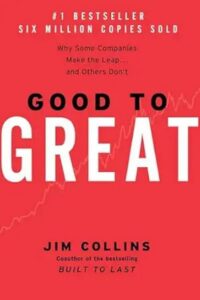
I really like Jim Collins, Good to Great. I know it is a classic. It is hard to pick that one versus The 7 Habits of Highly Effective People by Stephen Covey. Those are two of my favorites.
Both deal with culture and process, right?
That is what these teams are, too. When you think about whether it is an athletics department or it is a professional sports team, there have been people who were there before you. There has been some commercial activity, strategy, process, and approach. You are not building anything that has not existed yet, right?
You are taking something, and you are trying to take it. Success off of somebody else’s shoulders.
You are taking something that is good, and you are trying to make it great. A lot of the principles of that book are important. I talk about The 7 Habits all the time. As a leader, there is a grid in that book, and I know you are familiar with it, where it is urgent, important, and not urgent. One of the leadership philosophies that I have always tried to employ after reading that book is that if you are a leader and you are always focusing all your time on the things that are important and urgent right in front of your nose, you are never thinking about big-picture strategy.
That is the strategy piece. I wish I had it in front of me. I am literally re-reading the book for the ninth time. What is it? Be proactive, begin with the end in mind, put first things first, think win-win, seek to understand before being understood, synergize, and sharpen the saw. There you go. There are your seven. Let us go. There is the rip, right? Well said. Last question. You have a niece or nephew. They are 6 or 7 years old. You are sitting on the edge of a dock, and they go, “Uncle Jared, what does it mean to be successful?” Now you have to answer the question for a 6 or 7-year-old. You cannot give a lengthy Walden quote. Go.
Definition Of Success (Lou Holtz Quote)
I am going to quote the great Lou Holtz: “Find something you like to do, find something you do well, find someone to pay you to do it.” It is that simple.
I love it. What a great ending. There you go, buddy. Best of luck with your endeavor at Michigan State. I am on the sideline cheering you on. I appreciate you, buddy.
I appreciate the time, Lance. I am sure we will be talking soon.
All right, brother.
Important Links
- Jared Kozinn on LinkedIn
- Good to Great
- The 7 Habits of Highly Effective People
- Lance Tyson on LinkedIn
- Lance Tyson on Instagram
- Lance Tyson on X
- Subscribe to our Newsletter
- The Human Sales Factor
- Selling is an Away Game
- Download our Playbooks
- Schedule a call with one of Tyson Group’s members
- Check out Tyson Group’s Open Enrollment Programs