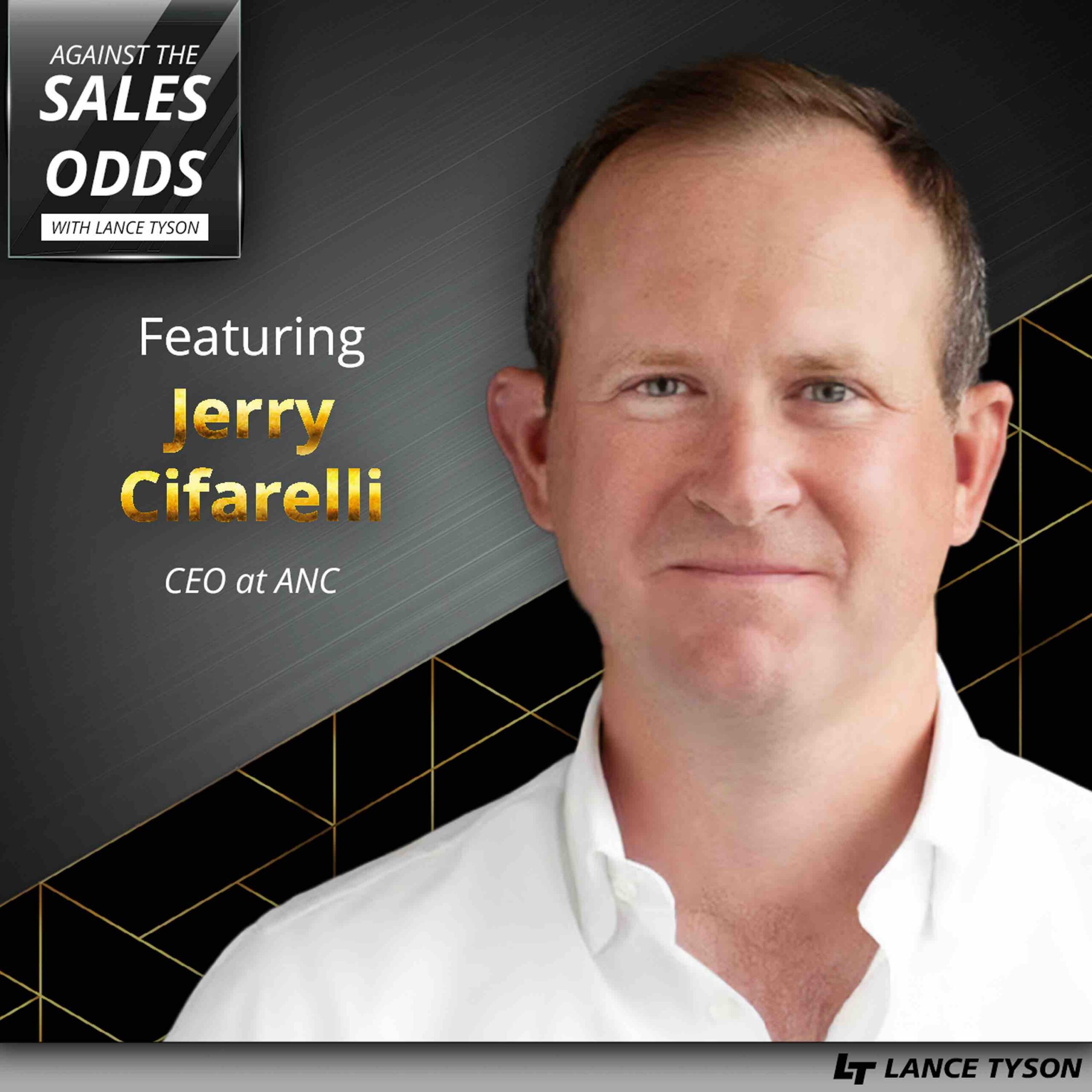
What does it take to win in high-stakes, multi-layered sales environments? Lance Tyson and Jerry Cifarelli unpack the realities of long sales cycles, navigating competing stakeholders, and leading empowered teams that drive profitable growth. This episode is a masterclass in modern sales leadership, authenticity, and building relationships that last beyond the deal.
👉 If you’re looking to elevate your selling strategy, shift your perspective, and compete where the decision actually happens, this episode is a must-listen.
Check out Tyson Group’s Open Enrollment Programs: https://www.tysongroup.com/openenrollment
Check out Lance’s Bestseller Books:
The Human Sales Factor – https://tysongroup.com/books#thehumansalesfactor
Selling is an Away Game – https://tysongroup.com/books#sellingisanawaygame
Download our playbooks: https://www.tysongroup.com/sales-playbooks
Schedule a call with one of Tyson Group’s member: https://bit.ly/41YJW7K
Subscribe to our Newsletter: https://tysongroup.com/#weeklynewsletter
Follow Lance across Social Media:
LinkedIn – https://www.linkedin.com/in/lancetyson/
Instagram – https://www.instagram.com/lance_tyson_1/
🎧 Tune in as Lance shares the mindset, behaviors, and tactics that separate average reps from elite performers.
Love the show? Subscribe, rate, review, and share! https://www.tysongroup.com/podcast
—
Listen to the podcast here
Win The Deal Without Losing The Margin: Inside Complex Sales & Leadership With Jerry Cifarelli
I’m excited about this episode of the show with Jerry Cifarelli. Jerry, President and CEO of ANC Sports. We have known each other for what, like two years now? Maybe two and a half? Twenty-first?
I think so. We got introduced to the great Kevin Rochlitz, the Baltimore Raven. It is great to see you again. It is great to be with you, Lance.
Introduction Of ANC Sports And Its Verticals
Ironically enough, the Law of Attraction, I am with Kevin and the team tomorrow in Baltimore. The day after St. Patty’s Day. I am there. I have got to fly Southwest. I can live with it. I guess it is only once in a while, at least in Baltimore. Jerry, just with the audience, and we have talked about this before, we have got a lot of salespeople who tune in. We have a lot of sales executives and presidents. Tell me about ANC sports, which you might not know about.
I appreciate it. ANC sports stands for Alan Norman Cohen. We are a media and technology company. We always say that. We are probably one of the companies that really do sit between the intersection of media and technology. Our firm operates off of really three verticals. Technology, service, media, and sponsorships. We do integrated partnerships within mostly sports and entertainment venues and some commercial venues, malls, transportation hubs, etc.
To the non-sports side, give somebody an example.
We work a lot with at-home media companies. Where we help integrate technology for what they would call spectacular canvases that they go out and monetize for out-of-home media assets.
Think of a product, though. If I were sitting in the stands and I am like, “I go to sports,” if I am looking around at an arena or something like that, what am I saying?
In a sports application, think about the large scoreboards that you see, whether it is you are at a basketball game, or you are at a Cleveland Cavs game, the center rung that you see there, or you are in a Philadelphia 76ers game, etc. In the NFL, the large video boards that you see in the end zones. That is really called the cherry on top of what we do, but we do a lot of stuff behind the scenes, back to house that really drives the business.
I am looking behind you, I am looking at 40 on the 40 last time I physically saw you gave you a big hug. You were you are recognized as a 40 under 40 sports executive or an inside sports business that was recently in New York, what about 6 or 7 months ago? Tell everybody about that recognition and the size of your business. Maybe it does not have to be a revenue number. It can be just like, where do you spend most of your time? Tell them a little bit about ANC structure, and people go over that a little bit.
I appreciate it. That recognition obviously does not come without the people. I like to say that we are probably in about 80% of all professional sports in some capacity, whether that is through our technology business, our service business, or our media and sponsorship business. The way that we are structured is we are broken up into those three verticals, and we have a president of each vertical, a newly created president of each vertical division, however you want to dice it.
Our goal is to go out there and create an integrated partnership that touches all three divisions that we work with. We feel that by doing so, it obviously drives scale and drives growth for the business. If you think that we go out and do a technology deal, we put new scoreboards, we put in new ribbon boards, etc., at MetLife Stadium, like we are doing.
We also operate the games at MetLife Stadium. We have a service provider. We have a person there who operates it. We go out, and we do some integrated sponsorships and some media deals on their behalf through our brand consulting business or our agency representation business. Our goal is to be a true turnkey, vertically integrated service provider within a venue.
We work backwards on that, like some of the deals you may have. With some of those partnerships, you may have that in terms of other technology deals you have with other teams. You might bring those sponsors in that way. An NFL team might look at you as an extension of the revenue arm at some level, and on top of that, provide the technology.
100%. We started off this conversation talking about the great Kevin Rochlitz. We did a lot of work with them, their technology, and in their legends clubs, the new stuff that they did, some outdoor displays as well. We also brought a partner to them with LG, where LG is the official home appliance provider for the Baltimore Ravens. That is something that really we are the only ones in the space that can do to the extent that we are doing.
It seems like a complex sale. It seems like a fully integrated sale. I can imagine the competition is stiff there, or could be in some of the areas.
I would say we compete against ourselves. There is no real competition.
I spoke like fully injured. Sure entrepreneur. There you go. Along with some other alpha predators out there, too, right?
Exactly. In each vertical, you always think that there are people that you compete with. At the end of the day, we compete against ourselves. We compete against making sure that each other is being the best that we possibly can be. That is the only thing that matters.

Jerry’s Career Journey And Start In Sales
I love that answer. I spent a lot of time against sales odds. I want my audience to understand what got you here. What was the journey that led you to a spot where you are scaling up a company in this competitive sports industry? Tell us about the journey a little bit. Where did you go to school? Where did you grow up? Maybe first job coming out of school, and then the trajectory from there. You have an interesting story as you arrived at ANC too. Start us off on the journey.
I appreciate that. I hope your audiences do not fall asleep tuning in to this, but hopefully it is somewhat interesting. I went to St. Michael’s College up in Winniski, Vermont, a great school. I thought at the time that I was going to be a hockey player and play college hockey, but that did not last very long.
Aren’t they the St. Michael’s buzzers or something?
They are purple knights. I quickly became a bartender, though, and then quickly became a barback. As you can see, it did not start off the upward trajectory for me playing college hockey, then a bar, then a bar back. I turned it around, and after college, I went and I worked for Fenway Sports Group, where I was selling across their properties, working with the best salespeople in the world, getting to learn from them.
After that, I left, and I went back to business school at Fordham University in New York, and I did some digital ad sales, some inside sales, selling banner ads back when it was a thing. I think now it is like you click a banner ad, and it was a mistake. When I was there, you wanted to click it. I came to ANC when ANC went through an ownership change around 2011, I would say. I launched a collegiate division working alongside the two new investors.
At the time, my father, who was the founder of ANC. That was great. That was a Swiss Army knife, and I held a variety of different roles. We sold the company. ANC was sold to Learfield. I stayed on for a little bit, and I ended up scratching that entrepreneurial spirit of mine and went out and started my own business, C10 Media. Twelve months later, we acquired ANC.
You worked for ANC, and your father had found that you started a division on the collegiate side. You worked at Fenway, a big organization, a lot of deals. You went back to business school, working at Fordham, Hawkinson Digital. I love how you described it. Back then, that was not an easy sale. That was the best job in the world.
I hope everyone does that. Every salesperson should call some random dentist’s office in the middle of nowhere and try to sell them on a banner ad. That will teach you everything. I love it because I have a similar journey when I was up at Penn State, I worked for the radio station, Meese Talls, and I sold radio ads. I get it. I am not saying the same thing, but it was like advertising our little rinky-dink radio station.
I was doing it before AirPods, and you actually had to wear a headset and just dial for some dollars.
I love it. You joined ANC, and you started a collegiate division. That is what you are approximately. Is that right around 2011?
2011, yeah.
How long are you there? What do you start to realize in this sales journey, a little bit about yourself? Was it easy? Was it hard for you? What was the mood?
I just said every salesperson should do it is to pick up the phone and dial for those dollars taught me a tremendous amount. It taught me not to be afraid to call someone, regardless of who you are. From there, you gain more confidence than other people that you can email and send notes and put together packages. You learn to get creative. When I started at ANC with this bar sale that we are doing, it was very consultative. I learned quickly that there is never a no. You can constantly create a yes. You make your own deal structure.
You can reshape the deal and reshape the solution a little bit. I love that.
Exactly. I quickly learned that. I was probably learning not to be as loose by making some mistakes. After that, I picked it up quickly and realized that, at the end of the day, you are learning from the customer. They are telling you exactly what they need. You are packaging something up, and you are delivering it back to them. No different than when you are trying to build a custom home or whatever it may be. You have got to learn about what that person wants, put it all together, put that package together, and off you go.
Now that makes total sense. You start that division, and then it is a quick turn that the organization sells to Learfield. You start your own business, and you said less than a year, you are back at the table again with ANC. It is interesting, good salespeople like yourself. Being an opportunist or creating an opportunity where one did not exist, or being able to move on a lane, becomes really critical. Would you agree with that?
We were owned by Learfield. I did 3 or 4 years underneath Learfield, and it was spectacular. Talk about salespeople. I got one of the best salespeople all throughout the country selling on their property. You have got to learn a lot from those folks. Learfield is absolutely a tremendous company, and they are nothing but the best group of people there.
You got an opportunity to reinvest in the company and take it back over. I would assume you had a little bit of understanding of the company. Maybe talk about your sales skills there and put deals here. What the magic is, we started talking about your approach to business and growing the business, deal structure and negotiation, they are all your forte, understanding, being able to do a quick gap analysis. Talk about the speed of that, and whatever you are comfortable with, and how you are able to pull that off.
Rebuilding ANC’s Culture And Consulting Focus
When I became the owner of ANC, that really came through that exact opportunity that just happened to be available at an agreement that I got to make with their CEO. It is an incredible agreement for both. I hope the folks in the field would say they are as proud of that deal as I am. At the end of the day, when I came back, we had something that got a little bit into your box sale, widget sales. We turned it into it.
When you invested in it, it was more of a box sale.
It was more of a widget sale. A lot of responses, kind of like an RFP business. That does not fit me as a person. That would not fit the culture of the company I wanted to lead. We really focused on driving a consultative culture, driving a culture that is collaborative, driving a culture that empowers others to go out and put together creative opportunities for our customers. That is what has allowed us to scale as quickly as we have.
When you look at that, too, as you come across, one theme is definitely coming out. You have said consultative three times at this point. Being a good consultative business person or seller or both, you certainly do an evaluation, you certainly diagnose, and you make a prescription, because you are all about gap analysis. When you took over the reins of ANC, you definitely built a culture, but how did you reshape the offering?
There is something to be said about an entrepreneur like yourself, as much as I spend like even Tyson Group on Inc 5000, I meet a lot of these founders and folks that reshape the market. They see something in the market, as you explained, you have got a technology sale, a service sale, and the media side, but an integrated partnership. You saw something there. What kind of changes did you start making to the design? Where did you see those market lanes?
I know you said that about being an entrepreneur. I was talking to someone the other day, and I was telling them I started my company, and in the first twelve months, I bought a company. I feel like I did not even have enough time to become an entrepreneur as much as I could.
You started C10, and then you reinvested in ANC, right? You moved.
Yes. We moved super fast and became an operator. For the first three years, what you do is you analyze the organization and what you have, the deals, the partners that you have, the people you have. You set the pathway, you set the strategy, and then it works. You restructure the business around that strategy, then you retool it again in year three around the strategy to set it up to supercharge the growth of the business.
What we found is that when we first came in, we just looked at it and we said, “You cannot get greedy on one side and lose money on the other side.” It’s you have to just find that happy medium and say, “One plus one equals three.” That is exactly what we need to focus on. We need to be able to drive our organization. We have to be focused. You cannot be everything to everybody. You have got to be really good at what you do.
You can’t be everything to everybody. You’ve got to be really good at what you do. You’ve got to own what you do.
You have got to own what you do. That is it. Anyone could say, “I can do that for you,” and have no idea what they are doing. We really had to take a step back and say, “This does not work for us. We are not going to do that anymore. It is just not who we are.” We had to take a little bit of a step back and say, “We have got to be more vertically integrated instead of very wide as an organization.” That is what we focused on. That is what made us successful. This is 2023, when we made that.
2011 is when you came through, and in 2023, is when you start to rebuild the company and talk. As you looked at it, what I hear you say is that you start to look at what the offering was, and we do not want to necessarily be a buffet approach. A lot of organizations are, and I can even in my own journey, it is like it cannot be everything.
We will go out of business. We are going to be hyper-focused. When you looked at the approach, what did you say? All we are going to do is less of this and more of this. You said it, we look at the deals. What kind of deals do we have? We have an existing customer base. I am looking at the people. Where did you decide you could be the best in the world at? Maybe that is a better question.
We are the best people. At the end of the day, we are a people organization. I felt that we could have the best people in our industry, hands down. When we think about what we would be the best in the world at, to answer your question, I think we could be the best executors, we could be the best communicators, and we could be the best people at taking care of our clients.
That is what we can be. That is really all that we can ask for at the end of the day. I felt that if you called one of our customers and you said, “Tell me a little bit about ANC,” they would say that they would deliver for me. If any hiccups, they still deliver. That to me is what I felt that we could be the best at. That is really all we had to focus on.
When you look at the market, and you say your approach, you brought up an NFL team. When you look at their business, you look at what you offer, you look at your people, and you have confidence in that. What is the gap that you fill? What is the outcome that you feel for them? Is it a speed thing? Is it an expertise that they do not have, and that is where the trust goes for delivery?
We provide peace of mind, and we have an added value to their business. One thing that we understand is the sports and entertainment business. We understand how it works. We understand the importance of driving revenue, the importance of sponsorship, and the importance of partnership for these vendors. We also understand how they have to sell tickets, they have to win games, and they have to put on a good fan experience. Why should they worry about your video technology?
That is something that we should take from that we should worry about. That is peace of mind. How do we allow them to focus on what they are really good at and what means the most? We help them execute on that side of the business. We drive some more revenue back to them because that is a meaningful piece for their business. We are compliments. That is really all we are. Yes, we are filling gaps in areas that they need, but really, we are complementing their business across the board. That is probably the most important thing and what separates us from others.
Your solution impacts, first of all, the game experience. It is such a big play and going into a stadium right now. It is the boards, the scoreboards, the screens. It enhances everything. On top of that, as you said before, for a lot of people who are tuning in, they think it is just the game. It is the whole immersive experience, and then being able to monetize that, where your technology is connecting the marketplace with their audience or the audience with the marketplace.
What you are saying, I could be the best in the world, is that we can actually give them peace of mind. They do not have to worry about that. They know we are going to deliver. Let us break down the competitive landscape. There is one thing I definitely know about you, getting to know you the last two or three years. You are definitely competitive. There is no doubt in my mind.
I did not even realize you were a hockey player, considering all my sons played college hockey. One of my son’s coaches, when he played for the South Shore Kings, I think he coached at I think there is a St. Michael’s in Canada, but I think he went to St. Mike’s. I know exactly what school you are talking about. On the technology side of the business, give a taste or feel to the audience how big some of the competition just is there on the technology side, with the boards and things you have mentioned to me before. Who are some of the big catches you are running against there?
Our biggest competitor in the technology space is a publicly traded company. We run against the Samsungs of the world, big consumer electronics companies as well. At the end of the day, we have a great partnership. We went out, and we created a partnership with LG Electronics. We have LG as the big consumer brand that is providing us with the best-in-class technologies. At the same time, we represent them as their agency of record in the sports media marketplace.
We are doing deals on their behalf as a brand consulting business and agency records. That is a great thing. As I said, we do not compete against anyone. We really do compete against ourselves. We really do compete against how creative we can get? What people do not understand is that day in and day out, we are dealing with presidents, we are dealing with CEO’s, we are dealing with the owners, we are dealing with the smartest people in the world. What makes us great is that we get creative and we can be solution-oriented.
Are you saying that when you compete against yourself, sometimes you are only as good as your last idea?
Yeah, pretty much.
You compete against the last idea. No doubt, right? That group of people, whether it is the Al Guidos of the world or any other executive of a sports team, they are demanding from their vendors ideation that you are bringing that value. That is it, the competition against yourself. When you look at the competitive landscape, what are some things you get pushed on?
You are obviously getting pushed on your ideation. How well can you come up with an idea? Talking about sports is tough. Talk about your sales process personally, because you, like me, are involved with a lot of the negotiation in sales. I am involved with my salespeople all the time. You mentioned you are a consultative seller.
You are spending time bringing ideas to the table and also understanding their business. What would you say is the toughest part of that, as you are in sports in the consultative process? Is it the negotiation of it? Let us assume ideation is off to the side here, competing interests out there. What is the toughest thing for you today?
The Complexity Of Multi-Sided Negotiation
No deal is the same. That is probably the toughest thing. No partnership you do with the team is the exact same partnership as it was with the last team. No partnership you do with an auto media company is the same. No partnership you do with a brand is the same. That is probably the toughest part of our job is that everything is different. You have got to know the numbers. You have got to know the facts. You have got to know the P and L. You have got to know the structure. You have got to be able to negotiate it because the structure could be different in one place than in another. That obviously affects everyone’s business.
How does that affect your people? What kind of stress does that put on them? Just in the sales process alone, not even how you operate it.
Our sales process is very collaborative throughout, from an internal group. We have folks who are constantly talking and working through deal structures, and we have some great heads of each division. At the end of the day, they will present where they feel that the structure could go to me, and we bounce ideas off each other. We are very lucky to have a good collaborative group.
The pressure to answer that question is whether or not somebody on the other side of the table, your partner that you are trying to work a deal out with, feels that the deal that they have should be the exact same deal that this person got, because the end of the day, that cannot be. It is managing the expectations on both sides. On our side internally, we have to manage the expectations of how a structure could look.
On the other side, we have to manage the expectations of “This is the best path forward for both companies.” We have to do partnerships that work for our brands, that work for the teams, that work for our technology partners, that work for our service providers. They all have to work for everybody and work for us.
I did not even think about it that way. That is unique because you could be bringing a hub of things together. You could be negotiating it on, and the way I look at it, Jerry, when I throw the word negotiation around, the third definition of Merriam Webster’s is negotiating, which is moving around through or over something. Negotiating is navigating at some level. You can have a three-sided negotiation going on at all times.
We always are, we always do. That is where the ADD is a superpower. You are constantly thinking about other things because there are other angles. There is always a different angle that you can play. There is always a solution. There is a solution in our business for everything.

It is a matter of finding the right solution at all times and getting everybody to agree on it. Maybe nobody has ever said this, but it sounds like you are triaging almost every deal, too. You are advancing it forward on one side because you have customer partners or vendors on this side. You are trying to sell to a team, and you are trying to get everybody to agree and then move it forward. Talk about your sales cycles or how long some of these cycles are. What do they go through on average?
They are long. I guess the best way to explain it is that they are very similar to the way that these deals are negotiated is just like media rights deals are negotiated. You have properties, you have broadcasters, you have streamers, you have to get everyone together. Everyone has to put their bid in. They have to have an ROI analysis on their advertising dollars, how they can get a return on the investment, what is good for the lead, what is good for the teams, etc. It is similar to those.
They are ten-year deals. Our deals, once we get them in place, are on average for 5 to 10 years. It is no different than a media rights negotiation. Very similar in that side of things. The second way is that there are constantly new properties coming up every year. They may have a 5 to 10-year life cycle on them. At the end of the day, every single year, you have got to go out and get new customers and new customers. It is a never-ending cycle.
You are constantly pumping fuel into all these deals, too. It is content, everything in there, sponsors, all those things. If they are 5 to 10 years in length, you are talking about anywhere from a very probable anomaly, which would be 6 to 14-month deals to get them across the systems.
It depends on what side of the business. The technology business is generally strict. Our NFPs protocol is attached to it. It may last 6 to 8 months to get across the finish line. That is like a one lump sum contract, and that technology is going to last about ten years. Then you are going to redo it, and you have to fight to keep that business. We sign service contracts with five-year deals. Every five years, you have to renew those service contracts. We are bringing in advertisers throughout that term.
That could be yearly, the advertising.
Yearly. We could be doing another project for that same customer. Generally, at times, the way we like to look at it is like we get a customer, it is a new account. We do 30 projects over the lifespan of our time working together. There is nothing that we cannot do with those customers. We expand upon our relationships with our customers day in and day out.
I am curious about a couple of things because this is the complexity of what you lead. Not only are you leading the company here, but you are also leading this business process, which just fascinates me. You said you have presence in the different divisions, service, technology, and the media partnership side. How do you get your people to talk them through the deal exhaustion that is there?
When just getting a new look, though, it takes a lot of energy. How do you manage that? I am not even talking your own because I know you are fully integrated into the business. I have watched you. I know a lot of your customers are my customers. I know how you run. How do you keep the team from dealing with exhaustion? They get tired.
I would say when we lose, we go out and find the next one. That is what keeps people from the deal exhaustion. You can constantly get exhausted if you almost sulk in the no. I do not do that at all. I try to get my team not to do that. We are going to lose business. It is what it is. There is other business for us to go get. Let us go find it. Let us create our market. Let us be our market makers. Let us not fight and be down on ourselves for losing a piece of business. Let us go get the next one. When we do it that way, it is easier to fight the deal exhaustion.
When we lose, we go out and find the next one, and that’s what keeps people from deal exhaustion.
What I hear you saying is that we have a growth mindset. We are in a constant motion of going after new business. We are constantly moving this thing forward. There are always things moving through. We are not playing defense with our contracts. We are actually playing offense with everything because of the very nature. If you look at that triangle you built, just the advertising, you are constantly selling into a deal that you have.
It is a never-ending story, but you are always going to go out and find a new logo to find business with, which is also what you are saying. I have got two questions on this growth mindset. One as an operator and one as an entrepreneur CEO, because you are wearing a lot of hats there. What kind of growth do you expect year after year? You have had this since you have been in business since 2023, your own, then you bought it, and you invested in ANC.
What kind of growth do you have that you look at the company? What is a successful year for you? Is it a double-digit growth? We are going to start doing a massive project with a plastics manufacturer owned by private equity. They have to outpace the market and double digits with everything that is going on. Tariffs, trade, fuel costs, and the economy, all that stuff. They have to move the needle because that is a private equity need. As you invest in the company, what does growth look like for you year after year? What do you need?
That is a good question. As I said, I admit I am an accidental CEO in many cases. I just started my own business. I became an operator of a company that has been around since 1997. Accidentally is not the right word. I feel that I have earned this spot. I have earned this chair. I belong in this chair and feel I belong in many more to come. When you ask about our growth mindset, I think about it as I want to constantly win more than we lose, improve our win rate, and improve our profitability. I judge our business by one number, and that is the absolute bottom line. That number needs to grow at a heavy rate year over year. That is how I judge it.
You almost have to because of all the different things. As you said, every deal is so different. It is more of a bottom-line number than it is a top-line growth because a deal could make or break a quarter, a month, or a half-year. No, it makes total sense.
Our deal sizes have gotten so large now that we are negotiating deals that could be a hundred million, could be five million. We are an asset-light business, so we have hard costs, we have costs of sale, and we have people. For me, we judge it by the bottom line. I hope I bring that attitude to our team day in and day out, as that is what we strive to do. We all work with one common goal in mind, and that is the bottom line.
It is important because in my own business, we are asset-light like you are. We have some technology we own. It is people-heavy, and deals have to be good. We have to constantly be looking at the attrition of the business to rebuild, to add new logos. It is very much like yours is, but I would not say we have off-the-shelf. We have some predictability in different parts of our business, but it is a tough thing.
It is tough to get people into that growth mindset. I love how you answered the question. How do we get around deal exhaustion? We go out and win another one. It is like a flywheel. When you look at your leadership style, I would just summarize your leadership style because you are selling, you are a chief revenue officer chair, at least when I hear you talk, you are managing big relationships, you are growing the company. What is your style?

Leadership Style Of Empowering Others
I empower others, I would say. I have been around micromanagers. It is definitely not me. I’m not saying that I do not love the detail, but I surround myself with others that I would say complement my skill set, and they are empowered to do what they are good at. I am not the best at everything. I am not the smartest guy in the room. I do not want to be. The day you are is the day you are not leading anything.
Well said.
I empower others and give them the time to do so. I would say that is my leadership style. We hold each other accountable. As long as we do that, we are all going to be successful.
I have talked to a couple of your people the last time was with the SBJ awards. One of your folks said, I am going to not quote exactly, but what I heard was, he rolls up his sleeves. “He is in here with us.” There are times, I guess, to sit on the perch, but you definitely roll up your sleeves. Every time I talk to you, you are as much of a road warrior as I am. Because of that style, number one, you have to have your signature integrated into this, because you are part of a team.
When I look at your organization, you are the epitome of the idea that sales is a team sport. It is a team sport, especially at ANC. You could not afford to do everything. You have got to have somebody in financial trust. You have got to have somebody willing to know all those details in the program and then some of the finer points of the deal. When you evaluate yourself, whether it be in the sales process or even how you run the business, say, “Look, I am just good at this.”
If you had to stick a mirror in front of you, say, “This is stuff that I do not gravitate to, or maybe I am not as good as I need to be here.” You hire it. I know my COO is way better than me at the details, project management, and following through. It is not my thing. I am fine holding people accountable, but it is just not my jam. I lose interest quickly. What would you say about your leadership style? What are some things that, “Man, this is my superpower. I am good at this.” These are some things that I am probably not great at, but I work with them.
Superpower And Weakness In Leadership
I would say my greatest strength is definitely not on the technology side of it that we have in our business. We have three great people on that side. That is not my strength. It never will be. It is just not me. I would say I am very good at connecting the dots, seeing the playing field. I am a people person.
Would you say that seeing the playing field is like a pattern? You are going to pattern recognition. You can see all the patterns.
100%. I would say that I can see how the year is going to play out on January 1st, really. That is the beauty of studying your business, knowing your business, knowing your market, knowing your customer base, and being in front of your customers, too. Just as you are, we are out on the road visiting our customers. That is what gives us the power to understand and be able to see the playing field because you learn from them.
I am in my office. I do not have a desk. I barely have a computer. I have a laptop I can plug into. Look at the screen here. You empower others to do what they are really good at. I go out and visit our customers, learn from them, and then we empower each other, and we go out, and we execute. That is what we do. You cannot leave behind a desk.
Treating Each Customer As A Unique Market
No doubt. It is interesting. The technology where you know you are weak, that is where you are hired, we do a lot of analytics, and it is not my thing. I know the patterns. I know that people want those data points. I am not good at it, but I can put a deal across. One of the things you and I talked about is that I think I have reached a different conclusion or a pregame.
We were talking about being a market maker. I actually think you see each of your customers as their own individual market. I think that is my assessment. You did not say this, but I am going to say it for you. You actually believe, and I think this is a really good thing, that all your customers suffer from the disease of uniqueness. You know they have to be dealt with uniquely. That is why when you go back, you cannot necessarily approach them in the same.
You have got to actually look at their own. You have got to listen to them. That is consultative. Another way to put that is bedside manner. The best docs in the world were the docs that do not treat everybody the same. It is the ones that connect with the patient at their level, wherever the patient is. I really liked that. Just for the leaders, how many employees do you have? Out of curiosity. The only thing I have ever asked you.
We have about 53, what I call the corporate employees. We have about 135 full-time and part-time employees all throughout the country, servicing our customers.
At different sites and organizations.
In any given year, we have somewhere between 180 and 200 employees, depending on the new customer base, new markets that we are working in, etc.
That is pretty exciting. One reason I brought it up is that a big portion of your employees are remote. You run a very virtual organization, too. You have a core in New York, but you also have a vast amount that, for a small to mid-sized company, and not in terms of revenue, just in terms of employees, you have to operate with a lot of trust with that, especially in a company of your size.
We have a lot of remote employees, probably more than any company would like when you do that percentage-based. We probably want more people here at the end of the day to work collaboratively. Now we have been so lucky with Microsoft Teams and all these other tools that they are all day, every day working together. As long as they are talking to each other on the phone, not working behind their email or their Slack, then we will be just fine.
Focus On Profitability And Legacy Businesses
I agree a hundred percent. When you look across the business landscape today in all businesses, it is always good to talk to somebody, another business leader. What are some of the things with the economy that you are excited about? What are some concerns you have right now? What business forecast, according to Jerry?
That is a question for a much smarter person than me.
We still have an opinion, Jerry. What do you think?
I would say that there is a lot of negativity on the legacy businesses out there, and everyone focuses on all these new AI and new technology businesses. Legacy businesses have stood the test of time for a long time. At the end of the day, let us not discredit profitability. I think that sometimes gets done in business these days. Profitability is discredited, and growth is there, but there is an adjusted this, adjusted that.
In business, that would be a great focus that I would like to see more credit given. We are in a world where we have really good people, good arts, and I think people care about each other. The rhetoric is not something that we need to listen to so much and draw our opinions that we all know if we do the right thing for each other, then things will work out just fine.
Especially when you have a CEO, and as many times as you have talked about your people, that is not a talking point for you. You are like, “I have got trust in my people.” They are fully integrated into the solution. You do not run a profitable company unless a lot of people care about the profit. That is the difference between being compliant and committed. You have got a group of people that are committed, and that is important.
I am not blowing smoke. I have just seen enough companies that you can tell. As far as all the new technology, there has always been new technology. How do we work with it? There are legacy businesses. They will stand the test of time because they will figure out the marketplace. They will shift with, not fight against. Last couple of questions. When you look at your approach to selling, we get all the sellers on here, too.
What advice would you give in selling right now? What are some of the headwinds you see? Because you are out there selling every day, just like a lot of people on here, you sell, and you sell your business, you are selling the existing business, and new business. What is the challenge out there right now that you are seeing, and what is some advice do you give?
The Importance Of Authenticity In Selling
Authenticity is so important. These days, some people force things, and the world is about speeding against your competitors, spinning this, that. If you are authentic and you are honest, you are never selling, at least as for me and my own personal experience. I am a very authentic person. My wife would probably say sometimes I am too authentic, and I just say what is on my mind, but I probably should take a step back and breathe. That is who I am. You get that with me. My hope is that that is something that I would like to see more of in sellers these days.
If you’re authentic and honest, you’re never selling.
There is a lot of posturing these days. Especially in a world where I can go to AI and get an opinion, give me your opinion. That happens in an impromptu and extemporaneous situation. The other thing is that it is interesting. Every time I brought up competition, you said, “Look, man, we are playing a lonely game. We are playing against ourselves. We found the enemy. It is us in some cases.” I love that. A lot of salespeople need to understand that they are competing against how authentic they are. They are competing against themselves at some level. Well said. Three questions. These are quick hitters. One. Do you have kids, or do you have nieces or nephews?
I have got three kids. A girl, boy, boy.
What age?
All under four.
Personal Definition Of Success
You are in the soup. I forgot you told me that. Think if they were six or seven or you had a niece or nephew and they said, “What is success to me? What does that mean?” What do you say to them?
I am probably not one to do a lot of reflecting. I guess being a father now, to me, success is about a healthy family. A great family. Being true to yourself and who you are. Regardless of what they end up doing and what you do in your life, I think that is the only thing that matters.
Safe to assume your business is, maybe you do not call them family, but an extension of something pretty important to you, based on what you have been doing?
Yeah, 100%.
I would be surprised if you did not say that. If you are going in to get a big deal done, you worked hard, your team has been working hard for like twelve months, and it is go time, and there are a couple of other players in there, and you roll up, and you are pitching. You are the pitch guy. What song are you playing in your head? You have got to get this done. Every competitive juice. This is the one you won for the one you lost.
It is a good question. It is probably not a song. I probably just channel the confidence. Not to sound arrogant, you always want to think you are the best in the world and no one can beat you. That is the only thing that I think about, you just get me in the room. I can close any deal. That is all I think about. I do not need to play music.
You are the first person who said, “It is not even a song, dude.” It is just like, “I am going to win.” I love that. If you had to gift somebody a book as a present or something like that, maybe you know somebody who got a big role. What would you gift them? Besides my books, of course.
Probably, Born to Be Wired. The John Malone book was spectacular. I just finished that one. That was really cool. I love the media business. It has got to take you from the cable cowboy era all the way to F1 and what they have done there to scale that business. Now, with everything going on with Paramount and Warner Brothers, it is probably a great read.
I love that. I just wrote that down. I have not read the book. Jerry, I appreciate you being on. This is a great conversation. It’s a really different conversation because you have an owner who is involved in his business, who is growing the business, and slinging it out every day. It is a national company. You are across the board. You are there. You have got a lot of people, and you are focused on your business. I love it. Thank you so much.
I appreciate it. It was great being with you.
Important Links
- Jerry Cifarelli on LinkedIn
- ANC Sports
- Born to Be Wired
- Lance Tyson on LinkedIn
- Lance Tyson on Instagram
- Lance Tyson on X
- Subscribe to our Newsletter
- The Human Sales Factor
- Selling is an Away Game
- Download our Playbooks
- Schedule a call with one of Tyson Group’s member
- Check out Tyson Group’s Open Enrollment Programs