
What does it take to build a high-performing sales organization in an industry that’s constantly changing?
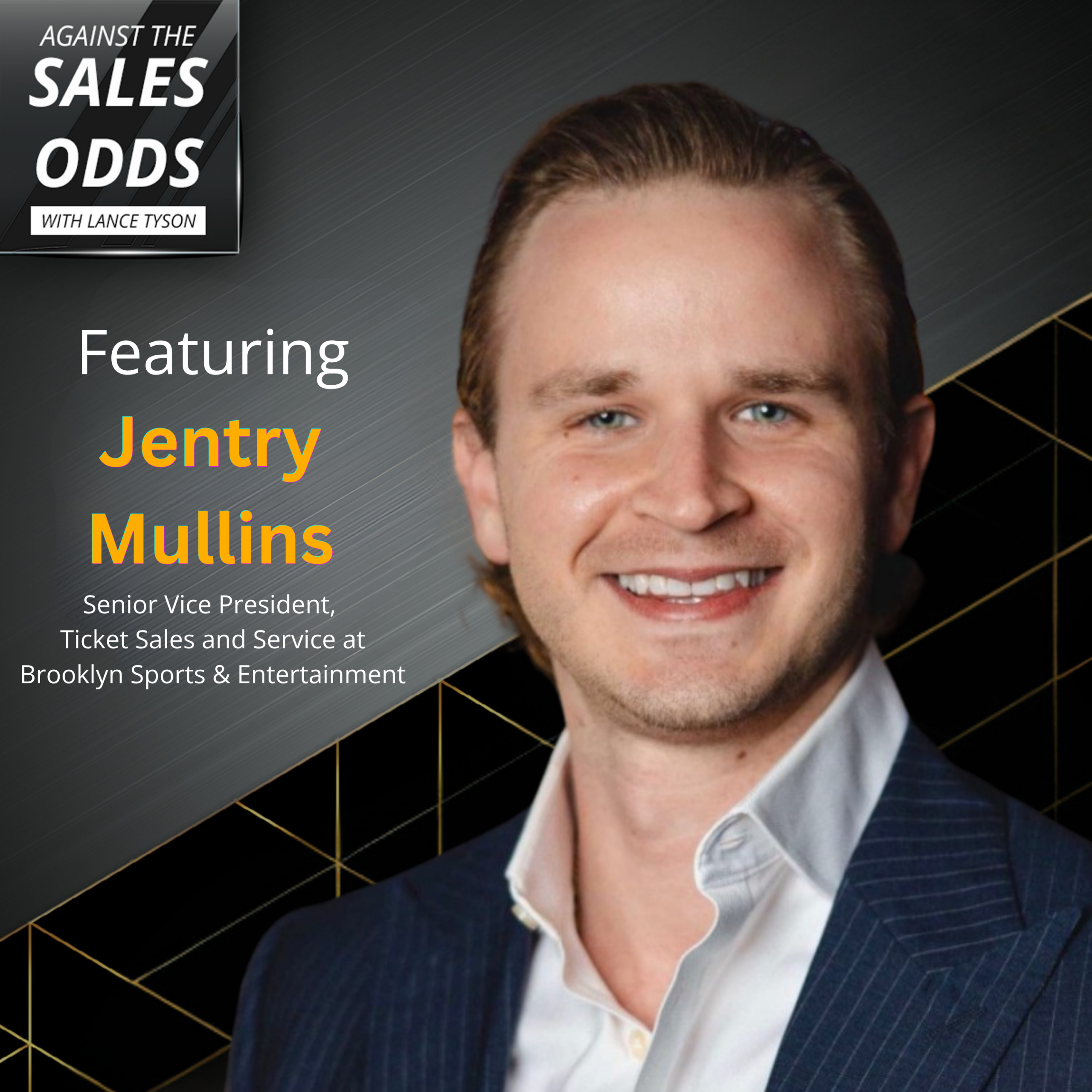
In this episode of Against the Sales Odds, Lance Tyson sits down with Jentry Mullins, who leads ticket sales and service across the Brooklyn Sports & Entertainment properties.
Jentry shares the lessons that shaped his journey from applying to 163 sports industry jobs to leading a 78-person sales and service organization. He breaks down why process, structure, activity, and accountability remain the foundation of predictable sales performance—and how those principles evolve as teams and leaders scale.
From rebuilding teams to developing leaders, Gentry offers practical insights on creating a sales culture that can perform today while staying ready for what’s next.
In this episode, you’ll hear about:
- Building predictable results through process and structure
- Leading and scaling high-performance sales teams
- Balancing radical candor with genuine care for people
- Creating cultures built on accountability and coachability
- Adapting to AI and changing buyer behavior
- Moving from passive selling to actively creating demand
- The power of continuous learning and marginal gains
- Lessons from a career spanning multiple professional sports organizations
Tune in for a candid conversation about leadership, sales, adaptability, and what it really takes to build teams that perform.
Check out Tyson Group’s Open Enrollment Programs: https://www.tysongroup.com/openenrollment
Check out Lance’s Bestseller Books:
The Human Sales Factor – https://www.tysongroup.com/sales-resources/books/
Selling is an Away Game – https://www.tysongroup.com/sales-resources/books/
Download our playbooks: https://www.tysongroup.com/sales-resources/sales-playbooks/
Get in touch : https://www.tysongroup.com/contact-us/
Follow Lance across Social Media:
LinkedIn – https://www.linkedin.com/in/lancetyson/
Instagram – https://www.instagram.com/lance_tyson_1/
Love the show? Subscribe, rate, review, and share! https://podcasts.apple.com/us/podcast/against-the-sales-odds/id1602260518
—
Listen to the podcast here
The Playbook For High-Performance Sales: Jentry Mullins On Leadership, Accountability & Adaptability
Leading Ticket Sales And Service At Brooklyn Sports & Entertainment
I have Jentry Mullins on. He is the SPP of Ticket Sales and Service for Brooklyn Sports & Entertainment. Jentry, we go back a few years. We’re in the pregame. We go back to your Phoenix years, right?
Yeah. We’re getting close to a decade.
It has been. I was in high school then. You were in middle school. That’s where I was. For everybody reading, SPP of Ticket Sales and Service for Brooklyn Sports & Entertainment. Give everybody an idea of what your role is and what your purview is.
First off, thanks for having me. I’m as excited as you were. My role here at Brooklyn Sports & Entertainment is overseeing all of our ticket sales and service efforts for the Brooklyn Nets, the New York Liberty, Barclays Center, and any of the other growth properties that we certainly have coming on board. That can include anything from entry-level sales from our inside sales group, which is a big one, to all of our other groups, including premium sales, premium service, luxury sales, luxury service, and membership sales. Those go all across the board for Liberty and for the Nets. We got a big group over here.
What’s that headcount that comes up to you?
The last time I put a count on it was 78. It’s a big thing.
How many leaders report up to you?
I get six direct reports.
Your headcount’s growing. You’ve got the Liberty there, too. That’s a hot property.
The growth of the W from the minute I stepped in here to where it’s at now is playing almost like a completely different sport. It’s been awesome to see. We’ve got our salesforce split onto two sides. The entire right side is almost the Liberty staff.
We were talking about the big Mercury sales team in Phoenix. It seems that it’s catching some serious fire. Bring the audience back to where you’re from and where you started. How did you get to one of the biggest cities in the world to SPP of a major sports and entertainment property?
I come from a little town called Clintwood, Virginia. It’s one of those towns with 2,000 people. Everybody knows your neighbors. There are two stoplights in the entire county. I went to a small school to play college baseball, and it didn’t work out. One of the best things about it was that there was a sports management program there that had to make you do an internship.
I went to the University of Virginia’s College at Wise, which is a small school. It’s a sister of UVA. The sports management program there taught you more about how to become a PE teacher than it is necessarily management. I had no idea what I was going to do. Baseball was such a huge ingrained part of my life that I can only think, like, “Hopefully, I can get a job at a minor league baseball team in the area around Johnson City.” Maybe the Bristol White Sox at the time.
One of the best things about my sports management program was that you had to do an internship. A lot of my classmates looked at it as, “How do I get this quick summer internship over?” They did a quick tennis tournament that weekend or worked at a local hometown sporting goods store. I was like, “If I want to work in sports, I probably need to find a good internship here.” I came across TeamWork Online for the first time. I had the reaction that probably everybody gets the first time you see TeamWork Online. It’s like, “Every sports job in the world is on this site. I can work for the Atlanta Hawks.”
We’re like, “There’s this much of an industry behind it on the business side?”

I applied to everything. I applied to HR opportunities and the community. I applied to anything and everything. I remember the count. I applied to 163 opportunities, and I got one response back. That was with the Tampa Bay Buccaneers. It was in a group sales capacity focused on their school fundraising program. I remember telling my professor at the time, like, “You go down and sell group tickets.” He’s like, “What do they need people to sell tickets for?” That’s the question I’ve had to answer my entire career. It’s like, “How do we get butts in seats?”
To this day, the best sale that I will ever have is getting that internship. I had no credibility in getting that in any sort of capacity. I had no idea about sales. I didn’t know it was like a function. The thing that let me get that internship was that I prepared so hard for those interviews. Two hours leading up, I knew where they went to school, what questions to ask, and what was asked for every single one of them. I got it, and that internship changed the entire trajectory of my life.
Who was running the show down there?
Ben Milson was overseeing the whole thing. Dino was another one.
He’s such a great guy.
Cultivating Growth: Lessons From A Major League Internship
That’s even the advice I give to a lot of our entry-level team members or the people I’m interviewing on a daily basis. I was so blessed to get dropped into a place that had a growth and development-type culture because it changed my whole perception. It shaped my whole filter of how I see my career. If I hadn’t been around people that invested in me from a development standpoint and cared about my growth, who knows where I would be?
That has shaped your philosophy because you’ve developed your people all the way along. From there, where’d you go?
I was in that internship for a summer, doing a lot of internship work. I was in the printing room for three weeks at a time. They were unpaid internships at the time, too. I was nineteen. We were talking about it before. I’m going home to a cattle farm.
I’m trying to figure out how to weave that into this whole conversation. I love it.
To go from that to being this nineteen-year-old kid living away from home for the first time in a big city like Tampa was a big adjustment. When you go into an opportunity like that that is so way too good for me, you want to hold onto it. You want to maximize this opportunity that you get. I remember showing up early and doing whatever I could to stay there.
I remember I was a little bit homesick six weeks in, and my dad gave me good advice. He was like, “Jentry, if you break your tail off and you’re a sponge, and you let them know you want to be there, then they’re going to want you back.” I did that. Luckily enough, I got to go back there as a full-time account executive after I graduated early.
If you just work your tail off and you’re a sponge and you let them know you want to be there, then they’re going to want you back.
I spent a year and a half selling the Bucks from a membership sales standpoint, and then another year selling in premium. The product on the field was not great. We got the number one pick with Jameis while I was there. There were so many good people. I learned so much about sales overall. I’m so grateful to that place.
You get out of a small school. You figure you’re not going to play baseball. You were like, “I’m selling. I’m now working for a pro sports team.” How are you as a salesperson? What was your philosophy? We were talking about the spring game. Where were you on the board?
I ended up being number one on the board in my first full calendar year. The year on premium, I ended up being 3rd or 4th. My philosophy, which impacts how I see the business, was that I came into the business as about as raw as I think a human being can come into this business. I’ve never thought of myself as ultra talented. I was very fundamentally sound. My philosophy across the board was this aggregation of marginal gains.
I was like, “I’m going to outwork people. There’s art and science to sales. I’m going to lean into the science of if I do X, Y, and Z amount of activity, it’s going to lead to X, Y, and Z amount of results.” In your terms, which you’ve taught me, predictable process, predictable results. The aggregation of marginal gains on that would say, “If I do a little bit more on each one of these, if I pitch a little bit more revenue, or I make a couple of more calls here, or I make a couple of more appointments completed here, it’s going to lead to X, Y, and Z more revenue.”
I love how you said the aggregation of marginal gains. I’ve never heard it said that way. I love that. I’ll give you credit the next time I use it. Well said.
It’s cool because that’s you as the individual contributor. When you get to start to expand that across the entire sales floor and across 78 individuals, that aggregation gets insane.
It becomes a compounding interest effect. It ties into even how you approach your internship. You said, “I sent 163 inquiries out.” You knew how to play the odds. Sometimes, that’s intuitive, too. You’re there for how many years?

It’s close to three.
What happened? Did you start getting the edge? Did you start to get looks? What was the play there?
Building Sales Process And Infrastructure With The Phoenix Suns
When you go through that internship, as I did, your life dramatically changes. The thing that stuck out to me was this person who’s investing in me and caring about me has changed my life. I said, “I want to do that for other people at scale.” The first day I got back to Tampa, it was all about this direct line of how I get to a leadership position as quickly as possible. It took quite a bit of work, but I ended up getting recruited for an opportunity with the Phoenix Suns.
There was an opportunity coming up in Tampa in the next couple of months as well. I loved my life in Tampa. It’s a great place. I have a great friend group and a great network there. I’d never been out West that much to that extent. Certainly, I didn’t have any friends out there. They reached out, and Dino put my name in the hat, which is why it’s so important to have people that are in your corner advocating for you. I don’t know how many people are wanting to recommend one of their top salespeople to leave, but Dino was doing that.
I was like, “I don’t have a lot of interest in going to the NBA on the West Coast,” but I’ve earned this opportunity to hear them out and hear the conversation. It was one of those where you get on a call with somebody like Kyle Pottinger at the time, John Torres, Eric Little, and then Nic Barledge. It was one of those things where every conversation was so aligned about how I saw the business and how I thought about it. They’re interviewing you as much as you’re interviewing them.
It’s so important to have people that are in your corner advocating for you
As I went through that, I was like, “This feels like a perfect fit for me.” Ben and Dino were both like, This is going to challenge you and stretch you. You’re going to learn so much.” I made it leap. It was something that I’m so grateful that I did because of learning the arena business and learning the grind of the NBA. You’re waiting for the week to see how this unfolds or what the reaction is. In the NBA, you’re winning today, and you may lose tomorrow. It’s so quick.
I like that you bet on yourself and also the fact that you’re going completely South from Virginia and then completely West. You’re drawing a big triangle or an angle around the country. You bet on yourself. You get hired as inside sales manager and inside sales leader, correct?
Correct. That was great. That’s probably the funnest job I’ve ever had when you’re around these entry-level team members who are so grateful, have such good energy, and are so vulnerable. I’ve always said it’s very similar to the VP role in the fact that you’re overseeing so many aspects of the business. There’s a budget. There’s headcount. There’s pacing. You’re having to understand groups, membership sales, and service. There are so many pieces to it. Phoenix was so good with process and structure. A lot of what I learned there is the infrastructure that I’ve taken to my other places as well.
That group is always so good at developing people. You look at people who came out of the Phoenix Suns. It’s the same with Tampa, too. I can think of so many of those folks that moved on from Phoenix. You can see it through the industry. What did you start to learn about leadership there? How did you start developing your core philosophy? Maybe you can share your core philosophy. People are at the center.
People first is how it has always been for me. Process and structure ended up becoming this thing that I didn’t necessarily understand. I remember some of the best advice I got when I got the job to leave from Tampa to Phoenix was like, “You got to be good at time management now.” I was like, “Time management? That’s the easiest part of the job. I understand how to do that.” All of a sudden, I went from managing myself for 25 events to managing 20 team members for 132 events.
That’s right. Well said.
There’s a lot more process and structure that has to be put in place there. From a coaching perspective, that’s where I got direct and candid. That’s one of the things that people have always hopefully appreciated about me. You always know where you stand with me and how I approach situations. Feedback, to me, is how we get better.
Feedback is how we get better.
You have to be transparent there. You have to come down a straight line. People need to know where they stand with you. It has to be a core philosophy. You said, “I got 15 to 20 people and 120 events. I got to be very direct about how I direct people, what I have them doing, and things like that.” Well said. What’s your timeframe there? Did you move up from there? Did you get additional responsibilities?
The first year in inside sales was always about, “How do I get good at this?” The second year was where they started to layer on a lot more responsibilities. I got to learn a lot about the membership sales and new sales vertical. That has always been the route that spoke to me and my discipline itself. I was there for a year, and then I got called about an opportunity to go up to Cleveland.
You’re almost completing the triangle. You’re almost back to the far East. Not quite, but you’re almost there. What was the call in Cleveland? Did you look back, or did you say, “I’m moving forward with this.”
Rebuilding Post-LeBron: Sales Pipeline Strategies With The Cavs
I got reached out to about the opportunity in Cleveland. It was a strong mentor of mine who went from the Suns to the Cavs. LeBron had left about six months before that. They had gone on a wild ride for the last year as a company. They went through this rebuilding phase, and then they were in the championship for the next four years, and then LeBron left again. Some people weren’t ready for the grind of that opportunity again, to go through that, and some people weren’t.
The opportunity for me at hand was like, “How do we rebuild the new business effort, the new business arm for the Cavs during a rebuilding phase at that point?” I said, “From a resume standpoint, if I can prove that I can sell in this environment, then that’s going to be a heck of a story for my resume for the rest of my career.”
Nick and so many other of my mentors have taught me along the way that there are two ways to look at things. You can look at it as the obstacle, or you can look at it as the opportunity. All of my stops have been challenging situations on the field or on the court, but it has helped bolster my resume from that perspective.
No doubt. It’s so well said. I hadn’t thought of that. In those four years in the championship, LeBron leaves for the 2nd time, not the 1st. It was his second roll. It’s a harder sale. A good team can help sales at all times. It doesn’t mean it’s a sellout, but it helps.
It’s a lot of work regardless, that’s for sure.
No doubt. You take over a new business. Are you changing your philosophy, or are you bringing the same offense, expectations, and coaching? What does that look like?
I went in there, and I didn’t necessarily think I would have to bring a lot of the process and structure that I had learned in Phoenix, but that was what helped me the most in Cleveland. It was bringing this pipeline management process and structure to a place that was good at generating revenue. That’s the kind of thing that I learned the most. It was how to be flexible about generating revenue.
I learned so much more about having to intertwine my efforts with our business intelligence and our marketing team more than I had ever done and more than I expected to have to do. That was cool for me because it stretched me in a way that I had to do. You find this out with roles that you get. Sometimes, what you walk into is maybe not what you expect that you’re going to end up doing.
There are two ways to look at things: as the obstacle or as the opportunity.
You were probably walking into a situation there, too. I say this with all due respect to any organization. You get a good product regardless. You can cheat a little bit on the sales side. Sometimes, it’s finding out why somebody is interested and where to point them as opposed to generating the interest, too. I assume that team probably had to make a shift in their methodology and mentality. Would you agree with that?
Yeah. The aggregation of marginal gains was a massive part of our philosophy and focus because we had to make up for the lack of interest on the court with sheer effort.
The salespeople had to create the opportunity and gain the interest. That’s well said. That took a different effort. Some people were probably on board with that, and some people weren’t.
That’s why the process and structure there are so important. If you’re setting clear cut expectations around the KPIs that are expected of you, sales can be a Black-and-White numbers perspective from at least a managing standpoint.
It changes how you’re coaching, cadence, and all that. You’re there. What’s the next stop internally there? You take over a new business. You gained additional responsibility from what I recall.
When I walked in there, I was overseeing inside sales and membership sales. A colleague of mine left on the premium side, so I got to take over the new sales side on the premium aspect, which was fun. Premium in the NBA is one of the funnest opportunities out there. It taught me a lot, working for somebody like Klaus who thinks about revenue in that type of way. When I walked into Cleveland, I was extremely rigid about how I thought about the business. When I walked out of Cleveland, I was way more flexible about what revenue-generating looks like and how you can think about it differently. A lot of those things are what I brought when I came here.
You got wiser there. What was the highest level you got at Cleveland in terms of title?
Senior director.
You were there for how long?
It was around 3 and a half to 4 years.
When I look at your career, it’s a rocket sled. I want everybody tuning in to understand something. You don’t get opportunities like Jentry does unless you’re executing and performing. I need everybody to get that. Pro sports sales is very competitive. Your name gets out there, good, bad, or ugly, pretty quickly. If you’re a non-performer, it’s out there.
If you’re a performer, it gets out there. I need everybody to understand that. It’s really important. Word travels fast. You get a shot in Brooklyn. When Jentry said he grew up on a farm in the South in a town with two stoplights, he has gone to some major markets that could be polar opposite to what he grew up with. What was the next opportunity? That was Brooklyn, correct?
A Wider Lens: Transitioning From Operations To Sales Consulting
Yes. I had a pit stop with General Sports from a consulting standpoint for a year.
You got in the training consulting business, too. When you got there, were you bringing your philosophy as the inside sales leader and the senior director? You were bringing that philosophy to your clients.
That was the cool part. You learn how to work with so many different people with your story and career in this vertical. It was cool for me to get to work with so many different people, get to tell them some of the things I’ve had a lot of success with, and then get to see if they take it and execute with it, or it goes in one ear and out the other. You find those things out.
The advantage that somebody like you has when you’re doing the training and consulting is interesting. I tell my trainers all the time, “Be careful.” Even when I talk to my peers, if they were on the operating side or any consulting, “You got to be careful because you get to leave.” Somebody like you always knew that if you tug the string on the sweater too hard, it could unravel everything. What I admire is that you know all the processes behind it, which you respect a little bit.
You have to be careful when you give advice, too. That’s important. When you left the operating side of the business and got into the consulting and training side, what did you start to realize about your approach? It probably changed. I’m not saying it softened, but maybe a wider perspective. Is there anything there that was like, “I might do this a little bit differently. I get to see so many people.”
Of the things I learned, one was that being somebody that’s easy to work with is such an underrated skill. I don’t think a lot of people get that. That would be one of them.

You have to be amiable at some level. You have to be able to be flexible. You have to be people-oriented, too.
Other than that, it is being super intentional with what you’re doing and owning your business. One of the things that I didn’t know that I was great at when I was in Cleveland was that I let my calendar control me. It’s a big learning lesson at some point in your career. All of a sudden, it has to flip at some point where you understand, “Am I actually moving the business forward today, or am I just in meetings by a thousand cuts?” When I learned that, I went from having almost 25 one-on-ones a week to, when you go to this consulting world, if I don’t put meetings on the books, they’re not happening.
That’s right. You look at anybody’s calendar. Whatever’s on their calendar, that will tell you what’s important to them. You and I were even competing in that industry a little bit. You have to watch how much time you give, too. A buddy of mine is in insurance. He’s starting to get into the coaching and training world.
I go, “You’re going to get to a point where you can only handle so many clients. You have to be careful with your time because you’re going to max yourself out. You can only handle so much.” That’s well said. When you brought that over back to the team side, you did that for 1 and a half years, 2 years, or maybe 3 years.
About a year.
When you were out there, it felt way more competitive. I felt like you were out there for three. You got the opportunity at Brooklyn toward the end of your tenure at General Sports, right?
The Nets were a client of ours. That’s how that whole thing kind of came together. I’d gotten to know them a little bit through that process and saw what was important.
You had credibility there, right?
Managing At Scale: Driving High-Performance Culture In Brooklyn
Yes. I hired a couple of people on our leadership team before I had even gotten here. It was cool to have this credibility already when I walked in the door. I thought it was this blank slate. It’s a cool opportunity to take everything that I had learned at all these different stops and be like, “How do I bring that together and do one thing?” As Type A as I am.
You don’t come off as Type A, though. I know a lot of Type A people. When I’m talking to you, it doesn’t feel Type A.
I’m more of an action person than I am with words. As Type A as I am, there’s a way that you think that you should run the business. The things that I believe about how you should run a successful sales and service culture. This was my opportunity to get to do that. It was a cool moment because coming from a small town in Virginia of 2, 000 people, I did want to prove to myself that I can live in the biggest city in North America. It lets you see where the cards fall here. I had to come here. They had KD and Kyrie at the time. I thought I was going to be learning this whole new aspect of a high-performing team on the court, and then four months in, they trade them.

It feels fairly familiar to how you got to Cleveland, doesn’t it?
I had a lot of confidence in that situation because of everything I learned. I was like, “I feel like I’m the most prepared person for this opportunity.”
They hired the right guy. Let me ask you this because I’m curious. You get to the biggest city. The team is massive. You’re 3X what you’re managing before. How’d you handle that? That’s why I asked you about the headcount thing. It’s a big team. It’s a lot of direct reports. How did you handle that?
It was a big learning lesson. It’s one of those things where you find out all the things you don’t know. I remember thinking to myself to have straight bullish confidence in what I think and what I know. I was like, “I could do this. I could do that.” You get into this role, and you’re like, “These are the things that I needed time for.” I go back to a lot of process and structure. Everything always comes back to me. It’s always your people. You are surrounded by people that care a lot, are coachable, learn, and want to do a great job.
All of a sudden, you get those people in place. You start to implement all of this structure and process, and then all of a sudden, the wheels start to get going on this thing. When you have to rebuild things, you’re looking for those flashes of like, “Are we starting to make some progress here?” I started to see that, and it was cool. A lot of that first year and a half was more so about, “Can we get effort and attitude in the right place?” It started to turn into the fun part.
You were dictating culture a little bit. I have two questions. We bring the bird down for a landing here. One is, what’s your opinion on the state of sales? For everybody reading, you have to understand Jentry has salespeople that sell the very simplistic B2C or Business-to-Consumer, but he also has a team that sells very complex B2B. When you look at the state of sales, what’s your philosophy, approach, or opinion on it?
The Next Frontier Of Sales: Emphasizing AI, Adaptability, And Radical Candor
The most important thing is how adaptable we all have to be in this day and age of sales. I was telling my boss this. I don’t know that I’ve ever been more excited about sales than I am now. The way that AI is impacting everything that we do on a day-to-day basis and at the rate that it’s changing, it’s brand new. I’m learning something new every day. Sometimes, in sports sales specifically, it can kind of feel like a sandbox. We’re doing the same thing cyclically every year. With everything that we’re doing from an AI perspective, it is this brand-new blue ocean that we’ve never been able to implement.
That’s so well-said. You talk about the law of attraction. We launched our newest program called the Adaptable Sales Methodology. I got a text before I hopped on here. We got our first lead in from that. My next book is actually on adaptable selling. It’s an older concept. The concept started in the ‘70s. You are so right. With AI, with how we have to sell, and with how consumers are buying, if you’re not willing to be adaptable, it’s game over. I agree.
If you’re not willing to be adaptable in this day and age, it’s game over.
Consistently learning. That’s the thing I try to model with our leadership team. If I’m not learning about these things, then it’s certainly not going to get modeled. It’s certainly not going to get cascaded. It’s massive.
I 100% agree with that. Second would be if you look at your philosophy moving forward, or you look at your leadership philosophy, if you have, in a nutshell, to say, “Here’s my leadership philosophy. This is how I approach leadership,” what is it? You said a lot. There are so many things here that indicate where it is.
It’s Radical Candor. I don’t know if you’ve ever read the book, but I recommend it to everybody. For those that haven’t read it, it’s about how I’m going to care about the person personally, and I’m going to challenge them directly. In this length, I’ve worked for so many great people. If I’m thankful for anything, I’m the culmination of a lot of people who were willing to invest in me. When you get people that are willing to invest in you and push you, you get to accomplish way more than you think that you can. Those are the best types of leaders out there.
You think about Nic Barlage or even Kyle Pottinger. It is radical candor. They’re straight shooters. They’re going to tell you how they feel and give you their opinion. There’s no doubt. I love that. I have a couple of last questions I ask everybody. Are you ready?
Let’s do it.
You’re going in to get the biggest sale you’ve ever had. You’re going with maybe one of your teammates. They say, “Jentry, come with me.” Maybe you’re negotiating salary for somebody. It’s something big that you have to get done, whatever it is. What song are you playing in your head?
It Should’ve Been a Cowboy by Toby Keith. That was always my sales song.
It’s on my playlist. Last two. These are easy. I’m going to my niece’s graduation. To anybody who’s graduating, I always give Oh, the Places You’ll Go!. What book do you give? What’s your go-to gift besides my book?

I’ve given that one to a lot of team members over the years.
Thank you. I appreciate that.
The book I gift the most is this book called The Almanack of Naval Ravikant. It’s written almost in a guidebook-like style. For those who don’t know, Naval is an Angel investor. He had so many moonshot investments. I’ve probably read it ten times. I’m really big on reading.
I’m ordering it right as we talk. I’ve never heard of the book. I’m taking your recommendation. I’ll get two books. One Colin recommended, and one you did.
I’m excited. Give me your review.
Last question. Let’s say you have a niece or nephew that’s 6 or 7 years old. You’re back home. You’re sitting on the edge of a dock. The feet of your niece and nephew are wading in the water. They say, “Uncle Jentry, what does it mean to be successful?” They are 6 or 7 years old. No big words here. What do you say?
Faith is a huge part of my life. From a faith perspective, I would say success, to me, would be when you get to the pearly gates, and God says, “Well done, my faithful servant.” Did I have a couple of things maybe in there that surprised Him? Did I over-accomplish maybe some things and I stretched myself?
Did you go the extra mile a little bit?
That would be the thing that at least I try to pursue daily from an intentionality standpoint.
I love that. Thank you so much. I appreciate your time today. Thanks for the investment in the show. Thanks for being a good partner. I appreciate you.
We certainly appreciate you and the rest of the crew that impacts our business on a day-to-day basis. Thanks for doing this. I’m a huge advocate for any type of content we can get out into the sports business world because we certainly need it.
Good content here, too. Thanks for your time, and thanks for sharing your thoughts.
Important Links
- Jentry Mullins on LinkedIn
- Brooklyn Sports & Entertainment
- Radical Candor
- Oh, the Places You’ll Go!
- The Almanack of Naval Ravikant
- Open Enrollment Sales Training Programs
- The Human Sales Factor
- Selling is an Away Game
- Sales Playbooks
- Lance Tyson on LinkedIn
- Lance Tyson on Instagram
- Lance Tyson on X
- Against The Sales Odds