
Sales Assessment Solutions
How Sales Assessments Improve Business Results
Many sales organizations struggle with inconsistent performance, low sales process adoption, ineffective coaching, and unclear development priorities. Sales assessments provide the data and insight needed to identify what’s driving performance and what’s holding teams back.
Sales assessments and diagnostics objectively evaluate sales competencies, leadership effectiveness, execution consistency, and organizational alignment, so you can make informed decisions about hiring, training, coaching and sales strategy. Instead of relying on assumptions, you gain a clear understanding of where gaps exist and how to improve sales effectiveness across your team.
Sales Assessments to Strengthen Your Sales Strategy
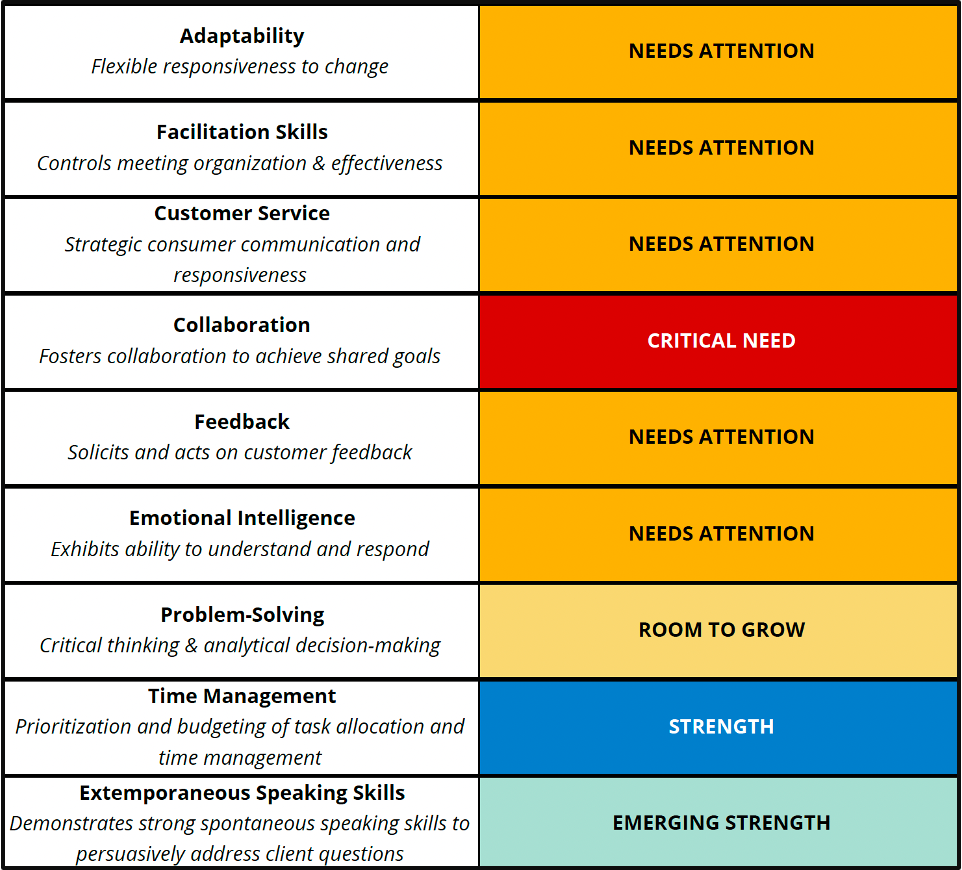
Tyson Group’s sales assessments and diagnostics give you a clear, data-driven view of the strengths, gaps, and growth opportunities for your sales team. The data provides actionable intelligence you need to:
- Pinpoint each sales rep’s strengths and weaknesses to build a targeted sales development plan.
- Identify key selling skill gaps so sales training solves the right issues.
- Develop sales talent, coach with precision, and drive consistent revenue results.
- Improve hiring decisions to shorten ramp times.
- Gain a holistic assessment of your entire sales organization and identify hidden gaps.
- Obtain a roadmap to address areas where your sales team is misaligned.
Tyson Group Sales Assessment Solutions
Sales Competency Assessments
Role-specific competency assessments that measure the skills and behaviors your sellers need to perform, so you can target training, hiring decisions, and develop talent against a clear performance standard.
Sales Team Diagnostic
An evidence-based diagnostic that reveals exactly what’s fragmenting your sales process across leadership, management, methodology, enablement, and talent, so you can fix what’s broken and optimize what’s working.
Frequently Asked Questions about Sales Assessments
-
What is a sales assessment?
A sales assessment is a structured measurement of a sales professional’s skills, behaviors, motivations, and mindset against the specific requirements of their role. Effective sales assessments go beyond personality profiles to identify how a salesperson performs across the actual competencies that drive results, from prospecting and discovery to negotiation and closing. Tyson Group uses sales assessments to help sales organizations hire the right talent, created targeted sales development plans, improve coaching ROI, and measure sales skill progression over time. The best assessments produce a clear diagnostic picture that sales leaders and salespeople can act on, rather than a static report that sits in a drawer.
-
What is the difference between a sales assessment and a sales diagnostic?
Sales assessments measure individual sales professionals. Sales diagnostics measure the sales organization as a system.
Tyson Group’s Sales Competency Assessment (SCA) evaluates individual salespeople across the specific competencies that predict sales performance, including selling skills, mindset, and behaviors. The output shows where each salesperson is strong, where they have room to grow, and how their profile compares to top performers in similar roles. It is the tool of choice for sales hiring decisions, individual development planning, and identifying selling skill gaps for each seller on your team.
Tyson Group’s Sales Team Science™ (STS) diagnostic evaluates the sales organization itself, including sales leadership, sales management, sales talent, sales methodology, sales process, and sales enablement. The sales effectiveness output identifies where the sales architecture is strong and where it is breaking down, scored separately for leaders and reps so the perception gaps become visible. It is the tool of choice for CROs and VPs of Sales who need to know which structural fixes will actually move performance.
Used together, the two produce a complete picture. A sales diagnostic surfaces where the the sales system is failing. A sales competency assessment surfaces which sales reps are ready to execute against the sales system once it is optimized.
-
How can sales assessments improve coaching?
Sales coaching without sales assessment data is guesswork. Sales managers who try to coach every rep in the same direction, or who default to their own strengths as the coaching template, produce inconsistent results because they are not coaching to the specific gaps that matter for each salesperson.
Assessment data changes the conversation. When a sales manager and a salesperson are looking at the same diagnostic view of the seller’s competencies, motivations, and behaviors, the sales coaching cadence gets specific. Development plans target the two or three gaps that will move performance the most. Progress becomes measurable. Salespeople see themselves in the data, which builds ownership over their own growth. Sales managers spend their coaching time where it produces the most return, rather than distributing effort evenly across the team.
The result is sales coaching that compounds. Salespeople grow faster, sales managers develop as coaches, and the sales organization builds a shared language for talent development.
-
How often should sales teams be assessed?
Sales assessment cadence depends on the objective, but three windows produce the most value.
Before hiring. Every candidate for a sales role should be assessed as part of the hiring process. This is the single highest-leverage moment for assessment data.
At onboarding. New hires should be assessed within the first 30 to 60 days to establish a baseline, calibrate the ramp plan, and identify where early coaching should focus.
Annually or after a major change. Full-team reassessments produce the most value when tied to a specific inflection point, such as a new strategy, a new methodology rollout, a sales leadership transition, or a shift in market conditions. Annual sales assessments also give sales leaders a longitudinal view of team development, showing where sales coaching investment is producing measurable skill growth and where more focus is needed.
Some organizations run continuous, lower-touch pulse sales assessments in between full sales assessments to track specific competencies over time. The right cadence for your sales team depends on turnover rate, development goals, and how quickly your market is changing.
-
How are sales assessments used for hiring?
Sales assessments give hiring managers a data-driven view of a candidate’s fit before the offer letter goes out. Interviews reveal what a sales candidate can articulate. Assessments reveal what they can actually do. The strongest hiring processes combine both, using assessment data to test the assumptions coming out of the interview and to identify candidates whose stated experience does not match their measured capability.
Tyson Group’s Sales Competency Assessment is used across hiring workflows to screen candidates against role-specific benchmarks, calibrate final-round decisions between finalists, and set realistic expectations about ramp time and onboarding needs before day one. Leaders that assess candidates before hiring make faster decisions, reduce mis-hires, and shorten the time from offer to full productivity.