In this episode of Against the Sales Odds, Lance Tyson sits down with Corey, a senior leader at Cosm, to explore the career experiences, leadership lessons, and revenue strategies that have shaped his journey across the sports and entertainment industry.
Corey shares how he went from sponsorship and inside sales roles to leadership positions across major sports organizations, including helping launch LAFC and leading revenue initiatives across Legends’ attractions. He also discusses his role at Cosm, where technology, media, live sports, and hospitality come together to create a completely new kind of fan experience.
In this conversation, Corey and Lance explore:
- How varied experiences across sports can build a broader understanding of revenue and operations
- Why effective leadership is about impact, not activity
- The importance of listening across departments and aligning teams around shared goals
- How to create simple principles that can guide people across different roles and venues
- Why transparency and long-term relationships matter in negotiation
- Corey’s definition of success—and the book that shaped his perspective on finding meaning
- A conversation about sales, leadership, culture, and what it really takes to build organizations that scale.
—
Listen to the podcast here
The Leadership Shift: From Activity To Impact
Redefining Live Entertainment And Venue Experience
I’m excited about this episode of the show. I have somebody on, Corey. We’ve known each other for years. Corey is the Senior VP and Head of Venues for Cosm. He just talked to me in the pregame that Cosm stands for when the Cosmos meets the Coliseum. Is that what you said?
That’s spot on.
Corey, I’m glad we finally got this together after all these years. Corey, tell the audience a little bit about your role, what you do for Cosm, and what Cosm is.
It’s always best to start with what Cosm is. For those who haven’t been, haven’t seen it on socials, etc., we’re a tech-meets-media company that just so happens to operate physical brick-and-mortar locations. If you think about us, we have a 75-year history in the planetarium space. Our technology has been hardened across those years.
We merged in 2019 and 2020. There was a culmination of different things that hit. There were a lot of folks leaving Fox who had been execs there who understood the media side of the business. They knew what that stood for. Everybody was trying to think about how we transform people consuming content. That’s when our team literally plugged in a linear sports feed into a planetarium technology and said, “This is the future. This is going to transport fans to the most marquee events across the globe.” That’s where Cosmos was born.
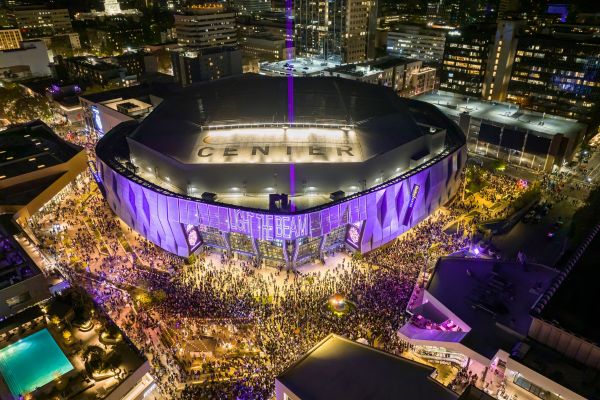
If you think about Cosmos, we want to pay homage to our history. At the same time, Coliseum. The Coliseum, the environment, the vibe, the energy, the atmosphere of walking down into the stands and feeling that’s really where we live. We live at the intersection of sports, art, and entertainment. Now we have four venues. One in LA, one in Dallas, one in Atlanta that just opened a little less than a month ago. We’ll have another one in Detroit this fall that will open. Cleveland will be our fifth. It will open in 2027. Bring it home to you.
I love that. It’s so funny when you say that. I can remember as a kid, you get so damn excited to go to a planetarium. You’d be like, “This is great.” What an innovative story. That’s a great brand story. I’m looking for a sales guy. That’s a hell of a way to describe what you do in your value prop, isn’t it?
Thinking about it from a sales perspective, having to pitch this from 2020 through 2024 via PowerPoints when our main tagline is you have to see it to believe it. It definitely was a little challenging, but providing the historical context, I think, is extremely important because it sets the level. Also, it points to the fact that everything you see in a Cosm is vertically integrated. One of the reasons, and I’m sure we’ll get to this, is why I was so excited about joining.
I’m like, “They own their tech stack.” From the cameras on the field at the pitch for a FIFA World Cup match, which we have three of them in our venues, to our production team on the ground at the venues, then feeding that back to El Segundo. We have a team going camera one, camera two, pushing that feed simultaneously out to multiple venues. It will be in LA. Dallas, Atlanta. There’s a lot of, I would say, stickiness there.
People automatically are attracted to things that we own, meaning we’re not dependent on any third party. We’ve carried that through to our entire ethos. As we talk about, like a startup and having that entrepreneurial spirit, especially from a sales side and across every single discipline, we’ve really fed into that. That’s our core ethos is like, why buy it when we can build it and do it ourselves?
Corey, just for perspective, when you’re head of venues, what all falls up underneath you? What’s that look like?
The Evolution Of Head Of Venues And Immersive Experiences
That was a unique piece for me, too, as I transitioned away from your traditional stick-and-ball venue, stadium team style. What does head of venues mean? What it meant in the beginning is vastly different from what I think it means right now.
You mean your job description changed from the time you started?
Exactly. Your role and responsibilities. Look, I look at my role as anything that impacts the driveway-to-driveway experience for our fans. Whether that’s influence on a ticketing platform, now we have ATT&CK, a product engineering team building that out, but we have proprietary ticketing platforms. If you think through our website, ticket sales, single-game sales, because primarily we’re all digital group sales, private events, sponsorship, food and beverage. Hospitality, you name it, anything that impacts the venue P&L. I always look at it.
Anything that’s in front of the house is Cosm. As soon as you walk into our venue, you’ll interact with a security guard, or you’ll interact with a fan ambassador. You go to our server runner or the heart of the house, which is our kitchen, from our exec chef to our CDC to our line cooks. Everything is Cosm. Everything falls underneath my purview, which is awesome.
Most recently was able to get into now we build out like a rev optimization team because now we’re understanding the value that we can create, especially when we operate in multiple markets. Now pricing comes through, customer service comes through. I just go back to that driveway-to-driveway experience. Anything that can be a touchpoint for the fan falls underneath, my purview, our purview. We have all these dotted lines to the other areas of the business, like the tech side and the media side and the brand marketing that continue to build and grow as well.
The argument you guys are making, instead of going down like I just had an appointment cancelled at one o’clock, because I think there’s a 1:00 FIFA game, and the client can actually make it down in Dallas. Your argument is that you do not even need to go there. If you’re in Cleveland or in Atlanta or Detroit, you can experience that here at its live entertainment. It’s just a different field. You just do not have to travel there. You’re getting all the angles. It feels like you’re in there. Does the sphere have, is that a good comparison to what you do? Maybe just at a bigger scale or is it, or is it more like something else just for context?
The sphere is a baseline, and I think that’s great. It’s almost like an anchor because people are familiar with it. Now they’re focused on what I’ll call live entertainment with the display in the background. We’re actually negotiating the rights with these league partners, whether it’s the NFL or NBA, Fox, media rights holders, ESPN, NBC, etc. Now we’ve gotten into this cinematic space, immersive, and we’re able to work with the studios. We have a deal for Harry Potter that we’re running right now in our venues. We’ve run Matrix in the past. We’ve done Willy Wonka.
If you look at us, the best way to see it is that we’re like a TV guide. We programmed it out because of the background for the Fox experience. I meant that tech meets media. We’ve developed all the tech. That’s all holistic. That’s all proprietary. That’s all vertically integrated. On the media side, we’ve gone out and constructed these meteorites deals because we’re never going to compete with what’s happening live at AT&T Stadium or SoFi Stadium.
That environment, that energy, walking through a tunnel and seeing 70,000, there are just certain goosebumps that hit. If we can remove some friction points and create a more intimate nature, so we have 1,500 people max capacity in our venues, You’re getting way more of a waitress-style experience. You have elevated food and beverage. You get premium everywhere. There’s a lot of different single-point touchpoints. We’re putting you in the best seats in the house every single time. You’re pitch-side at the NBA finals. You were court-side at the NFL.
You were literally on the field side. We’re trying to democratize access to the most marquee events around the globe. We also run 1400 plus events in our venues on a yearly basis. You were flipping the house multiple times, like, we have three FIFA matches, and we’ll flip the house. It’s all separate ticketed events, but if you go to our website, you go through our calendar, the first thing you’re going to see is all these different events listed out like a TV guide. We’re 365, 7 days a week, three events a day.
I cannot wait until you’re in Cleveland. You’re actually selling me on it right now. I’m like, this is great.
I’ve never oversold it
No, you do not have to, because I go back to that. I’m amazed that you have this older technology of planetariums and you’ve actually reinvented space. I’m just fascinated by that. Probably more fascinated by the brand story of how you got the name. Corey, how the hell did you get here? Where did you come from to land something this innovative? Where are you from? Where’d you go to school? First job? What’s that look like?
Taking The Scenic Route: From Small-Town Michigan To The NBA
I always try to sum it up by saying I definitely took the scenic route. I’ll start there. There was not a direct path.
You’ve affected a lot of people personally because there have been many people on this show that you’ve touched in their career.
I appreciate that. That was always one of my core pillars. My core philosophy is to develop tomorrow’s leaders. That’s been something that’s been ingrained in me since I started. I’m originally from Michigan, a small town, Jackson. It’s about an hour outside of Detroit. Very industrial, tool and die. My parents worked at a shop making brakes for Ford for 30-plus years. A little bit of the small-town, I would call it, mandate is the first one to go to college. I went to Western Michigan, stayed close to home, because I did not know any better. I legitimately chose to go to Western versus Michigan State because I did not want to wear green and white. That tells you how advanced my process is.
A deep selection process.
I applied for two, got accepted to two, and they’re like, I cannot wear green and white. Those aren’t my colors, but I did that. I was very fortunate coming out of college that I went to a job fair for the NBA. They used to hold it and offered an opportunity to start with the Phoenix Suns, and the rest is history. You go back to the Phoenix Suns in the early 2000s, you look at that lineage and look at who they had on their staff. I was surrounded by great people. Even if I did not even know what I was going to be or what I was going to become, it was almost like a maturation process through osmosis. I was just surrounded by really smart, intelligent, driven people. Automatically you get a little competitive spirit going, and you jump in.
It’s OK to be in a role that doesn’t necessarily give you joy, as long as it gets you closer to your joy. Everybody wants to do the fun stuff, but nobody wants to do the hard stuff.
What now? What would you take in school? How did you land in sports? What was that decision-making?
Originally, I wanted to be an accountant because I looked at my parents and they made $45,000 a year. I’m like an accountant coming out of college making $55,000. I’ll be rich. I sat in some accounting classes for the first two years. There’s nothing wrong with it. I feel like that’s a great baseline understanding for business in general. I just said, “Do I have anything in common with these folks? Could I see myself doing this for 30 years and pivoting to advertising promotions?” I thought I was going to work for the big three. I wanted to work for Ford or GM or Chrysler. Right around ‘20, ‘22, ‘23, or 2002, 2003, 2004, that’s when the down hit and all those companies shut up shop.
My parents’ shop shut down. Immediately, our town went from 60,000 people to 25,000 people. I was left going, “What am I going to do?” I was fortunate enough to take one sports marketing class, and that introduced me to the Grand Rapids Rampage. It was an arena league football team. I started selling many sponsorships. Many were $200 or $400 per game, shooting a blimpy subway gun out on the field, wearing a mascot uniform, but I absolutely loved it. I enjoyed it. I did it Monday, Wednesday, Friday, and Sundays. I took classes on Tuesdays and Thursdays. I did that my last two years.
You work the sports marketing side. As for our sports management side, why you’re in school, too. You were all in.
I was a worker. Definitely had to pay your own way and figure things out. You’re just believing in yourself at that moment. You have no idea what the outcome is going to become, but you’re enjoying it at the moment and just learning every single day. Just being around that type of energy and atmosphere was what fueled me.
Literally, if you’re tuning in to this, if you’re in the sports business, and I’m not criticizing anybody, you look at the folks that sold minor league sports. I was just talking to Kevin Rocklitz at the Baltimore Ravens about this. He worked for, like, Mandalay and for the Dayton, whatever Dayton baseball, minor league baseball team. It never ceases to amaze me. Literally, at minor league sports, you could be in a concession stand wearing a suit and doing everything you could, every job you could possibly imagine. That’s awesome. You go to the Phoenix Suns, you get hired in inside sales.
I was in inside sales. I learned more in a year of inside sales than I did in four years of college. That’s not a knock against Western Michigan, but I think there’s academia, and then there’s practical skills. I learned how to be a professional. I only own two suits, but they were the first two suits I ever owned. I had a rotation of four shirts and two ties or something like that. Look, I think you learn how to deal with a group of people because you’re brought into a world that’s professional. Piece mailing people from all different backgrounds, all different areas of the country.
I had never been west of the Mississippi. I drove my S10 out there with a few belongings, type of deal. You’re just betting on yourself. I went back like, there was no going back. It was either succeed or, like, I was going to stay. I was going to find a way. You did not have a parachute. There was no secondary plan. I burned the boats behind me and went all in, and I was just really lucky and really fortunate to be surrounded by, like, literally legends, I would call them, of the sports industry there.
Just for perspective, you were working with Bartledge at that time, Nick Bartledge, who runs the Cleveland Cavs and their properties. He’s now the CEO of the team.
Rick Welts was our president, who I believe is now with the Mavs. He’s with the Mavs. John Walker, Drew Cloud, Mike Toman, Jeff Lanello, and those were all leaders when I got there. On the team itself, it was Nic Barlage, Bill Fagan, Mark Jackson, Carlos Kasper, Kyle Hudson, Alan Lackovic, who just won an NBA championship. I’m probably forgetting a few, but it was a long lineage of folks that were just like, “Let’s ride together. Let’s figure this thing out. We’re all clueless, but I think we can do this together.”
That’s still one of the story teams. You do not see this a lot in sports entertainment, where the people you mentioned, probably 65%, 70% are still working in sports entertainment, and you do not see that often. There’s plenty where you have less than ten percent. The recruiting of that class from the leaders and the people there, like Mark Jackson, is running one whole set of revenue now for Phoenix. He took, he came back to that. Take a guy like Tomon. He’s the president of the Houston Texans at this point. That’s a story, hell of a story, class. You’re in sales there. You had a little experience with the rampage. How are you in sales? What’s that? What’s a young Corey look like?
Mastering Inside Sales And The Power Of Relentless Work Ethic
It was so long ago. I do not know if I can remember, but I think I was definitely tactical, I treated it like an assembly line, and I looked at output, input versus output. That was all I knew at that moment. That was all I knew at that time. I also knew how to outwork everybody around me. That was my one secret. I would call it my superpower, my secret sauce. It was turning the lights on, turning them off. With Nick Bartledge, legitimately, he and I would role-play together. We would stay late.
That’s where I first got introduced to leadership and management. We’re running a night sales team that probably had five people from ASU coming through. They’re trying to sell, whether it was Phoenix Suns mini packs. Phoenix Mercury mini packs. We had Roadrunners. We had Arizona Rattlers. There were a lot of different properties that you get experience with. You had a goal for each. That’s where I first got introduced to leadership and to management.
I also found out that I get more joy out of watching somebody else succeed than my own success. I’ve always been an individual who would say I’m not the best athlete, but I’m always a great teammate. That was how I was in inside sales. I knew I needed to get to the top of the board in order to get promoted. It was more like I needed to do this in order to get there. I really do not enjoy doing this.
The other piece is that it’s okay to be in a role or a job or doing something that doesn’t necessarily give you joy, but it gets you closer to your joy. That’s extremely important because everybody wants to do the fun stuff. Nobody wants to do the hard stuff. I had to go ahead and get in the mud and do the hard stuff for a little bit.

That’s the threshold. A lot of people do not realize you’re just not going to leap steps. You’ve got to run the gauntlet at some level, and it doesn’t matter what job you’re in. One of my sons, my son’s fiance and she wants to be a nurse practitioner right now. She has to run the gauntlet. She’s going to do everything. She has to do every job you do not want to do in order to get to the level to be able to do it. From there, you start to get it.
You start to, it sounds like you started there. You start to eye up leadership, and one of the things you’re known for in the industry is your philosophy of leadership. Anybody I’ve ever talked to, like you, has a certain philosophy, the way you run things. What’s that next step? Where do you go from inside sales at the Suns?
It’s important to point out things like, you go through this process where you feel like you’re being prepped or you’re being prepared. The Phoenix Suns always rewarded the right behavior. They always empowered people who wanted to grow their careers because they viewed it as a benefit to the Suns as a recruiting tool. If somebody from the Suns was actually able to get a job. I had full support from the Suns as I was seeking out opportunities externally. In the NBA, you’re a part of this network. You can use that. I interviewed for a couple of different inside sales manager jobs.
I did not get them. I want to state that because that was also key. I flew to spots. I interviewed, and I came back home, and I’m like, “Maybe I’m not ready.” It made me question, and I doubled down. I stayed with the Suns for three years and just continued to grind and work and, I would say, start to finesse a little bit of my philosophy as well, because I realized like not everybody was going to be built like me. It wasn’t that everybody was going to look at it on an assembly line. Until I got my first gig with the Atlanta Hawks and Thrashers.
Back to the Suns, not to interrupt you. The Suns, you’re still in sales for about three years. You get promoted. Are you working inside sales or ticket sales?
I was in inside sales after one year. I got moved up to account executive. At that time, the Suns were really successful, which always helps the sales numbers. You’re never selling wins and losses, but it certainly doesn’t hurt. They made a run with seven seconds or less and Steve Nash. It just afforded me more latitude, more opportunity to continue to coach and teach and train. That’s where I got really tight on what my structure looks like and how I can provide tools and resources to people to help them become successful. A lot of people come into it like none of us know really how to sell, but there are like multiple steps in order to get that muscle to I would call that muscle memory.
That scar tissue and go. I was afforded the opportunity to join the Atlanta Hawks and Thrashers when they had a hockey team. It was under stellar leadership as well. There were a lot of ex-NBA folks. You had Bernie Mullin, Brendan Donohue. Those were my direct reports. Chris Zaber was there as a director of sales as well. It just took another leap from a really strong organization to another strong organization. They were going through a little bit of a reboot. They had won sixteen games. Thrashers were never a playoff team. They wanted to hit the restart button on the culture of the Atlanta Hawks.
The teams, the product on the field or the court or the ice, was average at that point. You weren’t rocking it from a product standpoint. You guys had to sell at that point. You got it. Even a threat, and I think back to that time of the Thrashers, I mean, you had a couple good players, but you weren’t killing it at any level at all. That wasn’t helping you. What’s the title of that role when you get there?
I was an inside sales manager when I got there. When I left, I was the senior director at Ticket Sales and Service. That was about a seven-year period.
Seven years. At that point, you’re in sales in the role prior to that. Now you get into leadership. You mentioned your sales philosophy was that assembly line. I’m going to extract from that. A predictable process yields predictable results. These steps allow for X. As you said before, the fuel of that whole thing is a level of activity and time. Whether you’re winning or not. Is that correct? I do not mean to put words in your mouth. I just want to make sure.
I would say at that point in time, that was 100% how I evaluated and what success looks like or how to achieve success, full stop.
Even if you took somebody that’s less talented, because you could have talent all over. Some people are just charismatic. They can plug in. If you follow the formula at some level, you get some level of predictability. If you want to be here, like you said, now you get into leadership. How do you take that assembly line, or whatever you’re going to tag it as? How do you start incorporating that into your leadership? How do you start to evolve as a leader?
The Leadership Shift: From Assembly Line Tactics To Multi-Disciplinary Alignment
It was a quick pivot. What I would say from that, and knowing that, is to be able to do that over the course of time. That’s the challenging piece and get that consistency. It can get old real quick. It removes the fun nature of it. I wasn’t there for the fun side. I was there for survival. That was literally, and I remember this moment as you talked about, like, “Invite me on here.” We would pick our playlist, our song. At that point, and I’m in my mid-twenties, I literally picked my song, and it was Tupac, Me Against the World. That’s the way I viewed everything.
It was like, “I’m going to fight or flight, and on flight is not an option. I’m going to fight.” I just entered it into every situation as if it was a battle royale. I quickly realized as a leader that I’m a lot more dependent on all these other disciplines than my own. I need marketing. I need a CRM. I need analytics. I need ticket sales, box office. You truly need every other discipline or division of the business in order for your department to be successful. The fight mode is not possible, nor does it get.
It gets exhausting. It gets really tiring.
The ability to synthesize information quickly and make timely decisions not only helps you in a sales process, but it helps you in business as a whole
That carries through to the team. That carries through to your energy. I just realized there are no absolute truths. It’s okay to pause. I started to listen a lot more and understand a lot more. I would sit in meetings and, as opposed to being like a peacock, I would sit back and relax and just listen to all the other disciplines and what they were trying to achieve. I found ways to say, “Let me help you achieve that. Let me help you get to your outcome. Let me help you get to your goal by doing X, Y, Z.” That’s when I started to count the impact versus the hours. If I was so focused on the assembly line, I would never leave that assembly line, and that did not open my eyes to all the other areas of the business.
I just reviewed my surroundings, and I started to spend 30 minutes understanding a little bit more about marketing, 30 minutes understanding a little bit more about our data and analytics department, and 30 minutes spending a little bit more with our comms department. Those things started to go ahead and compound. I realized, “More will actually create a much bigger pie,” and it’ll actually help everybody that I’m managing, leading, coaching, teaching, because now we’re exposing them to all these different disciplines.
What you’re saying is profound at some level, because number one, the assembly line doesn’t work without it being multidisciplinary. Henry Ford doesn’t give that Model T off to regular Americans unless every discipline, including everything, is in there. You actually expand your thinking on that, too, but then you talk about some core fundamental concepts, issues that we deal with as leaders. You know this, especially in the role you’re in right now.
It’s a win-win philosophy because the other departments have to win along with your win if you’re ever going to get everybody bored. People support a process that they feel helps them succeed, and people support a world to help create at some level so their opinion counts. I got to seek to understand, and then you got to synchronize because it’s all it’s it’s all about the threading and the synchronization and of the whole thing to get it to work. If you have people not bought in, everybody loses at that level. Well said.
You hit the nail on the head as far as evolution. Obviously, I think it started in Atlanta, and you’re working across two teams. We had an NBA lockout. You go through a little bit of turmoil. Quickly, the Atlanta Thrashers left to become the Winnipeg Jets. You had a team leave a city. You go through that again, and you start to see the ebbs and flows of just life, not just business, but it’s like, “All this is cyclical. It’s all going to come back around. How can I leverage this? How can I use this?” You go back to my core values and my core pillar, like what drives me, what I’m deeply passionate about is growth, full stop.
I always want to be a continuous learner and always try to introduce our team, our people, to two books, two podcasts, two things that can evolve our thought process because I never want to become stale or static. The note that you just hit on is that I think getting exposed to all these different disciplines, the ability to synthesize information really quickly and make timely decisions, not only helps you in a sales process, but it helps you just in business. That’s been the biggest evolution since that point.
You said it so eloquently because the conflict at my level, at your level, is the argument between efficiency and effectiveness. You’ve got to have the efficiency, but you can’t get stuff done efficiently and do it efficiently. It’s the effectiveness and that performance. That’s really well said. The core philosophy, I wrote it down in the beginning three times, is to develop tomorrow’s leader. If everything I’m doing is with development, getting people out of the box at some level. That’s so critical. You’re there for three. You lose the team. Where’s the next stop for you?
Navigating Career Milestones And Overcoming Leadership Blind Spots
Early 2012, 2013, I think it was around. I went to the Minnesota Timberwolves and the Minnesota Lynx and became the vice president of ticket sales. You’ll know, I know, we all know that’s tuning in. You put a name or a title on a board at some point in your career, and you’re like, “That will be what success looks like.”
I’ve arrived at the top of the summit.
That arrival lasts about ten seconds. You quickly realize you got no joy out of that. You got a little bit of happiness, but no everlasting joy. Now it’s got to work, and it was there for two years. It was fun. It was a lot. I learned a lot. Once again, I think taking a process, or taking what you believe is your process, and trying to immediately implement it in a team that has a lot of history, a lot of culture, and a lot of people that have been there for a long period of time can be like a shock to the system. We went through that time.
We had a new VP of sponsorship. We had a new VP of comps. We had a new VP of sales. There might have been another VP that they brought in at that time. We all started alongside each other. I just think that was a huge, huge learning. Once again, for two years, I almost called it my MBA. I was going to Ohio U for my MSA at that time, which was crazy as well. I was able to go through that process and learn a lot.
What would you say was the biggest obstacle there that you learned from me?
I just think that you become so attached to your desired outcome that you close your blinders, and it becomes a racehorse. I was so focused on how to be a successful VP. I wasn’t focused on being the biggest successful teammate. It was my goals over your goals that I was going to achieve. I cannot allow myself to fail. I disregarded some of my own advice that I’ve been given or been giving out in Atlanta. In Atlanta, I grew from an inside sales manager to a senior director. People had seen the seven-year growth, not only business-wise, but professionally. I grew as a person, not just professionally. I immediately went to Minnesota.
I try to be that guy, I’ll call it, and feel like you have to carry yourself a certain way and buy a certain watch and do all these things. I got lost a little bit in the sauce. I said it earlier, I do not know if it’s a little bit of ego or ambition, but maybe a little bit of both. I got caught up in my own way, and I got out of there. I needed to get out of my way. There are people, we had some success and I think you can still create success, but not have the right culture or not have the right fit. I probably got my own way there.
It’s interesting. It’s very few leaders I get on here that can sit there and be humble enough to say, “Man, I’ve identified the problem, and it’s me.” It’s not a level. You’ve got to look at yourself in the mirror. That’s so well said. The other thing, the third dimension of what you said, is like, “I’ve arrived, I’ve done this.” You get in a spot where you get some folks, other VPs, and then it gets, I’m not saying this happened to you, but it always gets a little territorial. It’s always positioning.
Going back, if you’re always negotiating that, not a formal negotiation, but that’s always at play, it gets tiring, and it affects culture. I’m not saying it did, but you see it a lot. You’ve been involved with some monster companies. You can probably even see it where you are right now because that’s not bad. People are political, though. I’m not saying political parties, but there’s a problem. There’s politics, and they’re political in youth sports or in business. I own a small company, and there’s politics here. They do not come up to me, but I’m sure right underneath me, they’re all arguing shit out.
At times you treat the external sale a certain way, and then you treat the internal process a completely different way. You need to realize you’re still selling. Sometimes the internal sales are harder than the external sales. To be able to provide because you’re so quick, you just want to move so fast because you already know your desired outcome. As I mentioned before, I’ve taken the scenic route in my career, which has helped me with patience. Patience is a key piece. It’s okay not to fight or flight. It’s okay to just pause. There can also be two absolute truths. Not everything has to be one way or the other. As you navigate that, go through a process.
Understand context before reacting as well, because I’ve automatically struggled with this, and I struggle with it today. Am I reacting to the person that’s providing the news, or am I reacting to the news? Nine times out of ten, the news is okay. It’s how I’m reacting to the person delivering that news, that problem, or that issue. I just really need to remove that issue, that problem from that person, because my personal bias could be feeding into that. If I just solely look at the problem, I’m like, “They’re not wrong. They’re right. I need to fix that. I should fix that. I should address that.”
I agree. I literally say to myself, it takes all types. You do not have to like everybody, but you should respect everybody. Not everybody are you going to have a beer with. I say to myself, is this person bringing gas or water to this situation? I say to myself, “Am I bringing gas or water?” It definitely happens. I’m with you. Leaders are focused on one of three things as their priority. Time, cost, or quality. I would just guess, working with you a little bit before in this interview, time’s of the essence, and I’m with you.
It’s funny. I’m sure you’ve heard of it, like, good to great early on. I read that book, and that was the hedgehog concept. That hedgehog concept for my leadership or my philosophy, not just for leadership, but just for life. It’s like, “Corey, what are you deeply passionate about? Growth. I’m going to continue to grow, evolve. I’m going to get access to as much stuff.” What do I want to be the best enrolled at? That’s a gaudy title, but I want to develop tomorrow’s leaders. An economic engine used to be like, I’m going to run that assembly line. I’m going to be vigilant in pursuit of perfection.
Now it is time. Time is more valuable than the outcomes. Sometimes we spend time on things that actually do not create a desired outcome just to create work. Sometimes also, if there’s no action taken unless direction is given, that’s another use of time. Now, when we think through and the way we run here and the way I try to lead is, synthesize, I go back to that. I want to synthesize all the information that’s coming in.
I want to find alignment across all the disciplines because, as you mentioned, my job responsibilities are across multiple disciplines, but there’s a variety of different backgrounds and widely varying attitudes and energy and effort and also philosophies on the way they get decisions done. Talking to somebody in pricing is vastly different from talking to somebody in customer service. It’s vastly different from talking to an operator. It’s vastly different from talking to a salesperson. Taking all those inputs, synthesizing that information to find alignment, and then I disregard what doesn’t align.
That’s what the synthesizing does is alignment. You do not have to be in agreement to be aligned.
Spot on. I just hit repeat and let’s do it again. You create your health of the business, and you’re probably focused on 5 or 6 key factors. I can look at the health of the business across all those different disciplines and know exactly what I need to call out. We just rinse and repeat. At least there’s accountability built in. There’s transparency built in. The end goal is the execution, because a lot of times we’re not getting paid for ideas. We’re getting paid for results. Cannot have it sit on the shelf.
No doubt. Execution. Sometimes I interview folks, and we forget the business of business is to make money. If you go back to Drucker, not to be uber capitalist about this, but the business of business is to make money at some level. That’s the fuel, not to be the ugly capitalist. There are all kinds of other missions, but that means you’ve got to execute in a very consistent way. You’re in Minnesota. What are the next couple tours? You’re in an interesting spot because you’ve gotten into this event side of the business, and you’ve had a couple stops before that, before you start getting into these events driven outside of just sports entertainment. You’ve gotten on the entertainment side. What’s that look like?
Scaling Sports And Entertainment Operations With Legends
First and foremost, when I was in Minneapolis, I needed an outside source. I, ironically enough, got connected with Ryan Estes and started talking to him because he was based out of Minneapolis. He wasn’t really, like, I would call him a life coach or anything like that, but we did meet for coffee, and I’ll never forget. He gave me this assignment, and he said, “You need to go do this and write out where you want to go in your career, knowing you’re at this moment and you’re not happy and you’re trying to figure out the next step.” This is probably like 12 to 14 months into my Minnesota tenure.
You knew the writing was on the wall. Man, we’re having success numbers, but I’m not having success. I do not feel successful. I went through this process and built that out and wrote a five-year reflection paper. Ironically enough, as it’s serendipitous, life works in less than, I would say, eight months. I got a call from Mike Toman, who I hadn’t really been in touch with in a long time. He’s like, “There’s a new LAFC.” It’s the Los Angeles Football Club. It’s an expansion MLS team.
We’ve been hired at Legends to be their operator. It’s the first 360 project. We’re going to be the owner-operator. The owner’s rep is on time and on budget. You’re going to be able to help influence the premium product mix and the venue design. We’re going to handle all sales, not just ticket sales, premium sales, individual sales, group sales, sponsorship sales. We’re also going to do their F&B. He goes, “I’d love for you to come out here and be a part of this.” That was a pitiful point, because once again, it got me exposure to all these different disciplines.
We would literally sit every two weeks, and I’m sitting with a PM, which is a project manager, and he’s listening to all these adjectives, or he’s using all this terminology. I’m literally just writing it down, going, “I do not understand anything he’s saying, but I’m not going to be dumb enough to ask this question in front of the group. I’m going to go home and study.” Same thing on sponsorship, because up to that point, I hadn’t sold sponsorship. I do not know how to do that. I just listened and wrote down notes.
Same thing on the hospitality side, the food and beverage, listening in these meetings, writing down notes, and I started to understand the language, and I understand how to put a holistic vision together for a business and really manage a P&L. That’s where I got, I would say, introduced to it. I also became like, “There’s got to be more.” This is for me personally, more than ticket sales. I have to do more than just ticket sales because I need to continue to feel or fuel that growth. What am I deeply passionate about? Growth. This has given me all those things.
Happiness is fleeting and joy is everlasting—find joy.
It widens their purview. That was your start on the Legends piece, correct?
That was LAFC in 2015 through 2018 until we kicked the ball. Your contract runs up, and then you’re looking at the next step, and they’re trying to figure out what’s next.
Just for perspective for everybody on that Legends piece, what are some of the projects you were involved in just to cornerstone a little bit? There’s some story projects there too.
In LA alone, they had been working on Angels for hospitality, Los Angeles Angels. They had won the Rose Bowl with UCLA. So far was being built adjacent to us building LAFC, and so there was and then at that time, our president, Shervin, was out here in Los Angeles. Mike Tomlin was out here in Los Angeles. Now we’re starting to move away. I would say Legends was moving away from a boutique agency to more like Grander. They’re starting to pick up all those differences, like we call the wheel of services. LAFC was your first one.
There was just the ability, once again, to be surrounded by a lot of super talented people over the course of three years. It was just an accelerator. For personal and professional growth. The other piece that really opened up my eyes is working in a market like Los Angeles and selling a product in a market like Los Angeles. You follow the path, Phoenix to Atlanta to Minneapolis. Those are good markets, great markets. When you get to New York or LA. You’re like, “It’s a different platform.” You face a lot of folks that will go, we do not know anything about LA. You do not know anything about soccer.
That’s where I got to tap into my assembly line mixed with my new evolved. I’ll call it an evolved leadership style. I like to merge those two because they did. We built it out, and we built something out from 2015 to 18 to make LAFC one of the most successful teams. Expansion launches in the history of MLS. Now I believe they are the most valued club, if not the second most valued club. They have a great atmosphere, great energy. It was really cool to be exposed to a new sport in a new city and use the tools that you’ve built over 15, 20 years and see success.
I love that. From 2018 up until this point, what was the next evolution for you?
Chief Revenue Officer of Legends Global Attractions.
You get promoted up in the Legends. Legends opens up a completely new, I would call vertical or space or part of their portfolio. Now you’re taking all this experience from leadership, your own sales experience, being involved. A big market, and talk about that role for a second. That’s a big role.
It was unique. Once again, I’ll give Mike Tomlin a lot of credit, and he probably saw what the role would do for me versus what I thought it might do or could do. At that point, I wanted to stay within legends. That was the key piece. I did not necessarily want to go to another team and open up another stadium. I felt like you did that for three years. It’s a gauntlet. It’s time, energy, and effort. I wanted to be exposed once again to all disciplines. At that moment, the best way to do that is Legends Global Attractions. You get to own a property.
They hire you as the operator, and you’re in charge of that P&L. Whether it’s One World Observatory in New York, view Boston in Boston, whether it’s running tours and private events for SoFi Stadium, AT&T Stadium, running a museum like, in Dallas and there’s other immersive experiences out there. It was at the time when Van Gogh was coming out. We really focused on that vertical. There are tall towers, which are international, because there was one in London with the view from The Shard. There were iconic venues.
How do you run and drive ancillary revenue for these venues on off days, non-match day, non-game day? Iconic venues like SoFi, AT&T, and Bernabéu. What do you do for these immersive experiences that are trending, that want to build up, do pop-ups, and they have IP, they have some type of content, but they’re not really sure how to operate? How do you reimagine museums that might be treating it more like a nonprofit? How do you commercialize those museums like a college football Hall of Fame? How do you review Georgia Aquarium?
Core Principles Of Venue Management, Leadership, And Finding Joy
What do you do with some of those other entities out there? I just got exposed to a lot. I was in charge of new business development. Going and attracting and signing those deals, which meant you had to get on the legal side as well and understand those agreements and their management fee plus rev share. At the same time, you’re operating these, as each venue has a GM. Typically, they’re coming from an operational background.
They’re not from a sales background, and they’re running the full gauntlet. You have a GM who’s responsible for all ticket sales. You’re running the website. You’re running the ticket sales strategy and platform. They’re individual tickets. They’re time-based tickets. You’re doing private events. You’re touring and travelling. You’re doing sponsorship if you can. You’re also running all the hospitality, food and beverage, and merch on those assets as well.
I was listening to you, and what I was saying is, if you’re tuning in to this as a leader, everything Corey’s talking about is commercializing these attractions, many of them aren’t the same commercialization. AT&T, you’re literally doing tours of AT&T Stadium. One World Observatory, that’s an immersive experience. It’s a tour, but it’s also immersive. They’re just different, or commercializing a museum. They’re just all different.
As much as you would think that the assembly line becomes micro assembly lines, and then it also becomes what’s the same every single time. That’s what you look for, because there’s a you’re having to customize the approach and you’re going to have you have to look for patterns of similarity, but it’s not like running the London office and the you know the Shanghai office selling the same product. They are very different things, and what we promise to the customers is much different. Speak to your leadership that way, or maybe it’s more your management skills, because that’s a different animal, Corey.
If you try to solve everything, you solve nothing. That is going back to maybe where I’m at is trying to navigate and come up with what our core values are or what our core principles are as a Legends Attraction division. If you pick 2 or 3 things, usually you can get people to rally around those 2 or 3 things, regardless of their background, regardless of their discipline, regardless of what their responsibilities are. I really started to look at, like, how do I create visual aids? Everybody learns a little bit differently. A chef or an operator or a security or a salesperson or events person or a GM is, all of them came from different backgrounds.
It’s the greatest collection of individuals ever. Your entire business model is predicated on hourly employees doing the right thing or making the right decision at that moment in time to impact the fan experience. You try to simplify your messaging. You try to come up with core values that I can just walk around today in Cosm and go, “Cosm Pillars of Service.” They know it’s connected, it’s optimistic, it’s service-oriented, and it’s memorable. I would be like, “What’d you do that was memorable? I can be in any venue in any city during any event and say that to any employee or teammate, and they know how to respond.
That can be the same across these. That’s what’s the same across. This is what we believe in. I love that.
I love to create your beliefs, rally around those beliefs, create visuals, create infographics, simplify your messaging as much as you can, make it sticky. A lot of folks here at Cosm will say, “Here comes another Coreyism.” I’m always trying to distill things that could be sentences down to words and words down to a phrase. I always look at it through that. If I have to use a paragraph to explain, I’m probably too much, and it’s not going to be sticky enough to carry down to the hourly employee that’s working one shift at a Cosm on a weekly basis.
I’m constantly thinking through low lift, heavy impact. What does that look like? Scale. How does this scale? How does this message, how does this term, how does this phrase scale across our entire business? Regardless of your discipline, because I think that’s the other key piece. We just rally around those. Certainly, there are actions and things below that. Ultimately, if you do that and then you’re attached to P&L responsibility and transparency, the execution will take care of itself.
There’s no doubt. Looking at your career as we bring you back to Cosm at this point, as you said, it evolved from being a salesperson to managing ops and service and expectations of customers, internal and external, and the operations of a business, too. I love that. I love that embedded piece of culture. When you say, here are our pillars, it actually makes me think of Mike Tomlin because, that’s what he really is, here’s our pillars of leadership. Everybody knows that.
That’s common core. I was interviewing a guy the other day who worked for the Ritz-Carlton for multiple years. When you look at their principles of service and principles of how we treat internal and external customers, it comes across as the same, and that becomes the platform, which you lift the whole organization off of. That’s really well said, Corey. I appreciate this. Last three questions. As we bring this bird down for a landing, because this has been so insightful.
You’re going to sign a big deal, or you’re going to open a new property, or get an agreement to one of these. Say you’re at Cosme, or you’re negotiating to get programming for the World Cup. You got to get that big deal done. What’s playing in your head? What’s that song? You gave a song earlier, man. What’s the change, Corey, music?
I got a good one for you. I got a good one for you that encapsulates it. It’s Kenny Rogers. You got to know when to hold him, know when to fold him, know when to walk away.
That song has become much more real as I got older.
In any negotiation, we always talk about the win-win mentality, but also as you get more seasoned and I do not even mean to experience just the more negotiations you go through. You can enter a room and know what the general outcome or vibe is in that room and where people want to land. If you enter into, like, “I’m going to get some, we’re going to get some, we’re going to meet in the middle.” Full transparency, I always like to enter any negotiation or any process, sales process, with full transparency. I’m not trying to nickel and dime you.
I’m not trying to grab that extra five grand, ten grand. I’m looking at the LTV, lifetime value, for these things. It’s a small industry, and I think every industry is small. As our industries merge, like you talk about Cosm, it sits at like a little bit out here in order to the teams and more of that ticket sales and sponsorship sales and just in general stick and ball sports teams. It’s connected in a way in a lot of those relationships, a lot of those partnerships as we go into mixed-use districts like Centennial Yards or SoFi in the Hollywood Park. I’m working with and alongside a lot of the people that I knew from my previous life.
It’s like, “If we win, you win, we all win.” I just think that’s the level of transparency and knowing that you’re not going to go ahead and drive straight for the best deal for you, but it’s just going to enter into it. It doesn’t have to be yelling, screaming. It’s just this conversation because we’re all adults and we all want to go home to our families. We want to go home on the weekends. We want to celebrate the 4th of July and just understand that your outcome isn’t the most important thing in the room.
That’s really well said. What’s a book that you gift people? You talk about developing leaders of tomorrow, investing in people. If you had to give them one book to read and gift it, if you did, what would you gift them? Besides mine, of course.
The end goal is execution. A lot of times we’re not getting paid for ideas—we’re getting paid for results.
That’s a good point. Look, I think the philosophy has evolved and changed. Early on, I would read a lot of sales books and try to figure out how to negotiate, the best way to negotiate, and the best way to build teams. You piecemeal things, you take a lot from all of them, and then you create your own version. I would say, I’m always doing that. What I would gift would be Man’s Search for Meaning.
It just puts things in perspective because the other thing is, early on, when I was in a fight-or-flight mode, everything was the end of the world. Everything was going to be detrimental. Everything was permanent. You quickly realize that nothing is detrimental. Nothing is permanent. All of it’s chalked up as a lesson. It’s just about applying that lesson to the next time. It’s probably going to happen again at some point, too. You’re going to make mistakes. You’re going to step on your toe, and it’s okay.
Viktor Frankl, that’s such a good book. I read it four times in my life, and every time I read it’s a little different than it was before, or I needed it for that time in my life.
You need to hear it differently.
That’s what I did. There are like five books like that for me. Last one, and you got a little one at home. Last question, and think if you had a niece or nephew that was 7 or 8 years old, you’re at the edge of a dock, you’re up at the lake in Michigan. Your feet are hanging in the water, and they say, Uncle Corey, what does it mean to be successful? Seven- or eight-year-old go. What does it mean to be successful?
I would say I have said this before, and I’ll steal it from a book. Happiness is fleeting, and joy is everlasting, and finding joy. There are a lot of things that make you happy. There are a lot of things that can give you a jolt of dopamine for that minute, that moment, that time. When you find joy, you just hang on to that. It’s what creates memories. That’s what success looks like.
I love it. Corey, as always, when I first met you, you always had a lot of intention in what you did. I love that. It’s my favorite thing.
Important Links