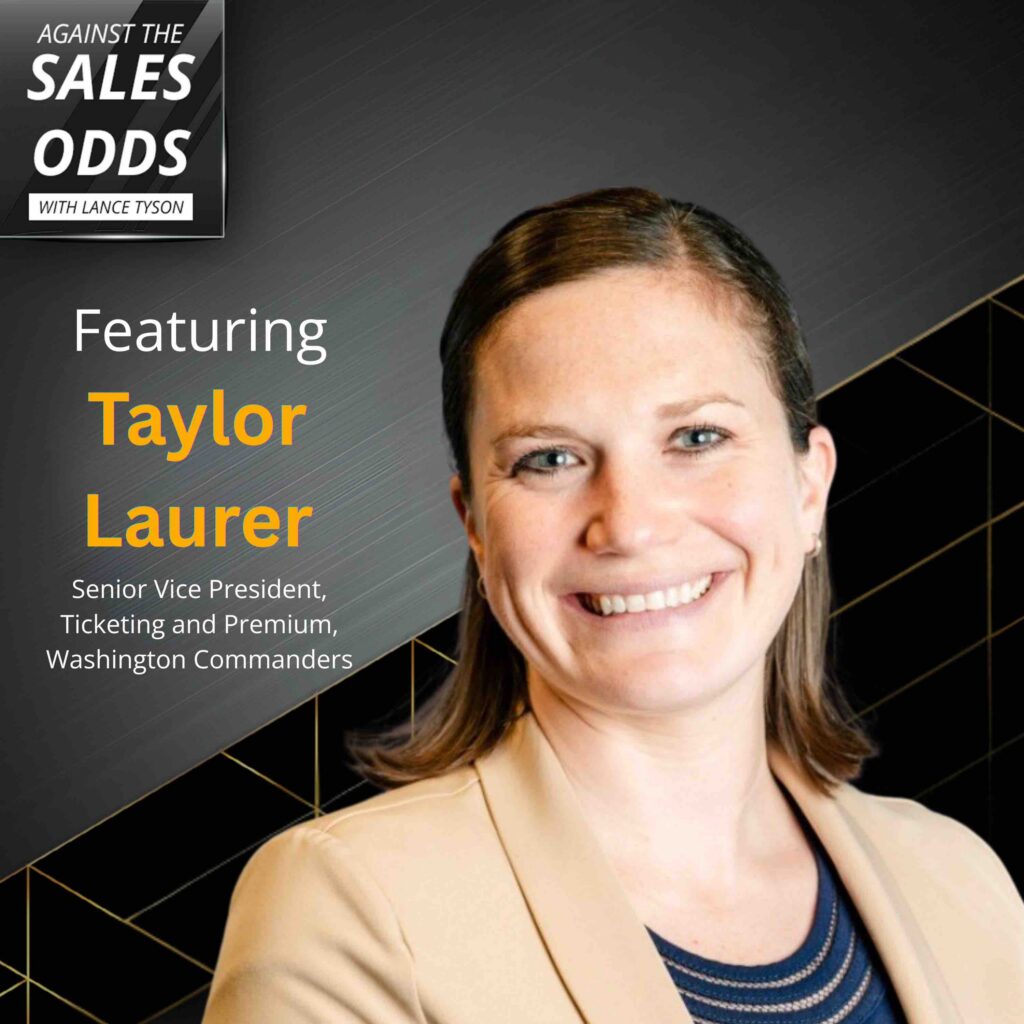
What does it take to lead through uncertainty, rebuild teams, and keep people motivated when the odds are stacked against you?
In this episode of Against the Sales Odds, Lance Tyson sits down with Taylor Laurer, Senior Vice President of Ticketing & Premium for the Washington Commanders, to discuss a career shaped by resilience, adaptability, and leadership under pressure.
From navigating LeBron James’ departure from Cleveland and leading through the Browns’ most challenging seasons to managing operations during the COVID-19 pandemic and helping transform one of the NFL’s most storied franchises, Taylor shares the lessons she’s learned from leading during moments of constant change.
Whether you’re leading a sales organization, managing a team, or looking to grow as a leader, this conversation offers practical insights on navigating challenges and performing when it matters most.
🎧 Tune in to hear why the best leaders don’t wait for perfect conditions—they learn to succeed against the sales odds.
Check out Tyson Group’s Open Enrollment Programs: https://www.tysongroup.com/openenrollment
Check out Lance’s Bestseller Books:
The Human Sales Factor – https://www.tysongroup.com/sales-resources/books/
Selling is an Away Game – https://www.tysongroup.com/sales-resources/books/
Download our playbooks: https://www.tysongroup.com/sales-resources/sales-playbooks/
Get in touch : https://www.tysongroup.com/contact-us/
Follow Lance across Social Media:
LinkedIn – https://www.linkedin.com/in/lancetyson/
Instagram – https://www.instagram.com/lance_tyson_1/
Lovethe show? Subscribe, rate, review, and share! https://podcasts.apple.com/us/podcast/against-the-sales-odds/id1602260518
—
Listen to the podcast here
When The Odds Are Against You: Taylor Laurer On Leadership, Change & Resilience
I’m excited about this episode of the show. This person, Taylor Laura, and I have gone back so many years from when she started her career, and her journey has been so interesting, and I’ve been fortunate enough to be a part of it. Taylor, welcome to the team. Taylor is the SVP of ticketing and premium for the Washington Commanders, a Harris-Blitzer property. Did I say that right?
That’s correct.
Welcome, Taylor.
Thanks, Lance. Thanks for having me. I’m excited to be here.
We were just catching up with the pregame. We both have Cleveland in common. That’s where we met. Taylor, tell the audience real quick what your responsibilities are to the Washington Commanders and the NFL. You’re in the shield. You’re working within the shield. Let’s go.
From Intern To NFL Executive
This is actually somebody just asking me what year this is for me going into. It’s like my fifteenth season going into the NFL, which is crazy. It’ll be my sixth season with the Commanders. As you mentioned, I’m our senior vice president of ticketing and premiums. I oversee everything that has to do with ticket sales, service, operations, and the same on the suite side. Overseeing all of our suite sales, service, and operations.
We have a very large team. There are probably about 65 or so between those two departments that run up through me. We’re focused on continuing to sell out all of our games on both the ticketing and premium side for every Commander’s game at our current stadium. It’s been a great journey since I started here, as I said about five years ago, going into my sixth season and seeing the tremendous growth that the team has had under the leadership. It’s been great.
From a sales standpoint, how many leaders report up into you and then report? What’s that org chart look like?
There’s probably, across all the different verticals within ticketing and suites, about five on the ticketing side and two on the premium side between sales, service, and ops that all funnel up to me right now.
How did you get here? That’s a big responsibility. It’s an NFL team. Fifteen years. I was ready to say a team, which started like middle school, fifteenth year in the NFL. In six years with this team, and we’ll get into the rest of your role. When you got to Washington, what was your first role? How did you migrate up to this, out of curiosity?
My first role was vice president of ticketing. As you know, I’ll give you some props, Lance. You were very integral in helping me land this job. When I first got here, the company was going through a complete business transformation. There had been a new team president who had come in and really hired a brand new executive team. At the time, we were really just looking to rebuild. The organization had gone through a lot of change and needed to reset. Really from the top down, everybody was brand new and really focused on moving the business forward.
At the time, the Commanders were last in the league in everything on the ticketing side. That had to do with ticket sales, revenue, gate receipts, season ticket members, everything. We had nowhere to go but up. Really, the first challenge that was put in front of me was like, “We have to build a staff.” We had to build a staff from the ground up. Paired with that was just hitting some pretty aggressive numbers and rebuilding it from scratch. That was probably some of the most fun I’ve had in my career, just coming in and really being able to build this thing from the bottom up.
It was a grind those first few months. We went from probably having about twelve reps across all verticals on the ticketing side and we had, in those first three months, we probably got close to 50 and we were just bringing everybody in and it was just like, we were staying until 10:00 at night, going through resumes, talking to people and it was just like churning through and really building this thing. It’s just been so cool to see how much we’ve grown from that first day in May to where we are now.
I’m so glad you brought that up because as we go through your journey, you knock on the door at operations, you’ve been on the service side of things, you’ve been on the sales side of things, and you started off in sales. When you think about where you are right now, let’s journey back to your first role. Where’s home, where did you go to school, what’s that first job out of college? Let’s dial back.
The Power Of Early Career Resilience
Go back, go back a long time ago, Lance. I’m from Cleveland, Ohio. I know you brought that up at the beginning. We both have Cleveland ties. From Cleveland, I am from a suburb on the East Side called Shaker Heights. I went to college at St. Louis University in St. Louis, Missouri, and studied business. We did not have a sports management program or anything like that. I got a generic business degree, actually, concentrated in human resources, which is sometimes really interesting for people, but if you think about it from a leadership perspective, it has a ton of really close ties.
I actually think it was extremely beneficial to how I’ve grown as a leader, having that educational background in HR. My first job out of college was with the Cavs. I was a seasonal intern, I guess you could say, with the sales department. While I was doing that during the day, I also was doing night sales because I really wanted to get my foot in the door with sales. As I said, I was interning with the sales department, but it was more in a supportive role.

What choice do you sport? St. Louis, you’re a Billiken, you come out of school, why sports?
It’s been a passion of mine since I was two years old. What’s funny is I originally wanted to go into sports broadcasting. I was like, “I’m going to be on ESPN. I’m going to be a sideline reporter.” Actually, funny enough, my senior year of high school, I did my senior project of a month internship at the Browns. I worked in the player personnel department because I had some personal connections at the time there, but they always knew I wanted to go into broadcasting. They would set me up with the video crew during training camp. I’d be on the sidelines, doing all my reporting.
I did not know that with the Browns.
That was my first taste in the professional sports world. When I went to college originally, I was going to major in communications. I’ll never forget, I was halfway through my freshman year, and I was like, “I think I need to go the business route.” I had talked to Buffy from Teamwork, and she had talked about how important ticket sales were and to jump-start your career in the sports world. I pivoted and went to the business school, starting my sophomore year.
By my junior and senior year of college, I was interning with the athletic department, and I was doing everything from men’s baseball operations to calling group-by-group sales for basketball. The great thing about sometimes going to a smaller D1 school is that when you work in the athletic department, you get to taste everything. I was doing all of that. I realized going through all of that that sales and ticketing was my passion and what I really wanted to do. After graduation, I reached out to some contacts at home in Cleveland and was able to land in that seasonal job with the Cavs.
You’re there in the seasonal job, and you’re there for one whole season, and then you make a transition full time?
I did. As I mentioned, I was there for a full season. About half the season I did night sales. Right after that season was over, I went into inside sales out of the night sales program.
Who was your leader in inside sales?
Funny you mentioned that. A man named Bob Civic. He was my first manager in inside sales, and then I grew through the inside sales program there. I knew I wanted to do service. I made that known from the beginning with my leadership team at the time, and so I was able to get promoted to the service team. I always knew leadership was the fit for me. I took it upon myself to make sure I positioned myself to be considered for a leadership position when I was very young in my career. I did extra training with my manager at the time and with the service manager at the time. When the opportunity became available to be the manager of the service team, they thought of me right away, and I was able to transition into that role rather quickly.
One thing is you’re probably there inside sales for about a year, maybe a little bit more.
It was about 8 or 9 months.
No, you were fast. How many people were in that inside sales team?
Probably ten, at least.
How many are still in sports?
Maybe one or two.
What’s really important for everybody tuning in to this is that typically in sports, the channel comes through like an inside sales program, and then you get promoted from there. You can tell, when somebody like Taylor starts in sales, it’s like an incoming class. When you get to Taylor’s level, there’s only really a few people left in sports. It’s a culling process. Where they might have stayed for several years after that, but when you get to this point, they’ve all moved on for all kinds of reasons. Start a family. They exit because they wanted to exit, and somewhere I’ve seen it because they didn’t want to exit either.

They go do sales in other industries or whatever the situation is.
You definitely are one of those survivors that got all the way through and saw the path. This is just for context for everybody. You get higher. I cannot remember. Did you hire the Cavs pre-LeBron or post-LeBron?
I was there with LeBron.
When he got first recruited, that’s when you got there.
I was there when he was first drafted, because he’s only a year older than me. I was there when I was doing the seasonal job. When I was inside sales, he was there for part of it, and then he left. I was on the service team when, I’ll never forget this, when he made his whole decision. We were all in the office. The entire ticketing staff was all in the office ready to go. When he made his decision to go to Miami, and how crazy that was. Yes, I was there during the end of his first time in Cleveland.
Got it. I’m just trying to form it in my head. You learn about yourself in sales? You’re hawking tickets for a couple of years between the seasonal program and inside sales. What do you start to realize?
What I started to realize is that it’s all about relationships and being able to connect with someone over the phone, and building that rapport really quickly was what I think ultimately drove my success early on. People buy from people they like. It’s not rocket science. It’s really not that hard to figure out.
I heard somebody say that one time, and I agree they do. Now you get into the service account management side of the business. Talk about that role a little bit.
Speaking of the time when LeBron, we had actually gone through just based on the timing. Everyone had to renew their tickets before the decision was made, just based on the NBA timeline and scheduling at the time. It was really tough when he left because obviously we had a lot of people that were upset. They may have renewed their tickets thinking that they were going to have LeBron and see LeBron.
It was that year, if I remember, or maybe it was a couple of years after that, where I think the Cavs won like twenty games, like they were so bad. This is what I always tell my staff is like, “That’s when you become the best version of who you are as a sales and service rep.” It’s during those times, regardless of what’s going on the court, on the field, on the ice, whatever it is.
When you become the best version of who you are as a sales and service rep. It’s during those times when you flourish.
That’s when I really just flourished because it really becomes all about your skill set and sharpening that tool set that you have and ensuring that you are doing your job the best that you can, regardless of team performance. During that time with the Cavs is when I became the best version. That’s really how I started to rise to the top was during the tough times, because I was able to be extremely successful when the play on the court was not that good.
They were not helped. In any industry, if the economy is good, it may be easier to sell. It’s easy to manage. In sports, when the economy is good and the team’s good. Selling really happens as we go through your career. It’s interesting that now that you say that, I didn’t realize that you’ve worked for a lot of teams on the field when they were in crisis.
It’s so bad. I’m telling you, if you look around the industry and you see some of the most successful executives, whether they’re team presidents or C-level positions, they have all worked for terrible teams because that is when they have had to really figure out what it takes to be successful. Everyone says it’s easy when the team is good, or there’s everything else going in your favor, but the best people in this industry are the ones who have worked for terrible teams.
I couldn’t agree more. How long at the Cavs and what’s the upward trajectory there? You start getting into a frontline management position and then what happens? What year is this too?
Lessons Learned From Fundraising And Sales
This was 2008. I graduated college in 2008. I was there from 2008 to 2012, I believe. I was there for 5 or 6 seasons, 2012, 2013. Crazy enough, I actually left sports for a couple of years just based on some transition.
Before you left though, where were you at?
The best people in this industry are the ones that have worked for terrible teams.
I was managing the service team at the Cavs. I was the manager.
Across the whole thing. You have it. That was like 2012.
It was about 2012.
What did you do? This is so interesting.
It’s so interesting. I actually left sports, and I went into fundraising, and I was working for a private school in Cleveland, an all-girls school. It’s actually where I went to school. There was just a lot of transition going on at the time at the Cavs from leadership. Obviously, the best things happen when you least expect it. I had an opportunity to go fundraise, which I will tell you, and I’m sure a lot of people realize this too, fundraising is sales. It is actually a grind. When you’re in charge of raising millions of dollars every single year, you are working your tail off.
I will say that it was an extremely successful time for me just because of the background and the training that I had had from a sales perspective. It is something that, when you’re looking to hire inside sales reps now, I always look, and a lot of them do, like we always look to see, did they have fundraising experience? Were they working at a call center in college? Those are the things that really translate very well into sports sales.
You leave sports, right? Talk a little bit about it because, you know, I’ve had so many coaching conversations over the years. Sports has been a boys’ club at some level. You made a decision, and you went through a grind to get up into a leadership position with the Cavs. When you made that decision to leave sports, was that hard for you?
It was extremely hard because I felt like I was giving up a little bit. I just had to evaluate where I was and what was going on at the Cavs at the time and what was going to be the best decision for me. I was able to do something that I was passionate about that also was strong for my skill set. I knew in the back of my mind, I said, “I’m going to get back into sports one day.” It was there for me, but I also wanted a new challenge.
I wanted to see the impact that I could have on the fundraising world and be able to offer education to girls in Northeast Ohio. Again, it was something that was near and dear to my heart because I had gone to school there. I had a personal connection, which I also think helps, but I always knew in the back of my mind that I wanted to and that I was determined to get back into sports.
Now that makes sense. Now when you think about that fundraising, would you say it was very similar to what you’re doing when you’re selling tickets or building relationships?
It’s very similar. I would travel all over the country meeting with alumni and trying to pitch the school. It was more of an emotional tie. Instead of selling tickets, I was selling the opportunity to help girls get an education. I was working on endowments, and I was working on having alumni put the school in their will. It was extremely similar. You have to get face-to-face with your donors. You have to have your pitch. You have to be able to tell the story. You have to build a relationship with these donors for them to trust you, for them to say, “I’m going to give whether, like I said, to the endowment or on an annual basis,” but it’s the same thing. The basic skill sets of what I learned through sports sales, it translated so well into that side of it.
How long did you do that, Taylor?
Two years.
You walk out and then what happens for you? It takes a turn. You’re back in the game again.
I’m back in the game. I get a call. Some of my old leaders at the Cavs had then gone to the Browns. The Browns were going through another leadership change at the top from a business side. Again, it’s about who you know, not what you know, in sports. I got a call about the opportunity to come work at the Browns with my old leaders from the Cavs. It was a no-brainer for me. It was the right opportunity at the right time. I had transitioned out of sports, did my thing, realized I needed the fast-paced environment of sports, and that’s where I really thrive and what really gets me going. I was able to go back into sports and be the director of service with the Cleveland Browns.
When you hop back into that role, and you look back, and you spent, you became an individual performer halfway, and you left a leadership position. What were you going to change about your approach when you got to the Browns? What was the adjustment you knew you had to make?
As you said, I knew I was more of an individual contributor. That’s what I was used to coming up through inside sales and then service. Obviously, then I was managing a team, but I still had my own book of business even when I was a manager.
You’re a player-coach.
Yes. When I transitioned into fundraising, I was an individual contributor. There was a team, obviously, but I’m personally responsible for raising millions of dollars. I didn’t have a team underneath me. I worked with volunteers, but it was a little bit different. One thing that I really took from that experience and going into the Browns was that I truly believed, and this was how I was ingrained in me. I mentioned Bob Civic being my inside sales manager at a very young age. It’s so important as a leader that you cannot expect your team to do something that you would not do.
It’s so important as a leader that you can’t expect your team to do something that you wouldn’t do.
Coming from being an individual contributor in that fundraising job and being in the weeds and grinding it out myself, I did that. I knew I had to do that with the Browns at the time and show my team that I would do that too. That was the mindset that I had going from that player-coach with the Cavs, individual contributor, and then being a true leader. Also knowing that I was going to grind it out with them. I was going to get in the weeds. I was going to be in the trenches with them because they were not going to do it. If they didn’t believe I believed in it, or if I didn’t earn their trust, then they were not going to be successful.
You had to show them you understood the job. Like, “I’m not making this up.”
We were in a rebuild in Cleveland too during that time, the 2013, 2014 timeframe when I started at the Browns. You have to be in it. You’re not going to be successful unless you’re in it. I was able to take that mindset and really bring that to the service team at the Browns when I started there.
Leadership Forged In Crisis
One of the themes that’s coming really clear here, and I do not know as long as I know you, I do not think I could articulate this. Even though you came in at a height at the Cavs, the bottom dropped out when LeBron left. If I were the season ticket holder then, I had a lot of access to tickets. I’d probably say it’s a better way to say it. Nobody wanted to go to the games at that point. LeBron left, and the excitement dropped out.
When you go to halfway through Brown, the fundraisers, they’re starting from a number that they do not have for an endowment. It’s at the bottom. You get back with an ownership transition at the Browns, and the bottom starts dropping out again. Maybe talk about them, because you had to build that whole team too. They didn’t have that staff there at all.
I probably started like 10 to 12 months after the true new staff came in. What was interesting is that they had also gone through a renovation at the Browns when I started. We were going through a ton of transition with the season ticket base that we had because we had done a renovation at the Browns. People had to be there to re-seat this entire lower level. I walked into just crap. It was going through that from the service side.
Not only was the team not performing, but we also had to deal with a lot of these service issues. It was really tough. I started, I think it was like right after they drafted Johnny Manziel, and there was like that huge hype. That obviously turned into complete disappointment. You go on with hope. That’s what we sold in Cleveland is the hope. Having that, but you pair the hope with some of the renovation and the reseating and all the service issues, it was tough.
The team believed that you really had to get the team to truly believe in what you were doing and have that buy-in from them. People really believe in a world that they helped create. I was really intentional about being a partner with my team instead of coming in and giving direction all the time. It was more that I wanted to see it more as a partnership with them.
People really believe in a world that they help create.
That makes sense. You had to, because you were truly going to a pure leadership role. There was no sharing anymore. You’re an overwatch and oversight. Now, your Johnny Manziel comes in 2013, 2014. We were talking about this in the pregame. What were the years that the bottom came? You own the record along with the five leaders of the worst record ever on the field. What years were they? Would you explain the record on the field?
We went 1 and 31, and there was a year we went 0 and 16, which, if you know anything about sports, is almost impossible to do in the NFL. You usually stumble in the NFL. You usually just stumble into one win at least. That didn’t happen. It was one of the most trying times in my career. We talked about me working at the Cavs when LeBron left. When we went 0 and 16 and that 1 and 31 two-year gap, it was extremely difficult. We had such a strong team there, and we had such a strong group of leaders across all the verticals in the ticketing and suites department there that you felt it, but I do not know if you felt it to the degree that another team would because we had such strong leadership.
I’ll never forget the day after our season ended when we went 0 and 16. I called the entire service team into my office. I said, “We are calling every single one of our season ticket holders, and we’re going to thank them for their support.” They looked at me like I was crazy. They’re like, “We just went 0 and 16, and you want me to proactively call all of my season ticket members and get yelled at and screamed at?” I was like, “Yes, I do.” We had a lot of tears and people were not happy about it, but it ultimately made a difference. We ended up renewing 85%, 86% after going 0 and 16, which is crazy.
Which is unheard of. Think about what Taylor’s saying. Her team renewed at 85% after winning one game in two years. The product, if the product is what’s on the field, it goes back to those relationships. I always remember one of the things that you, and I believe you’re probably still on this, you’re always about the little things. That little touch point wasn’t about the macro stuff, was like, because you brought that over from the NBA, certain amount of touch moments and things like that. I’m curious because what I love talking to you about is you can run with anybody.
You’re not intimidated by anything, but you have primarily been on leadership staff that is male-dominated. As a female in sports, I’m not trying to play that card because it’s sports. It is outnumbered one way or the other. They are skewed. Why does everybody try to still seem to skew. How have you dealt with that in your head and in your approach? To me, I had to bring an ‘80s t-shirt logo up. As with you, it’s always been no fear. There is zero fear. Talk about that for a second at that point in your career. You’re super young. It’s your first director title. How do you deal with that?
You have to embrace it, honestly. I thought one of the best things about being the only female in the room was that I was able to offer a different opinion or a different perspective very easily. That’s a little stereotypical, but it really is true. It actually is extremely positive when you’re in a room. You do not always want to be in a room where everybody’s agreeing and where everybody’s saying, “This is the best next step.” You want to have a little conflict. I say that in the best way possible, but you want to have a little disruption. Being the only female in a room and as intimidating as sometimes it was, I had to embrace it.
I had to pretend like it didn’t matter and offer that perspective and offer that different opinion and different viewpoint on things because one thing, Lance, that I’ve learned from you and your training is like, there’s a difference between being sympathetic and empathetic when you’re dealing with customers, whether they’re current customers or prospective customers. That’s also true in leadership. When you’re making decisions and when you’re in a room contemplating a major strategic decision, you have to think about empathy versus sympathy and vice versa. Again, as leaders, we cannot accomplish anything without our team.
We have to think about that, and we have to be able to drive the decisions because there’s a lot they’re going to end up being the ones executing it. We can make the decision whether it has to do with pricing, inventory management, strategy, whatever the decision is. Ultimately, we’re the ones that are feeding that information down, but we have to have them execute it. You have to be able to think about that fine line between sympathy and the empathy part when it comes to leadership. I do think being a female, I was able to do that in a strong way and help guide decisions that ultimately may not have happened or may not have been thought about if I were not in that room.

I would say you’re okay if somebody said no to you. I’m not saying I see a lot of leaders, male, female, across the board, look rattled. You never got rattled. I never saw you rattled in an intense conversation. People are always okay and still are. I might get my say, but I might not always get my way. That might be okay. That happens.
As long as I feel like I’ve said what I needed to say and whatever the decision is, that’s fine. I know that I can sleep at night by saying, “I am going to do what is best for the organization and best for the company, regardless of how I personally feel.”
I love that. You rise up at the Browns. Some things change politically there. Some things change with roles. You get some advancement. What’s that next role at the Browns? You go from director to what?
Senior director. At the time, as you mentioned, there was a lot of transition that was happening at the Browns. We had all of a leadership transition happening at the Browns. On top of that, then we had COVID. Was just chaos that erupted.
Navigating Tough Conversations And Culture
Before COVID, though, I do want you to talk about this. It’s really important. You also, like the 49ers were one of our customers. I felt they dealt with the kneeling situation, regardless of how you feel about the kneeling situation. I do not care what side you follow on this. I feel the 49ers dealt with it a year before, right after that. I do remember before COVID, your team took the brunt. Just to remind everybody, as it relates to kneeling, whatever your opinion is, what your opinion is of it. I’ve seen people who are for it, or against it. Taylor’s team had to take both in check. Talk about how you coach your team because I distinctly remember you coaching your team to lean in. Even took, you even made me take some phone calls.
I remember that.
There were a couple of calls I took in that room. I’m like, “Boy, I was getting destroyed.”
I forgot about that. That was one of the most challenging times, because you had the personal opinions and the personal viewpoints of your team members and your clients start to cross. It was very difficult to have politically driven, racially driven, however you want to put it, with clients. In those moments, it was so difficult. You cannot separate it. You cannot separate your personal versus professional opinion.
There are personal attacks.
That was probably the one time in my career where I was on the phone all day with upset customers. I also got very protective of my team because they do not deserve to hear some of the things that were being said to them on the phone. I will say that, to my detriment, sometimes I get very protective of how people also treat my team, and I will not stand for any crap that could be given to them.
If anyone is disrespectful to any of my team, I immediately say, I do not care if I’m a C-level executive or I’m an inside sales rep. I literally said, “Give me the phone number. I am going to call them.” There was probably a week straight where I was on the phone 24/7. I will say that, the full 9 or 10 hours I’m in the office, I’m on the phone with the upset customers. There was no winning in that situation. All I could do was just hear people out. You cannot win.
I remember you saying that your strategy, because I remember we were doing, you’re going, “Lance, none of this stuff is working at all.” I listened to some calls, took some calls. You and I arrived. It was more you than me, like, “We’re going to listen to him out, be somewhat empathetic about this and say duly noted and feel that way and then move on.” People wanted to complain, and your team was going to get the complaint. As I said, regardless of where you stand on that issue, it doesn’t really matter if you’re in the NFL at that time. You were blown up. That was before COVID.
It was before COVID. It was probably the most difficult time. As I said, because it was such a personal piece of business and life cross-section and these crossroads. There were a lot of tears from my team. I had tears, like some of the things that people were saying to me, I was like, “Holy crap. I would never think somebody could talk to an employee of a professional sports team like that.” At the time, I get it.
All we could do was listen and hear them out and be like, anyone who works in the service side of sports knows that sometimes you’re a therapist. You just have to listen to your clients. That’s it. At the end of the day, we got through it. I will never forget going to each game and saying, “Is this going to happen? Is this game a player going to kneel? How is this going to affect the next morning and the calls?” Especially because we were still losing games. It was just compounding.
Anyone who works in the service side of sports knows that sometimes you’re a therapist. You just have to listen to your clients. That’s and that’s it.
No doubt. I do not know if you thought about this. Your leadership has been forged in crisis. I never even thought about that, Taylor. Let’s go into the next crisis, right?
Managing Change Through A Pandemic
I’m ready. Bring it on. Hit crisis management 101.
No doubt, right? Now it brings us to COVID. This is right before this next step that you’re in right now. Talk about that a little bit.
We had COVID, and the entire live entertainment and sports world was put on hold. Nobody really knew we were all working from home, which was extremely challenging. This is, as everyone knows, when Microsoft Teams became the next best thing, because that’s how we all communicated for two years. What I really enjoyed about my time being a leader during COVID was that we were one of the states at the time that we were able to have limited fans.
I was thrown into this leadership role and trying to manage that from a ticketing perspective and looking at how we were going to put people in pods and measure six feet between these seats and the next available seats, going out with rulers. How do you manifest all of that in the ticketing system? How do we pick people? Who are the 6,000 or 7,000 people that are allowed to come into the stadium in these pods? It was so interesting. It was just such a unique time because nobody had done this before. I actually really enjoyed it.
Being the leader in the organization on what our planning is for this and getting fans back in. All of a sudden, we went from being able to have like 7,000 people in the stadium to 14,000, and she’s like, “We just doubled our number overnight for our next home game. What are we doing?” Communicating all of that, having masks at games, as all of those little things became. It became the norm for a while, but it was such a unique moment in time for sports in general, and being able to lead that charge was extremely gratifying for me, and it was such a unique time in my career.
It’s interesting. As you look at your career in another crisis, but then you start to get some looks, some hard knocks in. If you’re tuning in, Taylor’s one of the few on this show, and it doesn’t matter. A lot of people go to a lot of different roles. Taylor’s really a reorganisation at this point. Two in sports, one out, leaves the industry, gets pulled back in for all the right reasons, and then you get the shot. Now, for everybody listening to a senior director title in the NFL, it’s a big title. It’s equivalent to VP titles and all the other sports teams because they do not play sports. The NFL does not delve titles out. They’re very stingy about their title. You start getting recruited a little bit.
I do.
Right toward the end. Talk about that, and we’ll break back to center.
At the beginning of 2021, as I mentioned in the beginning, the Commanders were going through a complete business transformation and their entire executive team was new. The sports world is so small. It’s so funny, because people know each other, but they do not really know each other, especially being in the NFL.
They know your reputation.
We talk about coaching trees all the time, and certain leaders in sports have these coaching trees and have these connections. You know each other through a little bit of just. Knowing like, “This is a good team. They have a good business. Their ticketing department is set up like ours. Let’s go talk to them.”When we were at the Browns, we had that with the Miami Dolphins at the time. During a period of time, my CRO at the Browns and the CRO at the Dolphins were very close. We always knew that the Dolphins were set up like us, and they had very like-minded people.
The people that worked for the Dolphins were very similar to us. I’ll never forget this. I was on an NFL-like league call with a bunch of different ticketing leaders from across the league. I recognized someone who had been at the Dolphins. Again, we knew of each other. We had never really met. After that call, he had sent me a message and said, “I just went over from the Dolphins to the Commanders. I’d love to talk to you. I’m looking for a vice president of ticketing.
Let me know if you’re interested.” That individual was Dave Baldwin, who’s now the president of business operations for the Chicago Fire. Again, Dave and I never really had met, but we had communicated, we had talked, but he had sent me this message, and then, it was probably over the next 6 to 8 weeks. All of a sudden I was moving to Washington, DC, and I never would have imagined how quickly and how fast that would have occurred.
Making Big Career Decisions
It was so hard for you too. I want to interrupt you. I remember our conversation. I was given blood at the Red Cross, and I sat in the parking lot, and this is my appointment. You and I were going back and forth and debating why. You talked about this a little bit too as a female exec. You had young children at the time. You had one very young child at the time. Your husband has a really great career. This is like one shot. You were starting, already had roots in Cleveland. Talking about career decision-making a little bit. I was fortunate enough just to be involved with you. You trusted me to talk a little bit, but I just remember it was pulling at you. Talk about that for a second.
It was really hard. As you mentioned, I have roots in Cleveland. My daughter was two at the time. My husband had an extremely successful career in Cleveland as well. We had actually just moved houses during COVID. Literally, I think it was six weeks after we moved that I started the conversation with Dave about the potential role here. It was really hard. You had to weigh all the pros and cons. I’ll tell you, there was a time I was like, “There’s no way I’m going to be able to do this.”
You are ready to walk. You were like, literally, “I’m not doing this.” I was torn.
You were torn for me.
I was. I wasn’t the only person you were talking to. I do not want you to think about that, but I think I was torn. I just remember you were so frustrated, and we kept going back and forth. I’m sorry, finish that. It’s a nice thought.
It was extremely difficult, both personally and professionally. I had been with the Browns for seven years. My career had grown there. I’d learned so much from the Browns and everything we had been through there. It was an extremely difficult decision, but you only get one shot. I will say, you have to take a risk sometimes. This was a risk, but it was a little bit. I was moving across the country.
It was for your whole family.
I will say it ultimately came down to two things. It was the people that were here at the Commanders and the trust that I had in Dave. Because I had known who he was and his own coaching tree and the tree that he came from, there was an inherent trust in him. It was the opportunity to get to the VP level in the NFL and lead a rebuild of an historical franchise in Washington DC. When does that happen? It does not happen. It was the opportunity to create my own team and build my own team from scratch. Obviously in partnership with Dave, but like that does not happen.
It took a lot of conversations at home, but obviously I like thinking through my career trajectory. It ultimately came down to, “I cannot pass opportunity up.” Crazy enough, here we are five years later. My family’s thriving living here, absolutely loves living here. We’ve been able to create something so special here at the Commanders. I look out onto the floor, and I see the 60-plus people that are working out here. I’m like, “Holy crap, this is what we’ve accomplished.” We went through an ownership change. We went through a complete transformation of the business.
We had a really strong year team performance-wise, and then we had an extremely bad year team performance-wise. That pendulum shift so dramatically has probably led to crisis and chaos. That shift of the pendulum over the course of a couple of months was very difficult, and we’re still going through it, but I do not think I would have been able to, number one, rebuild the team that we did and then go through what we’re going through now without the experiences that I had in Cleveland. There’s no way. That’s also part of the reason, if you ask Dave, why he hired me and why he looked at me was because of the things that I went through and the challenging times and the crisis that I was able to manage before and how that ultimately helped set me up for success here.
No doubt. I look at what you’re involved in now. You’re involved with Harris Blitzer, which is a conglomerate of sports teams. You talk about the Sixers, Devils, Anders, Guardians, back to Cleveland. Joe Gibbs Racing, there are so many things that you guys were involved in. The focus on the new stadium here. You and Andrew have a lot of trust there. You guys have been through a lot since Dave left. What you’ve built together. You build individually. It’s critical.
I go back to now as we land this plane. How much of your success is because you’ve dealt with something like a major crisis? How does that tie into your day-to-day? I guess the question is, you’re great at crisis management. You can lead inside of that. How does that affect your day-to-day? Have you ever thought, even thought of that?
It’s so funny. You mentioned this before when you were asking me about being a female in a very male-dominated industry, especially in the NFL, but like nothing rattles me. On a daily basis, it’s really difficult to get me upset and to really cause me to be like, ” Oh-s***-moment. In my career, I have been through so many different points in time that have been so, like you said, crisis-focused or dramatic or like, “How did you do that?” Honestly, it’s given me such tough skin. I do think I had tough skin before, but now it’s like nothing’s really going to mess with me.
I’m glad you said that, because that’s what I think about it. Your skin is really tough. You and I have had some intense conversations, and you just do not get rattled with it.
Honestly, you do not have a choice. Especially in the NFL, you know this in sports too, but things can change so dramatically so fast. Every day is a fire drill no matter where you work. It’s just like, “What craziness is going to happen today?” Again, I do not think I would have been able to be where I am without those moments in time and being able to get through them like I did because that ultimately has led me to be successful here going through some of the craziness that we’ve had here. Again, I welcome it. I’m like, “Let’s go, bring it on. What you got?” I’m sure something will happen. I say that now, knock on wood, but I’m just ready for it now. I feel like I can operate well under that pressure and that crisis.
Embracing The Uncomfortable
I always feel that with you. I think of the word triage. You’re able to triage problems pretty quickly. It’s like, you have to, and especially with the account management side you experience. What would you say if you had to think of sales today, anything that’s cousin sales, account management, service, what’s the 1 or 2 word or phrase that you would say you have to be today as opposed to two years ago? Let’s take the relationship. Let’s take the word relationship out of it. You know how to do it. Let me take that out. You have to be what today?
I would say you have to be comfortable being uncomfortable. That’s what comes to mind. When you talk about advice that I give or when you talk with college students, like, “What advice would you give me?” Things like that. I say that a lot. I know it sounds so cliché sometimes, but it does resonate because you will not be successful in the sports sales industry if you do not get used to being uncomfortable. Conversations are going to be uncomfortable.
You won’t be successful in the sports sales industry if you don’t get used to being uncomfortable.
You’re going to have awkward interactions with prospective clients. You’re going to feel like when you’re learning the sales process, it’s going to feel uncomfortable for a while. You have to embrace that. You have to be able to welcome it because otherwise you are going to have a really hard time in this industry, honestly. That could translate on the sales side, and I think that could obviously translate on the leadership side too.
I agree. If you think about it, people who are uncomfortable being uncomfortable, they can triage things. What does that mean? Somebody like you, you can identify the problem. What are the causes of the problem? What are the possible solutions? What’s the best possible solution? Anytime you can be uncomfortable, you usually have a process to back up with confidence. Let me bring this down for landing. I guess the first question is you’re going to get a big deal. You’re going to get a big renewal, something really big. What’s that tune you’re playing in your head? What’s that song you’re playing in your head?
I feel like that’s like, “What’s my walk-up song?”
What’s the walk-up song? There you go. That’s exactly it. What is Taylor’s walk-up song?
Which is so like, this is so funny, and I do not know why my head goes here, but this might date me a little bit, but it’s a little cliché, but I’ll tell you why. It’s called “Eye of the Tiger.” For one main reason. I played basketball in high school, and our song that we would always run out to before we started our warm-ups was Eye of the Tiger. It always just got me pumped up. I always just associate that song with getting myself hyped and getting myself ready to go, from when I was 14 years old to 18 years old playing high school basketball. That’s what goes through my mind during that time because I have that connection with it.
I love that. Besides my book, what book do you give the most?
Besides Selling Is an Away Game. There are some very cliché ones. The 7 Habits of Highly Effective People, I think, is extremely beneficial. That’s one that I always go to just because I read it when I was young in my career, I think, because of Dale Carnegie training and working with you at a very young age, and it just helps you understand people, and like that we are in the business of people. I go back to, like, I know I joked about it at the beginning, having that HR background and really understanding, like, I would have college courses on motivation and behavior. That is like at the core. We are in the people business, and understanding people is what we’re trying to do. I really believe that really helped prepare me for sales and then ultimately into a leadership role.
I love that. Last question. You cannot take your own kids. If you had to take a niece and nephew, let’s say, and you’re sitting at the end of the block and they said, “Aunt Taylor, what does it mean to be successful?” What do you say? Now, you’ve got to communicate from 7 or 8 years old. Some philosophical, wide answers.

I have four nieces and nephews, so that’s okay. I’m trying to think they’re not. I have one younger than seven, and the three are older than seven. Honestly, in order to be successful, I think about this a lot. There are two things. Number one, it’s work ethic. Like you just have to work hard. As silly as that sounds, you just have to work harder than the person next to you. It is not this crazy equation. Is not something that is like some secret message or secret recipe. You just have to work your butt off.
Working hard and practising, like to a seven-year-old, that means practicing whether it’s reading, whether it’s math, like it’s practice. All you have to do is practice. That’s what it comes down to is your work ethic and your practice. Even right now, I do that. I know it seems crazy, but I know I have a big presentation or a big meeting, like I’ll stand in the mirror, and I’ll practice and I’ll role play. Like, “That’s like the basic stuff that we teach you when you’re inside sales.” That stuff just continues to translate. That’s really it.
Work hard and practice. There you go.
That’s it.
I love that. Taylor, what a great conversation. Memory lane, I am amazed, though, to think that you’ve been with four organizations. Almost every one was literally the knockout crisis. You talk about standing on your shoulders. I love the conversation. I appreciate it as always.
Thank you, Lance.
Important Links
- Taylor Laurer on LinkedIn
- Washington Commanders
- Lance Tyson on LinkedIn
- Lance Tyson on Instagram
- Lance Tyson on X
- The Human Sales Factor
- Selling Is an Away Game
- Download our Playbooks
- Schedule a call with one of Tyson Group’s Members
- Check out Tyson Group’s Open Enrollment Programs
- The 7 Habits of Highly Effective People